
Build a QA process that matches your team's stage and actually gets used every week.
Most customer service QA scorecards fail.
This is because QA scorecards aren’t usually built to scale. A Likert-scale rubric with 20 criteria might fit a 150-agent contact center with a dedicated QA analyst. But it often fails for a 12-person team where the manager is doing the reviews while handling escalations.
We've seen this pattern repeatedly across the support teams using Kommunicate. Despite genuine efforts and QA scorecards built on a solid foundation, teams struggle to follow through when the process is too complex.
To fix this, we should build a framework that matches your current stage of operations. Here's how to build one that actually gets used.
The typical QA scorecard guide tells you to:
That advice works, but it doesn’t account for team strength, bandwidths or experience.
A startup support manager can’t allot hour-long QA sessions to every customer service representative. However, an enterprise QA team can allot that time, and will get more benefit from it given their scale.
The root problem is that most customer service QA scorecards are designed to be one-size-fits-all. The easiest way to solve it is by matching your company’s stage with the complexity of the QA.
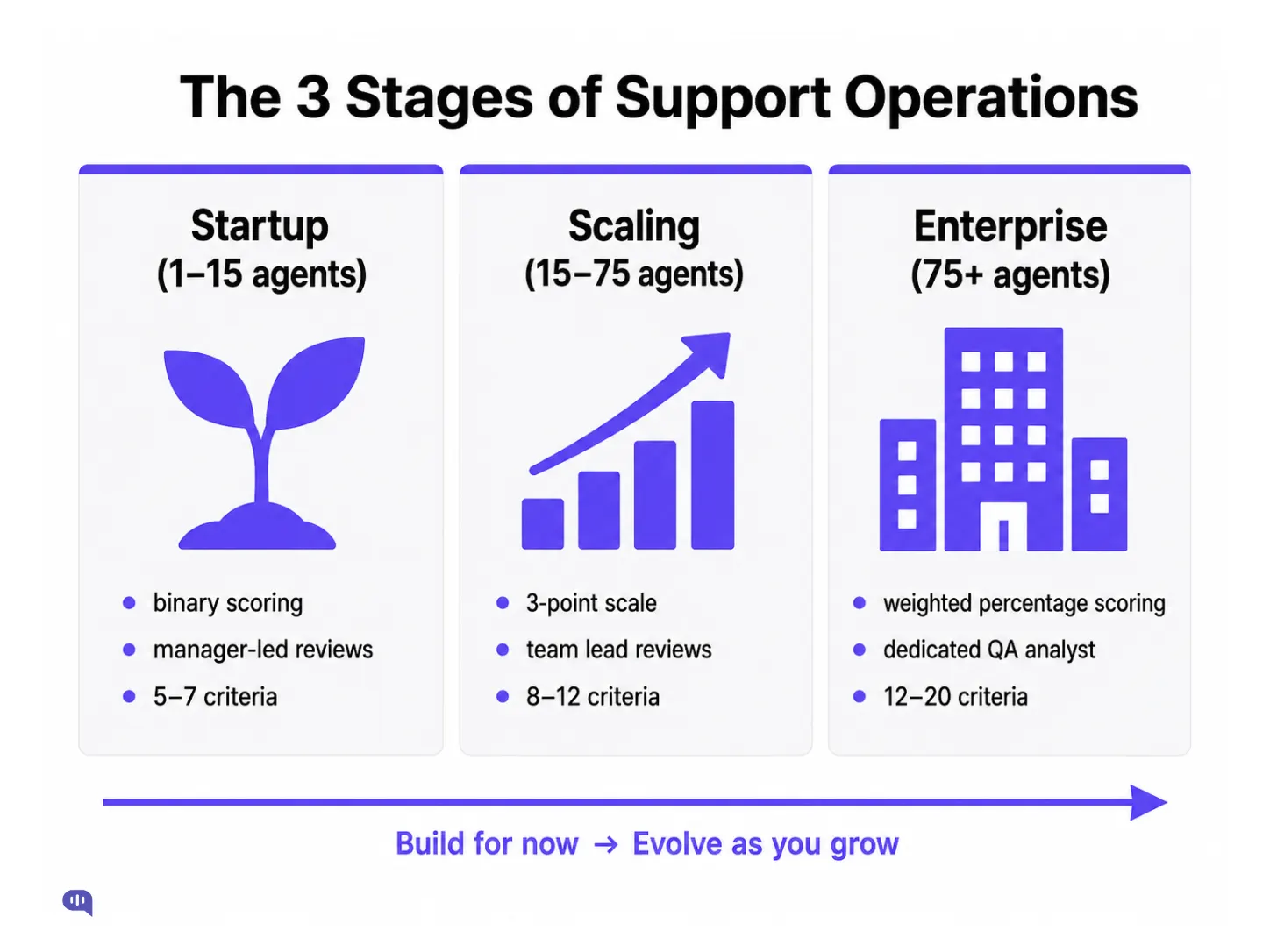
In our experience (Kommunicate works with thousands of support teams around the world), most support teams fall into one of the following categories:
QA is informal or nonexistent. The manager handles most reviews personally. There's no dedicated QA function, and process documentation is still being written. The priority is establishing a baseline and building the habit of review, not scoring perfection.
The team is growing faster than processes can keep up. A team lead or senior agent has started taking on some QA responsibility. You have enough ticket volume to see patterns, but calibration is still inconsistent. The priority is consistency and coaching at scale.
A dedicated QA analyst or QA team manages the scorecard. Reviews are sampled across channels, tiers, and time zones. There's a formal calibration process and statistical baseline data. The priority is continuous improvement and compliance.
Each stage needs to define quality analysis differently, and we’ll see how it looks at each of these stages.
The criteria on your scorecard should reflect what's actually achievable to measure and act on given your current resources. Here's how that breaks down across stages:
We've built the QA Criteria Weight Calculator below to help you distribute weights across your chosen criteria without the decision fatigue. Select your stage, toggle your priorities, and get a weighted scorecard you can put into practice immediately.
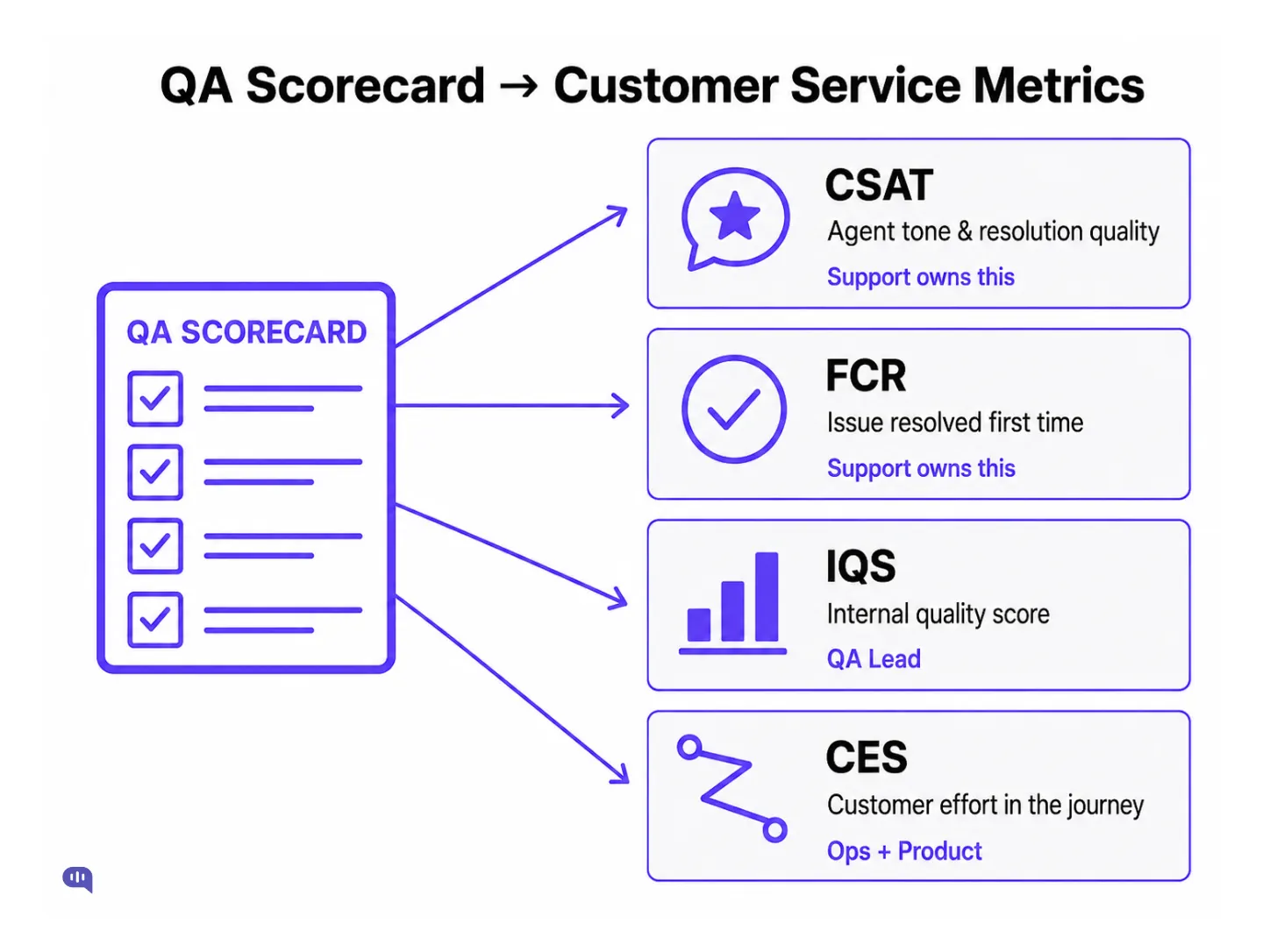
A QA score without a downstream metric is just a number. The point of running reviews is to connect agent behavior to business outcomes, and to do that, you need to know which metrics your scorecard is actually supposed to move.
Not all metrics belong to support.
Pinning your QA program to NPS penalizes support for problems that live upstream in the product or onboarding experience.
Track the metrics that your team can actually influence. For most support managers, that's CSAT at the conversation level, FCR, and your internal quality score. For a broader view of which customer service metrics to track beyond the scorecard, the breakdown by metric type is worth bookmarking.
A QA program that exhausts the manager and demoralizes customer service representatives doesn’t improve the quality of your support. The goal is a review cadence that surfaces patterns without becoming its own full-time job.
A few principles that hold across all stages:
The right QA scorecard isn't the most comprehensive one. It's the one your team can actually run consistently, week after week, and use to get better. Start with the stage you're in. Build criteria you can explain in one sentence. Score interactions in a way that produces actionable feedback. And revisit the scorecard every quarter to see if the old template is still relevant.