
A practical guide to customer support org charts, team roles, reporting structures, and when to evolve your support team at each stage of growth.
Most articles about support team structure treat it like a one-time architectural decision:
That framing is wrong, and most managers who've run growing support teams know it.
Your org chart is a current snapshot. The structure that worked at 8 agents will actively hurt you at 25. The structure that worked at 25 will start breaking at 60. The job isn't to pick the right structure once. It's to recognize when your current structure is starting to fail before it fails.
This article breaks down four growth stages, provides a concrete org chart for each, and is direct about the structural failure modes that signal it's time to evolve. We've also built an interactive org chart visualizer below so you can see what the next version of your team looks like before you need it.
Support structures don't collapse suddenly. They erode. The three failure modes we see most often:
The fix in all three cases isn't hiring. It's restructuring first, then hiring into the new structure. Adding agents to a broken structure scales the problem.
We’ve created a simple tool that shows the right org chart for different support team sizes and growth stages.
Now, we will walk through each of these org charts individually and explain why they are structured as they are.
At this stage, specialization is a liability. You don't have enough volume to justify dedicated tiers, and you don't have enough organizational knowledge to train specialists effectively. What you need is generalists who can handle the full range of issues and one person who doubles as lead and ops.
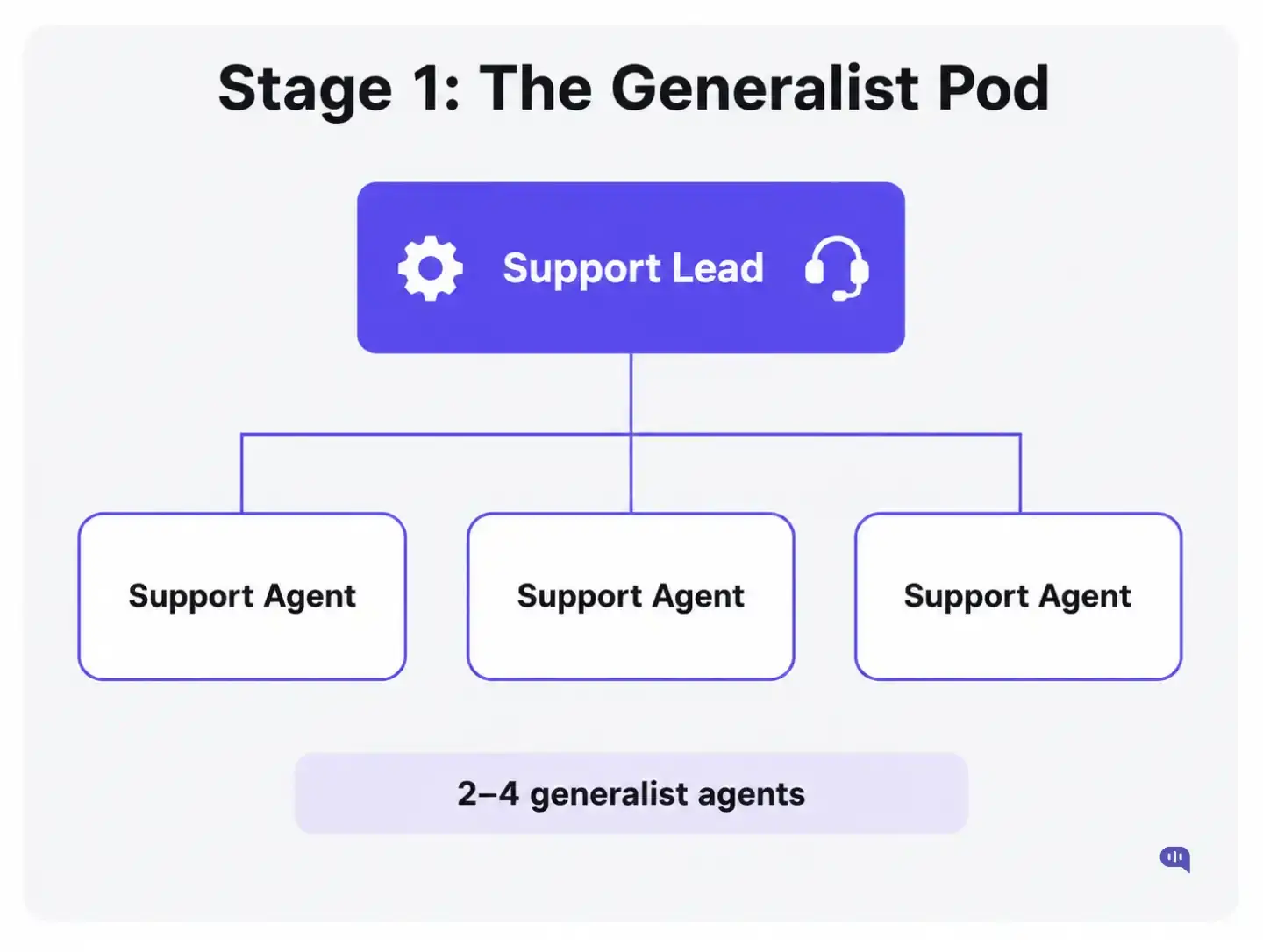
The lead at this stage wears every hat: handling escalations, building the knowledge base, running onboarding for new agents, and reporting metrics to leadership. This is sustainable only because the team is small.
Common mistake: Hiring a dedicated QA or training role at this stage. You're better off with one more generalist agent and a lightweight checklist process for quality.
Signal to move to Stage 2: Your lead is spending more time managing than supporting, response times are slipping despite reasonable volume, or you're consistently above 5 agents, and queue segmentation would meaningfully improve routing accuracy.
This is where the first real structure appears. Volume has grown to the point where not all tickets are equal, and routing every issue to the same pool of agents creates unnecessary noise. The Tier 1/Tier 2 split solves this:
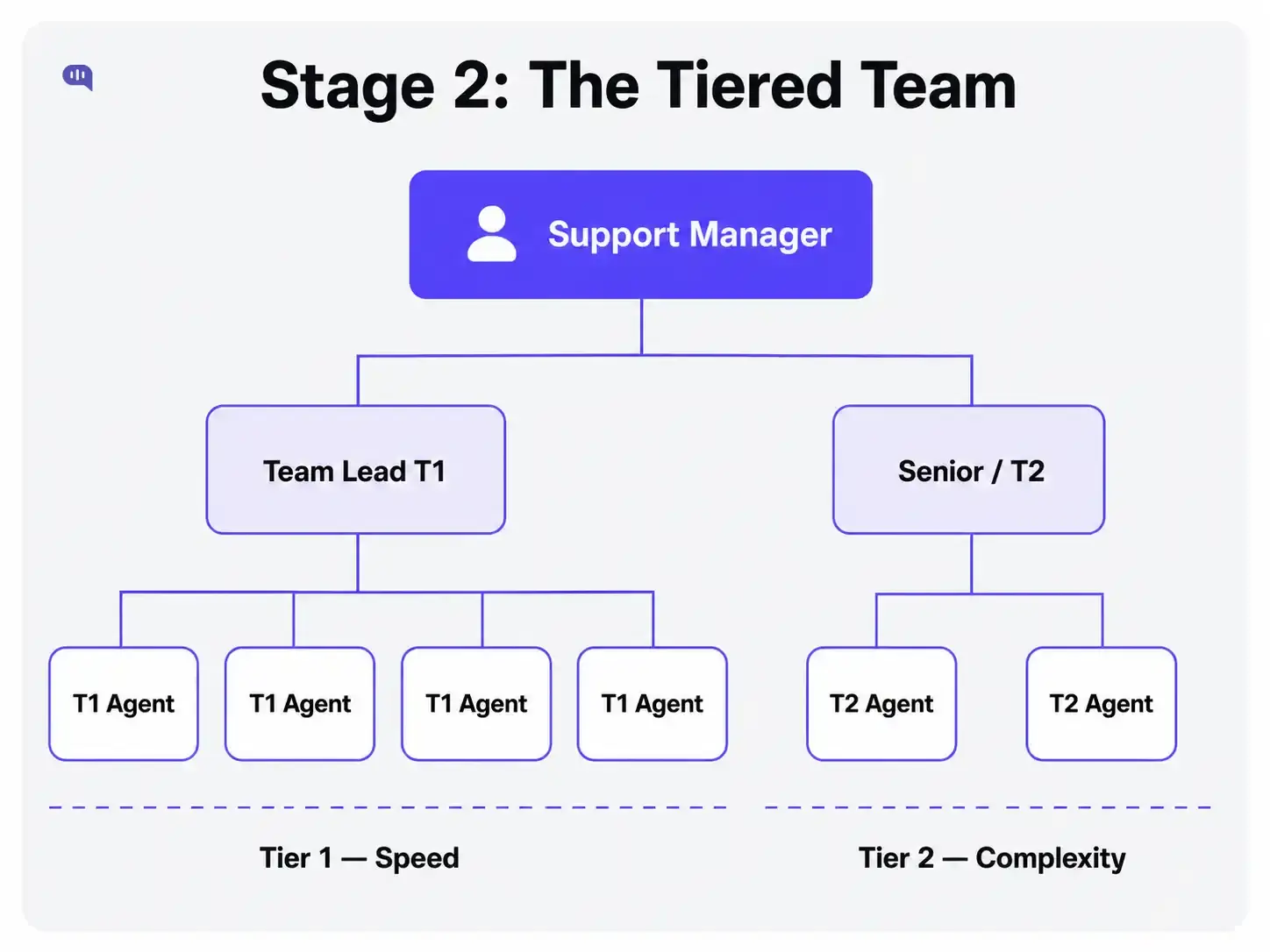
Each tier needs distinct performance benchmarks. Tier 1 is measured on resolution speed and first-contact resolution rate. Tier 2 is measured on resolution quality and escalation accuracy. If you're applying the same KPIs across both tiers, you're incentivizing the wrong behaviors at one of them. The "Customer Support KPIs: 10 Metrics Every Team Should Track" guide breaks down which metrics belong at each level.
Common mistake: Promoting your best Tier 1 agent into a Tier 1 Team Lead role without adjusting their ticket load. Leads at this stage still carry a queue, but it should be no more than 40-50% of a full agent's volume.
Signal to move to Stage 3: Team leads are managing more than 10 direct reports each, QA is being done inconsistently or not at all, or you're onboarding frequently enough that training is blocking leads from their actual management work.
This is where structure gets meaningfully complex. You now have enough agents that a single manager can't maintain meaningful visibility across the whole team. You need functional specialization: dedicated team leads per segment, a QA function, and, critically, a Support Ops hire.
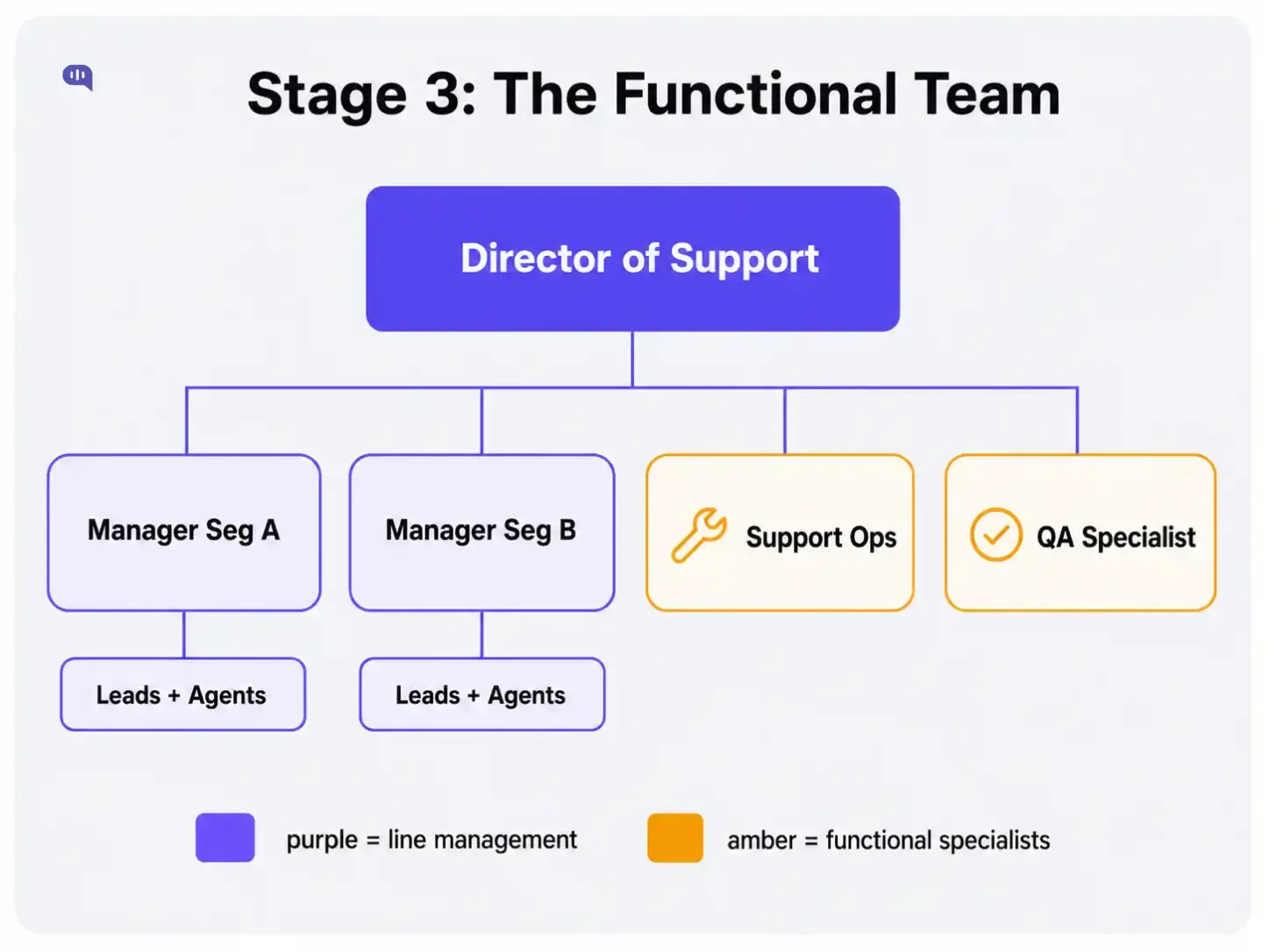
Segments can be defined by product line, channel (chat, email or voice), customer tier (SMB vs. enterprise) or geography. The right segmentation depends on where your ticket variance is highest.
The Support Ops hire is the most underrated role at this stage. By the time you're at 25+ agents, you have enough tooling complexity, workflow configuration, and reporting overhead to take time away from team leads who should be actively coaching.
Quality assurance also becomes a dedicated function here, not a side task. At Stage 2, leads can run ad-hoc QA. At Stage 3, you need:
The Customer Service QA Scorecard Framework and Free Template is a good starting point for building that process.
Signal to move to Stage 4: You have regional complexity (multi-timezone, multilingual), enterprise accounts requiring dedicated CSM-adjacent support, or workforce management is becoming a significant enough problem that ad-hoc scheduling is causing SLA drift.
At this scale, support becomes a business unit. The Director of Support reports to a VP or CCO, and the org chart has enough depth that most agents are three or four levels removed from executive decisions. That depth requires explicit escalation protocols, workforce management, and, increasingly, AI as a structural layer.
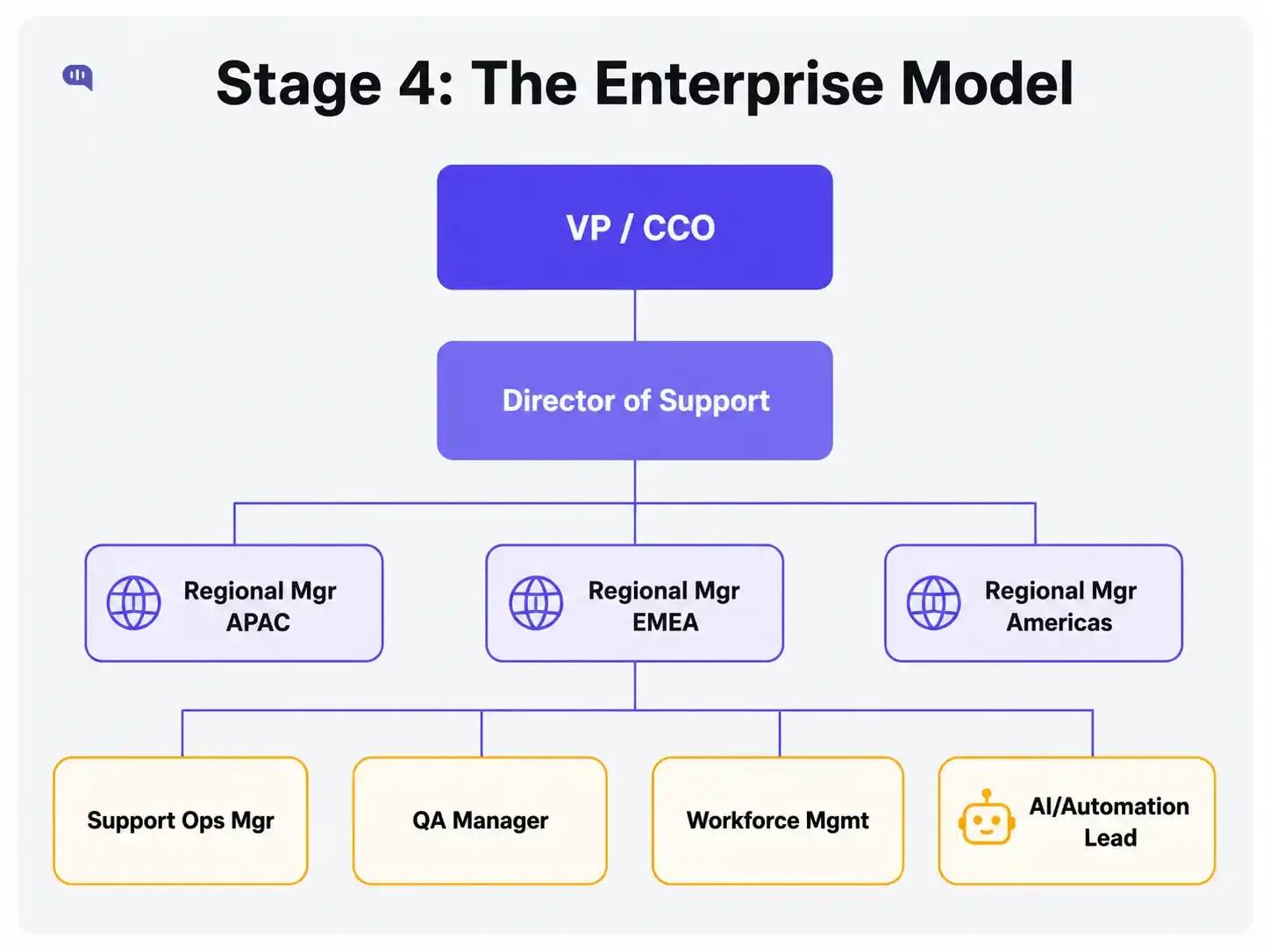
The AI/Automation Lead is now a real role on most enterprise support org charts. This person owns the Tier 0 layer: the chatbot and self-service flows that handle L1 deflection before a ticket reaches a human agent.
They sit between Support Ops and the product/engineering teams. They're accountable to the same SLA and CSAT metrics as human tiers. For a detailed breakdown of how AI fits into the 2026 enterprise support org, the 2026 Customer Support Org Chart covers the structural implications in depth.
The manager-to-agent ratio across the enterprise model should stay in the 1:7-10 range for frontline managers. Beyond 1:10, coaching volume drops to the point where managers are functioning as pure administrative overhead rather than performance drivers.
The four-stage framework above gives you the architecture for your support team. However, leadership should regularly evaluate support workflows to determine when the next structure is needed.
The best support managers we've seen run ahead of the structure. They're already sketching the next org chart while the current one still looks functional. By the time restructuring feels urgent, you're already three months behind.
Build the structure for the team you'll have in six months, and you’ll succeed.
If you need help implementing AI for your support team, book a demo to see how our AI agents work.