Updated on July 3, 2026
2024 and 2025 were an interesting period in customer service. Buoyed by enterprise expectations of AI, executives invested in AI en masse. A lot of those pilots failed, and as a result, employees developed a reflexive distrust of AI.
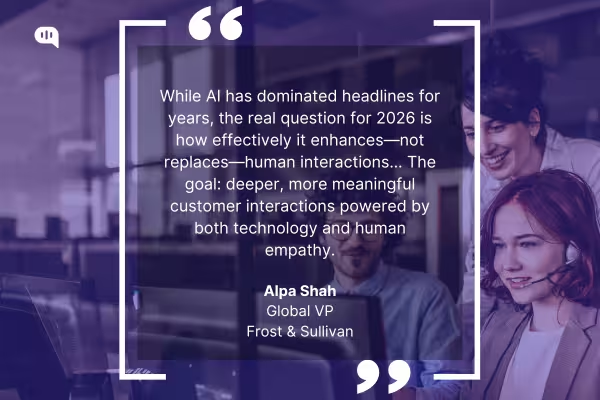
But, as expectations normalise and AI becomes a regular part of the workforce, it’s necessary to understand where it fits in on the customer support org chart. As Alpa Shah, the Global VP at Frost & Sullivan, said during the Zoom roundtable, “While AI has dominated headlines for years, the real question for 2026 is how effectively it enhances—not replaces—human interactions… The goal: deeper, more meaningful customer interactions powered by both technology and human empathy.”
Don’t have time to read the whole article? Listen to this short summarised version of the article:
In this article, we will take you through the striated org chart of early customer support teams and how that structure changes under pressure from AI. We’ll cover:
1. What is the Traditional Structure for Customer Support Teams?
2. Which Customer Service Workflows can AI Agents Handle in 2026?
3. Which Parts of Customer Support Need Human Empathy and Expertise?
4. How is AI Rebuilding the Customer Support Org Structure?
5. Why is “Human + AI” the only Sustainable Way Forward for Customer Support?
6. Conclusion
What is the Traditional Structure for Customer Support Teams?
Legacy customer support departments were built on a striated, tiered structure that worked through a filtering process. While this was the gold standard for decades, it created a “knowledge assembly line” that often breaks down under modern expectations. For a breakdown of how teams are structured across different growth stages, see our customer support team structure guide.
Practically, the structure worked in the following way:
Traditional Customer Support Org Structure: Three-Tiered Hierarchy
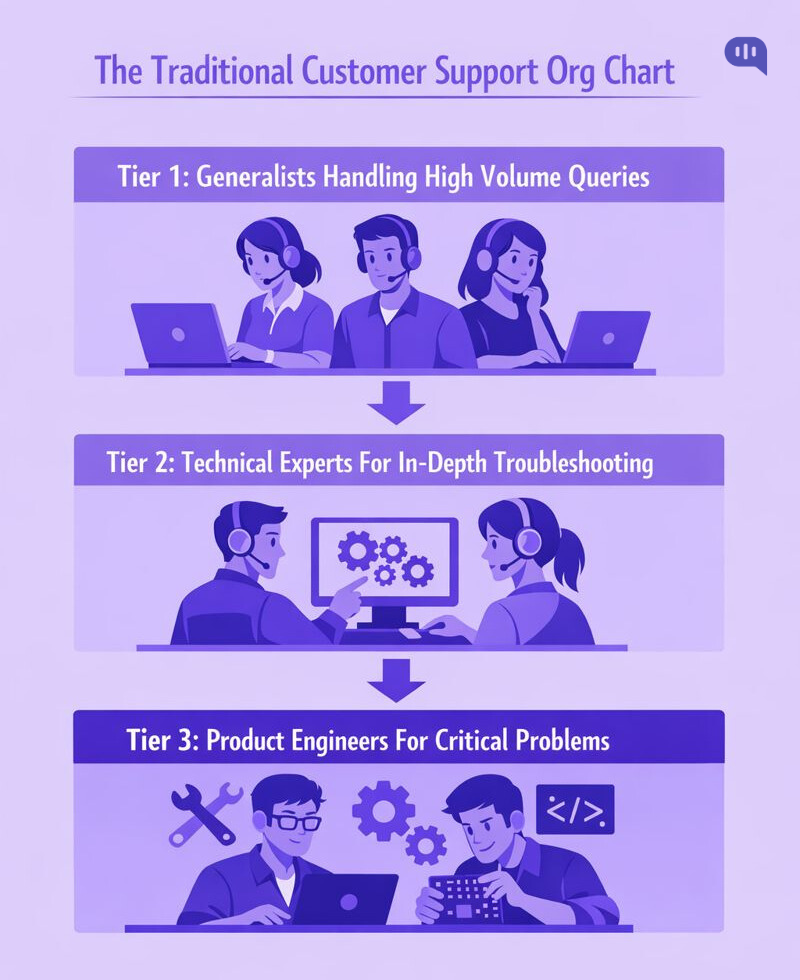
Most traditional organisations follow a Tier 0–3 structure. This design assumes that the least expensive reissues should filter issues that move from one stage to the next when necessary.
1. Tier 1 (Frontline): Generalists handling high volume, repetitive tasks (password resets, status checks).
2. Tier 2 (Specialists): Technical experts who handle more in-depth troubleshooting.
3. Tier 3 (Product/Engineering): The “final boss” of support, involving the people who actually built the product.
This kind of tightly controlled structure and flow leads to a few problems, especially apparent in enterprise workflows.
How Does the Traditional Customer Support Structure Hurt Teamwork?
The traditional customer support model creates functional silos. Departments become myopic, focusing on goals that are disconnected from the organisational ones.
This causes three problems:
1. The “Us vs. Them” Mentality: When employees are confined to these rigid boundaries, it breeds an environment of us versus them, undermining trust and teamwork across the organisation.
2. Coordination Failure: A study published in the Journal of Applied Psychology found that hierarchy often negatively impacts team effectiveness by enabling increased conflict and making it unclear who is in charge, especially under time pressure.
3. The Cost of Silos: According to research from PwC, “inefficiencies due to silos cost companies 350 hours per year.”
Additionally, these structural issues are passed onto the customer too:
1. The Fragmented Brand: The customer expects to interact with your organisation as a single entity. When an organisation has data silos, it leads to a fragmented user experience.
2. The “Filter” Problem: Traditional structures treat Tier 1 as a “human firewall” to protect the time of Tier 2 and 3. Agents are unsure about their authority in this position, which leads to longer resolution times.
The knowledge filtering process is outdated and can actively hurt interteam coordination within your customer support department. Thankfully, this structure is changing as AI agents can augment and automate workflows.
Which Customer Service Workflows can AI Agents Handle in 2026?
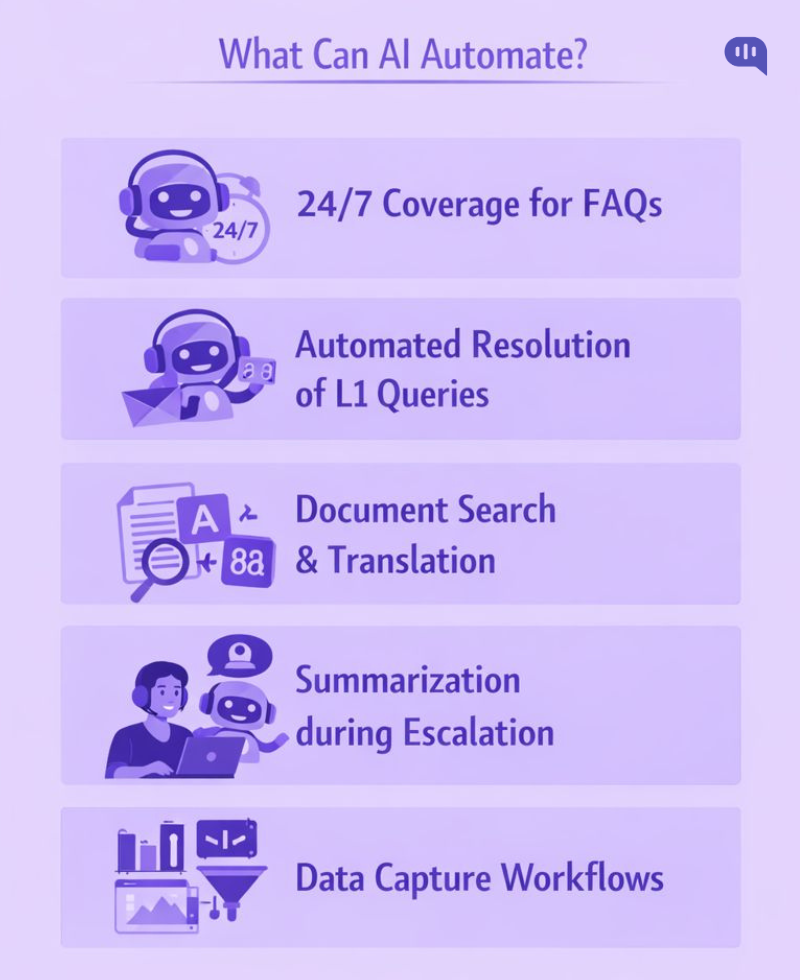
We’ve been working with enterprise clients like AMREF and DKSH for nearly half a decade. In our experience, the most common use cases of AI agents are:
1. 24/7 Coverage
AI agents can function as a triage and execution layer for your overnight staff. It can answer simple L1 questions and then transfer the complicated L2 and L3 questions to your agents.
This reduces the individual workload of your overnight customer service agents and reduces the amount of time they need to spend on repetitive tasks.
Workflows Automated: The agent interacts with your backend through OpenAI function calling, checking order status, resetting passwords, or updating shipping addresses instantly regardless of the hour.
2. L1 Resolutions
Most customer service AI agents use a system called RAG, which helps it answer FAQs accurately using documents, knowledge base articles and web pages from your business.
For customer service agents, this translates to an automated filtration layer that takes care of nearly 80% of the repetitive L1 questions they receive during the day.
This has two distinct advantages:
1. For customers, they get instant answers for their information questions
2. For customer service agents, they get more time to focus on business-critical problems
Workflows Automated: Using RAG (Retrieval-Augmented Generation), the agent scans your existing knowledge base to provide specific, cited answers to user queries within the chat UI.
3. Support Copilot
AI agents can become search and translation assistants for your team as well. Many AI agents come with two preloaded abilities:
1. Agent Assist: Where the AI agent can search through your documentation to find answers to the customer’s question, reducing the time your team would have spent searching for the answer.
2. Real-Time Translation: AI agents can translate customer questions into the agent’s native language to facilitate better conversations. This helps you improve your customer service coverage when you get global customers as well.
Workflows Automated: Document search and manual translation processes become easier with these capabilities.
4. Summarisation During Escalation
If a conversation needs to be escalated to another support team member or to the product team, AI agents can be used to preserve context. On your dashboard, the AI agent will provide a short summary of the conversation until that point, and also help the new assignee understand which solutions have already been attempted.
Workflows Automated – This prevents context loss between escalations, which is a common complaint from customers.
5. Form-Filling and Data Collection
AI agents act as a digital receptionist to ensure your human team has the full context before they even type their first message. By handling data gathering, the agent eliminates the initial back-and-forth typical of the discovery phase of a support ticket.
This ensures that when a human agent takes over, they aren’t asking for basic details like order IDs or software versions. To avoid “form fatigue,” the agent is best utilised to collect only the essential metadata required to move the ticket forward.
Workflows Automated: The agent identifies the user’s intent and prompts for specific, required data points (e.g., account emails, error codes, or device types), automatically populating these fields in your CRM or ticketing system in real-time.
As should be apparent from this list, AI agents are helpful in reducing the workload on your existing customer service team. It can automate repetitive tasks and help you increase productivity. However, a number of workflows still require human interaction.
Which Parts of Customer Support Need Human Empathy and Expertise?
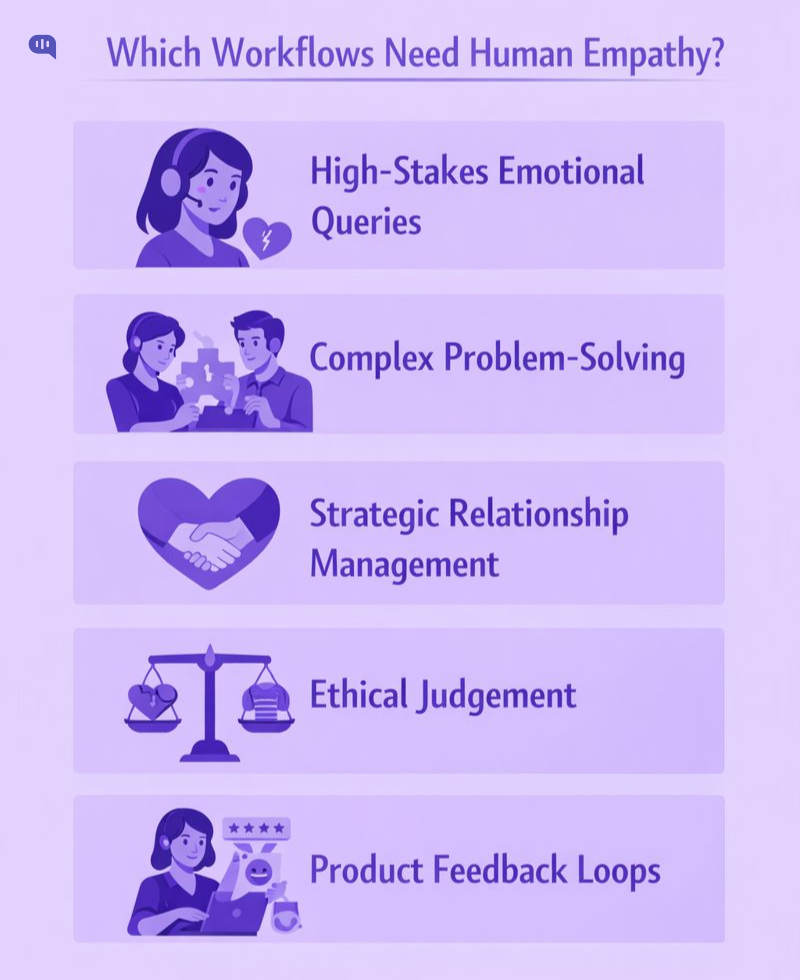
While AI agents are exceptional at execution and retrieval, they operate within a logic-based vacuum. In 2026, the human element isn’t just a “backup”—it is the specialised layer that handles the nuance, ethics, and emotional intelligence that code cannot replicate.
The most effective support structures recognise that the “Human + AI” partnership is strongest in three critical areas:
1. High-Stakes Emotional De-escalation
AI can detect frustration through sentiment analysis, but it cannot truly “feel” empathy. When a customer is facing a crisis, such as a major medical billing error for a client like AMREF or a supply chain failure for DKSH, they don’t want an efficient logic gate; they want to be heard.
- The Partnership: The AI identifies the high-stakes questions and instantly alerts a senior human agent, providing a summary of the issue, so the human can step in with an immediate, empathetic solution.
2. Complex Problem-Solving and “Grey Areas”
AI agents excel at following established SOPs (Standard Operating Procedures). However, they struggle when a customer’s problem falls between the cracks of two different policies.
- The Partnership: The AI handles the data retrieval (Support Copilot), surfacing relevant policies in seconds. The human agent then uses that information to make a subjective “executive call” that prioritises long-term customer loyalty over rigid rule-following.
3. Strategic Relationship Management
For enterprise clients, support is often about more than just fixing a bug; it’s about maintaining a multi-million dollar partnership. Humans are required to understand the political and strategic context of a request.
- The Partnership: AI manages the administrative overhead, allowing the Human Account Manager to focus entirely on the high-level consultation and relationship building.
4. Ethical Judgment and Compliance Edge Cases
AI agents are trained on historical data, which means they can inadvertently perpetuate biases or struggle with “moral grey areas” that haven’t been explicitly programmed into their safety guardrails. In 2026, regulatory landscapes (like the EU AI Act or updated data privacy laws) require a human-in-the-loop for decisions that significantly impact a user’s rights or financial status.
- The Partnership: When a request triggers a specific legal or ethical flag—such as a data deletion request involving conflicting jurisdictions—the AI pauses the automated workflow. It then presents the human compliance officer with the relevant legal documentation and user history, allowing the human to make a legally sound, ethical determination.
5. Product Feedback Loop and Root Cause Advocacy
An AI can tell you that 500 people asked about a specific bug, but it cannot effectively walk into a product sprint meeting and advocate for a change in the product roadmap based on the “vibe” of customer frustration. Humans are needed to translate raw support data into an actionable business strategy.
- The Partnership: The AI performs the “heavy lifting” of sentiment analysis and trend clustering across thousands of tickets. It provides the human Support Lead with a “Sentiment Report,” who then uses those insights to lobby the Engineering and Product teams for long-term fixes, ensuring that support isn’t just a cost centre, but a driver of product growth.
The synergy between these two forces ensures that efficiency never comes at the cost of the human connection. When an AI handles the “what” (data, status, and routine steps) and a human handles the “why” (context, emotion, and strategy), the resulting support experience feels both high-tech and high-touch.
In short, the AI agent acts as the engine, providing the power and speed to handle massive volumes of data, while the human remains the pilot, steering the conversation toward a resolution that satisfies both the business’s bottom line and the customer’s peace of mind.
In the next section, we’ll look at how the traditional pyramid structure is being replaced by a circular “ecosystem” where AI isn’t just a tool at the bottom, but a layer that wraps around every member of your team.
How is AI Rebuilding the Customer Support Org Structure?
For decades, the tiered hierarchy was the only way to scale your support operations. You needed to hire a massive base of Tier 1 generalists to protect the time of a few expensive Tier 3 experts.
In 2026, this has evolved into a circular ecosystem:
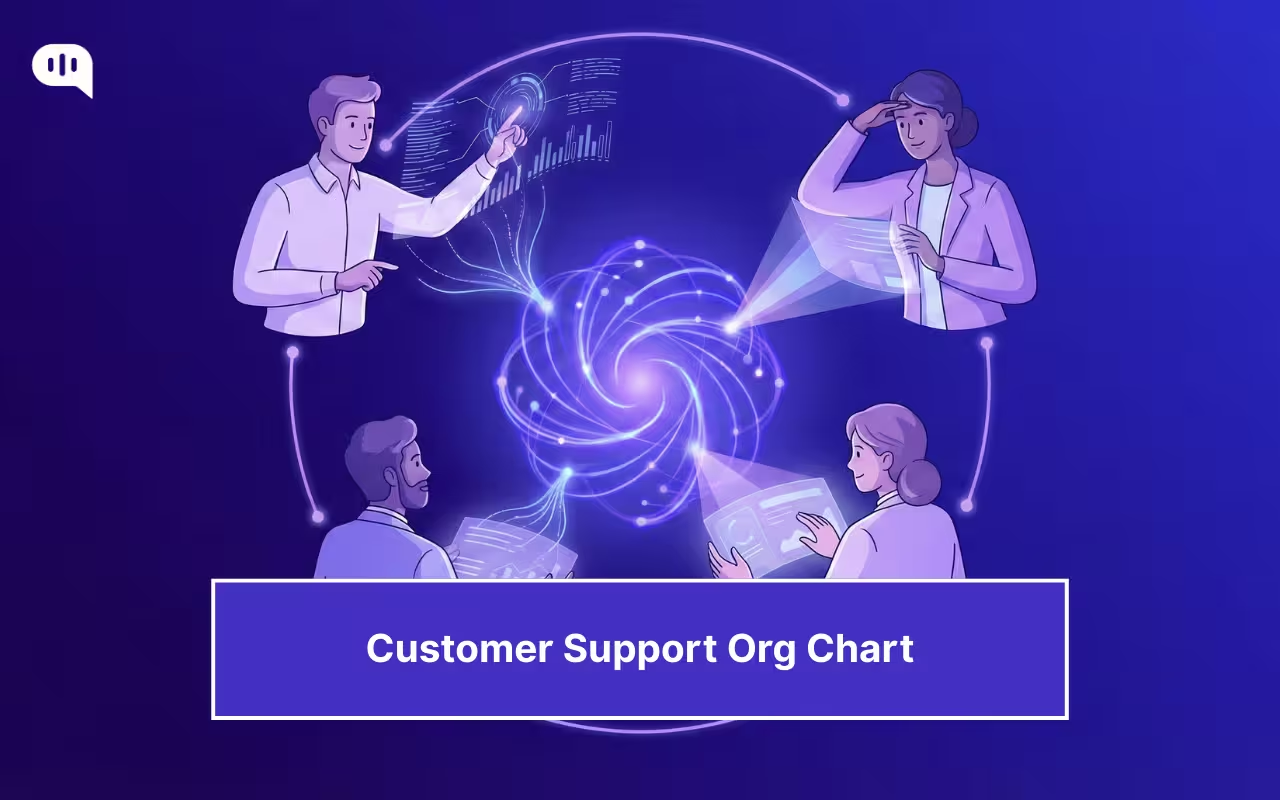
From the Pyramid to the Circular Ecosystem
In the old model, information flowed vertically and often got stuck in “filters.” In the new circular model, AI sits at the core as a shared utility layer that empowers every human role simultaneously. Instead of “scaling by headcount,” enterprise teams are now “scaling by capability.” If you’re planning this transition, our guide on scaling customer support covers the lessons from teams that have done it successfully.
- The AI Core: This is your 24/7 execution layer. It handles 80% of L1 queries, data collection, and routine API actions.
- The Specialised Perimeter: Human agents are no longer “gatekeepers” sitting at the bottom of a hierarchy. They are specialists arranged around the AI core, stepping into the “High-Stakes” or “Grey Area” conversations the moment the AI reaches its functional boundary.
New Roles on the 2026 Customer Support Org Chart
As the old tiers dissolve, three critical new roles have emerged to manage the “Human + AI” partnership. Aligning these roles to measurable targets from the start is key – use customer support OKRs to set team-level goals before you hire into these roles:
| New Role | The Mission | Why it Matters |
| AI Operations Manager | Managing the “Agent Stack.” | Just as you manage human performance, someone must audit the AI’s success rates, refine function calls, and ensure the models aren’t “hallucinating” outdated policy. |
| Knowledge Curator | Fuelling the RAG Pipeline. | This is the evolution of the Tier 1 agent. Instead of answering the same question 100 times, they spend their time ensuring the documentation the AI reads is perfect. |
| Collaboration Designer | Structuring the “Hand-off.” | This role designs the frictionless transition between AI and human, ensuring that when an escalation happens, the human has every piece of context they need instantly. |
Additionally, the traditional customer support career progression journey has also changed.
New Ways of Career Progression in Customer Support
In the traditional model, the only way “up” was to move away from the customer and into more technical or managerial tiers. In the 2026 circular model, the career path is defined by specialisation and strategic impact:
- From Generalist to Expert: Entry-level roles are no longer about surviving high ticket volumes. They are about mastering a specific domain—whether that is technical troubleshooting or high-value account management—while the AI manages the “busy work.”
- The “Agent-in-the-Loop” Mentality: Every employee becomes a supervisor of technology. Success is measured not by how many tickets you closed, but by how effectively you leveraged the AI to solve a complex problem or how much you improved the AI’s knowledge base for the next interaction.
The Death of the “Human Firewall”
Perhaps the most significant change is the psychological shift for the staff. For years, Tier 1 was treated as a “human firewall.”
By placing AI at the core to absorb that exhaustion, the circular ecosystem restores the “Human” to human support. Agents are brought into conversations when they are actually needed, leading to higher job satisfaction and significantly lower turnover rates in an industry historically plagued by burnout.
As we have seen, the “AI-only” pilots of the early 2020s failed because they ignored the complexity of human emotion and the unpredictability of edge cases. Conversely, the “Human-only” model is buckling under the weight of global, 24/7 demand.
The only path that doesn’t lead to a total breakdown of customer trust is the Centaur Model. In the next section, we will explore why this hybrid approach is a survival requirement for any brand that wants to remain relevant in the next decade.
Why is “Human + AI” the only Sustainable Way Forward for Customer Support?
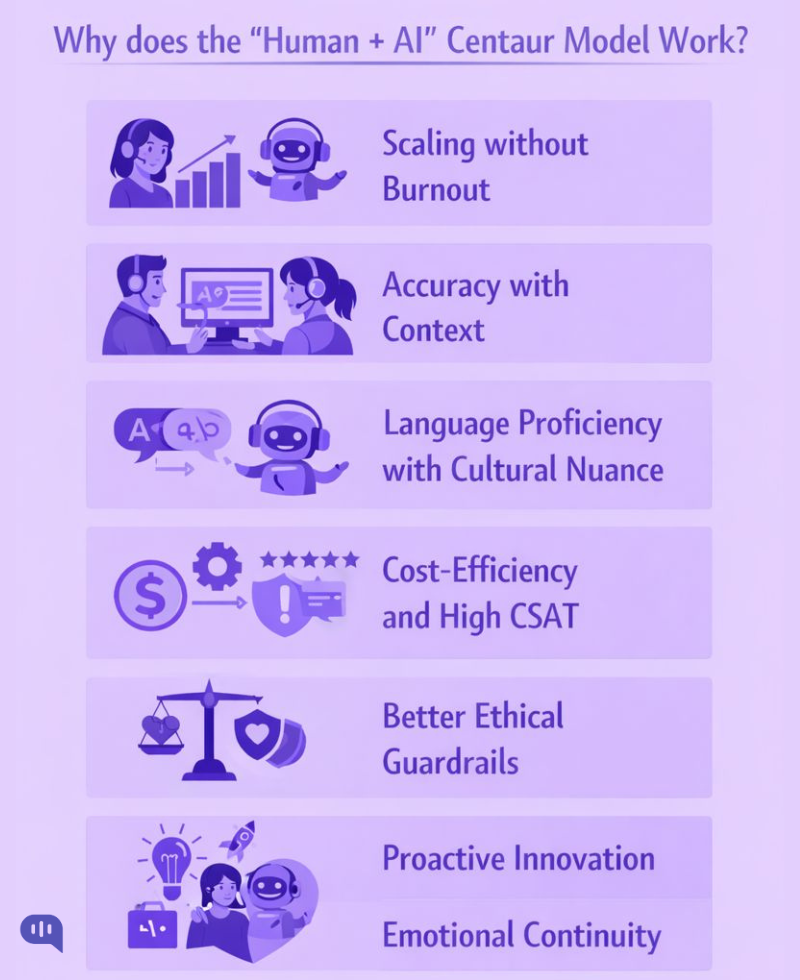
The “AI Gold Rush” of 2024 and 2025 proved one thing definitively: technology without a soul is a liability. While AI can process data at a scale no human can match, it lacks the biological hardware for genuine empathy and ethical intuition. Conversely, a human-only team is a bottleneck in a world that never sleeps.
Sustainability in 2026 isn’t about choosing one over the other; it’s about creating a “Centaur” model, where the machine handles the volume and the human provides the value. This leads to several benefits:
1. Scaling Without Burnout: AI handles the repetitive, 24/7 drudge work, allowing your human team to maintain high performance without the mental fatigue of answering the same fifty questions every day.
2. Accuracy Meets Context: While an AI (via RAG) provides technically accurate data from your knowledge base, humans provide the context.
3. Language Proficiency and Cultural Nuance: AI agents can translate 100+ languages instantly, but humans navigate the cultural etiquette, humour, and subtle social cues required to truly satisfy a global customer base.
4. Cost-Efficiency with High CSAT: Automating L1 queries significantly reduces “Cost Per Ticket,” but keeping humans available for complex issues ensures that your “Customer Satisfaction” scores don’t plummet due to “bot frustration.”
5. Ethical Guardrails: Humans act as the final moral filter for AI decisions, ensuring that automated logic remains compliant with evolving privacy laws and doesn’t perpetuate unintended biases.
6. Proactive Innovation: AI identifies the trends in customer friction, but humans are the ones who walk into the boardroom to advocate for product changes and business strategy based on those insights.
7. Emotional Continuity: In a crisis, a customer wants to feel “known.” A human agent can acknowledge a shared history and build a bond of trust that a reset-based AI session simply cannot replicate.
A “Human + AI” strategy is the only way to build a support organisation that is both invincible at scale and deeply personal in touch. By 2026, the companies that thrive aren’t the ones who replaced their people with code, but the ones who used code to make their people more powerful.
Conclusion
The customer support org chart of 2026 has officially moved past the era of experimentation. The “Pyramid” is gone, replaced by a circular ecosystem where AI is the core engine of efficiency, and humans are the specialised pilots of the customer experience.
By strategically deploying AI agents to handle 24/7 coverage, L1 resolutions, and data collection, organisations are reclaiming the human time necessary for empathy, complex problem-solving, and strategic growth. The result is a more resilient, scalable, and satisfying environment for both the employee and the customer.
As expectations continue to rise, the question for executives is no longer if AI should be part of the team, but how seamlessly it can be integrated to empower the people who drive the brand forward.
Ready to transition your team to a more sustainable, high-performance model? Book a 15-minute consultation with Kommunicate to learn how to integrate AI agents into your 2026 support strategy today.

Devashish Mamgain is the CEO & Co-Founder of Kommunicate, with 15+ years of experience in building exceptional AI and chat-based products. He believes the future is human and bot working together and complementing each other.