Updated on August 13, 2025
TL;DR: Session (service) messages are free-form replies you send within the 24-hour customer service window after a user writes in.
Template messages are pre-approved messages (marketing, utility, authentication) used outside the window or proactively; they’re priced per message by category.
WhatsApp accounts turn out very differently for personal and business usage. Although you may think the API responds the same way, it is not so. In WhatsApp Business, there are two different types of messages that you can send: session messages and template messages.
To make maximum use of your business account and understand how to reach your customers more efficiently, you must know the differences.
What’s the Difference Between WhatsApp Template and Session Messages?
WhatsApp launched the WhatsApp Business feature in January 2018 for small businesses. As of 2025, there are more than 200 million businesses that use this feature to reach their customers.
WhatsApp Business helps small business owners to:
- Carry out convenient two-way communication with customers
- Improve real-time customer support
- Provide a reliable channel for customers to reach the business
- Achieve global reach and initiate more conversations
- Save time and reduce delays in serving customers
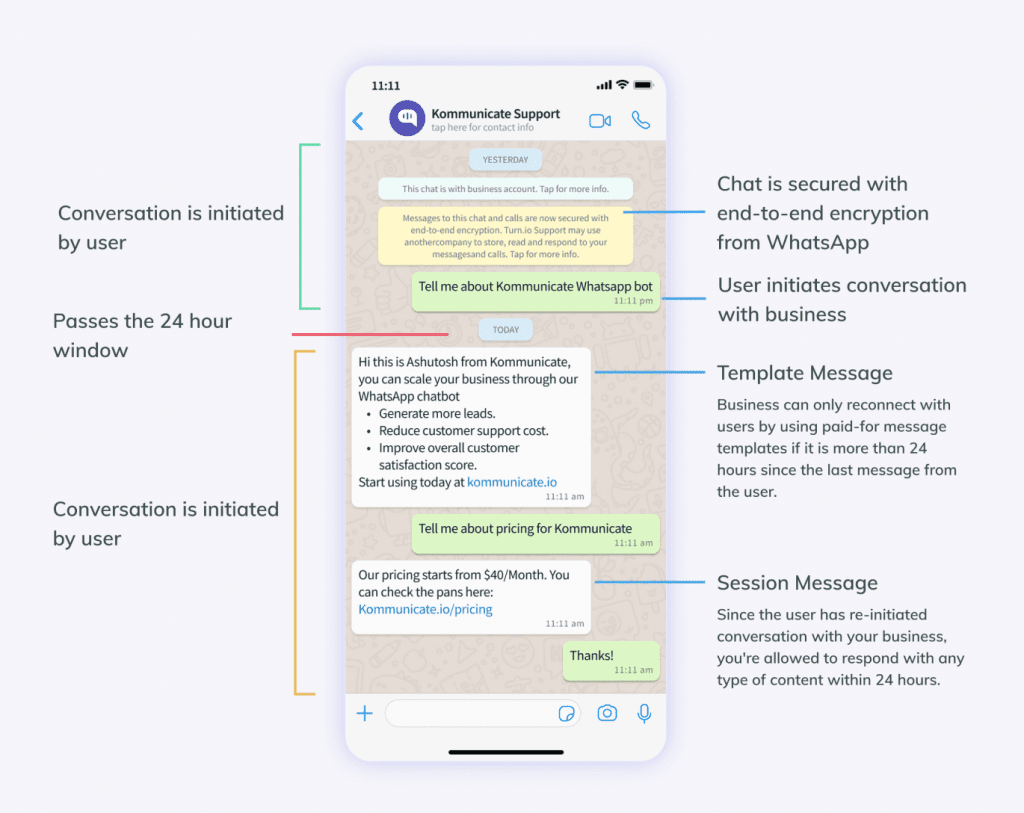
The two most popular types of WhatsApp messages for business accounts are templates and sessions.
- A WhatsApp template message is an outbound message that uses a pre-approved template for a conversation.
- WhatsApp session messages are the replies that you send to the user within a window of 24 hours.
| Session Messages | Template Messages |
| The user sends a message first, and the session lasts for 24 hours from the most recent message’s time. | These are generally unsolicited and are sent to users who have agreed to receive messages from your business. |
| The content is not pre-approved. | The template is pre-approved. |
| The business can reply to the user for free within 24 hours. | Template messages should be structured and are generally chargeable. |
| They are aimed at providing swift customer service and addressing their queries. | These can be appointment reminders, delivery alerts, shipping information, etc. |
Let’s explore each message type with examples.
Session Messages
When a user has your business number and messages you on your chat service, you can respond to them within 24 hours. There is no WhatsApp session message pricing, and you can respond for free. Your reply can be in the form of text, links, media, and so on, without any restrictions.
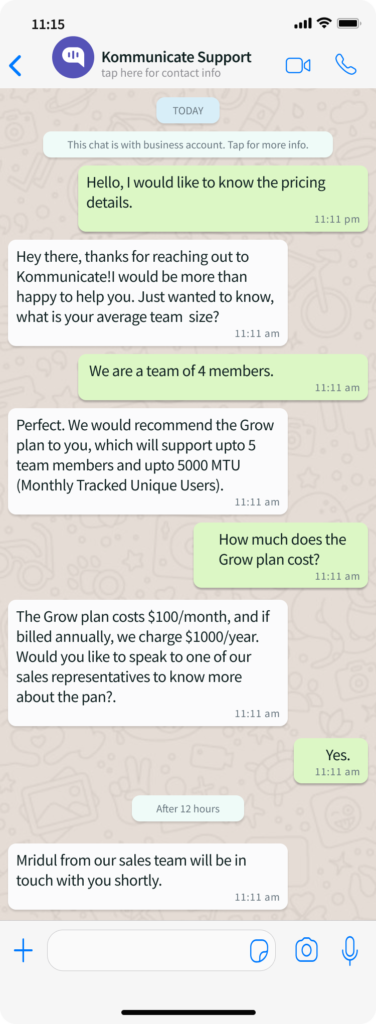
You can also send promotional content as a part of session messages. This includes messages with surveys, offers, discounts, and so on. There is no limit on the number of messages exchanged. Session messages help you address user concerns and run the business successfully.
For example, a user messages you to place an order. Within 24 hours, you can respond however you want to help with the purchase. You can also send the user additional information, offer alternatives, ask them to explore other products, and so on.
How Does the 24-Hour Limit Work for WhatsApp Session Messages
When a customer messages your business, a 24-hour customer service window opens. During this window, you can reply with service (free-form) messages at no charge. Every new message from the customer resets the 24-hour timer.
What Messages Can You Send Inside the 24-Hour Window?
- Service replies (free-form): Text, media, quick replies, etc. Free of charge under current per-message pricing.
- Templates (optional): You may use a template inside the window (e.g., order update), but it isn’t required.
What Happens After 24 Hours?
- The window closes if the customer hasn’t written back.
- To re-engage, you must use a pre-approved template (Marketing, Utility, or Authentication).
How Does this Interact with the 72-hour “Free Entry Point”?
- If a user contacts you via a Click-to-WhatsApp ad or Facebook Page CTA and you respond within 24 hours, a 72-hour free entry window opens where all your messages are not charged.
- However, you can only send non-template (free-form) messages while a customer service window is open—i.e., within 24h of the customer’s last message. (Templates remain allowed throughout the 72h.)
Template Messages
Message templates are defined as “message formats for common, reusable messages. If a business wants to send a templated message to repetitive queries, they can use this format.
Additionally, if you fail to reply to a user’s message within 24 hours, you can only contact them with paid template messages.

There are certain WhatsApp template message guidelines that control promotional content and prevent broadcasting. WhatsApp lets you create templates and submit them for approval.
Approved templates can be routine notifications, welcome and thank you notes, replies to customer issues, delivery and shipping notifications, etc. You can use placeholder values in templates inside double curly braces ({{…}}) for content that needs to be dynamically customized.

What are the Approved Use Cases for Template Messages?
WhatsApp reviews submitted templates within 48 hours to ensure high-quality interaction and stop spam. Make sure your templates fall under one of the approved formats.
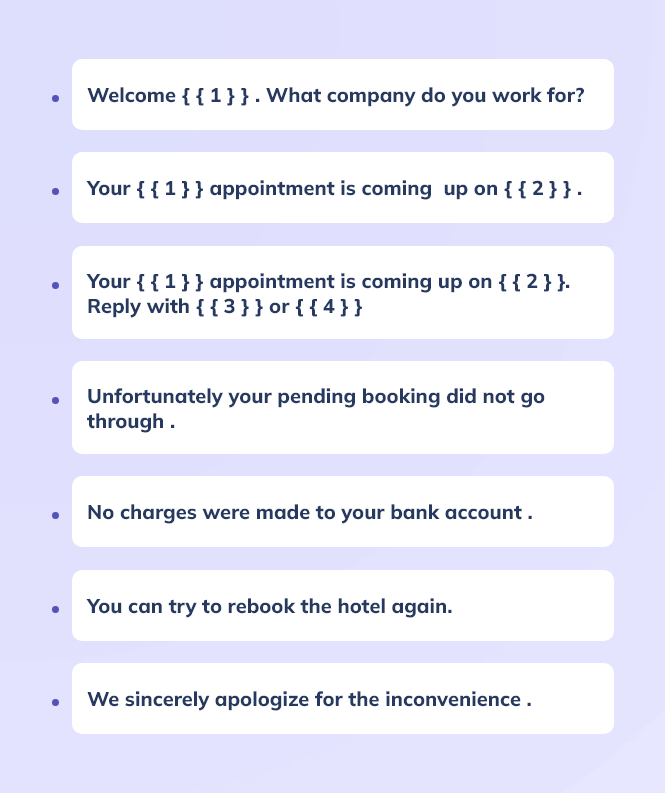
- Account Update: For updated information about user accounts
- Alert Update: To send important news or updates
- Appointment Update: To communicate confirmation, reminders, or changes in customers’ appointments
- Auto-Reply: For when your business is offline or on holiday
- Payment Update: To inform customers about their payments
- Personal Finance Update: To inform customers about their personal finances
- Issue Resolution: For responding to customers’ queries or feedback
- Reservation Update: To communicate confirmation, reminders, or changes in customers’ reservations
- Shipping Updates: To inform customers about their order’s shipping status
- Ticket Update: To send ticketing information or updates
- Transportation Update: To send transportation information
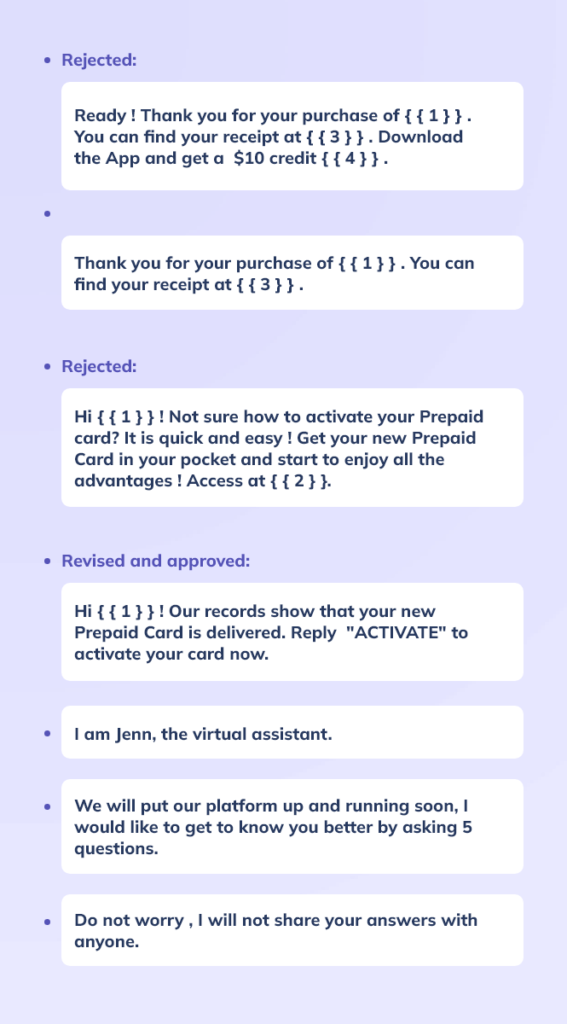
Message templates typically approved by WhatsApp include valuable information and are devoid of any promotional or misleading content.
Why Do WhatsApp Templates Get Rejected?
Templates that are rejected generally contain:
- Insufficient details
- Promotional content
- Spam
- Ambiguous messaging
Messaging Limitations
WhatsApp has messaging limitations for volume and quality. There are five tiers of limits, and new numbers are initialized at Tier 0. Subsequently, it is promoted based on the number of unique recipients and a good quality rating from WhatsApp.
| Tier | Limit (unique recipients / rolling 24 hours) | Notes |
|---|---|---|
| Tier 0 (unverified) | 250 | Entry level for new or unverified numbers |
| Tier 1 | 1,000 | Auto-upgrades with good quality and sufficient volume |
| Tier 2 | 10,000 | For business-initiated template messages only |
| Tier 3 | 100,000 | Subject to quality rating and compliance requirements |
| Tier 4 | Unlimited | Highest tier; still governed by WhatsApp policy/quality |
Now that you understand the types of messages you can send on WhatsApp, let’s talk about how your messages will be priced.
Pricing in 2025: Per-Message, Free Service Replies, 72-Hour Free Entry Points
As of June 2025, WhatsApp has moved from conversation-based billing to per-message pricing. Charges now apply per delivered message, and rates vary by category (Marketing, Utility, Authentication, Service) and market/currency.
| Situation | Charged? | Notes |
|---|---|---|
| Service messages (your replies to a user within the 24-hour customer service window) | No | No charge for service messages during the 24-hour window. Timer resets with each user message. |
| Utility messages in response to a user (e.g., order update after the user wrote in) | No | Utility responses to users are not charged. |
| Utility messages sent proactively (outside the 24-hour window) | Yes | Billed per delivered message; volume tiers may apply. |
| Marketing messages (offers, promos, reminders) | Yes | Always charged, inside or outside the 24-hour window. |
| Authentication (OTP) messages | Yes | Billed per delivered message; volume tiers may apply. |
You'll be billed on delivery, not on send. Rates are published by market × category on WhatsApp’s pricing page. 72-Hour “Free Entry Point” window
If a user messages you from a Click-to-WhatsApp ad or your Facebook Page CTA, and you respond within 24 hours, a 72-hour free entry window starts: all your messages (any category) are not charged during those three days.
You can send free-form service replies whenever the 24-hour window is open; templates are allowed throughout the 72 hours.
Practical cost controls
- Steer Users to Message First – Let users initiate (site widget, CTWA ads) so you can reply with free service or no-charge utility responses.
- Batch Promotions into Fewer, Higher-Value Sends – Marketing is always billed. Keep it reserved for high-intent segments.
- Use Templates Only When Needed – For post-24h re-engagement or proactive use, pick the correct category to avoid rejections and unexpected costs.
- Check Your Exact Rates & Tiers. Pricing differs by country/currency and category. You can find the latest prices here.
Conclusion
WhatsApp sessions and template messages are both beneficial for small businesses and let them connect to users at a place of their convenience. Knowing their specifics allows you to channelize content and budget the right way to reap maximum benefits.
If you want to use an AI chatbot to automate WhatsApp customer support, book a demo with Kommunicate!
At Kommunicate, we are envisioning a world-beating customer support solution to empower the new era of customer support. We would love to have you on board to have a first-hand experience of Kommunicate. You can signup here and start delighting your customers right away.