Updated on May 25, 2026
TL;DR
A WhatsApp chatbot is an automated system that handles customer conversations on WhatsApp without any human involvement. To create one you need access to the WhatsApp Business API through Meta and a no code chatbot builder. This guide covers everything from setting up the API, building your conversation flow, connecting it to WhatsApp, and testing your first live message. No coding skills needed and the entire setup takes under 30 minutes.
Introduction
Setting up a WhatsApp chatbot sounds straightforward until you actually try to do it. Suddenly you are navigating Meta’s developer portal, figuring out webhooks, hunting for API credentials, and wondering if you need a developer just to get started.
You do not. And it does not have to take days either.
Whether you are a business owner who wants to automate customer conversations or a developer setting this up for a client, this guide gives you the clearest path from zero to a live WhatsApp chatbot in under 30 minutes. Companies that have made this switch have seen support costs drop by up to 30% and response times improve by up to 35%, without adding headcount.
Here is everything we cover:
- What is a WhatsApp Chatbot?
- How Does a WhatsApp Chatbot Work?
- Why Your Business Needs a WhatsApp Chatbot
- Types of WhatsApp Chatbots You Should Know About
- What Do You Need Before You Start?
- Two Ways to Create a WhatsApp Chatbot
- How to Get Access to the WhatsApp Business API
- How to Build a WhatsApp Chatbot Using Kommunicate: 5 Simple Steps
- WhatsApp Chatbot Use Cases for Businesses
- WhatsApp Chatbot Limitations You Should Know Before You Start
- Why Kommunicate is the Best WhatsApp Chatbot Builder for Businesses
- Frequently Asked Questions About WhatsApp Chatbots
What is a WhatsApp chatbot?
A WhatsApp chatbot is an automated system that handles customer conversations on WhatsApp without any human involvement. It connects to your WhatsApp Business number through the WhatsApp Business API and responds to customer messages instantly, whether that is answering a question, booking an appointment, or routing a complex issue to a human agent. Unlike the standard WhatsApp Business app which requires someone to manually reply, a chatbot works around the clock with no downtime.
How does a WhatsApp chatbot work?
Every WhatsApp chatbot runs on three building blocks regardless of which tool you use to build it.
Trigger: This is what starts the conversation. For example a customer sends a message to your WhatsApp business number.
Condition: This is the rule the bot checks before deciding what to do next. For example if the customer is asking about order status, route them to the order tracking flow.
Action: This is what the bot actually does in response. For example it sends a message, shows a menu, collects information, or transfers the chat to a human agent.
Here is a simple example of how this plays out in a real conversation. A customer messages “I need help with my order.” That is the Trigger. The bot checks whether this matches the support flow. That is the Condition. It then replies with a message asking for the order number. That is the Action. From there the conversation continues automatically until the customer gets their answer or is handed to a human.
The way this logic is set up determines how well your chatbot performs. And that starts with understanding which type of chatbot is the right fit for your business.
Why your business needs a WhatsApp chatbot
Most businesses that come to WhatsApp start by managing conversations manually. It works at first, but as the message volume grows it becomes impossible to keep up without dropping the ball somewhere. A WhatsApp chatbot solves that by handling the bulk of your customer conversations automatically, so your team can focus on the work that actually needs a human. Here is what that looks like in practice.
Never lose a customer because your team was offline
Most customer questions arrive outside business hours. A WhatsApp chatbot answers instantly at 2am on a Sunday just as well as it does at 2pm on a Monday. No missed messages, no follow ups the next morning, no customers who moved on because you were too slow.
Handle more conversations without hiring more people
As your business grows, so does the volume of incoming messages. A WhatsApp chatbot handles hundreds of conversations simultaneously without any additional headcount. Your human team gets to focus on the conversations that actually need a person, while the bot takes care of everything repetitive and routine.
Reach customers on an app they already use every day
You are not asking customers to download a new app, create an account, or learn a new tool. WhatsApp is already on their phone and they already know how to use it. Meeting them there removes every barrier between a question and an answer, which means more conversations started and more conversions completed.
Turn WhatsApp into a sales and support channel at the same time
A WhatsApp chatbot does not just answer questions. It qualifies leads, shares product catalogs, takes orders, collects payments, sends order updates, and books appointments, all within the same conversation. For businesses that want one channel to do the heavy lifting across the entire customer journey, WhatsApp with a chatbot is that channel.
Types of WhatsApp chatbots you should know about
Before you start building, it helps to know what kind of chatbot you are actually building. The type you choose affects how your chatbot is triggered and how it thinks. Getting this right from the start saves you from redesigning your entire flow halfway through.
Inbound vs Outbound Chatbots
An inbound chatbot responds when a customer messages you first. This is the most common starting point for businesses and covers use cases like customer support, FAQs, order tracking, and appointment booking. The customer initiates and the bot responds.
An outbound chatbot initiates the conversation with the customer. This is used for order confirmations, payment reminders, abandoned cart follow ups, and promotional campaigns. One important thing to know is that WhatsApp requires pre-approved message templates and explicit customer opt-ins for outbound messaging. Most businesses start with inbound and layer outbound on top once the basics are running.
Rule Based vs AI Powered vs Hybrid Chatbots
A rule based chatbot follows fixed flows and responds based on keywords or button selections. It is predictable, easy to set up, and works well for structured conversations like booking flows or FAQs with clear answers.
An AI powered chatbot understands the intent behind a message rather than just matching keywords. It handles more open ended conversations and delivers a more natural experience for the customer, but requires more setup upfront. If you want to go deeper into this setup, here is a step-by-step guide on how to integrate ChatGPT with WhatsApp.
A hybrid chatbot uses rules for structure and AI for the gaps. This is what most businesses end up using because it gives you the reliability of fixed flows with the flexibility of AI where conversations go off script.
Now that you know what type of chatbot suits your business, the next step is making sure you have everything in place before you start building.
What do you need before you start?
One of the most common reasons people get stuck when building a WhatsApp chatbot is not the building itself. It is realising halfway through that they are missing something they needed from the beginning. This section saves you that frustration by laying out exactly what you need to have in place before you write a single message or configure a single flow.
A Facebook business manager account
Everything on WhatsApp’s business side runs through Meta. Before you can access the WhatsApp Business API you need a verified Facebook Business Manager account. If you already run Facebook or Instagram ads for your business there is a good chance you already have one. If not it takes around ten to fifteen minutes to set up at business.facebook.com.
A dedicated phone number for WhatsApp
You need a phone number that is not already registered on WhatsApp or WhatsApp Business. This will become your official WhatsApp business number that customers message and your chatbot responds from. It can be a mobile or a landline number as long as it can receive a verification call or SMS from Meta during setup.
Access to the WhatsApp Business API
The WhatsApp Business API is what makes chatbot functionality possible. Since the standard WhatsApp Business app does not support chatbots, businesses need a WhatsApp Business API account to automate conversations at scale. You get API access directly through Meta’s developer platform by creating an app, setting up a webhook, and verifying your business. Once that is done Kommunicate connects to your API and handles everything from there, including building your chatbot, managing conversations, and training your bot on your data. The guide covers the full API setup step by step in the next section.
A no code chatbot builder
Once your API access is in place you need a tool to actually build and manage your chatbot. This is where Kommunicate comes in. Its no code builder lets you design conversation flows, train your chatbot on your own data, and connect everything to WhatsApp without any developer involvement.
With all four of these in place you are ready to start building. The next section walks you through the two ways to create a WhatsApp chatbot so you can choose the path that fits your situation best.
Two ways to create a WhatsApp chatbot
There is no single way to build a WhatsApp chatbot. The right approach depends on how much control you want and how quickly you need to go live. Here are the two paths available to you.
Method 1: Using a no code chatbot builder (Recommended for Most Businesses)
This is the fastest and most practical route for the majority of businesses. You use a visual builder to design your conversation flows by dragging and dropping blocks, connect it to your WhatsApp Business API, and go live without writing a single line of code. Once your WhatsApp Business API is set up, building and connecting your chatbot on Kommunicate can be done in under 30 minutes.
This is the method this guide focuses on and we will walk you through it step by step using Kommunicate. It is the right choice if you are a business owner or marketer who wants to get a chatbot running quickly, or a developer who has been asked to set one up for a client without building something from scratch.
Method 2: Building directly with the WhatsApp business API
This approach involves writing code to interact with the WhatsApp Business API directly. You have full control over every aspect of how the chatbot behaves, how it processes messages, how it connects to your existing systems, and how it scales. There are no limits imposed by a third party builder.
The tradeoff is time and technical complexity. You need a developer who is comfortable working with APIs, webhooks, and server infrastructure. This is the right choice if you are building something highly customised, need deep integration with existing backend systems, or have requirements that a no code builder cannot accommodate.
Most businesses find that starting with Method 1 gets them live quickly, and only explore Method 2 when they have requirements that go beyond what a no code builder can handle. If you are unsure which path is right for you, Method 1 is almost always the better starting point.
How to get access to the WhatsApp business API
Before building your chatbot on Kommunicate, you need to connect your WhatsApp Business number to Meta’s WhatsApp Cloud API. This is a one-time setup split across two parts: the first part happens on Meta’s developer platform and the second part happens inside your Kommunicate dashboard.
Part 1: Setting Up on Meta
Step 1: Create your app and add whatsApp
1. Go to developers.facebook.com and sign in. If you do not have an account click Get Started and complete the registration.
2. Click on Create App on the top right
3. Add the App name and App contact email
4. You will move to the Use Case section. From the list, select “Connect with customers through WhatsApp”
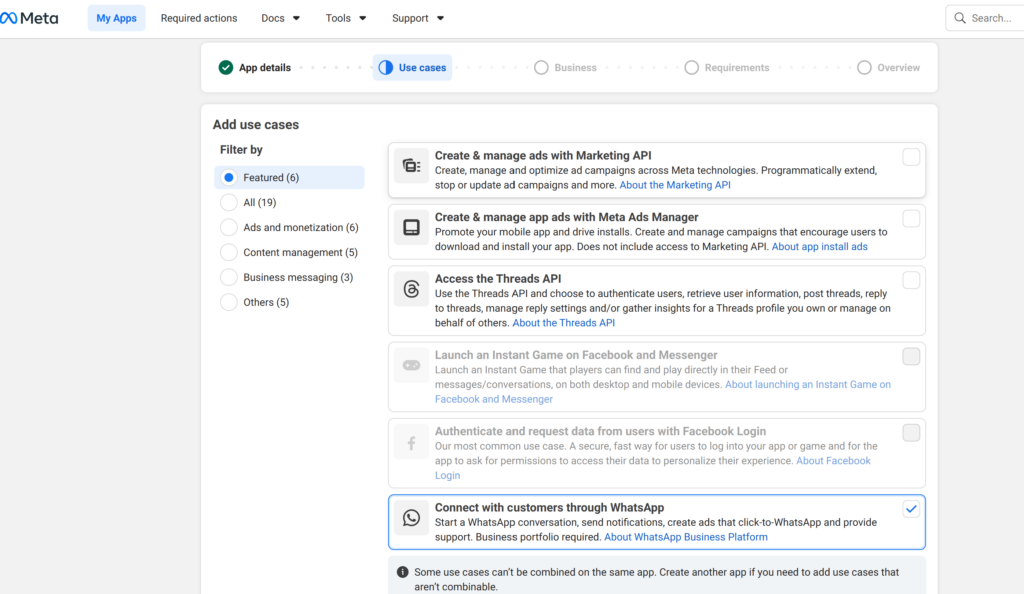
5. Connect your business portfolio to the App
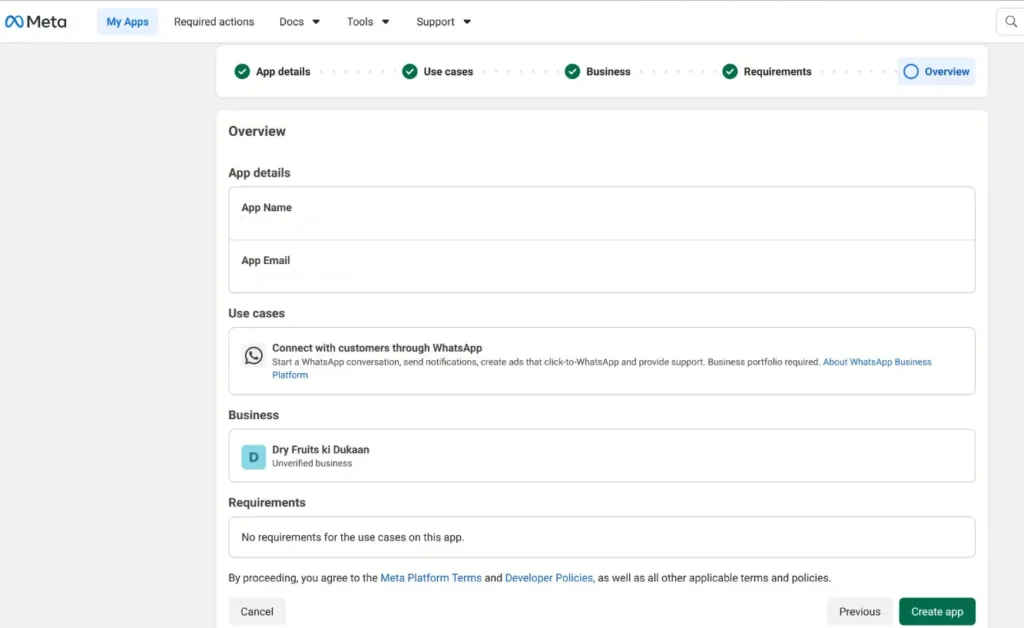
6. Once all the steps are complete, click on create app on the bottom right
7. Select Business as the app type, click Next, give your app a name, select your business account, and click Create App.
Step 2: Add and verify your business phone number
The number you use here must not already be registered on WhatsApp or WhatsApp Business.
- On the Getting Started page scroll down to Add a Phone Number and click the Add Phone Number button.
- Enter your WhatsApp Business Profile Display Name and select your business Category.
- Enter your phone number including the country code and verify it using the 6 digit code WhatsApp sends to that number.
Step 3: Collect your API credentials and generate a permanent access token
You need five pieces of information to connect Kommunicate to your WhatsApp account. Here is where to find each one:
- Select the phone number you just added on the Getting Started page and copy the Phone Number ID.
- On the same page copy the WhatsApp Business Account ID.
- Go to Settings > Advanced in the left panel and find the API Version number under Upgrade API Version, for example v16.0. Copy that.
- To get the Permanent Access Token go back to My Apps and click on the business name of your app to open Business Settings.
- Navigate to Users > System Users from the left panel and click Add.
- Give your system user a name, select Admin as the role and click Create System User.
- Click Add Assets, select Apps as the asset type, select your app from the list, enable Full Control and click Save Changes.
- Click Generate New Token, select your app, choose both whatsapp_business_messaging and whatsapp_business_management permissions and click Generate Token.
- Copy the token that appears. This is your Permanent Access Token.
Step 4: Configure your webhook
The webhook tells Meta where to send incoming messages so your Kommunicate chatbot can receive and respond to them.
- Go to WhatsApp > Quickstart and click Configure Webhooks.
- Click Edit and enter the following: Callback URL: https://omni-channel.kommunicate.io/whatsapp/cloud-api/webhook Access Token: kommunicate_private_access_token
- Click Verify and Save.
- Under Webhook Fields click Manage, select Messages in the modal and click Done.
Once your webhook is configured your Meta setup is complete. Keep your Phone Number ID, WhatsApp Business Account ID, API Version, and Permanent Access Token handy as you will need them in the next step to connect everything inside Kommunicate.
How to build a whatsApp chatbot using Kommunicate: 5 simple steps
With your WhatsApp Business API credentials ready the next step is connecting them to Kommunicate and building your chatbot. Here is the complete process from entering your credentials to going live with your first automated conversation.
Step 1: Connect your WhatsApp API credentials in Kommunicate
1. Log in to your Kommunicate dashboard.
2. Navigate to the Integrations section and select WhatsApp.
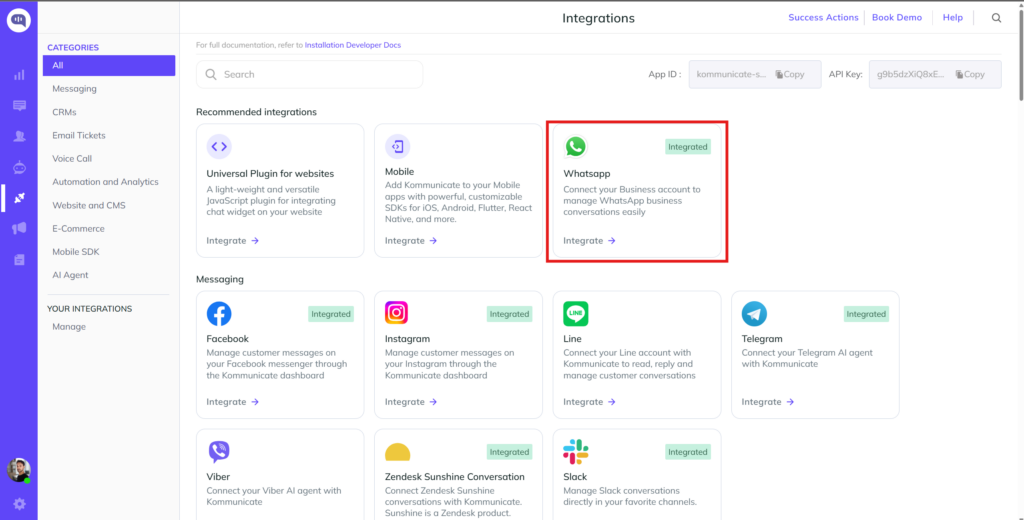
3. Click the Meta Cloud API option.
4. Click the Integrate a New Number button.
5. Enter your business phone number including the country code.
6. Enter your Phone Number ID, WhatsApp Business Account ID, API Version, and Permanent Access Token into the respective fields.
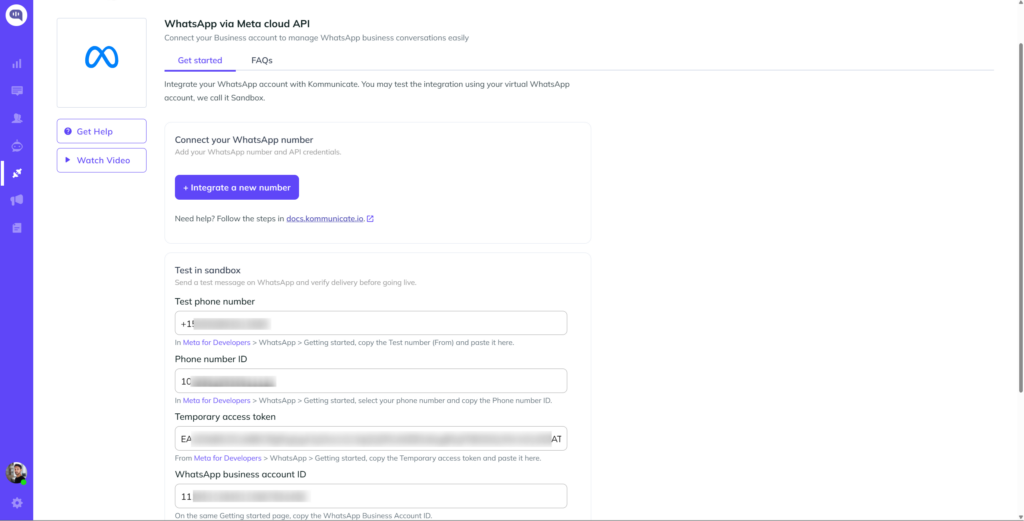
7. Click Save and Proceed.
Once saved Kommunicate is now connected to your WhatsApp Business number and ready to receive messages from customers.
Step 2: Create your chatbot on Kompose
1. From your Kommunicate dashboard navigate to the Agent Integration section.
2. Select Kompose Agent Builder from the options available.
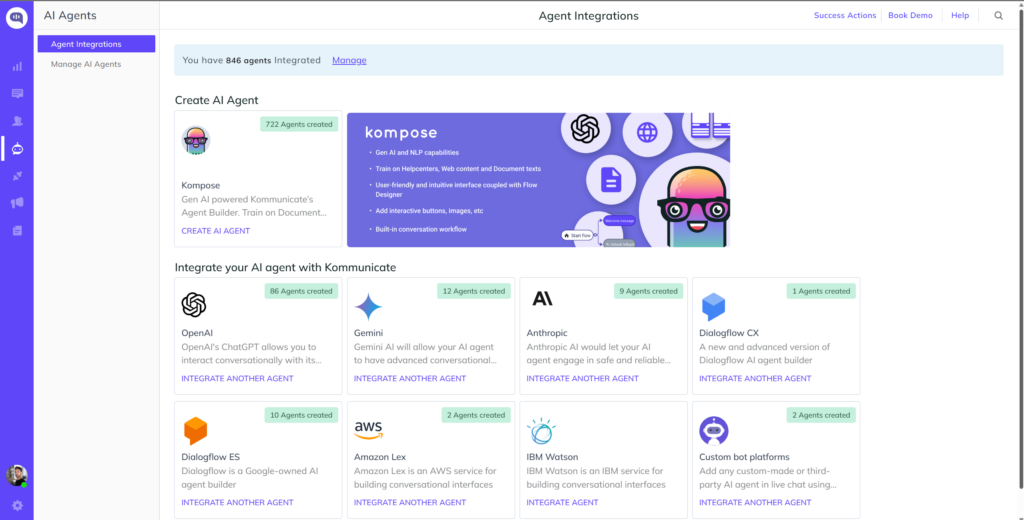
3. Create a new agent and give it a name.
4. Once created you will be taken into the Kompose interface where you will build your conversation flows.
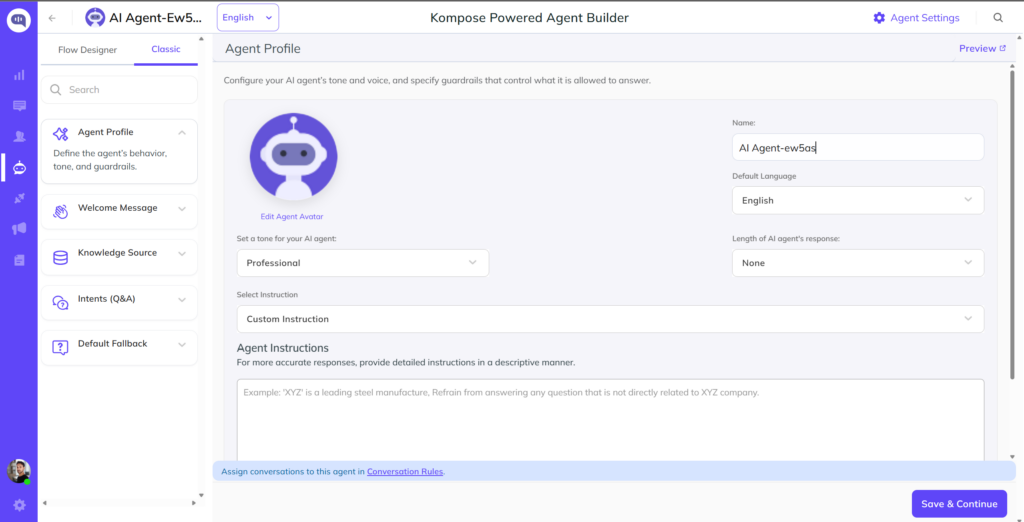
Step 3: Design your conversation flow and train your chatbot
This is where you define what your chatbot says and how it responds to customer messages. In Kompose every conversation is built around two elements.
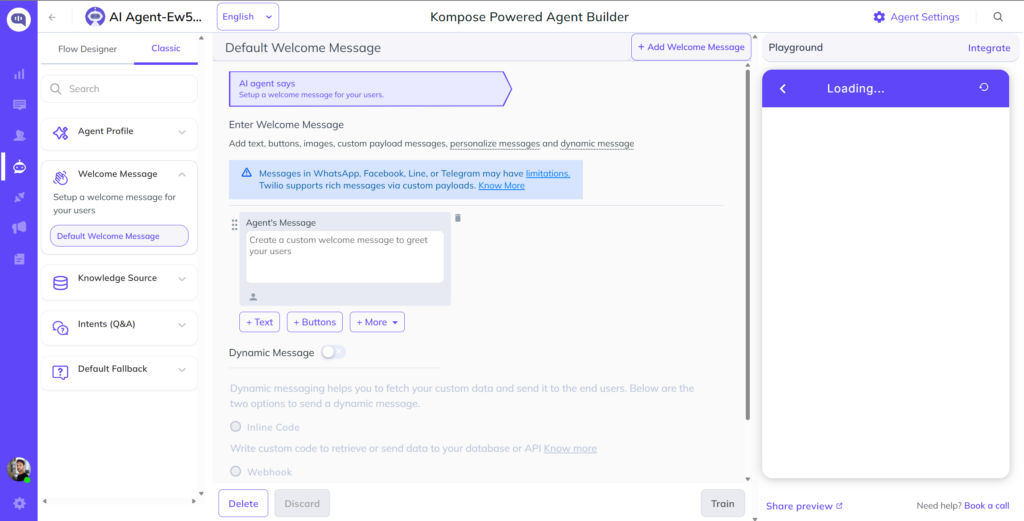
In the User Says section enter the phrases or questions a customer might send to your business. For example “What are your working hours” or “I need help with my order.” These are called training phrases. Add at least three to four different variations for each question so the bot can recognise the same question even when customers phrase it differently.
In the Bot Says section enter the response your chatbot should send back when it receives one of those training phrases.
You can also make conversations more interactive by adding buttons, lists, images, and forms. To do this click More in the Bot Says section and select Custom Payload.
Train your whatsApp chatbot on your own data
Instead of manually building every question and answer from scratch you can train your chatbot directly on your existing business data. Kommunicate gives you three ways to do this:
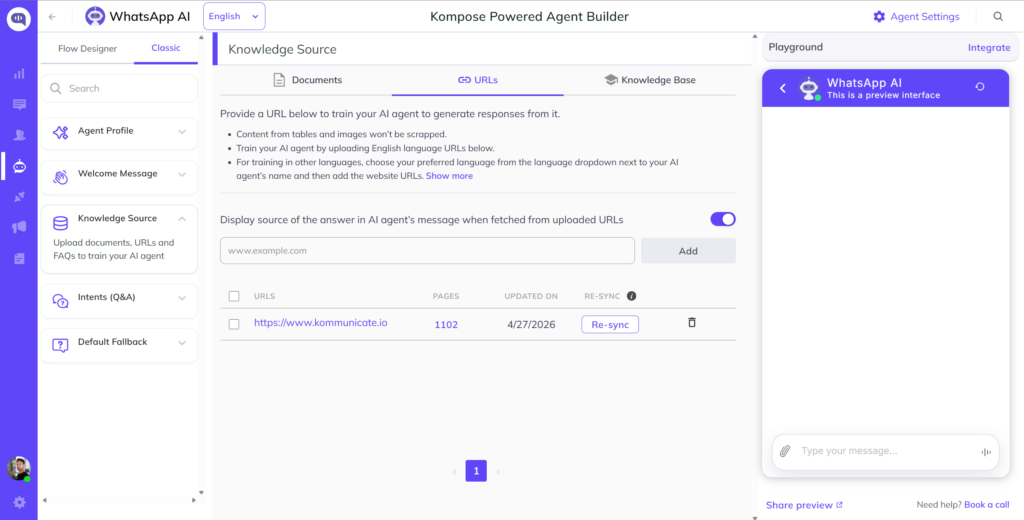
Upload documents – such as PDFs, Word files, or spreadsheets. Your chatbot will learn from the content in those files and use it to answer customer questions in your brand’s tone.
Train using your website URL – Enter your main website URL and Kommunicate will scrape your entire site automatically. You can then choose which pages to include or exclude from the training.
Connect your support platform – If your support articles are hosted on Zendesk or Salesforce, Kommunicate offers native integrations so you can train your chatbot on hundreds of existing articles instantly without copying anything manually.
Step 4: Set up bot to human handoff
Not every customer question can be handled by a chatbot. When the bot does not understand a message it should automatically transfer the conversation to a human agent rather than leaving the customer without a response.
- In Kompose find the Default Fallback intent. This is triggered whenever the bot cannot match a customer message to any of your trained responses.
- In the Bot Says section of the Default Fallback intent click More and select Handover.
- If you want the conversation transferred to a specific agent click Assign to Specific Human and enter that agent’s email address. If you leave it blank the conversation will be routed based on your existing conversation routing rules.
Step 5: Enable your bot and test your WhatsApp chatbot
1. Go to Settings in your Kommunicate dashboard and navigate to Conversation Rules.
2. Enable the Assign New Conversations to Bot option. This ensures every incoming WhatsApp message is automatically handled by your chatbot.
3. To test send a WhatsApp message from your personal phone to your business WhatsApp number.
4. You should receive an automated response from your chatbot.
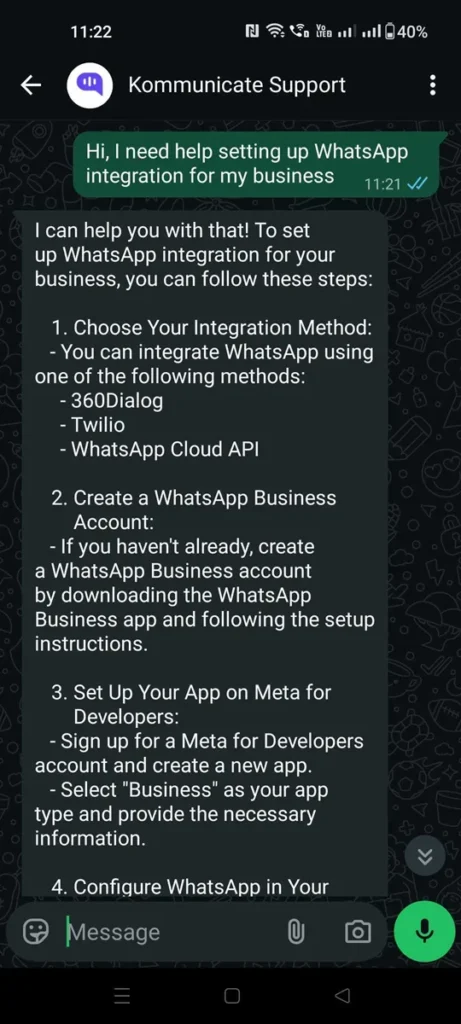
5. Go to the Conversations page in your Kommunicate dashboard and confirm the conversation has appeared there with the bot’s response visible.
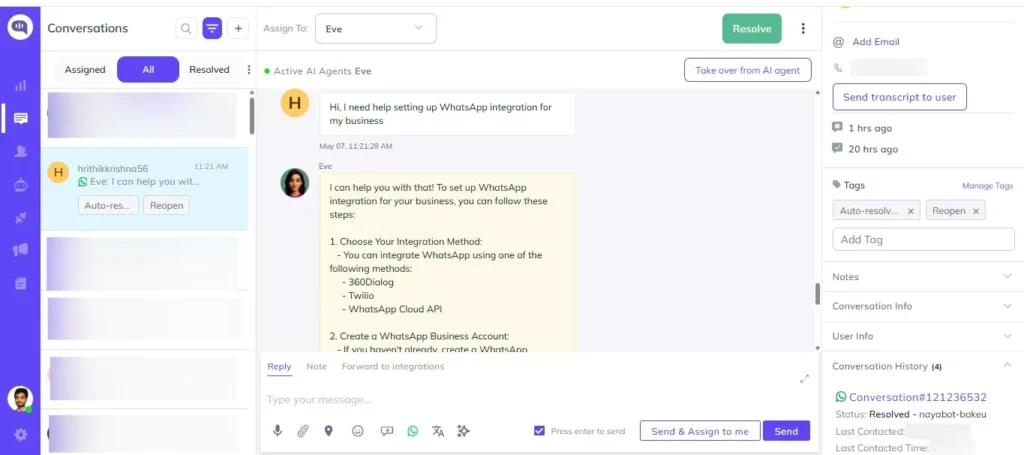
If the bot responds correctly on WhatsApp and the conversation appears in Kommunicate your chatbot is live and ready for customers.
WhatsApp chatbot use cases for businesses
WhatsApp chatbots are not a one size fits all tool. The way a hospital uses one looks very different from how an ecommerce brand or a real estate agency does. Here are the most common and impactful use cases across industries.
WhatsApp chatbot for customer support
Businesses use WhatsApp chatbots to handle the most common support queries automatically, things like order status, refund policies, account issues, and FAQs, without involving a human agent. For repetitive customer questions, a dedicated FAQ chatbot for WhatsApp can help answer common queries instantly and reduce the number of tickets your team handles manually.
When a query is too complex the bot transfers the conversation to the right agent with the full context already captured so the customer never has to repeat themselves.
WhatsApp chatbot for Ecommerce and order tracking
Ecommerce brands use WhatsApp chatbots to send order confirmations, shipping updates, and delivery notifications automatically. Customers can also message the bot directly to check their order status, request a return, or get product recommendations without visiting the website. This reduces support ticket volume significantly while keeping customers informed at every step.
WhatsApp chatbot for lead generation
Businesses use WhatsApp chatbots to qualify leads before they ever reach a sales team. The bot asks the right questions, collects contact details, understands the prospect’s needs, and passes only the most relevant leads to sales with all the context captured. This means your sales team spends time closing deals rather than chasing unqualified enquiries.
WhatsApp chatbot for healthcare and appointment booking
Clinics and hospitals use WhatsApp chatbots to let patients book appointments, receive consultation reminders, get medication alerts, and ask common questions about services, insurance, and hospital policies. This reduces the administrative load on front desk staff and makes it easier for patients to get the information they need quickly.
WhatsApp chatbot for education
Schools, coaching centres, and online learning platforms use WhatsApp chatbots to answer admissions queries, send course reminders, share study materials, and collect student feedback automatically. For institutions that receive hundreds of enquiries daily it removes the bottleneck of having to respond manually to every prospective student.
These are just some of the ways businesses are using WhatsApp chatbots today. Before you go ahead and build one though there are a few limitations worth knowing about so you can plan your setup accordingly.
WhatsApp chatbot limitations you should know before you start
A WhatsApp chatbot can do a lot for your business but it is not without boundaries. Knowing these limitations before you start building saves you from designing a flow that runs into a wall later.
The 24 Hour messaging window
WhatsApp only allows businesses to send free form messages within 24 hours of the last message a customer sent. If that window closes you can only reach out again using pre-approved message templates.
Outbound messages require pre-approved templates
Any message your business initiates must use a WhatsApp approved template reviewed by Meta before it can be used. Plan for a review period of up to 24 hours when submitting new templates.
Media file restrictions
WhatsApp does not support all file types. The files your chatbot can send and receive are limited to specific formats for images, audio, video, and documents. Always check Meta’s latest supported media types before building flows that rely on file sharing.
Rich messages have display limits on WhatsApp
Not all rich messages such as buttons, carousels, and forms that you build in Kompose will render correctly on WhatsApp. Always test your conversation flows on an actual WhatsApp number before going live.
Some conversations may need a voice follow-up
A WhatsApp chatbot works best for structured, message-based conversations such as FAQs, order tracking, appointment booking, and lead qualification. But some customer issues are easier to resolve over a call, especially when the request is urgent, sensitive, or needs detailed back-and-forth clarification. In those cases, businesses can use WhatsApp chat as the starting point and move the conversation to voice when needed. If this is part of your support workflow, here is a guide to the WhatsApp Business Calling API.
Messaging tier limits
New WhatsApp Business API accounts start at a limited messaging tier that restricts how many unique users you can message in a 24 hour period. Meta increases these limits gradually as your account builds a positive messaging history.
Business verification takes time
Meta requires business verification before you can go fully live and this can take one to two business days. Factor this into your launch timeline and do not leave verification to the last minute.
Knowing these limitations upfront means you can design your chatbot flows around them rather than discovering them after you have already gone live.
Why Kommunicate is the best WhatsApp chatbot builder for businesses
There are dozens of tools that let you connect a chatbot to WhatsApp. Here is why businesses choose Kommunicate.
No Code setup with native WhatsApp integration
Kommunicate connects directly to WhatsApp through a native integration without any manual coding or installation. You do not need a developer to get it up and running. The entire setup from connecting your API credentials to building your first conversation flow can be done entirely from the Kommunicate dashboard.
Train your chatbot on your own business data
Most chatbot tools make you build every response manually from scratch. Kommunicate lets you train your chatbot on your existing data, whether that is PDFs, Word files, spreadsheets, your website, or support articles from Zendesk and Salesforce. Your chatbot starts answering in your brand tone from day one without weeks of manual training.
AI that knows when to step aside
Kommunicate’s AI agent does not just answer questions. It recognises when a conversation needs a human and transfers it automatically with the full context intact so the customer never has to repeat themselves. Your team gets involved only where they are actually needed.
All your conversations in one place
Whether customers reach you on WhatsApp, your website, or any other channel Kommunicate brings every conversation into a single centralised dashboard. Your support team always has the full picture regardless of which channel a customer started on.
Scales with your business
Kommunicate is built to handle growing conversation volumes without your costs spiralling out of control. As your business grows your chatbot handles the increasing load while your human team stays focused on the conversations that genuinely need them.
Ready to get started? Explore Kommunicate’s WhatsApp chatbot platform to see how you can automate support, sales, lead qualification, and customer conversations from one place.
Final thoughts
Building a WhatsApp chatbot does not have to be complicated. As this guide has shown, the process comes down to three things: getting your WhatsApp Business API set up on Meta, building your conversation flows on Kommunicate, and testing before you go live.
Once it is running your chatbot handles the repetitive queries, qualifies leads, books appointments, and keeps customers informed around the clock while your team focuses on the work that actually needs a human. That is the real value of a WhatsApp chatbot for a growing business.
If you are ready to get started Kommunicate gives you everything you need to build, train, and launch your WhatsApp chatbot without writing a single line of code. You can have your first automated conversation live in under 30 minutes.
Try Kommunicate for free today and see how it works for your business.
Frequently asked questions about WhatsApp chatbots
A WhatsApp chatbot is an automated system that handles customer conversations on WhatsApp without any human involvement. It works by connecting to your WhatsApp Business number through the WhatsApp Business API. When a customer sends a message the bot checks it against trained responses and replies instantly. If it cannot answer it transfers the conversation to a human agent automatically.
The WhatsApp Business app is designed for small businesses to manage conversations manually. It has basic features like quick replies, labels, and away messages but does not support chatbots or automation at scale. A WhatsApp chatbot requires the WhatsApp Business API which enables automated responses, conversation flows, and integrations with other tools.
The cost has two parts. First there is the cost of the chatbot platform. Kommunicate plans start at $40 per month with a 30 day free trial and no credit card required. Second there is the cost of the WhatsApp Business API which is charged by Meta based on conversation volume. The first 1,000 user initiated conversations per month are free. Beyond that Meta applies conversation fees based on their rate cards which vary by country. Kommunicate does not handle Meta’s payment directly so you will set that up separately through your Meta account.
Yes. Using a no code builder like Kommunicate you can build, train, and launch a WhatsApp chatbot entirely from a visual dashboard without writing a single line of code. The only part that requires following technical steps is the one time WhatsApp Business API setup on Meta’s developer platform, which this guide walks you through in detail.
The WhatsApp Business API setup on Meta including business verification typically takes one to two business days. Once that is complete building and connecting your chatbot on Kommunicate can be done in under 30 minutes.
Yes. The standard WhatsApp Business app does not support chatbot functionality. To automate conversations on WhatsApp you must have access to the WhatsApp Business API. This is what allows your chatbot to send and receive messages programmatically.
Yes. A WhatsApp chatbot can guide customers through a product catalog, collect order details, and send order confirmations. For payments the chatbot can direct customers to a payment link within the conversation. Full in chat payment processing depends on the payment integrations available in your chatbot platform.
When the bot receives a message it does not recognise it triggers the Default Fallback intent and automatically transfers the conversation to a human agent. In Kommunicate you can choose to route this to a specific agent or let the conversation routing rules decide. The customer is notified of the handover and the agent receives the full conversation history so the customer never has to repeat themselves.
The WhatsApp Business API itself is free to access through Meta’s developer platform. However Meta charges conversation fees based on usage. The first 1,000 user initiated conversations per month are free. After that fees apply based on Meta’s rate cards which vary by country. You can find the latest pricing at Meta’s official developer documentation.
Yes. Kommunicate supports over 100 languages which means your chatbot can respond to customers in their preferred language. This makes it particularly useful for businesses that operate across multiple regions or serve a diverse customer base without needing separate bots for each language.

Manab is the Head of Go-To-Market (GTM) at Kommunicate, with over 12 years of professional experience. He collaborates closely with the engineering, sales, and marketing teams to deliver and position Kommunicate’s AI solutions effectively in the market.
Prior to joining Kommunicate, he worked at Cvent, an enterprise event management software company, and Entropik, an emotion AI company that helps brands understand and interpret consumer emotions.