Updated on April 23, 2026
Estimated reading time: 17 minutes
TL;DR
Slow response times are one of the biggest and most preventable drivers of poor healthcare customer experience. Research shows 62% of patients say long hold times discourage them from choosing a provider, and patients who have a bad call center experience are four times more likely to switch. This article breaks down response time benchmarks by channel (phone, portal, live chat, and email), explains why healthcare lags behind other industries, and offers five actionable strategies to close the gap.
You called your doctor’s office at 9:14 AM. It’s now 9:47 AM. You’re still on hold.
That’s not a hypothetical. It’s a Tuesday morning for millions of American patients, and for many, it’s the moment they decide to find a new provider.
Response time is the frontline statistic for healthcare customer experience. Yet, most healthcare organizations keep losing ground on it quietly: with every unanswered call and every unread portal message.
Healthcare has never been more competitive for patient loyalty. Patients today research providers online, compare experiences like consumers, and leave when their expectations aren’t met. The industry measures itself on clinical quality, but patients notice communication speed first.
This article makes the case that slow response times are among the most preventable drivers of poor healthcare CX. It covers what the data shows by channel, where the industry falls short, and what healthcare organizations can do with the right processes and patient experience software. Were covering:
- What do patients actually experience?
- Why does healthcare lag on response time?
- Response time benchmarks by channel
- The business case: what slow responses really cost?
- Five strategies to fix response time in healthcare CX
- What should you look for in patient experience software?
- Conclusion
- FAQs
What do patients actually experience?
Slow response times directly cause patient churn. The numbers show that this is a revenue problem, and not just a satisfaction one.
The gap between how responsive healthcare organizations think they are and what patients actually experience is wide. Accenture’s Patient Experience Benchmark Survey (2021) asked more than 10,000 Americans why they switched healthcare providers. The number one reason, cited by 78% of respondents, had nothing to do with clinical quality or cost. It was ease-of-navigation: difficulty doing business, poor administrative interactions, and inadequate digital services.
Press Ganey’s Consumer Trends Report (2021) reinforces this. The research found that 62% of surveyed patients said difficulty contacting the office (including long hold times) played a major role in discouraging them from choosing a provider. A separate study puts the underlying frustration in even starker terms: 42% of patients identify difficulty reaching their provider as the single largest barrier to good healthcare communication (DialogHealth, 2025).
These are not fringe complaints. Tebra’s 2025 Patient Perspectives Report, which surveyed nearly 4,000 patients, found that 65% would switch providers for a better digital experience. As the report put it: “What really matters now are the experiences around [clinical care]: how easy it is to reach your practice, how quickly you respond, and how seamless the digital experience feels.”
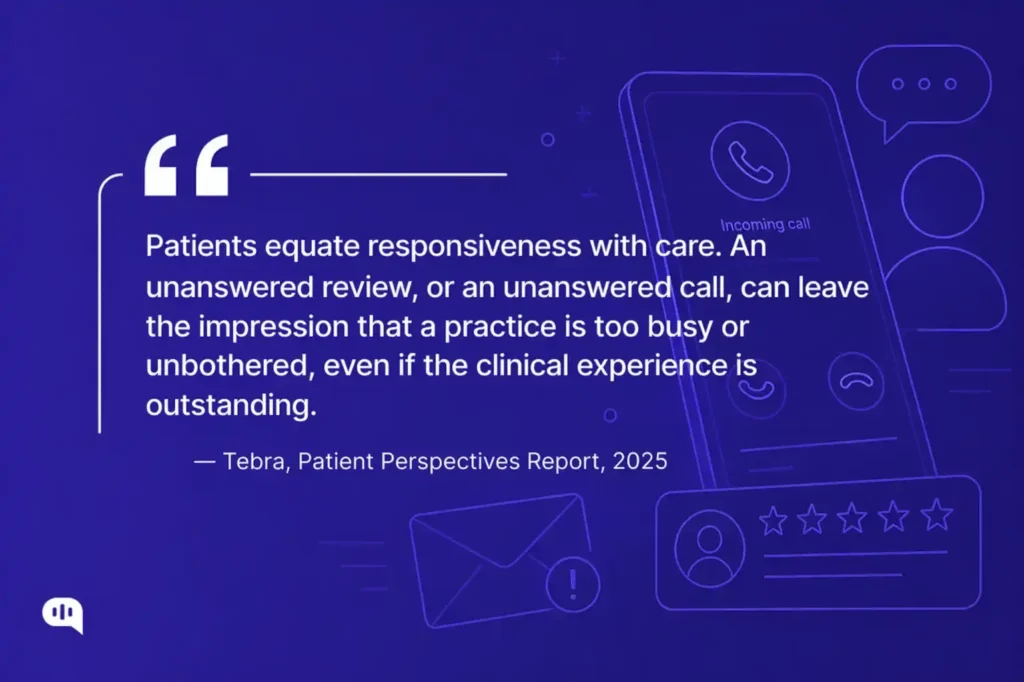
“Patients equate responsiveness with care. An unanswered review, or an unanswered call, can leave the impression that a practice is too busy or unbothered, even if the clinical experience is outstanding.” — Tebra, Patient Perspectives Report, 2025.
The data keeps pointing to this problem.
Patients who have a poor call center experience are over four times more likely to switch providers. And 55% of patients say they would think about changing providers if their communication preferences were not met.
But if the healthcare CX problem exists, why hasn’t it been solved?
Why does healthcare lag on response time?
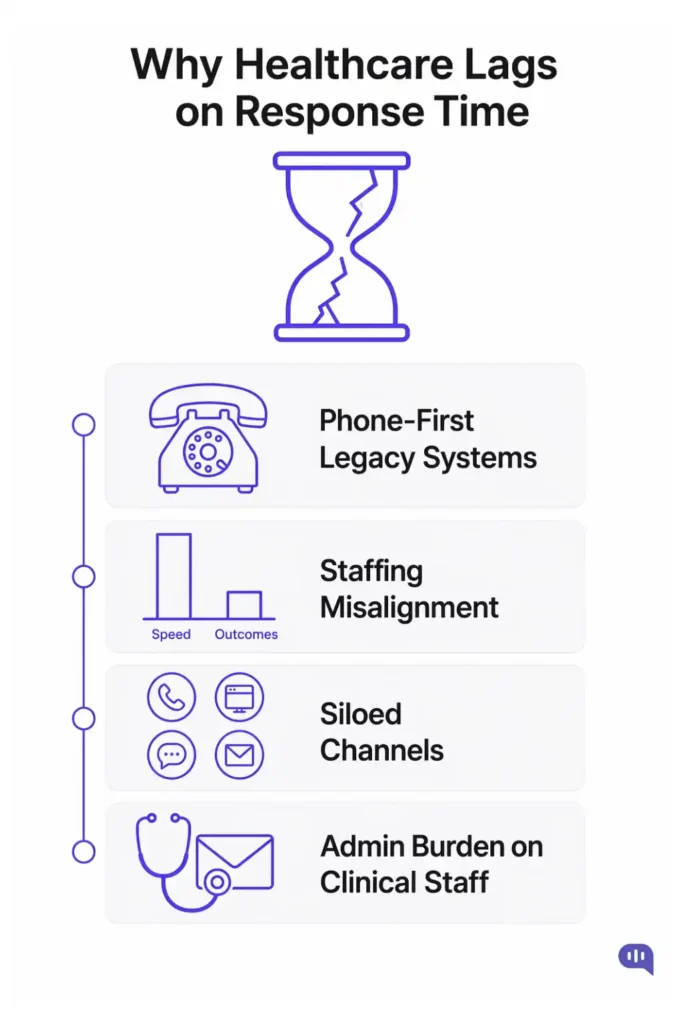
Healthcare’s communication infrastructure was built for volume and compliance, not for speed. The result is a system that manages care episodes well but handles the communication around them slowly.
That’s the core structural problem. Understanding it is the first step toward fixing it. Several compounding factors make response time a persistent challenge in healthcare settings.
1. Phone-first legacy systems
Most practices still route the bulk of patient contact through phones. Interactive Voice Response (IVR) systems are used by 84% of healthcare organizations, and Automatic Call Distribution (ACD) by 82%.
These systems were built to handle volume, not optimize experience, and they show their limitations when call demand spikes.
2. Staffing misalignment
Research shows that 68% of healthcare call centers track average handle time (AHT) as a primary KPI, but only 22% track conversion to booking rates by inquiry type. Staff are measured on how quickly they move calls along, not whether patients actually got what they needed.
3. Siloed channels
Patients move between phone, patient portal, secure messaging, live chat, and email.
When those channels are not connected, staff have no unified view of what a patient has already tried, asked, or was told. That’s when repeat calls, repeated explanations, and frustrated patients happen.
4. Administrative burden on clinical staff
Secure messages and portal inquiries often land directly with physicians or nurses who are already managing a full clinical load. Response time on digital channels ends up controlled by clinician bandwidth between appointments, not by a defined communication SLA.
AMN Healthcare’s 2025 survey found the average wait time for a new patient appointment is 31 days: a 19% increase since 2022 and a 48% jump since 2004..
When the system is already stretched that thin at the scheduling level, it’s no surprise that real-time communication falls behind. This is made clearer once we view the benchmark data across the industry.
Response time benchmarks by channel
Most healthcare CX discussion focuses on generic advice around reducing wait times or improving communication. What they don’t offer is channel-specific benchmarks.
Here’s what the data actually shows, and where healthcare currently stands against each one.
The table below is a reference healthcare operators can use to evaluate their own performance.
| Channel | Industry Benchmark (Good) | Healthcare Reality | Key Metric |
|---|---|---|---|
| Phone | 80% of calls answered in 20 seconds (80/20 rule) | Healthcare target: 30 seconds; ~80% of VHA centers miss even that | Average Speed of Answer (ASA) |
| Patient Portal / Secure Messaging | First response within 4 hours (urgent); 8 hours (routine) | 17.6% of messages go unanswered for 36+ hours | First Response Time (FRT) |
| Live Chat | First response under 60 seconds; best-in-class: 45 seconds | No healthcare-specific standard published | First Response Time (FRT) |
| Email (Administrative) | 1–4 hours (cross-industry standard) | Healthcare target: 4–8 business hours | Response Time |
Phone
The gold standard in call center operations is the 80/20 rule: 80% of calls answered within 20 seconds. In healthcare, the bar is already lower: the standard target is 80% of calls answered within 30 seconds.
Even that more forgiving benchmark is missed consistently. The Veterans Health Administration (VHA), the largest integrated healthcare system in the US, sets an average speed of answer (ASA) target of 30 seconds or less.
By the end of a recent study period, nearly 80% of VHA centers had not met that target (DialogHealth, 2025). Patients at VHA centers where ASA exceeded 107.7 seconds were measurably less likely to report they could “always” or “usually” access urgent care.
Additional benchmarks worth tracking on phone:
| Metric | Healthcare Benchmark | What It Means |
|---|---|---|
| Average Speed of Answer (ASA) | Under 30 seconds | Time from call initiation to connecting with a live agent |
| First Call Resolution (FCR) | 71–75% | Percentage of calls resolved without requiring a callback or follow-up |
| Average Handle Time (AHT) | 6.6 minutes | Total time per call, including hold time and post-call wrap-up |
| Call Abandonment Rate | Under 5% | Percentage of callers who hang up before connecting with an agent |
| Satisfaction impact of one transfer | −12% CSAT | Each transfer to another agent meaningfully reduces patient satisfaction scores |
What good looks like: ASA under 30 seconds, FCR at or above 75%, abandonment rate below 5%.
Patient portal and secure messaging
This is where the most significant gaps exist because portal adoption has surged. According to the Office of Nation Coordination of Health IT, 77% of US patients were offered online portal access in 2024, and 34% were frequent users, accessing records six or more times per year.
The most common activities were:
- Viewing lab results (90%)
- Reading clinical notes (80%)
- Messaging providers (79%)
- Scheduling appointments (77%).
With nearly 8 in 10 portal users actively messaging their providers, response time on secure messaging is now a core CX metric. The data is stark: one study of primary care secure messaging found that 8.5% of messages were not opened within 12 hours, and 17.6% received no response within 36 hours.
A UC Davis study put the satisfaction impact in direct terms: all patients who received an immediate response were “very satisfied.” When a response didn’t arrive until the next day, that figure dropped to 73.8%. The longer the delay, the steeper the decline.
What good looks like: First response to portal messages within 4–8 business hours. Urgent messages acknowledged within 1–2 hours. No message left unread beyond 12 hours.
Live Chat
Live chat is the fastest-growing patient communication channel, and the one where patient expectations are most shaped by experiences outside of healthcare.
Across industries, the 2025 average live chat first response time is 50–60 seconds. Best-in-class organizations hit 45 seconds, with top brands reaching 12–30 seconds through AI automation.
Live chat earns a 73% customer satisfaction score, compared to 61% for email and 44% for phones. According to a Freshworks study, AI now handles roughly 74% of initial chat interactions at leading organizations, enabling sub-30-second first responses at scale.
Healthcare-specific live chat benchmarks do not yet exist as a published standard. That gap is itself revealing. A patient whose last live chat was with their bank or retailer arrives at a healthcare chat window with identical speed expectations, and feels the difference acutely when those expectations are not met.
What good looks like: First response under 60 seconds. AI-assisted triage for common queries to achieve a sub 30-second initial response. Seamless escalation to a human agent for sensitive or complex issues.
Email (Administrative)
For general administrative inquiries the cross-industry standard is a response within 1–4 hours. The recommended target for healthcare is 4–8 business hours, already slower than ecommerce or SaaS. Patient expectations shaped by those faster industries often do not align with what healthcare delivers.
What good looks like: Acknowledgment within 2 hours. Full resolution within one business day for non-clinical matters.
We know that patient outcomes often have the largest impact on healthcare CX overall. However, even when delayed responses don’t weigh on patient outcomes, it has a measurable impact on revenue and ROI.
The business case: what slow responses really cost
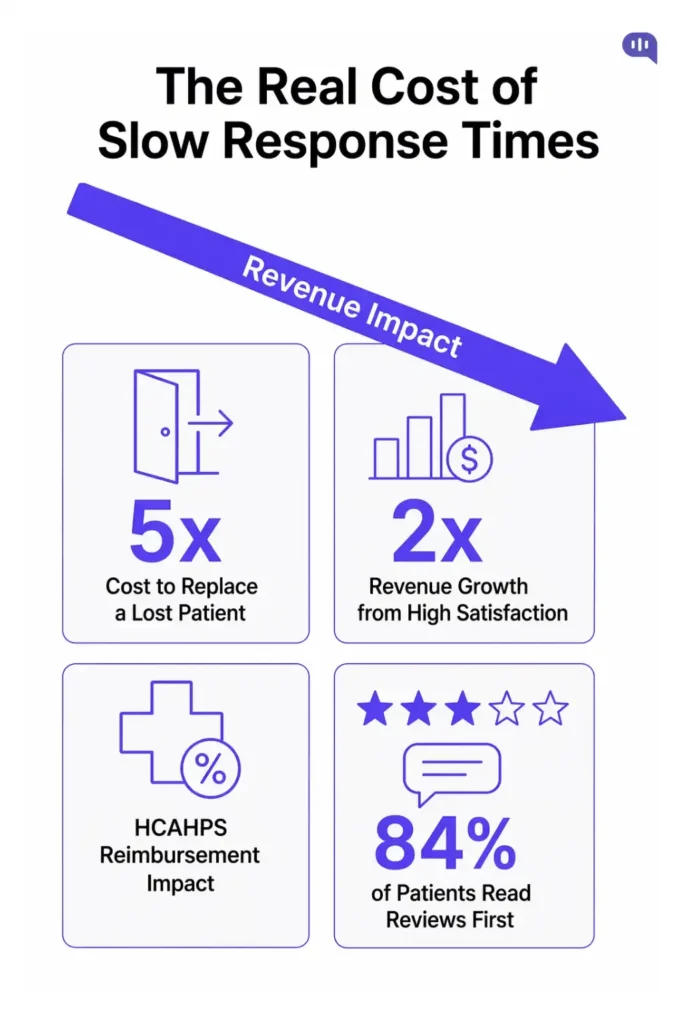
Healthcare organizations that invest in response time see measurable returns. Those that do not are losing patients and revenue in ways they may not be tracking.
The financial stakes are clearer than most operators realize. Here are some common costs we see with our healthcare clients:
1. Patient churn and acquisition costs
It costs five times more to acquire a new patient than to retain an existing one. Tebra’s 2025 survey found 65% of patients would switch providers for better digital convenience.
And a Cedar survey of more than 1,600 adults from 2019 found 41% would consider switching for a better digital experience overall, with younger adults four times more likely to do so than those over 65 (Healthcare Dive, 2019).
2. Revenue growth differential
Healthcare organizations focused on patient satisfaction drive over twice the revenue growth of those with lower satisfaction scores. Positive service experiences drive approximately 150% more spending compared to negative ones.
3. HCAHPS and reimbursement
The Hospital Consumer Assessment of Healthcare Providers and Systems (HCAHPS) survey is tied directly to Medicare reimbursement through the Value-Based Purchasing program. Communication responsiveness (how quickly patients get help, how well staff communicate) is embedded in the scoring methodology. Slow response times reduce reimbursement as well as satisfaction.
4. Reputation risk
In December 2024, 84% of patients checked online reviews before booking care. Reviews that mention hold times, unreturned calls, or slow portal responses are among the most common negative signals, and among the most visible to prospective patients making provider choices. Tebra found that 70% of patients said a provider’s reply to a negative review improved their opinion. Responsiveness, in other words, is reputation.
So, we need to start fixing it. We have tried and worked with global organizations like Amgen and Amref to solve these problems. We recommend five strategies to mitigate the slow communication problem.
Five strategies to fix response time in healthcare CX
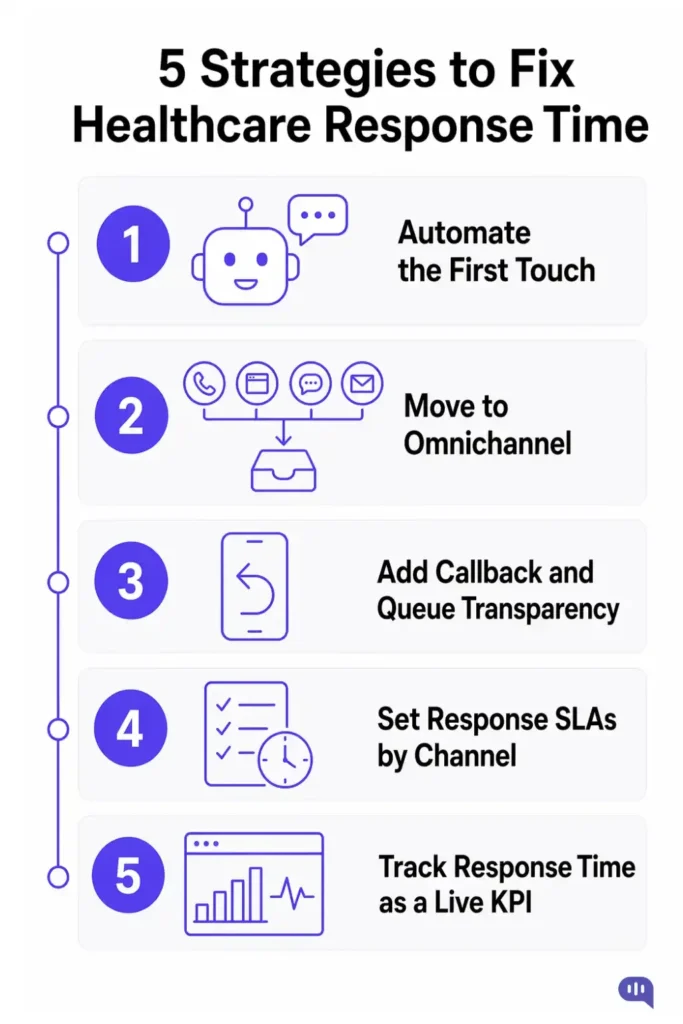
The organizations closing the response time gap share a common approach: a combination of process redesign and technology investment. Here are five strategies that consistently move the needle.
1. Automate the first touch
The majority of incoming patient contacts (appointment scheduling, prescription refill requests, basic FAQs, directions, and hours) do not require a human agent to resolve. AI-powered chatbots and virtual assistants handle these instantly, 24/7, reducing load on human staff while delivering the response speed patients expect.
The critical requirement: EHR integration. An AI layer that cannot access a patient’s appointment history, prescriptions, or care team can only handle surface-level queries. AI connected to an EHR system handles substantive self-service interactions that genuinely reduce inbound volume.
2. Move to omnichannel communication
Most healthcare organizations offer multiple channels. Far fewer offer a unified experience across all of them. Multi-channel means patients can reach you in different ways. Omnichannel means your team has a single view of every interaction regardless of channel.
When a patient who sent a portal message on Monday calls on Wednesday, your staff should see that message immediately. Each transfer reduces patient satisfaction ratings by 12%. Omnichannel platforms eliminate the unnecessary transfers that occur when no one can see what the patient has already tried.
3. Implement callback options and queue transparency
Callback features (where patients leave their number and keep their place in the queue without staying on hold) dramatically reduce abandonment rates and frustration. Queue time estimates delivered by SMS while a patient waits convert an opaque, open-ended hold into a managed expectation. Both are high-impact, low-cost interventions that improve satisfaction without adding headcount.
4. Set and publish response SLAs by channel
Healthcare organizations rarely publish response time commitments. Doing so (even as internal operational targets) creates accountability. When a portal system auto-sends a confirmation stating “you will receive a response within 4 business hours,” two things happen: patient anxiety decreases, and staff have a clear standard to meet.
Kaiser Permanente, for example, sets the expectation during the portal messaging flow that responses take 1–2 business days, and actively manages satisfaction around that commitment.
The discipline of setting channel-specific SLAs drives the operational and staffing changes needed to actually meet them.
5. Track response time as a live KPI
Response time only improves when it’s measured. Around 80% of healthcare organizations use patient satisfaction surveys like HCAHPS and Press Ganey, but far fewer track first response time, resolution time, or abandonment rate at the channel level as a live operational metric.
Patient experience platforms that include communication analytics make slow-response patterns visible before they become satisfaction problems. The best platforms connect operational metrics to satisfaction scores, so teams can see in real time how response time is affecting CX outcomes.
We already have a guide about patient experience platforms, so we will only briefly touch on the features you should look at while choosing one.
What to look for in patient experience software?
When evaluating patient experience software for response time improvements, the features below are the ones that move the metrics.
| Feature | Why It Matters for Response Time |
|---|---|
| EHR Integration (Epic, Athena) | Gives AI and agents patient context in every interaction, enabling faster and more accurate responses without manual record lookup |
| Omnichannel Inbox | Unifies portal, chat, SMS, and email in a single queue so staff have a complete interaction history and avoid duplicate or missed responses |
| HIPAA-Compliant Messaging | Required across all communication channels; ensures secure response workflows can be standardized without compliance risk |
| AI-Powered First Response | Handles routine queries instantly and around the clock; escalates complex issues to human agents, reducing first response time at scale |
| Response Time Dashboards | Makes SLA performance visible to operations teams in real time, enabling proactive intervention before delays become satisfaction problems |
| Automated Reminders and Follow-Ups | Reduces avoidable inbound volume by proactively answering common questions before patients need to call or message |
For a detailed breakdown of the leading platforms, including NexHealth, Relias, Well iQ, Televox, and others, see our full review of the best patient experience software for healthcare in 2026.
Conclusion
Response time is a primary driver of whether patients stay, return, and recommend. The data is consistent across studies: patients who cannot get through leave. Patients who wait too long for a portal reply grow less satisfied with every hour. And organizations that do not track response time by channel are losing patients and revenue in ways they are likely not measuring.
The gap between where most healthcare organizations are and where they need to be is closable. AI-assisted first response, omnichannel inboxes, callback queuing, and published SLAs are producing measurable gains in patient satisfaction, retention, and HCAHPS scores at organizations already using them.
If you’re ready to change the slow response times at your organization, we can help! Book a call with Kommunicate to learn how international orgs like FCB Health, Amgen, and Amref manage response times at scale!
Frequently Asked Questions (FAQs)
Healthcare customer experience (CX) refers to how patients perceive every interaction they have with a healthcare organization, across every channel and stage of their care journey. This includes administrative touchpoints such as scheduling, billing, and portal messaging, as well as in-person and clinical interactions.
Amy Goad, managing director at Sendero Consulting, puts it clearly: “You are a customer when you are trying to schedule an appointment, when you are trying to coordinate insurance, when you are trying to find lab results while navigating a patient portal, and when you are conducting research on who you want to be your provider” . The distinction matters because healthcare CX can be damaged long before a patient ever sees a clinician.
A good response time for a healthcare call center is an average speed of answer (ASA) of 30 seconds or less, with a target of answering 80% of calls within that window. This is already lower than the general industry standard of 20 seconds. The First Call Resolution (FCR) benchmark for healthcare is 71–75%, meaning most patient concerns should be resolved without a follow-up call. Each transfer to another agent reduces patient satisfaction by 12%, so limiting transfers is as important as limiting hold time (DialogHealth, 2025).
For routine portal messages, the recommended response window is within 4–8 business hours. Urgent messages should receive an acknowledgment within 1–2 hours. Research shows that 100% of patients who received an immediate response to a secure message were “very satisfied,” a figure that dropped to 73.8% when the response came the following day and continued to fall with each additional hour of delay (American Medical News, 2013). No portal message should go unread for more than 12 hours, including on weekends, when studies show delay rates are significantly higher.
Patient experience typically refers to interactions that happen within a clinical care setting: the quality of care received, the behavior of clinical staff, and outcomes of treatment. Healthcare customer experience is broader. It covers every interaction a patient has with a healthcare organization, including before and after care delivery. Scheduling, billing, hold times, portal messaging, and website usability are all part of CX but fall outside the traditional definition of patient experience. Both matter for satisfaction, retention, and reimbursement, but they require different measurement tools and improvement strategies.
Response time affects HCAHPS scores through the communication and responsiveness domains of the survey. HCAHPS asks patients how often staff responded when they needed help and how well nurses and doctors communicated. Organizations with slow response times, whether on the phone, through portals, or during a hospital stay, tend to score lower on these domains. Because HCAHPS scores are tied to Medicare reimbursement through the Value-Based Purchasing (VBP) program, poor responsiveness has a direct financial consequence beyond patient satisfaction.
The leading cause of patients switching providers is ease of navigation, not clinical quality. Accenture’s Patient Experience Benchmark Survey of more than 10,000 Americans found that 78% of patients who switched cited difficulty doing business, poor administrative interactions, or inadequate digital services as the primary reason.
Tebra’s 2025 research found that 65% of patients would switch for a better digital experience. Slow response times, unreturned calls, and unanswered portal messages are among the most cited specific triggers within the navigation difficulty category.
Yes. AI-powered tools are among the most effective ways to reduce response times in healthcare. Across industries, AI now handles roughly 74% of initial chat interactions at leading organizations, enabling first response times under 30 seconds at scale.
In healthcare, AI chatbots integrated with EHR systems can handle appointment scheduling, prescription refill requests, and basic FAQs instantly, without requiring a human agent. This reduces inbound volume for staff and delivers immediate responses for patients. The critical factor is EHR integration: an AI layer without access to a patient’s records can only handle surface-level questions.

Devashish Mamgain is the CEO & Co-Founder of Kommunicate, with 15+ years of experience in building exceptional AI and chat-based products. He believes the future is human and bot working together and complementing each other.