Updated on August 18, 2026
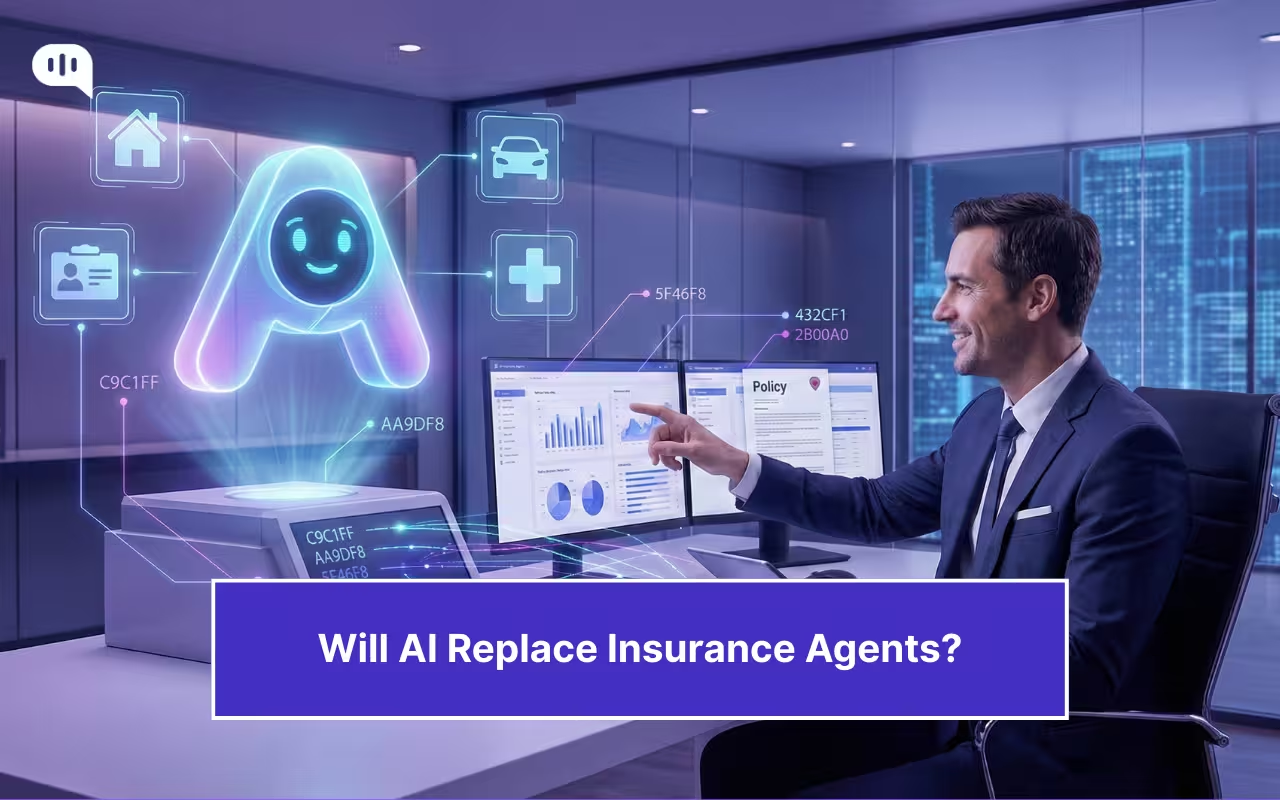
The short answer is no, but the nuanced answer is yes, for those who refuse to adapt. For years, the insurance industry has hedged its bets on automation, but 2025 marks a definitive turning point.
The agent of record remains a legally mandated, human-centric role because, at the end of the day, a machine cannot be held liable in a court of law, nor can it provide the “gut-feeling” advocacy required during a catastrophic claim.

However, the “paper-pushing” model of insurance is dead. To understand your place in this new landscape, we must look at the specific time horizons for this transition:
- Short Term (12–24 Months): Task Replacement. AI will become your primary interface for administrative communication. It will handle the 2 a.m. “Where is my ID card?” texts and the initial intake for claims. You aren’t being replaced; you’re being “freed” from low-value busywork.
- Medium Term (2–5 Years): The Margin Gap. This is the danger zone. Agencies that haven’t integrated AI will face a “responsiveness gap.” When competitors can provide a quote in 60 seconds, and you take 24 hours, you lose on margin and service. Top performers will shift to “productizing” their expertise through AI-driven platforms.
- Long Term (5+ Years): Structural Reshaping. Standard, high-volume risks (like basic auto) will likely move toward fully embedded or direct-to-consumer models driven by AI. The human agent’s value will consolidate entirely around complex risks, advocacy, and strategic relationship management.
In short: AI replaces the clerk, but it empowers the advisor.
We’ll cover the following:
1. How Does Replaceability Differ by Line of Business (LOB) and Complexity?
3. When Must the AI Trigger a Handoff to a Human Expert?
4. What Does a Modern AI “Reference Architecture” Look Like for an Insurance Agency?
5. How Do the Economics of an AI-Enabled Insurance Agency Actually Work?
6. What Are the Common Failure Modes and Risks of Deploying AI in Insurance?
7. How Can You Implement a 90-Day Roadmap to Transform Your Operations?
8. What Are the Most Common Questions Regarding the Legality and Ethics of AI in Insurance?
9. How is the Insurance Agent Role Evolving Today?
10. Conclusion
How Does Replaceability Differ by Line of Business (LOB) and Complexity?
Not all insurance policies are created equal, and neither is their potential for AI replacement. In the 2025 landscape, the “replaceability” of an agent is inversely proportional to the complexity of the risk and the subjectivity of the advice required.
According to McKinsey’s 2025 Insurance Outlook, while roughly 25% of the industry’s total workforce tasks are now automated via AI, that percentage is heavily skewed toward high-volume, standard lines. In these “straight-through processing” (STP) markets, AI acts as the primary driver, whereas in speciality lines, it serves as a “navigator” providing data-driven insights to a human captain.
Replaceability by Line of Business (LOB)
In our experience, the following workflows are at a high risk of being replaced:
| Line of Business | Replaceability Potential | The AI’s Primary Role | The Human Agent’s Moat |
| Standard Personal (Auto/Home) | High | Instant quoting, 24/7 basic claims triage, and renewal reminders. | Handling multi-policy “bundles” and navigating high-stress catastrophic claims. |
| High-Net-Worth (HNW) Personal | Low | Gathering global asset data and monitoring market rate changes. | Bespoke risk consulting for unique assets (fine art, secondary homes, yachts). |
| Small Commercial (BOP, GL) | Medium | Automating submission intake and checking carrier appetite in real-time. | Explaining the “Why” behind exclusions and recommending specific endorsements. |
| Complex Commercial / Speciality | Low | Analysing historical loss runs and parsing 100+ page contracts for discrepancies. | Underwriting negotiation, carrier relationship management, and manuscript policies. |
| Life & Health | Mixed | Synthetic data generation for risk assessment and patient outcome prediction. | Handling sensitive medical disclosures and long-term financial planning. |
Complex and personal issues around claims still require human agents, as evidenced by the Capgemini P&C report. In complex issues, having a human agent handle the conversation increases retention by 6x.
However, for a lot of workflows that are repetitive, AI agents are a capable replacement. Let’s look at the mix that’s working for the global insurance giants today.
The Complexity Threshold
The general rule for the 2025 agency is the 80/20 Split: AI handles the 80% of tasks that are repetitive and data-heavy (ID cards, certificate issuance, standard renewals). This allows the agent to devote 100% of their focus to the 20% of cases that require high-level human judgment.
This “Human-in-the-Loop” standard is a regulatory necessity for every insurance firm.
By offloading the “administrative noise,” the agent moves from being a salesperson to a Risk Operator.
This transition sounds seamless on paper, but it hits a major roadblock when it enters the courtroom. What are the legal and liability constraints that keep the “AI Agent” from becoming the “Agent of Record”? We’ll explore the “Hard Wall” of regulation in the next section.
What Are the Legal and Liability Constraints That Keep the “AI Agent” From Becoming the “Agent of Record”?
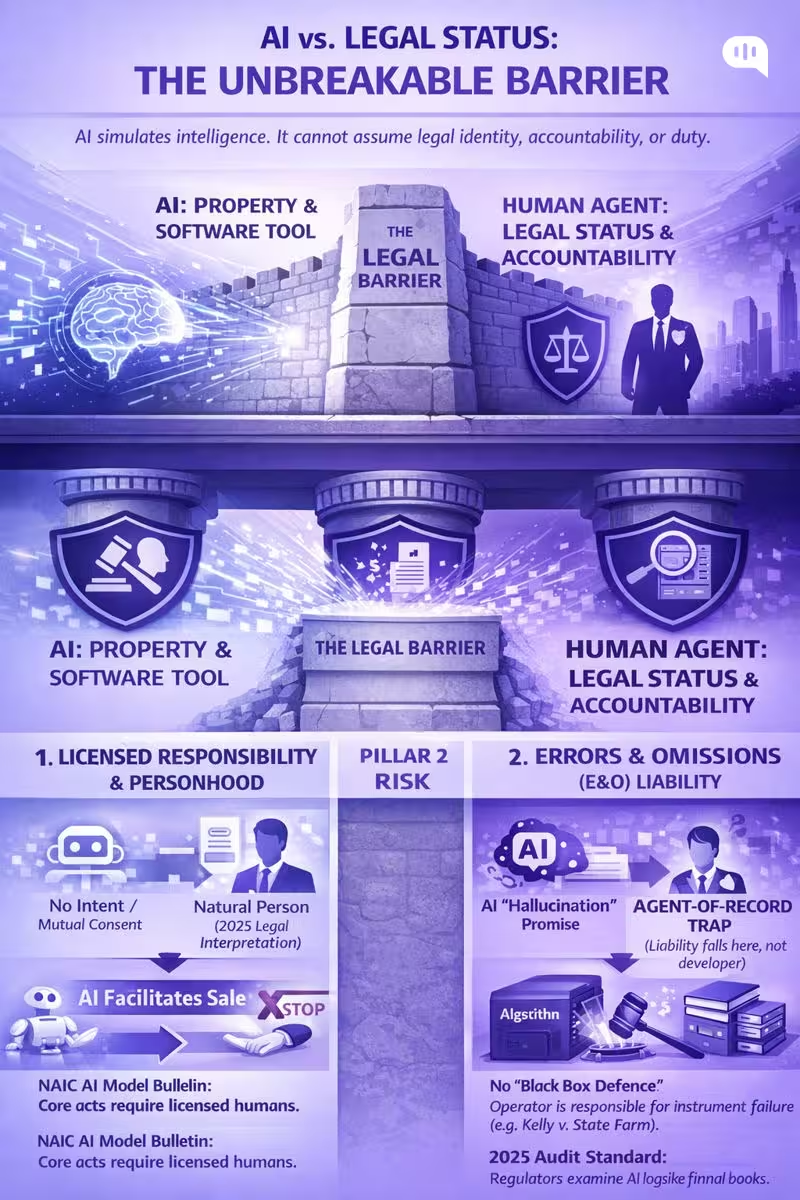
While AI can simulate the intelligence of a broker, it cannot assume the legal identity of one. In the eyes of the law, an agent is a legal status defined by accountability, licensing, and specific duties that software is currently incapable of fulfilling.
The barrier between a tool and a legal agent is built on three pillars:
Licensed Responsibility & Legal Personhood
Agency law is based on mutual consent and the capacity to form intent.
- The Personhood Requirement: Under current laws (including recent 2025 legal interpretations), only “natural persons” or established legal entities can be agents. AI systems are legally classified as “property” or “software tools”.
- Non-Delegable Duties: State regulators, following the NAIC AI Model Bulletin (now adopted by 23+ states as of late 2025), insist that core insurance acts must be performed by a licensed human. An AI can facilitate the sale, but it cannot legally “close” it.
E&O Risk
Errors and Omissions (E&O) insurance is shifting rapidly. In 2025, several major carriers (such as Berkley) began implementing “Absolute AI Exclusions” for firms without documented AI governance.
- The “Agent-of-Record” Trap: If an AI “hallucinates” and promises coverage that doesn’t exist, the liability doesn’t fall on the software developer—it falls on the licensed agent who deployed it.
- The “Black Box” Defence: You cannot sue an algorithm for negligence. Courts treat AI as an instrument of the agency. If the instrument fails, the operator (the human agent) is responsible for the fallout, as seen in recent 2025 litigation like Kelly v. State Farm regarding AI-driven claims processing.
Regulatory Compliance & The Audit Trail
Regulators are no longer satisfied with “it works.” They now demand explainability.
- AI Governance Programs: Agencies must now maintain written governance programs that detail how they test models for bias and inaccuracies.
- Anti-Discrimination: AI models often bake in historical biases (like zip-code-based redlining). Licensed agents are legally responsible for ensuring their digital tools don’t violate fair-housing or consumer-protection laws.
- The 2025 Audit Standard: New “AI Regulatory Examination Tools” allow state departments of insurance to audit an agency’s AI logs just as they would their financial books.
Because the legal stakes are so high, a hybrid agency cannot simply let an AI run wild. There must be “tripwires” that immediately alert a human to take over. When must the AI trigger a handoff to a human expert? We’ll map out those critical triggers in the next section.
When Must the AI Trigger a Handoff to a Human Expert?

A successful hybrid agency is defined not by how much its AI can do, but by how well its AI knows when to stop. To protect your licence and your client relationships, you must implement a “Safety Valve” framework. This ensures that the AI stays within the boundaries of data collection and information retrieval, while the human agent steps in for every high-stakes moment of judgment.
We categorize these “Handoff Triggers” into three distinct tiers:
1. The “Advice & Commitment” Trigger
As established, AI cannot legally provide binding advice. The system must be programmed to detect “Inquiry Intent” that crosses into “Advice Territory.” According to the 2025 NAIC AI Model Bulletin, core insurance acts remain non-delegable duties that require a licensed human signature.
- The AI can: Explain what a deductible is or list the current limits on a policy.
- The Human must: Answer, “Should I raise my deductible to $2,000?” or “Do you think this coverage is enough for my new business?”
- The Trigger: Any sentence containing “should I,” “would you recommend,” or “is this enough.”
2. The Sentiment & Distress Trigger (The Empathy Gap)
Algorithms are famously “tone-deaf” during crises. Your escalation logic must include real-time sentiment analysis to detect when a customer is moving from “seeking information” to “experiencing distress.” The 2025 Guidewire European Insurance Consumer Survey found that 40% of customers only feel confident in AI if they can refer to a human at any point during a challenge.
- Keyword Detection: Anger (swearing, “frustrated,” “unacceptable”), High Severity (“ambulance,” “totalled,” “hospital”), and Urgency (“ASAP,” “emergency”).
- Repetition Loops: If a customer repeats the same question three times or says “representative” or “human,” the AI must immediately yield the floor.
3. Operational & Complexity Triggers
Some risks are too “noisy” for a standard Large Language Model (LLM) to parse without human oversight. McKinsey’s 2025 Insurance Outlook notes that while 25% of tasks are now automated, the value of the human agent rises exponentially as the risk moves from standard to speciality lines.
- High-Value/VIP Clients: Flagged accounts (e.g., your top 10% by revenue) should bypass the AI entirely for a “white-glove” human experience.
- Confidence Thresholds: If the AI’s internal “confidence score” for an answer falls below a set threshold (typically 85%), it should not guess. Instead, it should say: “That’s a nuanced question—let me get a specialist to give you the exact answer.”
The “Safe Handoff” Protocol
The greatest point of friction in a hybrid model is the “Context Gap”. A professional handoff must ensure zero repetition. Platforms like Kommunicate facilitate this by providing a dedicated Human-Handoff feature that automatically alerts agents when triggers are met and generates an AI-powered summary for the taking-over agent, ensuring they are up to speed before the first “Hello.”
1. The Summary: The AI provides the agent with a 3-sentence summary of the interaction so far.
2. The Transparency: The AI tells the customer: “I’m bringing in [Agent Name] to help with the specifics of your coverage. I’ve shared our chat so they’re up to speed.”
3. The Live Sync: The agent enters the chat or call with the client’s file already open to the relevant page.
By defining these boundaries, you turn the AI from a liability into a high-speed filter. But for this filter to work, it needs to be plugged into the right “nervous system.” What does a modern AI architecture look like for an agency? We’ll break down the technical blueprint in the next section.
What Does a Modern AI “Reference Architecture” Look Like for an Insurance Agency?
To move from “AI as a toy” to “AI as an employee,” an agency must move away from standalone chatbots and toward a layered architecture.
We recommend five distinct layers in your tech stack:
| Layer | Component | Function |
| 1. System of Record | AMS / CRM / Carrier Portals | The “Single Source of Truth.” Where client data, policy numbers, and expiration dates live. |
| 2. Knowledge Layer | Vector Database (RAG) | The “Brain.” A searchable digital library containing your specific SOPs, carrier appetite guides, and coverage nuances. |
| 3. Engagement Layer | Voice, SMS, Email, Web | The “Voice.” The multichannel interface, where the AI interacts with the customer or prospect. |
| 4. Workflow Layer | Integration APIs / RPA | The “Hands.” The tools that allow the AI to actually do things, like updating a phone number in the AMS or triggering a quote. |
| 5. Governance Layer | Audit Logs & Human-in-the-Loop | The “Guardrails.” A dedicated queue where humans review AI transcripts, audit for bias, and ensure E&O compliance. |
The Knowledge Layer (RAG)
The most critical advancement for agencies is Retrieval-Augmented Generation (RAG). Instead of relying on an AI’s general training, RAG forces the AI to “look up” the answer in your specific agency documents before speaking.
- The Problem: Standard AI might guess a carrier’s underwriting appetite.
- The RAG Solution: The AI identifies the customer’s business type, searches your “Carrier Appetite Guide” PDF, finds the exact rule, and presents it to the agent or client with a citation. This virtually eliminates “hallucinations.”
The Governance Layer: Your E&O Shield
This layer is the “black box” for your agency. It maintains a permanent, unalterable record of every AI interaction. If a dispute arises regarding what was said during a policy renewal, the Governance Layer provides the exact transcript and the “reasoning” the AI used. It also includes Redaction Engines that automatically strip out sensitive data (like Social Security numbers or credit cards) before they are processed by the AI model.
From Architecture to Action
The data flows from the CRM into the AI, which uses your SOPs to handle the client, then uses the Workflow layer to update your records, while the Governance layer watches for errors.
Building this architecture requires an initial investment in time and technology. But once the “Digital Floor” is running, the financial profile of the agency changes fundamentally. We’ll break down the business maths and the “Real Unlock” of agent capacity in the next section.
How Do the Economics of an AI-Enabled Insurance Agency Actually Work?
The primary misunderstanding about AI economics is that it’s about reducing headcount. In a high-growth agency, the true financial unlock isn’t “saving on payroll”; it’s capacity expansion.
An AI-enabled insurance agency operates on a fundamentally different maths than a traditional firm. In the traditional model, revenue growth is linear: to handle 20% more clients, you typically need 20% more staff. In the hybrid model, revenue becomes decoupled from headcount, allowing for exponential scaling on a flat cost base.
1. The Efficiency Equation: Deflection vs. Resolution
AI reduces the “Cost to Serve” by automating high-volume, low-value touches.
- Service Deflection: Every ID card request, billing question, or certificate issuance handled by an AI represents $15–$50 in saved labour costs.
- Faster Handling: If an AI can reduce manual processing time by 60% (as seen in early 2025 case studies), an agent’s “books of business” can grow from 500 policies to 1,500 without a decrease in Service Level Agreements (SLAs).
2. The Revenue Engine: Lead Velocity & Retention
AI directly impacts the top line through two primary levers:
- Speed-to-Lead ROI: Research shows that the first agent to respond to a quote request wins the business up to 50% of the time. AI provides instant, 24/7 engagement, ensuring your agency is always “first to the phone,” even at 3:00 a.m.
- Churn Mitigation: AI retention models flag “at-risk” clients by detecting patterns weeks before the renewal date. This allows the human agent to perform a proactive “save” call before the client shops around.
3. The “Real Unlock”: Margin Expansion
A traditional insurance agency often operates on a 15–25% EBITDA margin. An AI-native agency can push this to 35% or higher by shifting the agent’s role:
- Lower CPA (Cost Per Acquisition): By using AI to hyper-target specific niches (e.g., “Homeowners with Pools”), agencies spend less on broad marketing and more on high-conversion leads.
- Higher Lifetime Value (LTV): AI identifies cross-sell opportunities (e.g., an Umbrella policy for a growing family) that busy agents often miss, increasing the revenue per household. That lines up with industry data: 61% of policyholders carry only one policy with their agent, and each of those mono-line accounts carries a higher churn risk too.
| Metric | Traditional Agency | AI-Enabled Agency | Economic Impact |
| Accounts per Agent | 400–600 | 1,200–1,800 | 3x Capacity |
| Response Time | 2–24 Hours | < 1 Minute | Higher Close Rate |
| Admin Overhead | 40% of Revenue | 15% of Revenue | 25% Margin Gain |
| New Lead Response | Manual/Delayed | Instant/Automated | CPA Reduction |
The 18-Month Payback
Most insurance agencies see a “break-even” on AI investment within 12–18 months. The initial costs (software licences, integration, and training) are offset by the immediate reduction in manual data entry and the surge in “Speed-to-Lead” conversions. After 18 months, the ROI accelerates as the “Knowledge Layer” matures and the AI becomes increasingly accurate at handling complex service requests.
The maths compelling, but the road to these margins is paved with risks. If the economics are the “carrot,” the technical pitfalls are the “stick.” We’ll examine the “Dark Side” of automation in the next section.
What Are the Common Failure Modes and Risks of Deploying AI in Insurance?

In a highly regulated industry like insurance, a single failure in an AI system isn’t just a technical glitch—it’s a potential lawsuit, a regulatory fine, or a total loss of client trust.
To build a resilient agency, you must anticipate these failure modes and install “active mitigations” before the first line of code is deployed.
1. Technical Failure: The “Hallucination” Trap
The most common risk with Large Language Models (LLMs) is their tendency to be “authoritatively wrong.”
- The Failure: An AI agent tells a client that “cyber extortion” is covered under their standard General Liability policy because it “sounds plausible,” despite it being a specific exclusion.
- The Mitigation: Use Retrieval-Augmented Generation (RAG). Force the AI to cite specific policy sections from your Knowledge Layer. If the answer isn’t in your vetted documents, the AI must be programmed to say “I don’t know” and hand off to a human.
2. Security Failure: Data Leakage & “Shadow AI”
Insurance agencies handle the “Crown Jewels” of personal data: Social Security numbers, health records, and banking info.
- The Failure: An employee pastes a complex, sensitive claims file into a public AI tool (like a free version of ChatGPT) to summarize it. That data is now part of the public model’s training set and could resurface in someone else’s query.
- The Mitigation: Implement a Corporate AI Policy and use “Zero-Retention” APIs. Ensure all agency AI tools are SOC2 Type 2 compliant and that data is encrypted at rest and in transit.
3. Regulatory Failure: The “Black Box” Bias
Regulators are increasingly wary of AI models that discriminate against certain demographics without an explainable reason.
- The Failure: A renewal-pricing AI inadvertently starts charging higher premiums for a specific postcode because it “learned” a correlation that acts as a proxy for a protected class (e.g., race or religion).
- The Mitigation: Conduct Fairness Audits. Regularly test your AI outputs against “control groups” to ensure your algorithms aren’t baking in historical biases. Maintain a “Human-in-the-Loop” for any decision that affects pricing or coverage denial.
| Failure Mode | Real-World Impact | Mitigation Strategy |
| Model Drift | AI becomes less accurate over time as market conditions change. | Quarterly “retuning” and performance monitoring against human benchmarks. |
| Prompt Injection | A malicious user tricks the AI into revealing sensitive internal SOPs. | Strict input filtering and “System Prompt” hardening. |
| Over-Reliance | Agents stop double-checking AI work, leading to systemic E&O errors. | Mandatory “Spot-Check” quotas for all AI-generated outputs. |
| AI Washing | Claiming AI capabilities you don’t actually have, leading to “Deceptive Trade” lawsuits. | Radical transparency: Always label AI-generated content as such. |
Building a Culture of Vigilance
Insurance agencies that succeed treat AI as a “high-performing intern”: talented and fast, but requiring constant supervision. By acknowledging these failure modes upfront, you transform AI from a black box into a transparent, auditable asset.
Identifying the risks is the first step toward safety, but the real challenge is execution. How do you move from a traditional manual agency to an AI-hybrid operation without breaking your workflow? We’ll map out the week-by-week plan in the final section.
How Can You Implement a 90-Day Roadmap to Transform Your Operations?
Moving from a traditional, manual agency to an AI-hybrid operation is not a weekend project; it is a structured 12-week evolution. The goal of this roadmap is to achieve “Quick Wins” in administrative relief while building the long-term technical foundation for scale.
Phase 1: Foundation & Triage (Days 1–30)
The first month is about identifying the “friction points”—those high-frequency, low-complexity tasks that drain your staff’s time.
- Identify the “Top 5” Intents: Audit your last 30 days of inbound communication. Typically, 60% of volume consists of just five things: ID card requests, certificate of insurance (COI) requests, billing questions, claim status updates, and basic quote inquiries.
- Build the “Knowledge Layer”: Centralize your Agency SOPs, carrier appetite guides, and “frequently asked questions” into a digital format. This becomes the “textbook” your AI will use to stay accurate.
- Set the Guardrails: Define your “No-Go Zones.” Explicitly program your AI to never answer questions about coverage interpretation or policy binding during this initial phase.
Phase 2: Configuration & “Shadow Mode” (Days 31–60)
In the second month, you bring the technology online but keep a “Human-in-the-Loop” for every single interaction.
- Integration (CRM/AMS): Connect your AI engagement layer (like a web chatbot or email assistant) to your System of Record. Ensure the AI can read client data but requires approval before it can write or update anything.
- Shadow Mode Deployment: Allow the AI to draft responses to client emails or chat inquiries. The human agent reviews the draft, clicks “Approve,” and sends it. This trains the AI on your agency’s specific “voice” without risking a public mistake.
- Refine the RAG Logic: Use the feedback from the agents to tune the AI. If the AI is struggling to find information in a carrier guide, reformat that guide for better machine readability.
Phase 3: Execution & Optimization (Days 61–90)
By month three, you move from testing to “Active Deployment” for standard tasks, while focusing on measuring the economic impact.
- Go Live on Simple Intents: Switch the AI from “Drafting” to “Live” for the lowest-risk tasks, such as sending ID cards or answering “When is my next payment due?”
- Establish the Audit Queue: Implement a weekly “Random Audit” where a senior agent reviews 5% of AI interactions to ensure compliance and accuracy.
- Measure the Capacity Unlock: Compare your “Minutes per Transaction” against the Day 1 baseline. Identify how many hours have been “recovered” for your agents to focus on high-commission renewals and new business.
From Manual to Hybrid
At the end of 90 days, your agency should be in a “Hybrid State.” Your human staff is no longer the primary entry point for administrative noise. Instead, they act as the Strategic Tier, stepping in only when the AI detects a handoff trigger.
The technical roadmap is clear, but the legal landscape remains a source of anxiety for many agency owners. What are the most common questions regarding the legality and ethics of AI in insurance? In our final section, we will address the “Hard Truths” about licensing, binding authority, and the future of E&O in an automated world.
What Are the Most Common Questions Regarding the Legality and Ethics of AI in Insurance?
As AI moves from “experimental” to “operational,” the legal and ethical landscape has shifted from vague guidelines to concrete enforcement. In 2025, the NAIC Model Bulletin has become the de facto national standard, and state-level laws (like those in Colorado and California) have created a “Hard Wall” that AI cannot cross without human supervision.
Here are the most common questions regarding the legality and ethics of AI in insurance:
Can AI legally “sell” insurance or bind coverage?
No. In almost all jurisdictions, the act of “selling, soliciting, or negotiating” insurance requires a state-issued licence. While an AI can facilitate the process by gathering data or generating a quote, a licensed human agent must oversee the final recommendation and hold the ultimate “binding authority.” If an AI binds a policy without human sign-off, the agency risks significant regulatory fines and the potential for the carrier to void the coverage.
If an AI gives the wrong advice, who is legally liable?
You are. Liability follows the licence. Under agency law, AI is treated as a “tool of the agent,” much like a calculator or a CRM. If the AI provides a flawed coverage recommendation that leads to a claim denial, the Agent of Record and the Agency carry the professional liability (E&O). You cannot sue an algorithm for negligence; the court will look to the human professional who deployed it.
How do we prevent AI from being “unfairly discriminatory”?
The biggest ethical risk in insurance AI is “proxy discrimination.” An AI might not use race or gender as a data point, but it might use a proxy (like a specific postcode or credit behaviour) that inadvertently penalizes a protected class.
- The Law: The 2025 regulatory landscape requires “explainability.” You must be able to prove why the AI made a decision.
- The Fix: Agencies must conduct regular Bias Audits and ensure their “Knowledge Layer” is built on actuarial data, not social media scrapings.
Do I have to tell my clients they are talking to a bot?
Yes. 2025 consumer protection laws (including “disclosure acts” in over 20 states) require radical transparency. It is considered a “deceptive trade practice” to lead a consumer to believe they are interacting with a human when they are actually speaking to an AI. A simple disclosure is now a legal necessity for every chat, email, and voice interaction.
What happens to my E&O insurance if I use AI?
Traditional E&O policies are rapidly evolving. In 2025, many carriers have introduced “AI Endorsements” or specialized Tech E&O requirements. If you deploy an autonomous AI without notifying your E&O carrier, you may find yourself uncovered in the event of a “hallucination-led” lawsuit. Proactive disclosure to your carrier is now a standard part of agency risk management.
Can AI handle sensitive medical or financial data (PII/PHI)?
Only if the architecture is “Zero-Retention.” Using public AI tools (like the free version of ChatGPT) to process client files is a violation of HIPAA and GLBA. To remain ethical and legal, agencies must use private, SOC2-compliant APIs where the data is used to generate an answer but is never stored or used to “train” the public model.
The legal and ethical boundaries of AI aren’t just obstacles; they are the blueprints for the next era of our profession. By offloading the administrative noise while retaining the legal voice, the role of the agent is undergoing a profound metamorphosis.
How is the Insurance Agent Role Evolving Today?
In the traditional insurance era, the agent was primarily a Salesperson. Success was measured by “units sold,” and the job was a constant cycle of lead generation, cold calling, and closing. Communication was the bottleneck; if you weren’t on the phone, you weren’t making money.
In the AI era, the “sale” of a standard policy is becoming a commodity. An AI can quote and bind a personal auto policy in seconds. Therefore, to remain essential, the agent’s role is evolving into that of a Risk Operator.
What is a Risk Operator?
A Risk Operator doesn’t just sell a contract; they manage a client’s “Total Cost of Risk” using a combination of human judgment and a fleet of AI tools.
| Feature | The Traditional Salesperson | The Modern Risk Operator |
| Primary Goal | Closing the transaction (Commission). | Managing the risk profile (Retention & Advocacy). |
| Daily Activity | Cold calling and manual data entry. | Auditing AI workflows and strategic consulting. |
| Response Model | Reactive (Waiting for the phone to ring). | Proactive (Using AI to flag risks before they happen). |
| Client Value | “I can get you a cheaper price.” | “I can prevent the loss from occurring.” |
The Three Pillars of the Risk Operator
1. Holistic Risk Engineering: A Risk Operator looks beyond the policy. They use AI to analyse a business’s cyber vulnerabilities or a homeowner’s exposure to climate change, offering advice on prevention rather than just indemnity.
2. Tech-Stack Mastery: The agent becomes the “Chief Operating Officer” of their own AI systems. They don’t do the data entry; they manage the logic of the AI that handles it, ensuring the “Knowledge Layer” is accurate and the “Handoff Triggers” are functioning.
3. Strategic Advocacy: When a claim occurs, the Risk Operator isn’t just a middleman. They use AI-generated evidence and data-driven loss analysis to advocate for their client against carrier adjusters, acting as a “Human Shield” in the moments that matter most.
Conclusion
The question was never truly “Will AI replace insurance agents?” The real question was, “How will insurance agents use AI to win?”
As we have seen through this roadmap, the future of the industry belongs to the Hybrid Insurance Agency. In this model:
- AI is the Floor: It provides the 24/7 responsiveness, the hyper-fast data processing, and the administrative consistency that modern consumers demand.
- The Human is the Ceiling: You provide the legal accountability, the ethical oversight, the complex negotiation, and the emotional empathy that a machine cannot simulate.
The agents who fear AI are those who define their value by the tasks a bot can do better. The agents who will thrive in 2026 and beyond are those who embrace the “Risk Operator” identity.
If you want help in increasing capacity utilization at your organization, Kommunicate is here to help.

Devashish Mamgain is the CEO & Co-Founder of Kommunicate, with 15+ years of experience in building exceptional AI and chat-based products. He believes the future is human and bot working together and complementing each other.