Updated on August 20, 2025

Over the past few years, the conversation around AI has been about replacement. So much so that a brand’s entire GTM motion was based on eliminating human employees (and met with outrage).
Recently, this sentiment has shifted. We understand agentic AI much better now, and the concept of human AI collaboration and human-in-the-loop systems is becoming popular.
Enterprises are moving towards a synbiotic combination of humans and AI agents for their workflows. At its core, this move towards “collaborative intelligence” arms workers with functional and practical knowledge of the speed and precision of AI.
This is the best of both worlds, as enterprises get access to novel thinking from human employees and improve productivity with AI agents.
We will explore the human AI collaboration, its implementation in AI agents, and its benefits for customer service. We’ll cover:
1. What are the Architectures of the Different Types of Human AI Collaboration?
2. How can AI Collaborate with Humans in Customer Service?
3. How does HAIC Affect Customer Satisfaction?
4. What are the Benefits of AI-Human Collaboration?
5. How does Kommunicate’s Human-in-the-Loop System help?
6. How have HITL AI systems Affected Industries?
7. Conclusion
What are the Architectures of the Different Types of Human AI Collaboration?
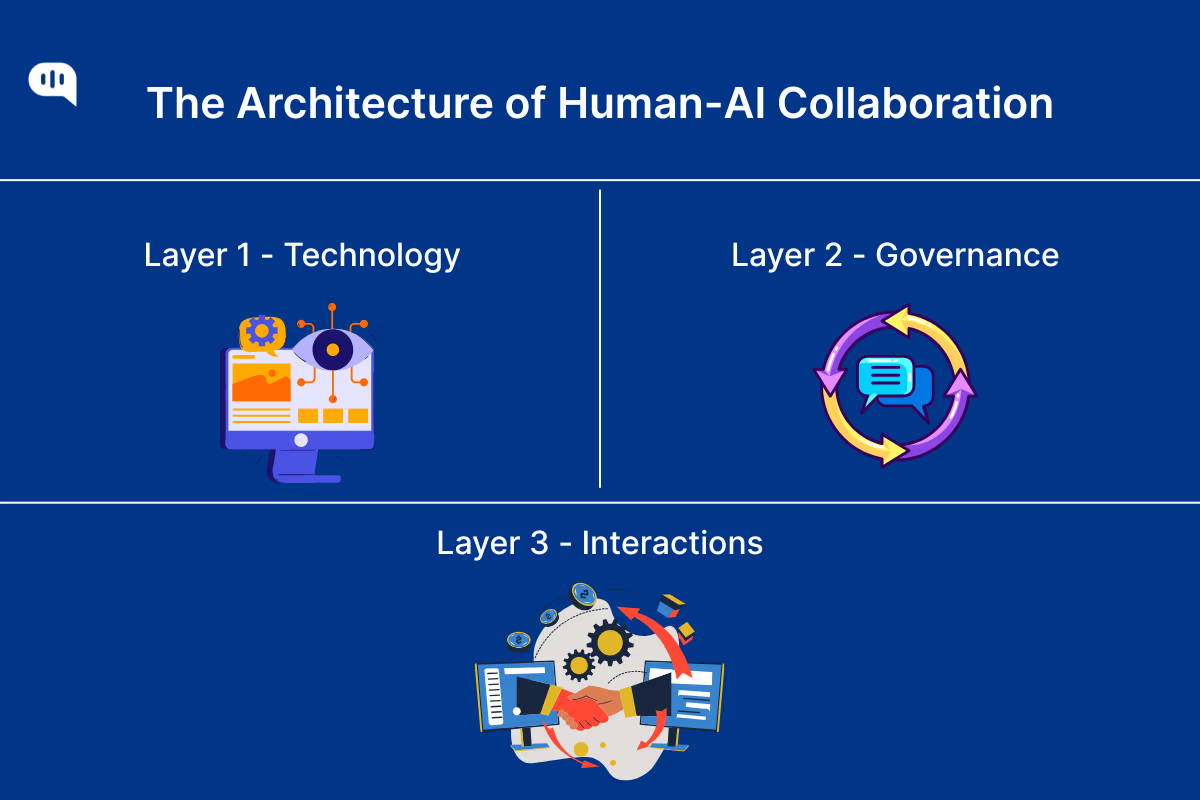
Creating an effective interface for human-AI collaboration is a design problem. Agentic AI companies approach this design differently and make different kinds of architecture.
These architectures include an underlying AI technology, a governance framework, and a design system for the human-AI interactions. Let’s discuss each point with a little more detail.
What Role Does AI Technology Play in HAIC Architecture?
The choice of the AI technology under human AI collaboration systems is essential. This determines the types of tasks that these human-AI systems can do. Businesses classify these technologies by their capabilities and scope.
Capability-Based Classification – When you classify your products based on their capabilities.
- Reactive Machines: These are the most basic AI systems. They can only operate on present data and predefined rules without learning. IBM’s chess-playing supercomputer, Deep Blue, is a classic example.
- Limited Memory AI: This category includes most AI systems in use today. They can use past data and experiences to make better real-time decisions. These are the most common HAIC applications. Examples include customer service tools/.
- Theory of Mind (ToM) AI: These are theoretical AI systems that can understand human emotions and sentiments. Such an AI would be more engaging and empathetic.
Scope-Based AI Types: When you classify AI systems by how intelligent they are.
- Artificial Narrow Intelligence (ANI): Also known as “weak AI”. All current AI, including the most advanced generative models, falls into this category. It excels at its designated function but cannot operate outside of it.
- Artificial General Intelligence (AGI): “strong AI.” AGI is an AI system able to understand, learn, and apply its intelligence to solve any problem.
- Artificial Super Intelligence (ASI): This AI system has surpassed humans in intelligence.
Once your system has an AI system of reasonable scope and capability, you can work on creating a governance system.
What Role Does Governance Play in HAIC Architecture?
This layer defines the system’s control and authority between humans and AI. The governance layer controls the overall safety and autonomy of your HAIC systems.
They can be classified as follows:
| Model | Human Role | AI Role | Intervention Point | Level of AI Autonomy | Primary Use Case Example |
| Human-in-the-Loop (HITL) | Active Participant, Validator, Trainer | Assistant, Data Processor | Required for task completion or model training | Low to Medium | AI-assisted medical diagnosis, where a doctor must confirm the AI’s findings. Customer Support |
| Human-on-the-Loop | Supervisor, Safety Override | Autonomous Operator | Can intervene to abort or correct | High | A self-driving car where the human can take the wheel in an unexpected situation. |
| Human-in-Command | Ultimate Decision-Maker | Advisor, Analyst | Makes the final decision based on AI input | Medium to High | A financial analyst uses AI to generate investment strategies but makes the final trade decision. |
With these layers, you’d have chosen the capability of your systems (with the AI technology) and the safety & autonomy (with governance). Next, of course, is understanding and choosing how the AI and human interfaces interact.
What Role Do Interaction Dynamics Play in HAIC Architecture?
This final layer defines how humans and AI interact in real time. Academic research has identified several distinct patterns and types of interaction.
Interaction Patterns: These models describe the sequence and flow of information between the user and AI.
- AI-first Assistance: The AI presents its prediction or solution to the user upfront. The user can then choose to accept, reject, or modify it.
- AI-follow Assistance: The human makes an independent judgment and is shown the AI’s recommendation. The human can then compare and reassess their responses.
- Request-driven AI Assistance: The user must actively query or request help from the AI. This is how our Agent Assist feature works.
Collaboration Types: These describe more complex, ongoing relationships.
- Situational Collaboration: When the AI and humans work together based on a specific situation.
- Deliberate Collaboration: The human and AI jointly synthesize a plan. Each task is well-defined and works towards a shared goal.
- Hybrid Intelligence: Here, humans and AI learn together. The AI learns from the human’s implicit knowledge and feedback, while the human gains new insights from the AI’s analysis.
When these layers work together, you can build an effective system where humans and AI collaborate. Customer service is one of the most important places where these collaborations occur.
How can AI Collaborate with Humans in Customer Service?
Customer service is one of the most natural areas where humans and AI can collaborate. The average enterprise can get thousands of support tickets daily, and agents struggle to keep up with this volume of customer requests.
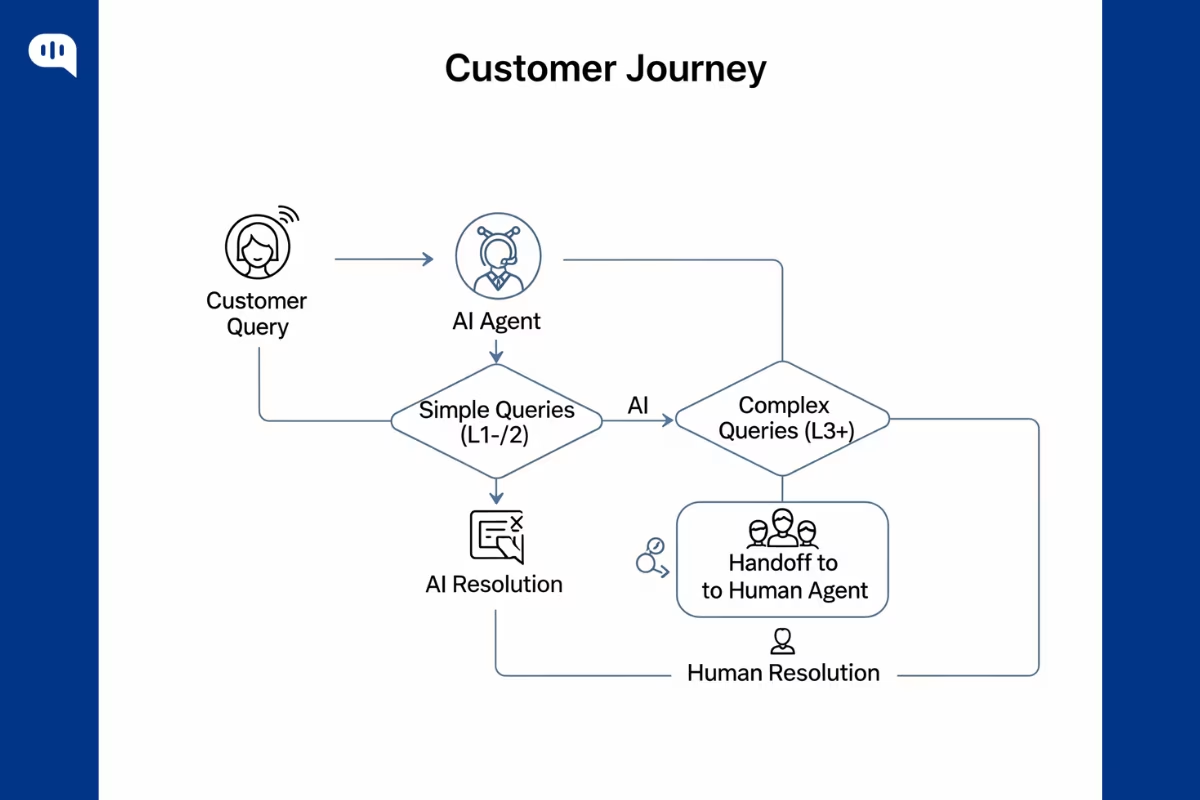
So, with newer AI models, businesses are moving to a hybrid approach where:
1. AI agents handle simpler L1 and L2 questions and deflect them (Taking care of 70-80% of the volume)
2. Humans handle complicated issues (L3 and above) with some AI assistance
We’ll understand how this works in real-time.
How are Customer Service Teams Dividing Labor Between Humans and AI?
Most customer service departments opt for a strategic division of labor:
1. AI as Front-Line Support – AI always initiates the conversation. Then, with input from the customer, AI understands whether it can handle the ticket alone or requires human input.
This takes care of most of the repeated questions that customers ask. We’ve seen up to 65% ticket deflection with this approach.
However, if the AI agent can’t handle a question, it hands off the conversation to a human agent.
2. Humans as the Escalation Path – When AI can’t handle the ticket, it is escalated to a human agent.
The human can then de-escalate customers, handle their emotions, and solve complex technical problems. Since humans receive fewer calls, they have more time to deal with each customer problem and can approach it with more care and empathy.
This is a straightforward methodology where AI becomes the de facto frontline worker, while your support team becomes the backbone of the function. There’s also another paradigm, where AI continues to support human agents when they deal with more complex issues.
How Can Customer Service Teams Use AI CoPilots?
Aside from answering L1 and L2 queries, AI agents can assist humans with complex questions. We have this feature live on Kommunicate, and it can:
1. Fetch and Summarize Information – Our AI agent instantly summarizes the customer conversation to the agent when it hands off the query. Additionally, agents can ask technical questions about the customer query, and the AI agent will fetch the relevant information from databases through Retrieval Augment Generation (RAG).
2. Real-Time Assistance – The customer service agent can consult the AI for advice. Our AI agent will fetch the required documentation, translate questions, and provide structured answers that the agent can use to solve problems and answer questions.
3. Routing and Prioritization – AI agents can route queries to the appropriate team and assign them priorities based on the complexity of the problem.
Customer service functions gain the most productivity by combining the Copilot AI with the customer service AI agent. Human agents get more time to focus on more complicated customer problems and get ready to be helped by the AI assistant throughout their workday.
We can positively affirm that this improves the productivity of customer service teams. But what happens to customer satisfaction and experience?
How does HAIC Affect Customer Satisfaction?
It’s difficult to estimate the influence of human AI collaboration on customer satisfaction. The key influences can be both positive and negative. In our experience, implementing HAIC itself is not a qualifier for the overall quality of customer service.
Depending on how it is implemented, it can have a positive or negative influence on customer satisfaction.
What are the Positive Influences of HAIC for Customer Satisfaction?
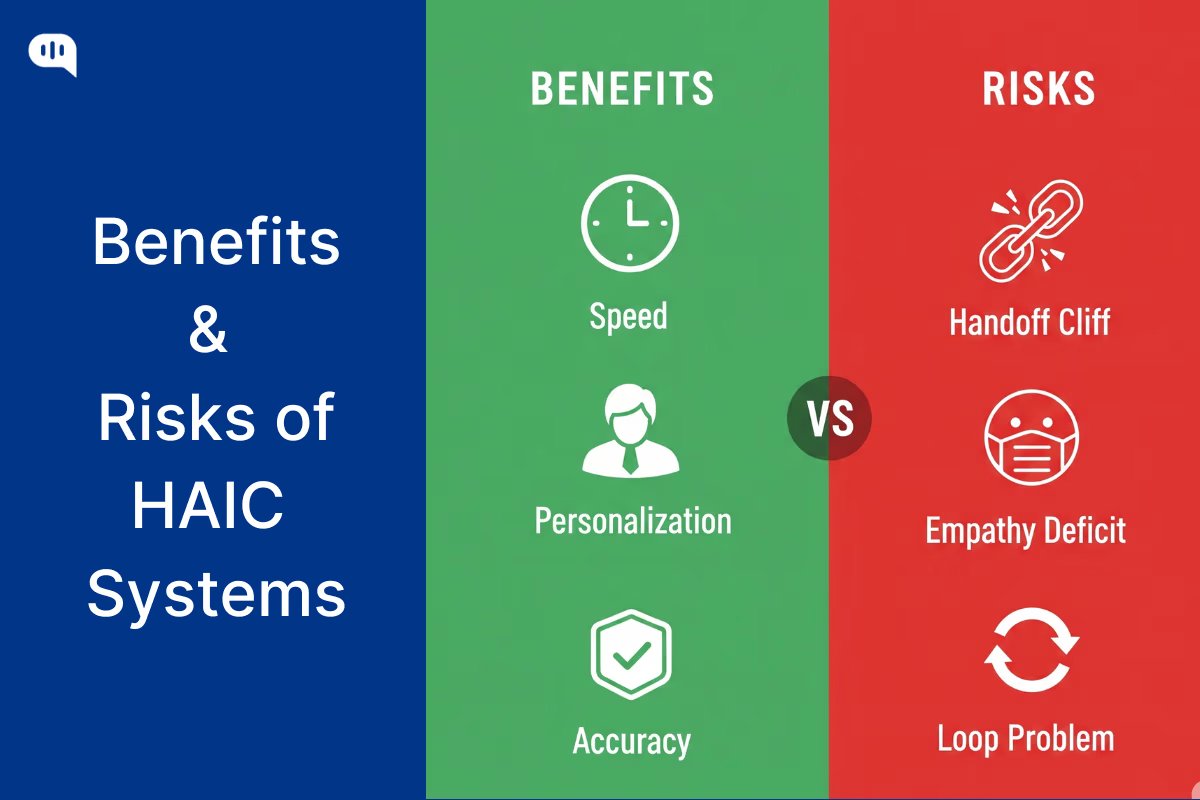
A well-made human AI interface improves customer satisfaction with –
1. Speed and Availability – AI agents work round-the-clock and can provide up-to-date information to your customers whenever they need it. This leads to a noticeable decrease in wait times, as L1 and L2 queries receive nearly immediate responses. For example, Bank of America’s AI support agent resolves customer queries in 44 seconds.
2. Personalization at Scale – AI agents can tailor their responses to customer questions based on their conversation history, purchases, and profile. While human agents can be more effective at personalizing a small cohort of customers, AI’s data processing capabilities mean that HAIC systems can replicate this at scale.
3. Accuracy and Consistency – Humans are much more prone to errors and inconsistency than AI. Your customers might have entirely different experiences when they move from one agent to another.
AI assist helps you maintain this accuracy and consistency throughout, making it possible for you to stay on brand tone in every interaction.
These factors will increase your customer satisfaction. However, we’ve seen cases where HAIC has gone wrong as well.
What are the Risks of HAIC for Customer Satisfaction?
Despite the benefits, a poorly strategized HAIC creates the following problems:
1. The “Handoff Cliff” – The biggest failure point in hybrid support is the jump from bot to human. If customers must re‑explain the issue, re‑authenticate, or wait in a new queue, the customer becomes frustrated.
In modern HAIC systems, the human agent gets the full context of the customer query when the conversation is transferred, and they can pick up after the AI agent.
2. Empathy Deficit – Automation breaks down when a situation needs nuance or emotional intelligence. Forcing users through a rigid script during sensitive or urgent moments makes them feel ignored. The system must detect these cues and route to a person.
3. The Loop Problem – Customer satisfaction takes a nosedive if customers get stuck in a conversation loop without any way to contact a human agent. The path to a live agent must be obvious, quick, and effective.
The success of HAIC systems depends on consistent and recurrent training. Experienced teams track CSAT, NPS, Time to Resolution, and Human Takeover Rate continuously to see friction points and fine‑tune the system.
If you can bridge these drawbacks, then the positive influences should increase the customer satisfaction scores for your team. We’ve seen this with Lula, where our AI agent delivered a 40% increase in CSAT after proper implementation.
Even if we zoom out, the paradigm of human AI collaboration can have a lot of benefits for the modern enterprise.
What are the Benefits of AI-Human Collaboration?
Human AI collaboration isn’t just a contact center automation play. It can be effective in almost every enterprise function because it improves workers’ productivity and makes them more effective during the workday. This adds the following benefits to the enterprise layer:
1. Productivity & Efficiency is Increased – Repetitive tasks (data entry, basic reports, first‑pass analysis) are offloaded to AI so people can tackle complex, strategic, and creative work. This raises output and morale.
2. Better Decisions, Faster – AI surfaces patterns and data‑driven recommendations at machine speed while humans add context, ethics, and strategy. You get stronger, more well‑rounded decisions than either could deliver alone.
3. Cost Optimization & Scale – AI scales without adding headcount or overtime. In customer service alone, bots are projected to save businesses over $8B annually by handling thousands of queries. The same principle applies to any digital workload.
4. Elevating the Human Role – With HAIC, humans can shift from “doers” of routine tasks to orchestrators of systems. One person can now supervise AI processing of 5,000 documents and personally review the 50 that genuinely matter. Humans still handle:
- Creativity and innovation
- Empathy and relationship building
- Ethical judgment and value alignment
- Strategic thinking and complex problem‑solving
5. A Continuous Learning Loop – Every correction, exception, and feedback cycle improves the model. Humans teach, and AI learns. Over time, systems get more innovative, more reliable, and better tuned to your business.
These benefits make AI an effective tool for back-office work everywhere. Humans get to build faster, more effective & efficient workflows, and the repetitive tasks become machine-generated.
We can explain this with a case study of Kommunicate’s human-in-the-loop system.
How does Kommunicate’s Human-in-the-Loop System help?
At Kommunicate, our AI agents use a human-in-the-loop system to perform customer service at scale. This is how it works:

1. The Query Comes In
- Customer view: They ask questions on the chat widget/WhatsApp/social media/ website/ app.
- Under the hood: Kommunicate’s AI agent understands the question, fetches answers from your knowledge base/RAG, and verifies real-time confidence and sentiment scores.
2. The Agent Keeps Looking for Fallback Messages
The AI agent constantly checks: “Should I keep going or bring a human in?”
At Kommunicate, we use the following triggers:
- A fallback message
- Negative sentiment or urgency keywords (“refund now”, “card blocked”, “legal notice”)
- Compliance‑sensitive queries
- Explicit user request: “Talk to an agent” / “human, please”
Whenever the agent sees one of these red flags, it routes the conversation to a human.
3. The AI Packages the Entire Conversation for the Human Agent
Before the conversation is handed over to a human, the system assembles a complete snapshot:
- Full chat transcript + entities extracted (order ID, email, error codes)
- User profile, past tickets, plan tier, language preference
- Bot actions taken so far (articles shown, forms filled)
This summary of information ensures that the human agent doesn’t have to ask the customer again.
4. The Conversation Shifts to a Human Agent
- The conversation is routed to the right queue/team based on skills, language, SLA, or business hours.
- The agent console opens with all context pinned.
- The customer sees a clear status, and it stays in the same thread.
5. Agent Assist Continues the Collaboration
Even after routing, AI doesn’t disappear. It shifts to co‑pilot mode:
- Draft reply suggestions, tone adjustments, and knowledge article recommendations
- Auto‑summaries for long threads and quick macros for repetitive responses
- Suggested next steps or checklists (“Verify KYC”, “Offer upgrade coupon”)
6. Resolutions and Feedback Fuel the Next Stage of Training
After the issue is resolved, the following happens:
- The customer reviews the conversation for CSAT
- Signals around accuracy and customer feedback are fed back to the model so that it can learn more
This six-step workflow helps our customers directly answer customer questions at scale. The AI agent quickly answers L1 and L2 questions and automatically routes the conversations to human agents.
This kind of human-in-the-loop human AI collaboration is effective across industries. We’ll explore this next.
How have HITL AI systems Affected Industries?
Here’s a table showing how human-in-the-loop AI systems can help different industries.
| Industry | AI Applications (Examples) | Why HITL Is Critical (Risk / Requirement) | Humans’ Role in the Loop |
| Healthcare | Detect tumors in mammograms Classify lumbar spinal stenosis from MRIs. Predict patient risk from EHRs | Life‑and‑death stakes demand safety, liability control, and regulatory compliance. HITL makes opaque models transparent and auditable, building physician/patient trust. | Clinicians validate AI flags, interpret results in full patient context, make final diagnosis/treatment calls, and assume legal/ethical accountability. |
| Finance | Real-time fraud detection & AML monitoring Credit scoring Algorithmic trading | A single mistake can trigger massive losses or penalties. HITL is a governance layer that prevents systemic risk and ensures KYC/AML compliance. | Analysts review alerts, judge false positives/edge cases, document decisions for regulators, and protect brand/reputation. |
| Manufacturing | Robotized assembly & precision tasks Predictive maintenance from sensor data Automated quality control | Needed to maintain quality, adaptability, and resilience (Industry 5.0). Machines can’t judge nuanced/aesthetic criteria or novel situations alone. | Operators monitor performance, troubleshoot anomalies, perform nuanced QC (e.g., finish quality, ripeness), and continuously refine processes. |
HITL isn’t a “nice to have” in high-stakes domains—it’s the accountability and trust layer for HAIC systems. This framework improves the accuracy and reliability of your AI implementation.
Conclusion
Human-AI collaboration represents a fundamental shift from the replacement narrative that dominated early AI discussions to a more nuanced understanding of complementary intelligence. Rather than viewing AI as a threat to human employment, forward-thinking organizations discover that the most powerful outcomes emerge when human creativity, empathy, and strategic thinking combine with AI’s speed, consistency, and data processing capabilities.
As we progress, the organizations that will thrive are those that master the art of collaborative intelligence. The future belongs not to humans versus machines, but to humans and machines working together to solve complex problems at unprecedented scale and precision.
The question is no longer whether to adopt AI, but how thoughtfully you can integrate it into human-centered workflows that deliver operational excellence and meaningful human experiences.
If you want a HAIC system to deliver exceptional customer service at the enterprise level. Talk to us!

Adarsh Kumar is the CTO & Co-Founder at Kommunicate. As a seasoned technologist, he brings over 14 years of experience in software development, artificial intelligence, and machine learning to his role. His expertise in building scalable and robust tech solutions has been instrumental in the company’s growth and success.