Updated on June 19, 2026
TL;DR
Our rankings:
| Rank | Platform | Accuracy Score |
|---|---|---|
| 1 | Kommunicate | 98% |
| 2 | Intercom Fin | 98% |
| 3 | Cognigy | Enterprise-grade |
| 4 | Decagon | High |
| 5 | Botpress | Configurable |
| 6 | LivePerson | High |
Accuracy scores for Kommunicate and Intercom are from a documented 85-question benchmark. Scores for other platforms reflect published resolution rates and third-party evaluations.
Most chatbot vendors have developed structured scripts for their insurance conversational AI offerings. offerings. It always includes:
- A clean FNOL flow
- A renewal reminder
- A lead capture form
These are practical implementations, but they’re not the right metrics for assessing whether they’re good chatbots for insurance. Most chatbots fail when they have to correctly restate policy inclusions or recommend the right policies to people.
For example, if a policyholder asks whether their HO-3 covers sewer backup damage, the chatbot has to check:
- Which endorsement do they have
- Which state they’re in
- The exact clause language in their specific policy version
A chatbot that hallucinates this answer creates an E&O liability, a compliance exposure, and a customer who discovers they’re not covered after the fact. When a query is ambiguous, the safer pattern is to route it to a human instead of automating the decision.
So, this article will focus on these real challenges around insurance chatbots and the vendors that can solve them. We’ll cover:
- The two criteria for measuring insurance chatbots
- The top 6 chatbots for insurance
- What should you demand from a vendor before buying an insurance chatbot?
- A quick implementation plan
- Conclusion
The two criteria for measuring insurance chatbots
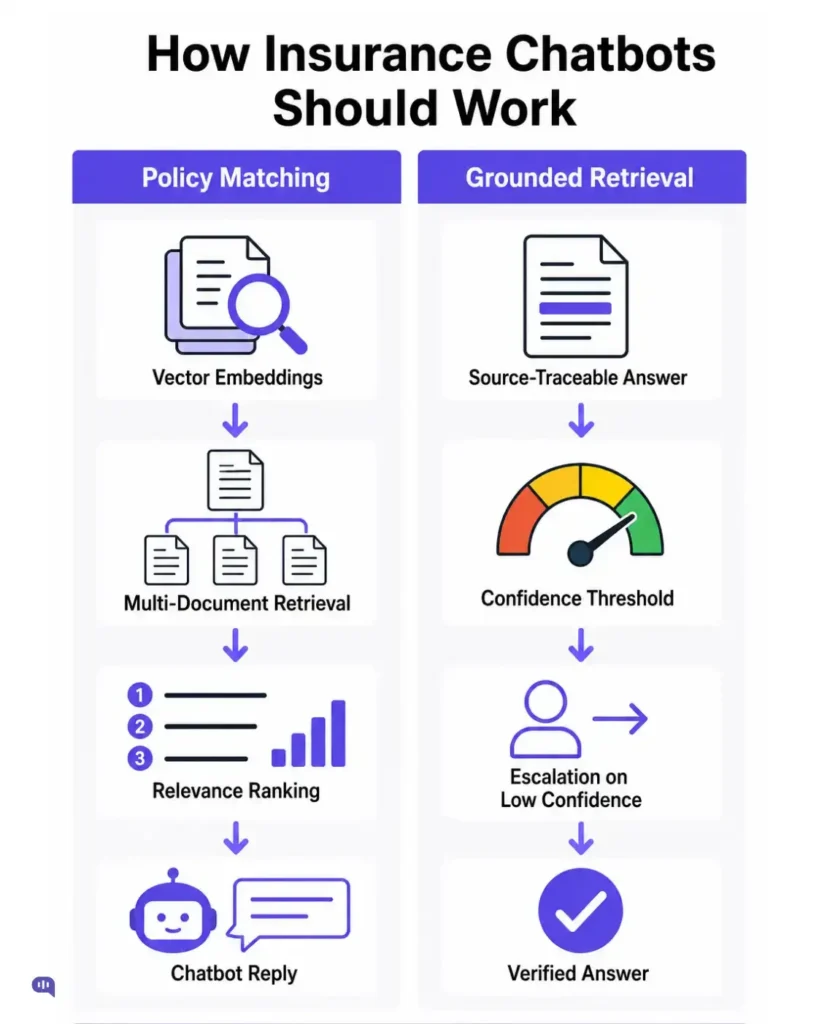
We’re mainly judging these tools based on the following factors:
1. Policy matching: Finding the right policy for the customer
A mid-sized carrier might offer 40 to 80 distinct policy products (auto, home, umbrella, commercial lines, speciality riders, state-specific variants). When a policyholder asks a question, the chatbot must first determine which product(s) apply to them before it can answer.
This is a semantic retrieval problem that most general-purpose chatbots are not architected to solve.
What strong policy matching requires:
- Vector embeddings that capture semantic meaning, not just keyword matching — so “will my car be covered if I lend it to a friend?” maps to the permissive use clause in the auto policy, not every document containing the word “car”
- Multi-document retrieval that can draw on a policyholder’s specific product, endorsements, and state-level regulatory version simultaneously
- Relevance ranking that surfaces the most applicable document chunks first, so the LLM is filtering out the noise.
Kommunicate’s RAG pipeline addresses this with a layered approach: vector similarity scoring, relevance filtering, and document ranking before anything reaches the language model.
Why does this matter?
A chatbot without proper semantic retrieval will match customers with policies they’re not qualified for or properly covered by.
2. Grounded Retrieval: Answering Without Hallucinating
Hallucination in insurance is not an academic problem. A chatbot that states the wrong deductible, misquotes a coverage limit, or fabricates an exclusion that doesn’t exist in the policy creates real legal and regulatory liability. State insurance commissioners hold carriers accountable for customer-facing representations, whether made by a human agent or an AI.
Grounded retrieval means the chatbot’s answer:
- Is always traceable It is specific language in a specific document
- Crosses a certain confidence threshold
The benchmark we reference throughout this article tested exactly this. Across 85 questions drawn from real insurance and financial services knowledge base content, chatbots were scored on two dimensions:
- Accuracy – Does the answer match the source document?
- Content quality – Is the answer well-formatted, appropriately comprehensive, and easy to act on?
For an explanation of the full methodology, see the documented comparison here.
These two capabilities are interdependent. You cannot have reliable grounded retrieval without precise policy matching upstream. And precise policy matching is worthless if the generation starts hallucinating facts about your content.
For every vendor you find, you should verify the chatbots’ accuracy against your own documents and knowledge bases.
In addition to the two top-most criteria, we’re also evaluating these tools on two complementary criteria (Knowledge ingestion and hallucination handling).
Our final scorecard
| Capability | What Weak Looks Like | What Strong Looks Like |
|---|---|---|
| Policy matching | Keyword search returns broadly relevant content; LLM selects from noisy chunks. | Vector + relevance scoring surfaces the specific policy, version, and endorsement; ranked before generation. |
| Grounded retrieval | Fluent answer with no source citation; confident even when wrong. | Answer cites specific policy clause; low-confidence queries escalate to human agent. |
| Knowledge base ingestion | Manual upload of static PDFs; no sync with CRM or ticketing systems. | Native integration with Salesforce, Zendesk, and automatic re-indexing on document updates. |
| Hallucination handling | Model fills gaps with plausible-sounding content. | Hard guardrails prevent generation beyond retrieved context; refusal when confidence is below the threshold. |
With this scorecard in place, let’s start evaluating our candidates for the top chatbots for insurance.
The top 6 chatbots for insurance
Rankings at a glance
| Rank | Platform | Accuracy Score | Content Quality Score | Hallucination Handling | KB Ingestion | Best For |
|---|---|---|---|---|---|---|
| 1 | Kommunicate | 98% | 78% | Relevance filtering + low-confidence escalation to human agent | Salesforce, Zendesk, web scraping, document upload | Carriers needing document-grounded accuracy + human handoff |
| 2 | Intercom Fin | 98% | 68% | Confidence thresholds; answers can be surface-level on complex queries | Intercom Articles, web crawl, document upload | Teams already on Intercom’s helpdesk stack |
| 3 | Cognigy | Enterprise-grade | High (voice-first) | Deterministic flow locks on high-risk topics; LLM only for lower-stakes queries | PDF libraries, intranets, web content via Knowledge AI | European carriers, IVR modernization |
| 4 | Decagon | High | High (workflow-first) | AOP guardrails constrain generation to defined workflow boundaries | Confluence, Zendesk, Guru, Slack, custom databases | Carriers automating complex multi-step workflows |
| 5 | Botpress | Configurable | Configurable | Custom implementation required; not preconfigured out of the box | Custom knowledge bases, CRM/ticketing integrations | Developer teams wanting LLM flexibility |
| 6 | LivePerson | High | High | Blended model: complex queries routed to human agents | CRM systems, policy admin platforms, web content | Large contact centers, omnichannel voice + chat |
We’ll also review each of these models individually in the following sections.
1. Kommunicate: Best for grounded accuracy at enterprise scale
Kommunicate’s strongest differentiator is the architecture of its RAG pipeline. Rather than passing all scraped content to the language model, Kommunicate applies a filtering layer combining:
- Vector similarity
- Relevance scoring
- Keyword matching
To remove irrelevant or redundant chunks before generation. Retrieved documents are then ranked by relevance, ensuring the model works with the most contextually precise information first.
The result in the benchmark: 98% accuracy (matching Intercom) and 78% content quality (ten points ahead of Intercom). Both bots retrieved correct information, but Kommunicate’s answers were consistently better formatted, more comprehensive, and easier for a policyholder to act on.
For insurance-specific workflows, Kommunicate supports native knowledge base ingestion from Salesforce and Zendesk. Source citations can be included in responses, giving compliance teams an audit trail. When the chatbot cannot answer with sufficient confidence, it escalates the conversation to a human agent via a shared inbox without dropping context.
Deployments include HDFC Life’s Elle virtual assistant and Conte.IT, an Italian auto insurer that automated 90% of its customer conversations. For more on what insurance chatbot deployments look like end-to-end, see our insurance chatbot use cases and examples guide.
Best for: Carriers and MGAs prioritizing document accuracy, compliance auditability, and hybrid AI + human workflows.
Pricing
- $34/month for Starter plans
- $168/month for Professional plans
- Custom pricing for enterprise customers
Compliance: SOC 2, GDPR, HIPAA-ready.
Knowledge base integrations: Salesforce, Zendesk, web scraping, and document upload.
2. Intercom Fin – Strong Accuracy, Weaker on Content Depth
Intercom Fin runs on the company’s proprietary APEX model, purpose-built for customer service resolution. In the same 85-question benchmark, Fin matched Kommunicate on accuracy at 98%.
Where Fin fell short was content quality at 68%, versus Kommunicate’s 78%.
In practice, this gap shows up in the depth of answers. Intercom Fin tends to return correct but surface-level responses, accurately reporting that information exists, without the formatting, comprehensiveness, or actionable framing that a policyholder actually needs to act on the answer.
This works for simple FAQ deflection, but it fails at complex technical queries. When it comes to complex questions, it creates a secondary problem: the policyholder gets a technically correct answer they cannot act on and escalates anyway.
Fin integrates tightly with Intercom’s existing helpdesk, CRM, and ticketing infrastructure, which is its real advantage for teams already on the Intercom platform. Conversation context is preserved through escalation, and it supports deployment across web, WhatsApp, SMS, and Instagram.
Best for: Teams already running Intercom as their primary support platform who want incremental AI without re-platforming.
Pricing:
- $0.99/resolved conversation (standalone, min. 50 resolutions/month)
- $39/seat/month – Essential (includes Fin AI)
- $99/seat/month – Advanced
- $139/seat/month – Expert
Compliance: SOC 2, GDPR-ready.
Knowledge base integrations: Intercom Help Center, Zendesk, Salesforce, HubSpot, web crawl.
Watch out for Content quality gaps in complex, multi-clause policy queries. Test on your actual policy documents before committing.
3. Cognigy (NiCE Cognigy) – Enterprise & voice-first
Cognigy was acquired by NICE in late 2025 for $955 million and now operates as NiCE Cognigy, tightly integrated with NICE CXone’s contact center infrastructure. For carriers that run large voice contact centers and need to modernize their IVR layer, this is the most complete enterprise offering available.
Cognigy’s Knowledge AI module supports RAG over PDF libraries, intranets, and web content. Compliance teams can apply deterministic flow controls to specific topics. The tradeoff is implementation complexity. Cognigy is not a “point at your knowledge base and go” product. Real insurance deployments typically run three to five months, require professional services or a strong internal team, and land in the low- to mid-six figures annually. Cognigy holds SOC 2 Type II and ISO 27001 certifications and natively supports GDPR. PCI DSS and HIPAA are available through enterprise agreements.
Best for: European carriers, global insurers on NICE CXone, and carriers modernizing legacy IVR systems.
Pricing:
- Custom enterprise pricing only; no public tiers
- Typical insurance deployments range from low to mid six figures annually
- Requires professional services for implementation
Compliance: SOC 2 Type II, ISO 27001, GDPR-native; PCI-DSS and HIPAA available under enterprise agreements.
Knowledge base integrations: PDF libraries, intranets, web content via Knowledge AI; Guidewire, Salesforce, Genesys, NICE CXone
Not ideal for: Teams that need fast deployment or don’t have a dedicated implementation resource.
4. Decagon – Best for complex workflow automation

Decagon is built around Agent Operating Procedures (AOPs): natural language instructions that compile into executable code. Instead of designing conversation flows visually, teams write plain-English SOPs (“if a policyholder requests a claim status update and their claim is less than 72 hours old, pull from the claims API and respond; if older, escalate to the adjusting team”) and Decagon converts those into production logic.
For insurers with complex, multi-step workflows, this architecture is genuinely powerful. Where Decagon is less developed is in insurance-specific document retrieval. It’s a strong workflow automation platform that supports knowledge bases, rather than a knowledge-base-first platform with workflow capabilities layered on. For carriers whose primary need is accurate policy Q&A across a large document corpus, Kommunicate or Intercom Fin is a better starting point.
Best for: Carriers automating high-complexity claims or servicing workflows where multiple backend systems need to be orchestrated in a single customer interaction.
Pricing:
- Custom enterprise contracts only; no public pricing page
- Supports both conversation-based and resolution-based pricing
Compliance: SOC 2, GDPR, HIPAA; data masking and usage governance included.
Knowledge base integrations: Confluence, Zendesk Help Center, Guru, Slack, and custom databases.
5. Botpress – Best for SMB teams
Botpress is an open-architecture platform that stays current with the latest LLM releases and gives development teams full control over the AI stack. It supports RAG over custom knowledge bases, automatic translation across 100+ languages, and pre-built integrations with most CRM and ticketing systems. The visual drag-and-drop canvas makes it accessible to non-engineers for flow design, while the underlying platform is fully extensible for developers.
For insurance, Botpress is the right choice when you have a capable internal engineering team and specific requirements that off-the-shelf platforms don’t accommodate:
- A proprietary claims system
- A Custom policy administration platform
The tradeoff is that implementation and ongoing maintenance require more internal resource than a managed SaaS deployment.
Best for: Carriers with strong engineering teams who need maximum customizability.
Pricing:
- Pay-as-you-go — Free + AI spend
- Plus — $89/month + AI spend (live chat, KB indexing)
- Team — $495/month + AI spend (RBAC, advanced support)
- Enterprise — $2,000+/month (SSO, custom SLA, onboarding)
Compliance: Configurable; SOC 2 and GDPR available on enterprise plans.
Knowledge base integrations: Custom knowledge bases, CRM and ticketing integrations via API; 100+ language support.
Watch out for: Hallucination guardrails require custom implementation.
6. LivePerson – Best for large contact centers
LivePerson’s conversational AI platform has deep roots in insurance. The platform supports simultaneous handling of multiple conversation streams, integrates with major CRM and claims systems, and provides agent assist tools that surface relevant policy content to human agents during live conversations.
For carriers replacing aging contact center infrastructure across web chat, SMS, WhatsApp, and voice simultaneously, LivePerson’s omnichannel orchestration layer is a genuine advantage. The platform is SOC 2 and HIPAA-ready.
LivePerson is less differentiated on the policy matching and retrieval accuracy dimensions that matter most for self-service policyholder interactions. It performs better as a blended platform than as a pure self-service chatbot.
Best for: Large carriers running omnichannel contact centers who need a unified platform across voice and digital.
Pricing:
- Custom enterprise pricing only
- Typically $40,000–$110,000/year at lower deployment scale
- Larger contact center deployments reach six figures
Compliance: SOC 2, HIPAA-ready, GDPR.
Knowledge base integrations: CRM systems (Salesforce, Genesys), policy administration platforms, web content; agent assist surfaces KB content to human agents in real time.
What should you demand from a vendor before buying an insurance chatbot?
Most vendor benchmarks are self-reported, cherry-picked, or tested on sanitized datasets that bear little resemblance to a real carrier’s policy document library.
Digital transformation leaders should look at the following factors before signing a contract:
| Evaluation Step | What to Ask | Why It Matters |
|---|---|---|
| Document Benchmark | Test on your actual policy documents, not a demo dataset. Include complex exclusion language, endorsements, and state-specific riders. | Edge cases in real insurance documents are where RAG systems typically fail. |
| Hallucination Rate | Request documented hallucination failure rates, not just resolution rates. | Resolution rate measures conversation closure; accuracy measures whether the answer was actually correct. |
| Source Citation | Ask the chatbot to show its work. Can it cite the exact policy clause or document section behind each answer? | Source-grounded responses are critical for compliance, auditability, and reducing E&O risk. |
| Low-Confidence Handling | Ask questions the system cannot answer from the provided documents. Does it escalate or refuse, or does it guess? | Confidently incorrect answers are significantly riskier than transparent uncertainty. |
| Knowledge Sync | How are document updates handled? Manual re-upload, scheduled sync, or automatic sync from systems of record? | Insurance policies, riders, and regulatory language change frequently. The knowledge base must stay current. |
| Compliance Stack | Independently verify SOC 2 Type II, HIPAA, GDPR, and any state-specific insurance regulatory requirements. | Vendor-reported compliance claims should always be independently validated. |
Remember that the resolution rate is not an accuracy metric. A chatbot can close 80% of conversations by giving plausible-sounding answers that happen to be wrong.
For insurance purposes, the metric that matters to your compliance team and your E&O insurer is how often the chatbot’s answers are correct.
Additionally, it pays off to lead with an implementation plan that’s vendor-agnostic and supports fast deployments.
A quick implementation plan
Kommunicate deploys between 4 and 5 enterprise-grade chatbots every month. This depends on quick turnarounds and a highly flexible implementation plan. For any insurer trying to move into Kommunicate, we recommend the following process:
There’s a wide gap between “chatbot connected to a knowledge base” and “chatbot in production handling real policyholder queries on complex policy documents.” Here is what the timeline and integration work actually looks like for an insurance deployment:
Weeks 1–3: Knowledge base architecture.
This is the step most vendors underestimate. Uploading PDFs to a vector database is straightforward. Ensuring that the indexing captures table structures (coverage limits by tier), conditional logic (exclusions that depend on other clauses), and document relationships (base policy + endorsements + state amendments) requires deliberate architecture work. Kommunicate’s ingestion pipeline handles structured data extraction, which is critical for policy documents that aren’t simple linear text.
Weeks 3–6: Integration with systems of record.
For most carriers, the chatbot needs to pull data from at least two systems: the knowledge base (policy documents) and a CRM or policy administration system (this policyholder’s specific coverage, claim history, and payment status). Kommunicate’s native Salesforce and Zendesk integrations reduce the need for custom development here. Cognigy and LivePerson have prebuilt connectors for Guidewire and Duck Creek, the dominant policy administration systems for US carriers.
Weeks 6–10: Compliance review and guardrail configuration.
Any customer-facing AI in insurance goes through a compliance review before going live. This is when you configure the topics the chatbot cannot answer generatively (coverage interpretations that require a licensed agent, anything that could constitute a coverage representation), test low-confidence escalation paths, and validate source citations against your policy library.
Week 10+: Pilot and iteration.
Start with a bounded use case before opening the chatbot to full policy Q&A. Measure accuracy, escalation rate, and CSAT separately. Most carriers see positive ROI within 12 months; the carriers that see it within 6 are the ones that resisted the temptation to go broad on day one.
Conclusion
The market for chatbots for insurance is not short on options. What it is short of is honest evaluation criteria for a domain where a wrong answer has real financial and legal consequences.
The two things that separate production-ready insurance chatbots from demos are:
- Policy matching across large document corpora
- Grounded retrieval that cites exact policy language instead of confabulating.
Evaluated on those dimensions, Kommunicate leads the field, with a RAG pipeline built for the messy reality of real insurance policy libraries. Intercom Fin matches on accuracy but trails on content depth.
Cognigy, Decagon, Botpress, and LivePerson each serve specific deployment contexts well, but none is optimized for the document-retrieval problem the way Kommunicate is.
The test any DT leader should run before signing: hand the vendor your most complex policy document and ask it three questions a real policyholder would ask. If the chatbot cites the clause, it’s ready for production. If it doesn’t, it isn’t.
If you want to deploy a chatbot for insurance and need help, feel free to book a meeting with us.

A Content Marketing Manager at Kommunicate, Uttiya brings in 11+ years of experience across journalism, D2C and B2B tech. He’s excited by the evolution of AI technologies and is interested in how it influences the future of existing industries.