Updated on June 23, 2026
Key takeaways
- AI customer service in telecom applies chatbots, NLP, machine learning, and AI agents to automate support and personalise interactions at scale.
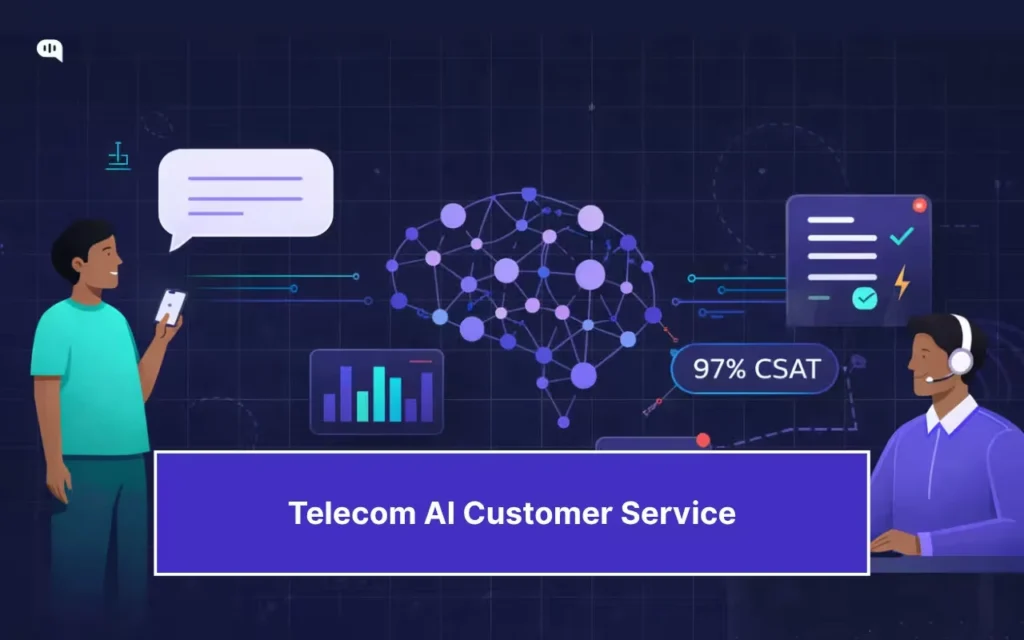
- 97% of telecom executives report measurable CSAT improvements after deploying AI in customer support (Kommunicate, 2026).
- AI reduces telecom operational costs by 30-40% and post-call work by up to 50% (Oliver Wyman, 2025).
- McKinsey estimates generative AI can lift telecom customer support productivity by 30–45%, and contribute $60–100 billion in industry-wide value.
- The generative AI in the telecom market is on track to grow from $428 million in 2025 to $9.78 billion by 2034. (Precedence Research, 2026)
- Most telcos conflate AI chatbots with autonomous AI agents. The distinction determines which customer problems actually get solved.
AI customer service in telecom uses artificial intelligence technology to automate and personalize customer support across billing, network troubleshooting, plan management, and more.
Unlike rigid-rule-based systems, modern AI can understand ambiguous queries, reason through multi-step problems, and resolve many issues end-to-end within defined scopes, without human intervention. In this article, we will present an overview of current AI trends and use cases in telecommunications.
We are going to cover:
1. Why do Telecom Companies need AI Customer Service?
2. How does AI Customer Service Work in Telecom: 4 Core Technologies
3. 7 AI Customer Service Use-Cases in Telecom
4. AI Chatbots vs. Autonomous Agents: What is the Difference?
5. The Business Case for AI in Telecom Customer Service: ROI and Cost Savings
6. How to Implement AI Customer Service in Telecom? 30-Day Pilot
7. Challenges of Implementing AI for Customer Service in Telecom
8. The Future of AI Customer Service in Telecom
9. FAQ
Why Do Telecom Companies Need AI Customer Service?
46% of telecom customers changed providers last year due to poor service. Not pricing. Not coverage. Service. That single statistic, drawn from our research on the telecom service scenario, tells you everything you need to know about why the industry’s adoption of AI customer service has been faster and more urgent than in almost any other sector.

The Traditional Telecom Service Model
Telecom is a high-churn, commoditised industry where customer loyalty hinges almost entirely on service quality.
However, most telcos have built their contact centres on technology that is a decade or more out of date. Legacy billing and operational support systems (BSS/OSS) sit in silos. Customer data is fragmented. Moreover, the agents expected to resolve complex, time-sensitive issues are spending, according to Salesforce’s State of Service report, 68% of their time on non-customer-facing tasks rather than on customers.
Meanwhile, 61% of telecom service organisations are now expected to contribute directly to revenue growth, not just handle complaints. The tools simply have not kept pace with the mandate.
The scale of customer dissatisfaction is equally striking. The telecom industry has an average annual churn rate of 30–35%, roughly twice that of other retail sectors. In Canada, complaints against major operators grew by 38% in 2024 alone, with Rogers (the country’s largest operator) seeing a 68% increase.
This model directly contrasts with customer expectations for service engagements.
What do Today’s Telecom Customer actually Expect?
In our experience, most customers expect three things:
1. Quick resolutions
2. No repetition
3. Personalized Interactions
This is reflected in the data. According to a Salesforce survey:
- 88% of customers say good service increases their likelihood of staying with a provider
- 82% of customers say they expect brands to understand their individual needs
- 71% express frustration when interactions feel generic or impersonal.
Closing this CX gap at scale, across millions of subscribers and thousands of daily contacts, is not a people problem. It is an infrastructure problem, and the structural causes run deeper than most operators acknowledge.
How Does AI Customer Service Work in Telecom?: 4 Core Technologies
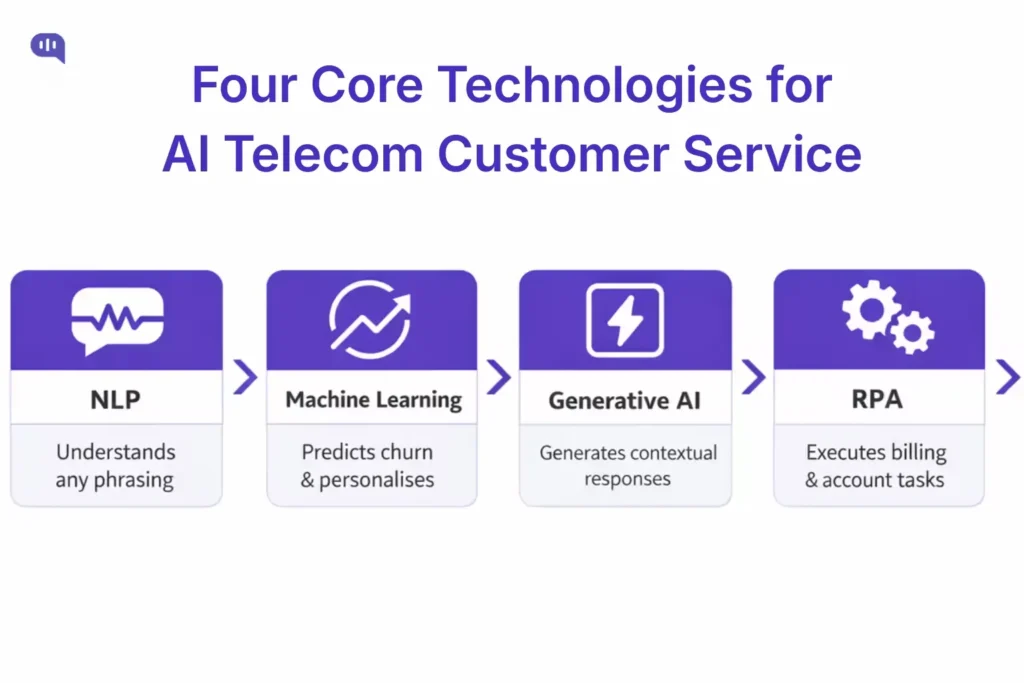
AI customer service is not a single product you buy and switch on. In practice, it’s a layered stack of technologies, each solving a different part of the problem. Understanding what each layer does is the starting point for deploying it well.
Natural language processing (NLP)
NLP is the technology that allows an AI system to understand what a customer is actually asking, regardless of how they phrase it. A subscriber saying “my bill looks way higher than normal this month” and another saying “can you explain this charge?” are asking fundamentally the same question: and NLP is what allows an AI system to recognise that, respond accurately, and route the interaction appropriately.
As our technical overview of AI describes it, NLP is the foundation on which every other AI capability in the contact centre is built.
Machine learning and churn prediction
If NLP is what lets AI understand customers, machine learning is what lets it anticipate them. ML models analyse historical interaction data to identify at-risk subscribers early, and the signals that matter most are rarely about price.
When a subscriber crosses a risk threshold, the system can automatically trigger a personalised retention campaign: a targeted offer, a proactive service check, or a plan recommendation calibrated to their actual usage.
Telecom operators using personalised AI-driven experiences report 5–15% revenue uplift, according to industry analysis (McKinsey, 2024).
Generative AI (GenAI) in the Contact Centre
Generative AI is the most significant development in telecom customer service in the last three years. Unlike rule-based chatbots that respond from pre-written menus, GenAI models generate responses contextually.
In our experience with TelOne, we have seen that Gen AI can be used to automate up to 40% of incoming support queries, even for large-scale telcos.
Robotic process automation (RPA)
RPA is the transactional layer for AI: it updates account details, processes billing adjustments, routes tickets, and triggers fulfilment workflows.
When combined with NLP, RPA becomes genuinely powerful: a chatbot that can not only understand a billing dispute but also resolve it in the same conversation.
These four technical parts work together to form agentic AI for telecom that can advance customer service. This can occur across many use cases, 7 of which we will highlight in the next section.
What Are AI Customer Service Use Cases in Telecom?
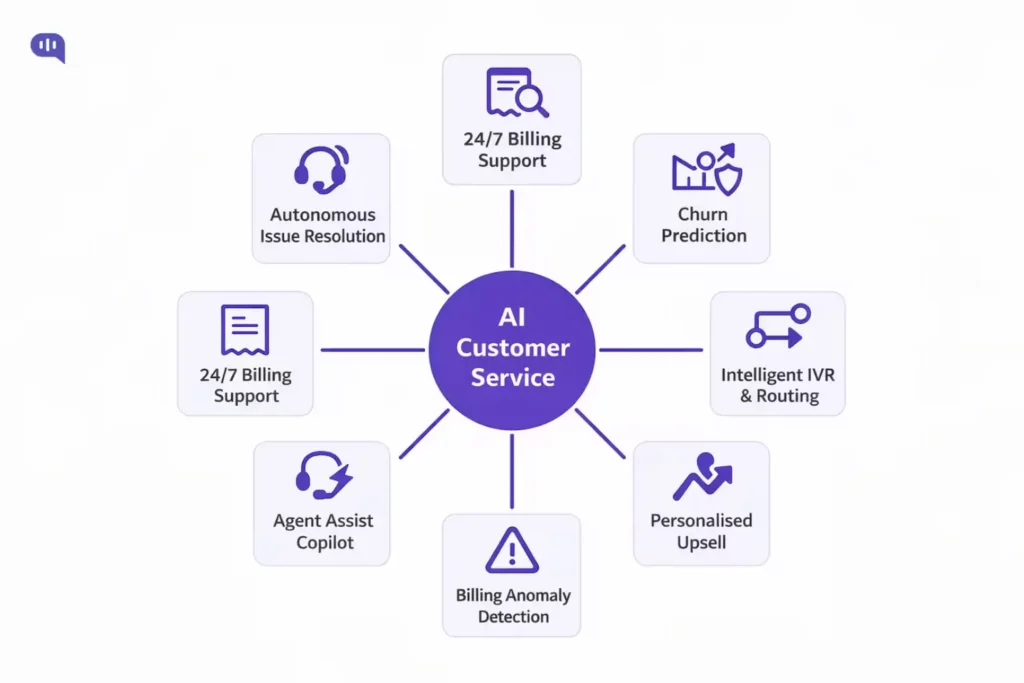
Our telecom AI platform is built to address the complexity of telecom customer journeys. It can manage everything from simple account queries to multi-system issue resolution.
Here are the seven use cases that we have seen across our clients:
- AI chatbots for 24/7 Billing and Plan Support – The highest-volume, most repetitive tier of telecom support is the natural starting point for AI deployment.
AI Chatbots handle these interactions at scale, around the clock, without queues. - Autonomous AI Agents for Complex Issue Resolution. Unlike chatbots, autonomous AI agents can reason through multi-step problems, query multiple backend systems, and resolve issues end-to-end without any human handoff. A customer calling about a service outage can be met by an agent who already has full network context, can communicate restoration timelines, and can dispatch a technician, all within a single conversation.
- Churn Prediction and Proactive Retention. Our models continuously monitor customer conversations with AI agents and human representatives. You can access customer data most likely to churn from Insights and use it to drive marketing and sales efforts.
- Intelligent IVR and call routing. AI-powered IVR systems detect customer intent from natural speech and route calls directly to the appropriate team or self-service channel, bypassing the multi-level menu navigation that has made traditional IVR one of the most complained-about experiences in telecom. In markets where WhatsApp is the dominant communication channel, reducing churn at key friction points through async messaging is already producing measurable results.
- Billing Anomaly Detection and Proactive Dispute Resolution. AI models monitor billing and usage data in real time, flagging anomalies before customers notice them. Proactively identifying and resolving a billing error before it appears on a statement is fundamentally different from asking a frustrated subscriber to raise a dispute through the support queue.
- Personalised Upsell and Cross-Sell. AI analyzes each subscriber’s usage patterns and service history to identify genuinely relevant upgrade opportunities. A customer consistently hitting their data limit is a natural candidate for a higher-tier plan. A household with five connected devices may benefit from a multi-line bundle. When AI surfaces these recommendations at a contextually appropriate moment, conversion rates are materially higher, an approach covered in depth in AI customer journeys for cross-sell and upsell.
- Agent Assist Copilot – For complex or emotionally sensitive interactions that require human judgment, AI copilots provide live support to agents by surfacing relevant knowledge base content, suggesting compliant responses, flagging retention opportunities, and automatically generating post-call summaries.
While call routing and billing anomaly detection might need customized solutions to implement (depending on your tech stack), the other 5 use cases are available by default on our platform.
The reason this is possible is the agentic nature of today’s AI models, such as Claude Opus 4.6 and ChatGPT 5.4. These models are far more capable than the previous generation of rule or heuristics-based chatbots. Let us briefly examine how that makes a difference for telecom operators.

AI Chatbots vs. Autonomous Agents: What is the Difference?
An AI chatbot is, at its core, a sophisticated response engine. It matches a customer’s query to a pre-defined pattern and returns the associated answer or action. It works well for predictable, bounded interactions. It fails when a customer’s problem does not fit a known pattern, requires information from multiple systems, or demands a decision that was not anticipated at build time.
An autonomous AI agent operates differently. Rather than matching queries to patterns, it reasons through goals. Given a customer’s situation, it can formulate a plan, query multiple systems, execute actions, and adapt in real time if the situation changes. The practical implications for telecom are significant.
| AI chatbot | Autonomous AI agent | |
| How it works | Pattern-matching against pre-set rules or prompts | Goal-directed reasoning across multiple systems |
| Handles ambiguity | Poorly — escalates or loops when the query does not match | Yes — asks clarifying questions and adapts in real time |
| Resolution depth | Tier 1 only: FAQ, billing Q&A, plan information | Tier 1 and 2: outage resolution, order management, churn rescue, dispute handling |
| System access | Single system or pre-configured integrations | Multi-system: CRM, billing, network ops, field service |
| Customer limitation | 70% of telecom customers find some issues too complex for a chatbot | Designed to handle exactly the questions that chatbots cannot |
| Best deployed for | High-volume, predictable, bounded interactions | Complex, multi-step problems requiring end-to-end resolution |
Most autonomous agents also use the chatbot interface; however, their functionality differs significantly. Therefore, most modern customer service stacks in telecom revolve around:
- An AI agent
- A customer service representative
The AI agent escalates complex issues to the customer service representative only when it is necessary.
Since this change has been underway for a few years, we can also confidently estimate the ROI of such a tech stack.
The Business Case for AI in Telecom Customer Service: ROI and Cost Savings
According to expert analysis and our own internal data, we have accumulated the following statistics:
| Metric | Figure | Source | Year |
| Customer support productivity increase (GenAI) | 30–45% | McKinsey | 2024 |
| OPEX/CAPEX reduction from AI deployment | 30–40% | Oliver Wyman | 2025 |
| Post-call administrative work reduction | 40–50% | Oliver Wyman | 2025 |
| Average handling time improvement | 1.5–2× | Oliver Wyman | 2025 |
| Telecom operators reporting improved CSAT | 97% | Internal data | 2026 |
| Cost per AI chatbot interaction | $0.25–$0.50 | Internal data | 2025 |
| Cost per human agent interaction | $3–$6 | Internal data | 2025 |
| Revenue uplift from personalised AI experiences | 5–15% | Internal analysis | 2026 |
| Projected GenAI revenue value for telecom | $60–100 billion | McKinsey | 2024 |
| GenAI telecom market size (2025) | $428 million | Precedence Research | 2025 |
| Projected GenAI telecom market size (2034) | $9.78 billion | Precedence Research | 2034 |
The per-interaction cost comparison alone is worth pausing on.
At scale, shifting even a fraction of those interactions from human-handled ($3–$6 each) to AI-handled ($0.25–$0.50 each) represents hundreds of millions of dollars in operational savings.
The McKinsey projection of $60–100 billion in industry-wide GenAI value reflects this compounding effect across the full range of AI applications, from customer support to network optimisation.

What are Real Operators Seeing?
TelOne automated 40% of its customer communications through an AI chatbot on WhatsApp. This meant that over 20,000 conversations were resolved without human intervention.
AT&T has integrated AI chatbot technology into both its customer-facing and agent-facing operations, using AI to triage queries, surface accurate troubleshooting guidance, and reduce the time agents spend searching across disconnected systems.
Vodafone’s TOBi AI assistant operates across multiple markets, handling tens of millions of customer interactions annually across billing, plan management, and technical support. Markets with full TOBi integration have seen digital resolution rates improve meaningfully versus traditional IVR and web self-service channels.
Major operators worldwide have discovered that AI helps them maintain more personalized relationships with customers. This reduces churn and makes it easy for telcos to expand their subscriber base without increased capex.
However, how does implementation work? We follow a 30-day plan for most of our customers.
How to Implement AI Customer Service in Telecom? 30-Day Pilot
Most AI implementations in telecom fail not because the technology is inadequate, but because operators attempt to deploy too broadly, too fast. According to Gartner, only 20% of AI projects fully meet their initial expectations. The operators that succeed tend to follow the same principle: start narrow, prove value, then scale.
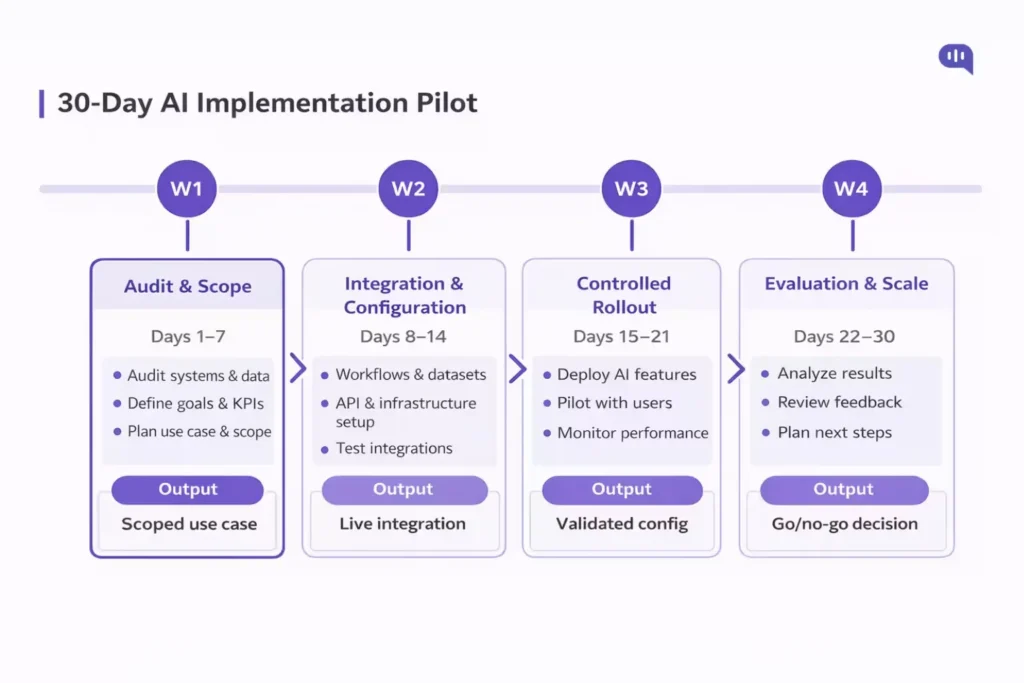
The following 30-day framework is designed to take a telecom operator from a scoped problem to a measurable pilot with minimal disruption to existing operations.
Week 1: Audit and Scope (Days 1–7)
Before any technology decision, identify the highest-volume, lowest-complexity tier of your contact centre interactions — typically billing enquiries, plan information, and account status queries. These represent the strongest candidates for initial AI deployment because they are well-defined, high-frequency, and do not require access to sensitive or multi-system data.
During this week, your team should:
- Pull 90 days of contact centre data and categorise interactions by type, volume, and average handling time
- Identify the top 10–15 query types that account for the largest share of volume
- Map which of those queries can be resolved with information from a single system (e.g., billing platform or CRM)
- Document current escalation paths and identify where handoffs break down
At the end of Week 1, you should have a clearly scoped pilot use case — not a broad ambition, but a specific interaction type with defined success criteria.
Week 2: Integration and Configuration (Days 8–14)
With a scoped use case, the technical work begins. The primary integration requirement at this stage is a read connection to the system of record for the chosen interaction type — typically the billing platform or CRM.
Key tasks during this phase:
- Connect the AI platform to the relevant backend system via API
- Configure the agent’s knowledge base with accurate, current product and policy information
- Define escalation logic: under what conditions should the AI hand off to a human agent, and what context should transfer with it.
- Establish your baseline metrics: current cost per interaction, average handling time, first-contact resolution rate, and CSAT for the chosen query category.
Avoid the temptation to expand the scope during integration. A tightly configured AI that resolves one query type reliably is more valuable — and easier to iterate on — than a broadly configured one that handles many query types poorly.
Week 3: Controlled Rollout (Days 15–21)
Deploy the AI to a limited, controlled segment of your traffic: typically 5–10% of the relevant interaction type. The goal here is not volume; it is validation.
During this phase:
- Monitor resolution rates, escalation rates, and customer satisfaction in real time
- Review transcripts daily to identify failure patterns (query types the AI mishandles, edge cases not anticipated during configuration, and tone or accuracy issues)
- Make iterative configuration adjustments based on observed performance rather than waiting until the pilot ends
- Ensure your human agents are briefed on the escalation experience — the handoff quality is as important as the AI’s own resolution rate.
This week will reveal most of the issues that would otherwise appear at full scale. Treat every escalation as a data point.
Week 4: Evaluation and Scale Decision (Days 22–30)
By Day 30, you will have enough performance data to make an informed decision about whether and how to scale the deployment.
Evaluate against the baseline metrics established in Week 2:
- Resolution rate: What percentage of the targeted query type was resolved without human intervention?
- Cost per interaction: How does the AI-handled cost compare to the human-handled baseline?
- CSAT delta: Did customer satisfaction for this interaction type improve, decline, or remain the same?
- Escalation quality: When handoffs to human agents occurred, were they smooth and context-complete?
A well-scoped pilot should demonstrate a resolution rate of 60–70% within its first 30 days, with improvement expected as the configuration matures. If these thresholds are met, the case for expanding coverage is straightforward to make to internal stakeholders.
We’ve also compiled these steps into a table for easy access.
| Week | Phase | Key Activities | Output |
| Week 1 (Days 1–7) | Audit & Scope | Pull 90 days of contact centre data; categorise by type, volume, and handling time; map single-system queries; document escalation paths | Scoped pilot use case with defined success criteria |
| Week 2 (Days 8–14) | Integration & Configuration | Connect AI platform to billing/CRM via API; configure knowledge base; define escalation logic; establish baseline metrics (AHT, FCR, CSAT, cost per interaction) | Live integration to one backend system; documented baseline |
| Week 3 (Days 15–21) | Controlled Rollout | Deploy to 5–10% of target traffic; monitor resolution and escalation rates daily; review transcripts; iterate on configuration; brief human agents on handoff experience | Validated configuration; identified failure patterns |
| Week 4 (Days 22–30) | Evaluation & Scale Decision | Measure resolution rate (target: 60–70%), cost per interaction delta, CSAT movement, and escalation quality against the Week 1 baseline | Go/no-go decision with data to support stakeholder sign-off |
While implementing a pilot (even at scale) is relatively simple, AI does come with some unique challenges.
Challenges of Implementing AI for Customer Service in Telecom
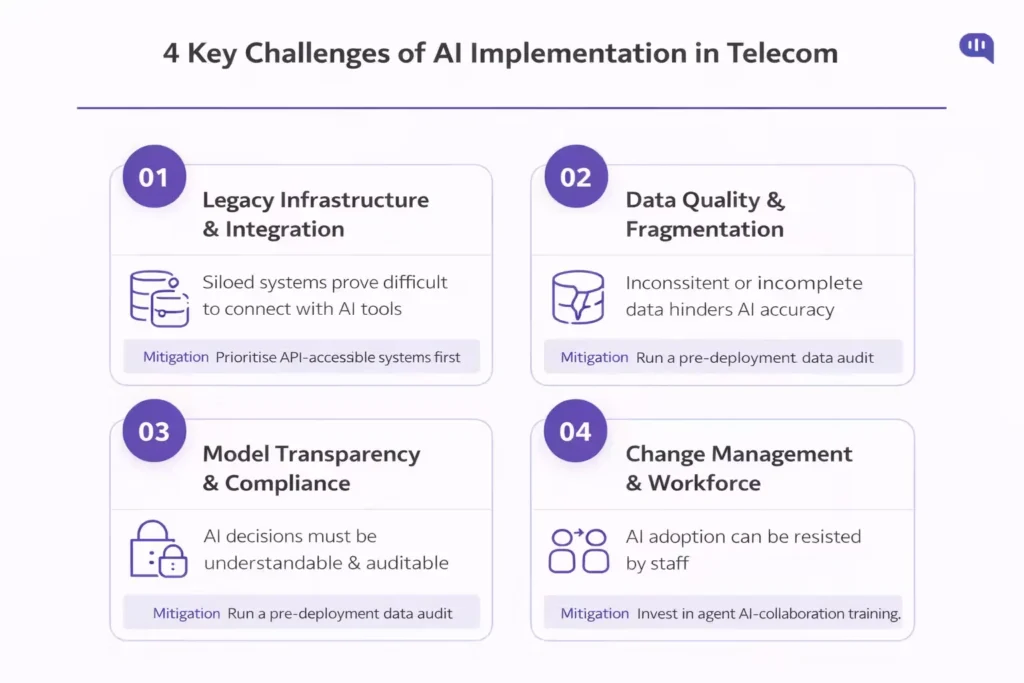
The business case for AI in telecom customer service is well-established. The implementation reality is more complex. Below are the four most significant barriers operators encounter, and the approaches we have seen work in practice.
1. Legacy Infrastructure and Integration Complexity
Telecom BSS/OSS environments are among the most complex in any industry. Many operators run billing, network management, CRM, and field service systems that were built independently, integrated incrementally over decades, and were never designed for API-first access.
The result is that even a well-designed AI agent can be bottlenecked by the data layer beneath it. An agent that cannot reliably query a billing system in real time cannot reliably resolve a billing query.
The practical approach is to prioritise API accessibility when selecting use cases. Deploy AI against API-accessible systems before addressing legacy integration as a parallel infrastructure project. Attempting to modernise the data layer and deploy AI simultaneously significantly increases the risk of implementation.
2. Data Quality and Fragmentation
AI systems are only as reliable as the data they are trained on and grounded in. In telecom, customer data is frequently fragmented across systems, inconsistently structured, and complicated by long account histories, multiple services, and household-level relationships.
Poor data quality manifests in AI deployments as incorrect account information surfaced to customers, inaccurate billing explanations, and failed resolutions that erode customer trust faster than a human agent ever would.
Before deployment, a data audit targeting the specific systems the AI will query is a necessary prerequisite.
3. Model Transparency and Regulatory Compliance
AI models used in customer-facing contexts can present transparency challenges. When an AI agent makes a billing decision or surfaces a retention offer, both the operator and the customer may have limited visibility into the factors that drove that outcome.
This is not merely a technical concern. Telecom operators operate under regulatory frameworks that require explainability in customer-affecting decisions. The opacity of large language models can create compliance exposure if not addressed through proper governance architecture.
Model interpretability tools, human-in-the-loop escalation for sensitive decisions, and clear audit trails for AI-driven actions are the practical mitigations. These should be designed into the system architecture from the outset rather than retrofitted.
4. Change Management and Workforce Readiness
The human dimension of AI deployment is consistently underestimated.
In practice, the most effective deployments treat AI and human agents as complementary rather than competitive. Agents whose roles shift toward handling escalations, complex disputes, and emotionally sensitive interactions typically report higher job satisfaction than those handling high-volume, repetitive queries. The change management challenge is communicating this clearly, early, and consistently to the frontline.
Operators that invest in agent training on AI collaboration consistently outperform those that treat agent enablement as an afterthought.
These deployment challenges are not the be-all end-all for telecom AI customer service. In fact, with organizational changes and the right platform (Kommunicate emphasizes AI + human customer service), most of these challenges can be overcome.
These developments are only set to accelerate in the coming years, and executives need to make faster decisions based on the future. Before we end this article, we’ll explore the future trends that’ll influence the generative AI tech in the telecom sector.
The Future of AI Customer Service in Telecom
The deployments described in this article represent the current leading edge of AI in telecom customer service. The trajectory from here is both clear and rapid.
From Conversational AI to Agentic AI — at Scale
The defining shift of the next two to three years is not the adoption of AI, but the transition from conversational AI to fully agentic AI across all tiers of the contact centre. Conversational AI responds. Agentic AI reasons, decides, and acts.
For telecom specifically, this means AI systems that do not merely answer questions about outages, but also detect them, assess the customer’s service history, communicate proactively, dispatch field technicians where required, and follow up on resolution.
Multi-Agent Collaboration
The next architectural evolution in telecom AI is the movement from single agents to coordinated multi-agent systems. Rather than a single AI handling the full customer journey, specialised agents will collaborate in real time, sharing context and dividing tasks by domain.
Emerging interoperability standards, such as the Model Context Protocol (MCP), are accelerating this shift, enabling agents built on different platforms to exchange context and act in concert. The practical implication for telecom operators is that a customer’s issue will be addressable across all relevant systems simultaneously, rather than routed sequentially through each.
Voice AI and Emotional Intelligence
Voice remains the dominant channel for complex, time-sensitive telecom issues. The next generation of voice AI goes beyond transcription and intent detection to real-time emotion detection, enabling the system to adapt its approach based on a customer’s expressed sentiment.
The Competitive Divergence
The data suggests that the window for differentiated advantage through AI is narrowing. Early adopters are already optimising second-generation deployments. By 2027, agentic AI is projected to be standard practice rather than a competitive differentiator.
For operators yet to deploy, the case for urgency is straightforward: 46% of customers already changed providers last year due to service quality alone. The operators building AI infrastructure today are competing for existing subscribers.
Conclusion
The evidence across this article points in one direction. Telecom operators that deploy AI in customer service are resolving more queries, at lower cost, with measurably higher customer satisfaction. The technology stack to do this is mature, proven at scale, and accessible without a multi-year infrastructure overhaul. What separates operators seeing results from those still in planning is not ambition or budget. It is the discipline to start with a narrow, well-scoped use case, prove the value in 30 days, and build from there.
The urgency is real. With annual churn rates of 30–35% and nearly half of customers citing service quality as the reason they left their last provider, the cost of inaction compounds every quarter.
By 2027, agentic AI is projected to be standard practice across the industry. The operators who begin today will be optimising second-generation deployments by the time their competitors are running first pilots. AI customer service in telecom is no longer a future investment. For the operators serious about retention, efficiency, and growth, it is the present one.
If you want to deploy an AI customer service solution, feel free to book a call.
FAQs
AI customer service in telecom is the use of artificial intelligence to automate and personalise customer support for billing, network issues, plan management, and other service interactions. It allows telecom providers to deliver faster, more consistent support at significantly lower cost than traditional human-only contact centre models.
Telecom companies deploy AI chatbots to handle high-volume, predictable queries 24 hours a day without human involvement. In more mature deployments, chatbots serve as the first tier of a layered system, seamlessly escalating to autonomous AI agents or human reps when queries exceed their capability.
According to Salesforce, approximately 60% of telecom service organisations have fully implemented AI, with 77% planning to increase their investment over the following year. Microsoft projects the figure will reach 90% by 2027.
An AI chatbot matches customer queries to pre-defined responses and is effective for simple, predictable interactions. An autonomous AI agent reasons through complex, multi-step problems to resolve issues end-to-end without human intervention. Around 70% of telecom customers regularly encounter queries too complex for a chatbot to resolve.
AI-driven customer service reduces telecom OPEX and CAPEX by 30–40%, cuts post-call administrative work by 40–50%, and improves average handling time by 1.5–2× (Oliver Wyman, 2025). The cost per AI-handled interaction is $0.25–$0.50, compared to $3–$6 for a human-handled contact.
Machine learning models monitor subscriber behaviour to identify at-risk customers before they cancel. When a subscriber crosses a risk threshold, AI triggers personalised retention interventions, such as targeted offers, proactive outreach, or plan recommendations based on actual usage patterns.
Three challenges consistently determine whether implementations succeed or stall: data fragmentation (most telcos lack the unified customer data layer AI needs), the complexity ceiling of chatbots (rule-based systems cannot handle the full range of telecom service queries), and AI transparency requirements (particularly in GDPR-regulated markets, where automated decision-making must be explainable and auditable).
Yes. Cloud-based, subscription-based AI platforms have substantially lowered the entry point. Smaller providers typically start with a single cloud-hosted chatbot covering billing and FAQ support before expanding and starting with narrow limits on initial spend while building the interaction data and operational confidence needed for more sophisticated deployments.
The trajectory is towards autonomous AI agents handling the majority of customer interactions end-to-end, with proactive sentiment-aware outreach becoming a standard capability. Microsoft projects 90% of telcos will use AI for customer experience by 2027.

Devashish Mamgain is the CEO & Co-Founder of Kommunicate, with 15+ years of experience in building exceptional AI and chat-based products. He believes the future is human and bot working together and complementing each other.