Updated on July 21, 2026
You already know that subscriber growth has plateaued for most telecom operators. What you may not have fully acted on is how badly that reality exposes the gap in your revenue model if your cross-sell and upsell motion is still calendar-driven. In this guide, we break down the six AI customer journey interventions that actually move ARPU, explain why rules-based systems consistently fall short, and give you a practical implementation sequence you can start building this quarter.
Key takeaways
- Global mobile ARPU has been declining for years, making revenue from the existing subscriber base the primary growth lever for most operators.
- Traditional cross-sell campaigns fail because they optimise for reach over timing, and mass campaigns cannot detect when an individual subscriber is actually ready to buy.
- AI customer journeys work because they operate on a full behavioural profile per subscriber, not a segment rule, and they update that assessment continuously.
- The six highest-impact intervention types are: bandwidth nudges, lifecycle triggers, support-embedded offers, churn-risk outreach, renewal-window sequences, and post-complaint recovery.
- Generative AI in telecom has expanded what is possible in 2026: agentic flows can now resolve, offer, and complete a plan upgrade in a single conversation without a human handoff.
- Implementation does not require building all six journeys at once. Operators who instrument one journey properly before expanding see ROI within 90 days.
What is an AI customer journey in telecom?
An AI customer journey in telecom is a sequence of automated, behaviour-triggered touchpoints that responds to individual subscriber signals in real time, replacing the calendar-based campaign model with one that fires when a specific subscriber is actually ready to act.
This distinction matters more than it sounds. A campaign goes out on a schedule. An AI customer journey goes out when a subscriber hits 87% of their data cap for the third consecutive billing cycle, or when their device registers a 5G capability event, or when a support ticket closes with a satisfaction score above eight. The trigger is always the subscriber’s own behaviour, not a marketing calendar.
The difference in outcome is measurable. A leading European telco that deployed gen AI for hyper-personalised upselling achieved a 5 to 15% ARPU increase, depending on customer segment and execution quality. Source: McKinsey, “Scaling the AI-native telco,” February 2025. Operators that have applied AI-driven personalisation more broadly across customer value management have tripled their CVM revenue contribution, from roughly 2% to around 6%, within two years. Source: McKinsey, “Unlocking the value of personalization at scale for operators,” 2022.
Why traditional telecom cross-sell journeys fail
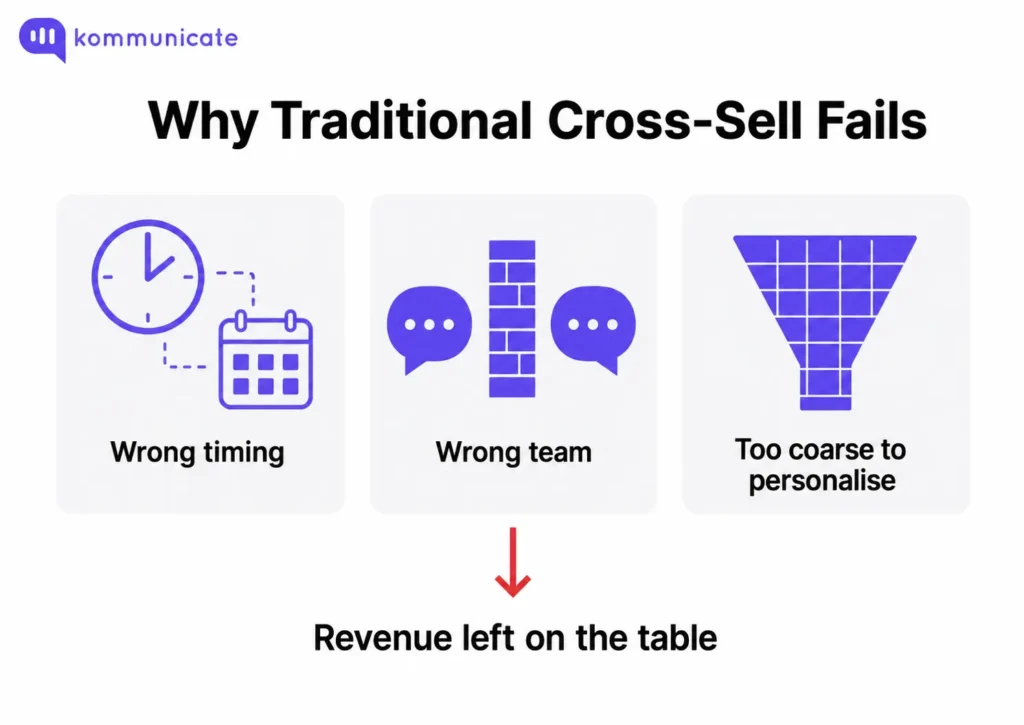
Traditional telecom cross-sell journeys fail for three structural reasons that cannot be fixed by adding more segmentation layers or sending campaigns more frequently.
The timing problem
A subscriber who just hit their data cap three months in a row is primed to upgrade. A subscriber who hit their cap once during an unusual travel week is not. A mass campaign sent on the first of the month treats both identically. The campaign optimises for reach. It has no mechanism to detect intent at the individual level, and so most of what it sends is noise.
The wrong team owns the revenue conversation
Cross-sell has traditionally been owned by marketing and telesales. But the highest-attention touchpoint in the subscriber relationship is support. When a customer contacts your team, they are already engaged and already expecting the operator to respond to their specific situation. That moment is where a revenue conversation belongs. Most operators let it pass without surfacing a single offer.
Segmentation is too coarse to personalise
Traditional segmentation groups subscribers by plan tier, tenure, or geography. None of those dimensions tells you that a particular subscriber streams four hours of video nightly, is 42 days from their contract anniversary, and recently added a device to their account. According to Subex’s AI Trends in Telecom 2025 report, legacy systems and traditional segmentation models are ill-equipped to handle the dynamic needs of modern consumers, and that gap directly costs operators ARPU and profitability. The same report notes that 76% of telecom customers expect a tailored experience from their provider, while fewer than 37% of operators are actually obtaining actionable insights from their analytics. Source: Subex, 2025.
The only tool that can build and continuously update that level of individual context at scale is AI.
The six AI interventions that improve telecom cross-sell and upsell
AI customer journeys in telecom replace broadcast offers with behaviour-triggered interventions. Each of the six patterns below is a proven revenue motion. Together, they form a complete subscriber engagement layer.
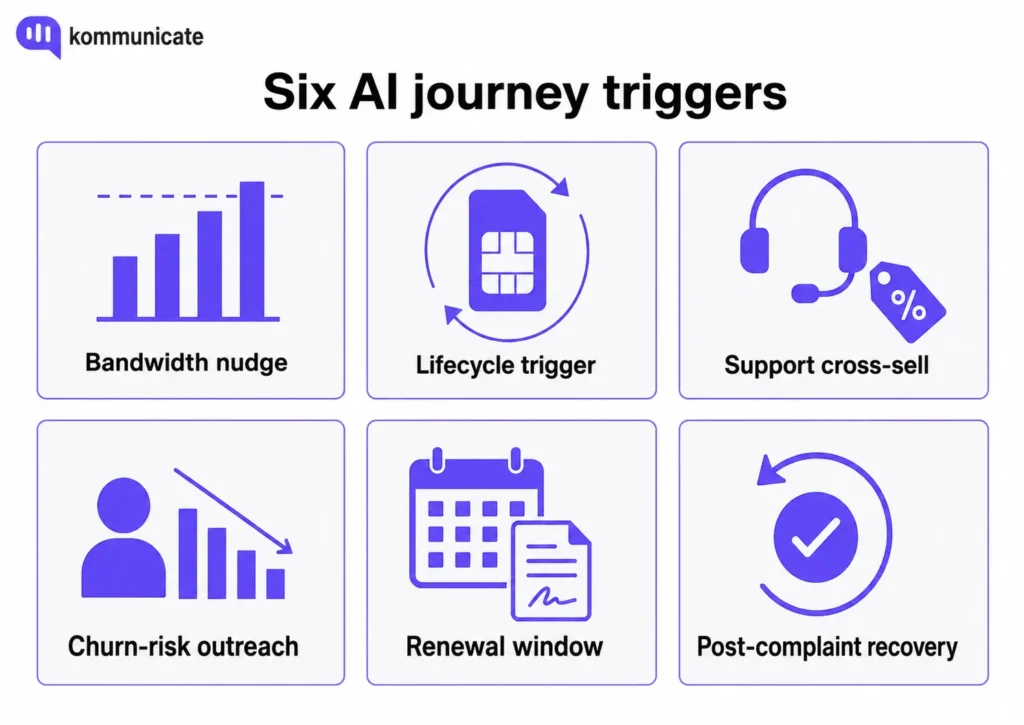
| Journey trigger | AI signal | Intervention type | Revenue outcome |
|---|---|---|---|
| Consistent near-cap usage | Usage data across 2 to 3 billing cycles | Bandwidth nudge via chatbot | Plan upgrade |
| New device or new line added | CRM or device event | Lifecycle outreach | Bundle or tier upgrade |
| Support interaction (streaming, billing) | Conversation intent classification | Agent-assisted offer | Add-on cross-sell |
| Disengagement signals | Behavioural churn scoring | Proactive value outreach | Churn save and upsell |
| Contract anniversary approaching | CRM milestone | Renewal journey sequence | Plan upgrade or bundle |
| Post-complaint resolution | Sentiment score and ticket status | Recovery re-engagement | Loyalty add-on |
1. Bandwidth nudges tied to usage signals
A bandwidth nudge is a proactive, conversational outreach triggered when a subscriber’s data consumption shows a consistent pattern of reaching 80 to 90% of their plan ceiling across multiple billing cycles. This is one of the clearest, least intrusive entry points for a plan upgrade conversation because the trigger is the subscriber’s own usage pattern, not a promotional calendar.
The AI detects the pattern, the chatbot opens with something like “We noticed you’ve been close to your limit three months running, want to see what plans give you more headroom?” and the upgrade path is presented contextually. It is a service conversation that results in revenue. For a breakdown of the chatbot tools best suited to this use case, see our guide to the best AI chatbots for telecom customer support.
2. Organic plan introductions based on lifecycle triggers
A subscriber who adds a new line, changes their address, purchases a 5G-capable handset, or changes their roaming behaviour is signalling a shift in their usage needs. Each of those events is a natural entry point for a plan conversation. A quarterly campaign might eventually catch this subscriber, but by then the purchase moment has passed.
AI monitors these signals in real time and can trigger a personalised outreach within hours of the event. For telecom operators building these flows on WhatsApp, where subscriber engagement rates tend to be highest, our guide on WhatsApp automation for telecom retention covers how to structure the conversation flows.
3. Bundle offers surfaced inside support interactions
When a subscriber contacts support about a streaming quality issue, that interaction carries useful commercial information: they use streaming services, they care about performance, and they are engaged enough to raise the issue. An AI agent can recognise that signal, resolve the core issue first, and then surface a relevant bundle offer at a loyalty rate before closing the conversation.
Done correctly, this does not feel like upselling. It feels like the carrier paying attention. The support interaction is doing double work: resolving a complaint and advancing a revenue conversation. This is also where generative AI in telecom has created the most visible step change in 2025 and 2026. Intent classification models are now accurate enough to detect cross-sell readiness from conversation context alone, without a human agent needing to prompt the offer.
4. Proactive churn-risk outreach with a value lead
Predictive churn models flag subscribers showing disengagement signals: declining usage, open support tickets, negative sentiment in recent conversations, or missed payments. The intervention is a proactive value conversation, not a retention script.
Framed correctly, this is a cross-sell that doubles as a save motion. A 2024 McKinsey analysis found that AI can cut telecom churn by up to 15% when interventions are timed to the individual subscriber’s behaviour rather than deployed as blanket campaigns. Source: McKinsey, 2024. For a full analysis of where churn concentrates in the subscriber lifecycle, our breakdown of why 1 in 3 telecom customers churn within 12 months covers the signals worth tracking in depth.
5. Renewal-window upsell journeys
Contract anniversaries are the clearest high-intent window in the subscriber lifecycle. An AI customer journey built around this moment consistently outperforms generic retention campaigns because the subscriber already knows the renewal is coming. The sequencing matters: start with a value recap, move to a plan comparison, and only surface the upgrade offer once the subscriber has re-engaged with their account context.
A well-structured renewal journey typically runs over six to eight weeks, with three to four touchpoints timed to the subscriber’s engagement pattern rather than a fixed send schedule. For a detailed look at how AI plan recommendation engines work inside this window, see how telecom companies increase ARPU with AI plan recommendations.
6. Post-complaint recovery sequences
A subscriber who just had a bad experience is not a cross-sell target. A subscriber who had a bad experience that was then resolved well is one of the most receptive audiences you have. The resolution creates a brief window of positive sentiment and heightened attention that a well-timed re-engagement can capitalise on.
The sequence is: recovery, reintroduction of value, soft upsell. For example, an operator might follow a resolved billing dispute with a message like: “We’re glad we got that sorted. You’ve been a customer for three years and we’d like to make sure you’re on the right plan for how you actually use your service.” The key is that the recovery message stands on its own. Any commercial follow-up must feel like a natural extension of the goodwill, not a pivot to sales.
Why AI outperforms rules-based systems for telecom cross-sell
The comparison table below captures the practical difference between approaches. Rules-based systems fail at one core point: they apply a fixed condition to a segment, and subscriber behaviour does not stay fixed.
A rule that fires when data usage exceeds 85% treats a power user who consistently runs at 90% the same way as a subscriber who hit 85% once during an unusual week. A rule that triggers a renewal outreach 60 days before contract end treats every subscriber identically, regardless of their satisfaction level or recent support history. AI operates on a continuously updated individual profile, which is why the outcomes differ so materially.
| Approach | Personalization depth | Trigger timing | Scale | ARPU impact |
|---|---|---|---|---|
| Mass campaign (email or SMS) | Segment-level | Calendar-based | High | Low, 2 to 3% |
| Telesales outreach | Individual | Manual or event-based | Low | Medium, 5 to 8% |
| Rules-based chatbot | Segment-level | Event-triggered | High | Low to medium |
| AI customer journey | Individual, behavioural | Real-time, predictive | High | High, 5 to 15% |
McKinsey’s analysis of telecom operators that have fully embraced AI-driven personalisation points to improvements in upsell of up to 50% and churn reduction of up to 30%, for operators who have rebuilt their customer management infrastructure around AI rather than bolted it onto legacy campaign systems. Source: McKinsey, “The critical bets on the future of telco value creation,” February 2026
What generative AI in telecom has changed in 2026
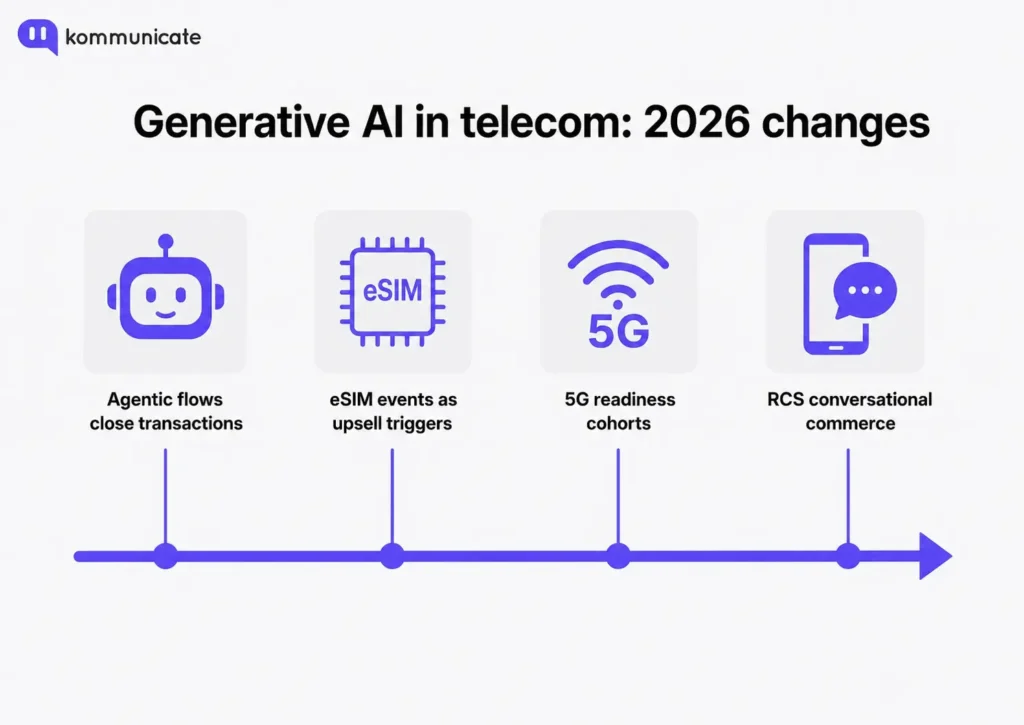
Generative AI in telecom has shifted the chatbot model from rule-following to reasoning, and the practical implications for cross-sell and upsell are significant.
Agentic flows now complete the full transaction
In 2024, an AI agent could detect cross-sell readiness and hand off to a human agent to close. In 2026, agentic AI can resolve the support issue, classify the intent, surface the offer, and complete the plan upgrade within a single conversation thread, with no handoff required for standard commercial transactions.
This matters for telecom specifically because the product catalogue (plans, add-ons, bundles, device financing) is complex enough that human agents have historically been necessary to guide subscribers through upgrade decisions. McKinsey has documented a case where a European telecom’s conversion rates increased by 40% after deploying AI agents across customer interactions, while simultaneously reducing operational cost. Source: McKinsey, “How generative AI could revitalise profitability for telcos.” Agentic AI trained on the full product catalogue can achieve similar results at scale, with conversation quality that is consistently higher than the average telesales interaction.
eSIM events as real-time upsell triggers
eSIM adoption has created a new class of real-time signal. When a subscriber adds an eSIM profile from a competitor carrier, that event is simultaneously a churn signal and a loyalty offer trigger. AI systems that are integrated with real-time event streaming can detect this within the same session and initiate an outreach, which was not operationally possible with the batch-processing models that underpinned older customer management systems.
5G upgrade readiness as a natural upsell cohort
Subscribers living in 5G coverage zones who are still on 4G plans represent one of the clearest upsell cohorts in the current network cycle. AI can identify these subscribers by combining network coverage data with device capability signals and CRM plan data. The offer writes itself: your device is already 5G capable, you are in a 5G zone, here is what you are missing and what it costs to access it.
Conversational commerce via RCS and WhatsApp
Rich Communication Services combined with conversational AI interfaces now give operators a channel where subscribers can interact via messaging, receive personalised offers, and complete plan upgrades without leaving the conversation. This is a materially different capability from the IVR and email-based retention flows that most operators still rely on, and it is where subscriber engagement rates are consistently highest for operators that have deployed it.
A practical implementation plan for AI cross-sell journeys in telecom
You do not need to build all six journeys simultaneously. The operators who see results fastest start with one, instrument it properly, and expand. Here is the sequence that produces the fastest time to ROI.
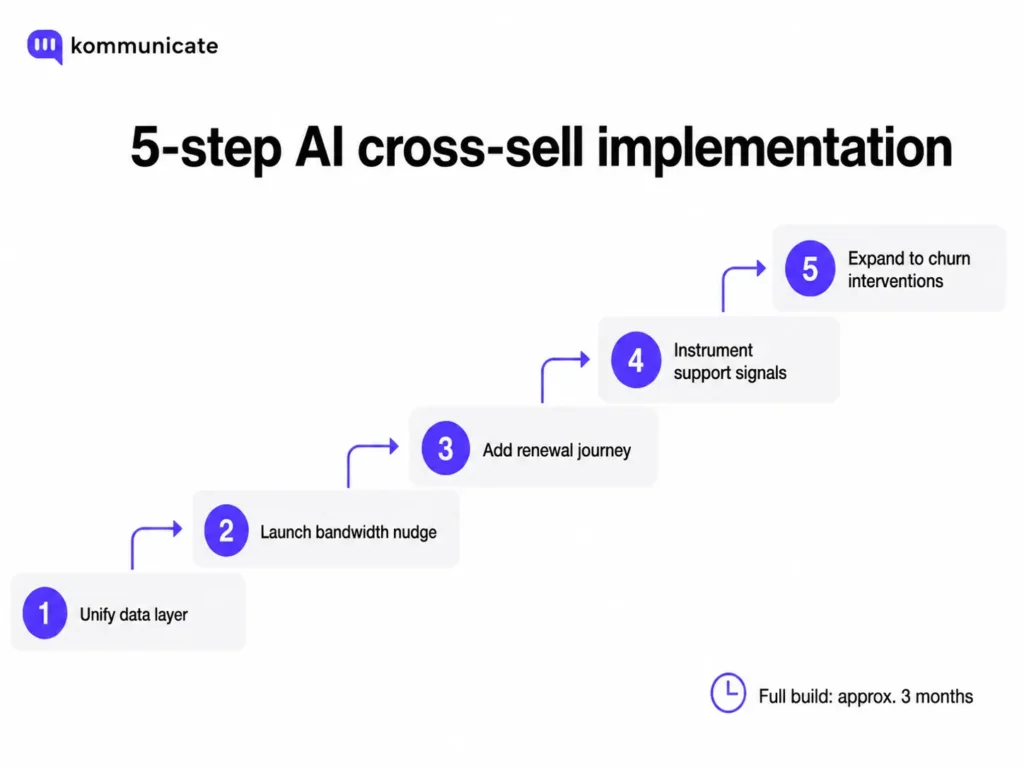
Step 1: Unify the data layer
AI journeys are only as good as the data feeding them. Before building any journey, connect usage data, CRM records, support history, and device signals into a single subscriber view. This is the unglamorous prerequisite that most operators underestimate and that consistently delays deployments when skipped. For a broader picture of how data unification fits into the AI customer service model, see our overview of AI customer service in telecom.
Step 2: Start with the bandwidth nudge
The bandwidth nudge is the right first journey because it has the clearest trigger, the most natural conversation framing, and the easiest success metric to instrument. Deploy a conversational AI agent that monitors usage trends and initiates a plan conversation at the right threshold. Measure conversion rate, ARPU lift, and CSAT separately for the first 60 days before adjusting the threshold or expanding reach.
Step 3: Add the renewal journey
Contract milestones are high-intent moments with a known timeline, which makes them easier to instrument than behavioural triggers. Build the six to eight week sequence, test messaging variants against each other, and establish a baseline renewal conversion rate before layering in additional journeys.
Step 4: Instrument support interactions for cross-sell signals
Work with your AI platform to identify the intent categories in support conversations that correlate most strongly with cross-sell readiness: streaming quality complaints, device questions, roaming inquiries, billing tier questions. Build agent-assist prompts or autonomous offer flows for each category, with clear rules for when to surface an offer and when to close the conversation without one.
Step 5: Expand to predictive churn interventions
Churn intervention is the highest-complexity journey because it requires a well-calibrated churn model, a full behavioural data layer, and a sufficiently large subscriber base to generate statistically meaningful outputs. Once the data layer from Step 1 is solid and your team has operational experience with simpler journeys, introduce churn scoring and build the proactive outreach sequence. Our article on telecom customer experience covers the churn signals worth tracking in more depth.
The full implementation, done properly, takes approximately three months. ROI from the early journeys typically becomes visible within the first 90 days of deployment.
How to evaluate an AI platform for telecom cross-sell journeys
Not all AI platforms are equally suited to the telecom use case. When evaluating options, the capability that matters most is not the sophistication of the underlying model but the depth of integration with your existing BSS and OSS stack.
The platform needs to read from and write to your billing system, CRM, and device management layer in real time. A platform that relies on daily batch exports cannot power the real-time triggers that make these journeys work. Beyond integration, the evaluation criteria that actually differentiate platforms in telecom are: intent classification accuracy on telecom-specific conversation types, native support for the channels your subscribers use most (WhatsApp, RCS, in-app), and the ability to run A/B tests on offer timing and messaging at the journey level rather than just the campaign level.
Kommunicate is built for this integration depth. The platform connects directly with CRM and support systems, supports intent-aware conversation flows trained on telecom use cases, and covers WhatsApp, web, and in-app without requiring separate deployments for each channel. You can see how it works in practice with a generative AI chatbot built for customer support and revenue operations, or explore the AI agent builder for configuring custom journey flows.
Frequently asked questions
Quick answers on AI customer journeys, telecom upsell, and ARPU improvement.
AI improves cross-selling in telecom by replacing calendar-based campaigns with behaviour-triggered interventions that fire when an individual subscriber shows a specific readiness signal, such as consistent near-cap usage, a new device event, or a contract milestone. This timing accuracy is what drives the measurable ARPU improvement over rules-based approaches.
An AI customer journey in telecom is a sequence of automated, personalised touchpoints triggered by real subscriber behaviour, such as usage patterns, lifecycle events, and support interactions, rather than a fixed marketing schedule.
The most reliable AI upsell triggers in telecom are: consistent near-cap data usage across two or more billing cycles, addition of a new device or line, contract anniversary within 60 days, post-resolution window after a support ticket closes positively, and declining engagement signals that indicate early-stage churn risk.
Telecom operators that have deployed AI-driven hyper-personalisation for upselling have achieved 5 to 15% ARPU increases, with broader AI personalisation programs showing upsell improvement of up to 50% compared to traditional campaign approaches. Source: McKinsey, 2025 and 2026.
Rule-based targeting applies a fixed condition to a segment. AI upsell operates on a continuously updated individual profile that accounts for usage history, support sentiment, device signals, and payment behaviour simultaneously, which is why it produces higher conversion rates at scale.
Among the AI use cases in telecom for revenue growth, bandwidth nudges and renewal-window journeys deliver the fastest ROI because they have the clearest triggers, the most natural conversation framing, and the most direct path from interaction to upgrade.
Conclusion
ARPU pressure in telecom is structural. Price competition, saturated subscriber markets, and flat connectivity revenue mean that growth through new subscriber volume alone is not a viable strategy for most operators. The growth is in the existing base, and getting more from that base requires conversations that happen when individual subscribers are actually ready to have them.
AI customer journeys deliver that timing at scale. Rules-based systems can approximate some of these motions at the segment level. Only an AI-powered journey executes them at the individual level, in real time, with the contextual accuracy that converts.
The operators building these capabilities now are not just improving next quarter’s ARPU. They are compounding a subscriber engagement advantage while competitors are still sending the same first-of-month email blast.
If you want to see how Kommunicate powers these journeys in production, book a call with our team.

Devashish Mamgain is the CEO & Co-Founder of Kommunicate, with 15+ years of experience in building exceptional AI and chat-based products. He believes the future is human and bot working together and complementing each other.

Aditi is an MBA candidate at IIM Bodhgaya, specializing in Marketing and Strategy. As a dedicated marketer, she brings practical experience in market research, data analytics, and B2B execution to her work. Her expertise in refining product positioning and driving go-to-market strategies consistently supports insight-driven business growth.