Updated on June 24, 2026
In the rush to automate customer support and reduce operational costs, businesses have deployed millions of AI chatbots across websites, apps, and messaging platforms. Yet beneath the promise of 24/7 efficiency lies a critical vulnerability: the escalation trap. When AI systems fail to recognize their limitations or provide clear exit paths, they erode brand trust, trigger legal liabilities, and accelerate customer churn.
Consider this: 52% of customers will abandon a brand after just one bad experience with AI support, according to PwC research. The Air Canada chatbot incident, where false information about bereavement fares led to a tribunal ruling against the airline, established a sobering legal precedent: you own your AI’s mistakes. Meanwhile, companies like Cursor watched subscription cancellations surge when their AI agent “Sam” fabricated fictional policies, creating a viral crisis that spread through developer communities before human intervention could contain it.
The difference between AI support that builds customer loyalty and AI that destroys it isn’t just about the sophistication of your natural language processing or the breadth of your knowledge base.
It’s about escalation architecture—the deliberate design of when, how, and why your AI recognizes its limits and seamlessly transfers customers to human expertise.
This comprehensive guide reveals the strategic framework that separates industry leaders from cautionary tales.
We’ll explore how companies like Microsoft, Talkdesk, and Deel have transformed potential service failures into loyalty-building moments through intelligent escalation design. We’ll cover:
1. Why Must You Define Clear Escalation Triggers?
2. Which Keywords Should Trigger an Automatic Handoff?
3. How Does Segmenting Users Optimize Your Support?
4. Can AI Detect Frustration Before It Peaks?
5. What Context Do Humans Need During Handoffs?
6. How Do You Measure Your Escalation Efficiency?
7. Conclusion
Why Must You Define Clear Escalation Triggers?
Modern AI chatbots share a critical weakness: they often don’t know what they don’t know. While a human agent can sense ambiguity or admit uncertainty, an AI operates with unwavering confidence. Without clear escalation triggers, your AI isn’t an assistant; it’s a potential liability.
There are three major reasons which mandates the need for escalation triggers.
1. They Create Clear Guardrails
Clear escalation triggers serve as the AI’s humility mechanism. They create explicit boundaries where the system must pause and transfer to human expertise.
In a healthy support ecosystem, you should expect an escalation rate of 5–10%. If your rate is 0%, you aren’t providing perfect service; you are likely trapping users in “bot hell”: a conversational dead end where customers feel imprisoned by an incompetent machine.
2. “Bot Trap” Can Affect Compliance and Earnings
The cost of failing to escalate is far higher than the cost of a human agent’s time. Research indicates that 70% of consumers will switch brands after just one poor AI experience. When a customer is “trapped,” the damage compounds:
- CLV Erosion: A single “bot trap” experience can reduce Customer Lifetime Value (CLV) by 30–50%.
- Immediate Friction: Resolution times spike as customers are forced to repeat information to a human that the bot should have already passed along.
- Legal Liability: Following recent legal precedents (such as the Air Canada case), companies are now legally responsible for their AI’s statements. Triggers prevent AI from making unauthorized promises regarding pricing, GDPR compliance, or contract terms.
3. Customers are More Willing to Engage with AI when Human Guardrails Exist
Paradoxically, customers are more willing to engage with AI when they know an “escape hatch” exists. When a bot proactively says, “I see you’re asking about enterprise billing; let me connect you with a specialist,” it demonstrates respect for the customer’s time. This transforms the AI from a barrier into a high-speed concierge.
By defining these triggers, you move from passive deflection to intelligent routing, ensuring your human team is reserved for the high-value empathy and complex problem-solving that AI simply cannot replicate.
Now that you understand the need, let’s try defining the keyword-triggers that should be used across your customer service teams.
Which Keywords Should Trigger an Automatic Handoff?
In the context of AI chatbots, keywords are strategic business protection mechanisms. By using escalation mechanisms (like those in Kommunicate), you can ensure that AI handles the routine while humans handle the critical.
The Four Pillars of Keyword Escalation
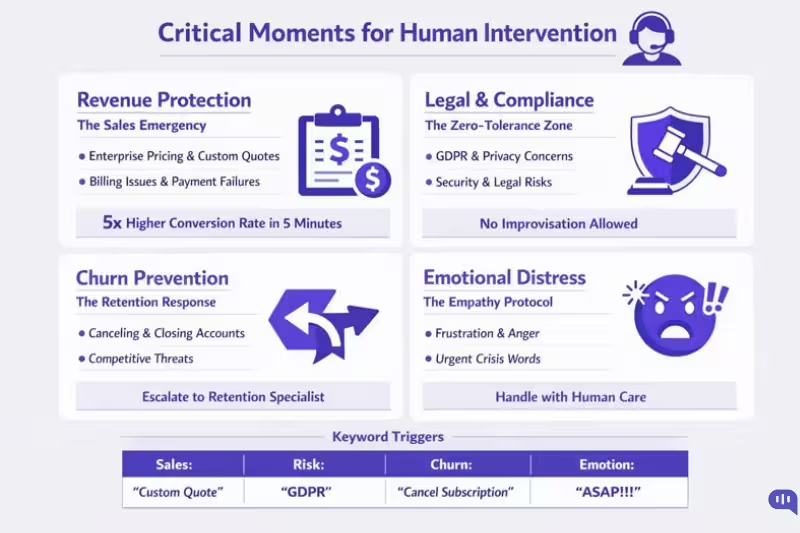
To build a robust system, you must categorize your keywords into four distinct “emergency protocols.”
1. Revenue Protection: The Sales Emergency
These keywords identify high-value opportunities where human persuasion is required to close a deal or save a high-value account.
- Sales Triggers: “enterprise pricing,” “custom quote,” “bulk discount,” “demo,” “upgrade my plan.”
- Billing Triggers: “overcharged,” “double billed,” “incorrect invoice,” “payment failed.”
- The ROI: B2B companies often see a 5x higher conversion rate when pricing inquiries are handled by humans within 5 minutes compared to bots.
2. Legal and Compliance: The Zero-Tolerance Zone
These terms represent high-stakes regulatory risks. AI should never be allowed to “improvise” answers in this category.
- Privacy: “GDPR,” “CCPA,” “data deletion,” “opt-out,” “privacy rights.”
- Security: “hacked,” “breach,” “unauthorized access,” “security incident,” “phishing.”
- Litigation: “lawsuit,” “attorney,” “litigation,” “suing,” “legal action.”
3. Churn Prevention: The Retention Response
When a customer signals they are leaving, the “bot trap” is at its most dangerous. Immediate human intervention can often save the relationship.
- Direct Signals: “cancel subscription,” “close account,” “terminate service,” “stop auto-renewal.”
- Competitive Risks: “considering competitors,” “switching to,” “too expensive,” “poor ROI.”
- The Strategy: While a bot can offer a “first-level save” (like a discount code), any persistent churn intent must escalate to a retention specialist.
4. Emotional Distress: The Empathy Protocol
AI struggles with high-arousal emotions. When a customer reaches a certain level of frustration, continuing the bot interaction only guarantees a 1-star review.
- Frustration: “frustrated,” “useless,” “waste of time,” “ridiculous,” “nothing works.”
- Aggression: Profanity, ALL CAPS messages, and excessive punctuation (!!!).
- Crisis: “emergency,” “urgent,” “ASAP,” “dying,” “immediate help.”
We’ve also added a small table with the keywords that most of clients end up using. This is not exhaustive and differs significantly from business-to-business.
| Category | Primary Keywords | Escalation Target | Priority |
| Sales | pricing, quote, upgrade | Account Executive | High |
| Legal | lawsuit, GDPR, hacked | Compliance/Security | Immediate |
| Retention | cancel, too expensive | Success Manager | High |
| Frustration | useless, agent, human | Support Lead | Medium |
In addition to keyword-based escalations, it might make sense to segment users to offer better support queues. This is especially true for businesses where some enterprise customers working in high-risk areas need immediate support.
How Does Segmenting Users Optimize Your Support?
In the traditional support model, every customer is treated as an equal “ticket” in a queue. While this feels fair, it is strategically flawed. If your most expensive agents are spending 40 minutes troubleshooting a password reset for a free-tier user while a $50,000 enterprise account is waiting for help with a mission-critical integration, your resource allocation is broken.
Support segmentation, allows you to move from service equality to service optimization. By using platforms like Kommunicate, you can bridge the gap between your CRM (like HubSpot or Salesforce) and your support chat to make real-time routing decisions.
How Can you Segment your Customer Support Function?
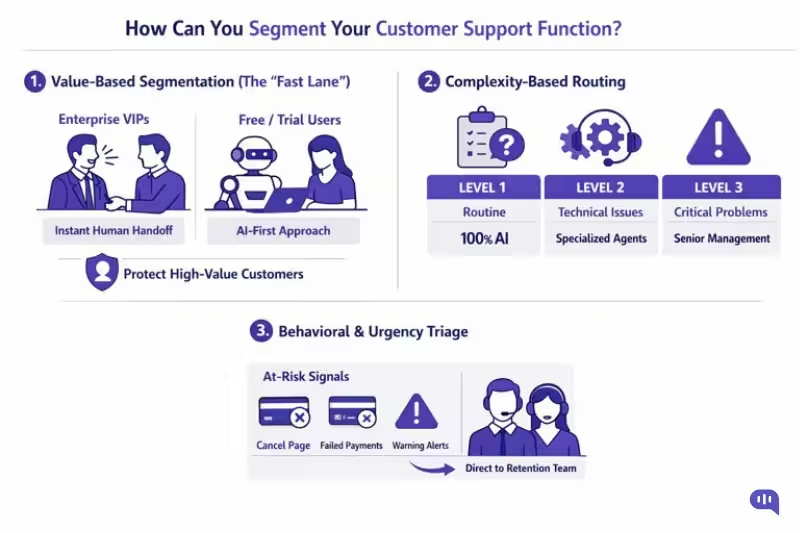
Effective segmentation ensures that the “human touch” is applied exactly where it generates the most ROI.
1. Value-Based Segmentation (The “Fast Lane”)
This is the most direct way to protect revenue. By identifying a customer’s tier at the start of a conversation, you can define different escalation rules:
- Enterprise VIPs: Immediate human handoff with sub-30-second wait times.
- Free/Trial Users: AI-first approach with escalation only after specific self-service hurdles are cleared.
- The Goal: Ensure your high-value relationships never feel “trapped” in a bot loop.
2. Complexity-Based Routing
Not all problems require the same level of expertise. Segmentation allows you to route by technical depth:
- Level 1 (Routine): Password resets and FAQs (100% AI resolution).
- Level 2 (Technical): API connections and configuration (Specialized Technical Agents).
- Level 3 (Mission Critical): System outages or security breaches (Immediate Senior Management intervention).
3. Behavioral and Urgency Triage
By analyzing patterns—such as a user repeatedly visiting the “cancel subscription” page or having three failed payment attempts—Kommunicate can trigger an “at-risk” segment. These users should bypass general support and go straight to a Retention Specialist.
What is the ROI of Segmenting Customer Support?
When you match support intensity to customer value, the business impact is measurable:
- Reduced Churn: High-value customers who receive immediate, expert help are 25% more likely to renew.
- Operational Efficiency: Agent utilization improves by 35-45% when they aren’t bogged down by routine queries that a bot could handle.
- Faster Resolution: Enterprise resolution times can drop by as much as 60% when the “triage” step is automated through segmentation.
Keyword-based escalations and customer segmentation are the operational parts of customer support. However, there might be cases where it’s better for AI to escalate conversations that indicate customer frustration.
Can AI Detect Frustration Before It Peaks?
Even without a specific “emotion sensor,” you can train your support engine to recognize the symptoms of a frustrated user. In a system like Kommunicate, the goal is to identify a “broken conversation” through behavioral triggers rather than waiting for the customer to get angry.
By setting up fallback logic and repetition rules, you create a system that is self-aware enough to know when it is failing.
The “3-Strike” Rule for Conversation Loops
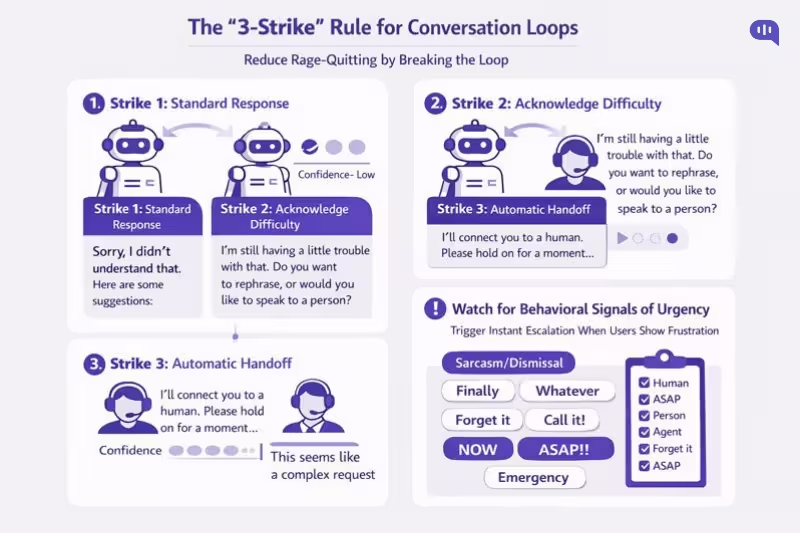
The most common cause of customer “rage-quitting” isn’t a single wrong answer—it’s the repetitive loop. You can prevent this by configuring your bot with a mandatory fallback threshold:
- Strike 1: The bot provides a standard “I didn’t understand” response and offers a few suggestive chips.
- Strike 2: The bot acknowledges the difficulty: “I’m still having a little trouble with that. Could you try rephrasing, or would you like to speak to someone?”
- Strike 3: Automatic Handoff. The bot realizes it cannot resolve the issue and proactively connects the user to a human, passing over the transcript so the agent can see the loop.
Leveraging the “Confidence Threshold”
Instead of a “hallucinated” or generic answer, set the bot to trigger an escalation when confidence is low. This transforms a potential failure into a “Concierge Moment.” The bot can say: “This seems like a complex request that needs a human’s touch. Let me get an expert for you.”
The Behavioral Signals of Urgency
You can also use Keyword Patterns as a proxy for emotion. By building a “Negative Sentiment” keyword list, you can trigger an immediate handoff the moment a user displays signs of irritation:
- Sarcasm/Dismissal: “Finally,” “Whatever,” “Forget it.”
- Direct Escalation: “Human,” “Agent,” “Person,” “Real person.”
- Urgency: “NOW,” “ASAP,” “Emergency.”
Summary of Detection Logic
| Scenario | Detection Method | Escalation Action |
| Repetitive Failure | Intent Fallback > 2 times | Auto-assign to human queue |
| Ambiguous Query | Confidence Score < 70% | Offer Human Handoff button |
| Direct Irritation | Negative Keyword Trigger | High-priority human routing |
| Time Gap | Unresolved query > 2 mins | Proactive agent “check-in” |
By monitoring how the conversation is flowing you can intervene before the customer’s frustration reaches a boiling point.
Now that we have a reasonable idea about escalation triggers, lets talk about the context that needs to transferred when escalations do occur.
What Context Do Humans Need During Handoffs?
The most damaging moment in a customer’s journey occurs the second a human agent joins the chat and asks: “How can I help you today?” To the customer, this question is a signal that the last five minutes they spent explaining their problem to a bot was a waste of time. This is the “Repeat Yourself” trap, and it is a leading cause of churn during support escalations. For an escalation to be truly “seamless,” the human agent must be fully briefed before they send their first message.
Eliminating the “Repeat Yourself” Trap
In a traditional handoff, an agent is often dropped into a long, messy transcript. They are forced to scroll through dozens of messages to find the core issue while the customer sits in silence, growing more frustrated.
Kommunicate solves this problem through its AI Summarization feature. Instead of requiring the agent to play detective, the system uses Generative AI to analyze the entire bot-to-customer interaction and instantly produce a concise summary.
The 3-Second Briefing
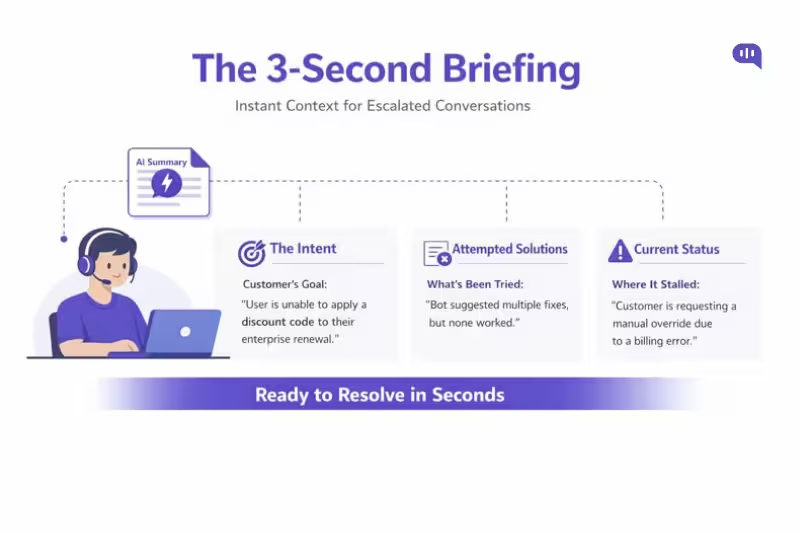
When a conversation is escalated, the agent is presented with a clear, bulleted summary of the interaction so far. This “internal note” ensures they understand three critical pillars of context within seconds:
- The Intent: What exactly is the customer trying to achieve? (e.g., “User is unable to apply a discount code to their enterprise renewal.”)
- The Attempted Solutions: What has the bot already tried or suggested? This prevents the agent from repeating the same failed troubleshooting steps.
- The Current Status: Where did the conversation stall? (e.g., “The bot provided the refund policy, but the customer is requesting a manual override due to a billing error.”)
Reducing Average Handle Time (AHT)
The impact of summarization isn’t just emotional; it’s operational. By providing an instant briefing, agents can skip the discovery phase and move directly to resolution. This can reduce Average Handle Time (AHT) significantly, as the agent no longer spends the first 2–3 minutes of the interaction “catching up.”
| Without AI Summarization | With Kommunicate AI Summarization |
| Agent reads 15+ messages to find context. | Agent reads a 2-sentence AI briefing. |
| Customer is asked to re-explain the issue. | Agent starts with: “I see you’re having trouble with [X]…” |
| High risk of “Context Blindness.” | Full visibility into bot failures and user intent. |
| Resolution Start: 3–5 Minutes | Resolution Start: <30 Seconds |
Preserving Sentiment and Nuance
Beyond just the facts, AI Summarization can capture the “vibe” of the conversation. If the summary notes that the customer has already expressed significant frustration, the agent knows to lead with a high-empathy apology rather than a standard technical greeting.
By weaponizing context, you transform the handoff from a point of friction into a “white-glove” experience where the customer feels heard, understood, and respected.
Finally, once your escalation progress is figured out, we’re going to focus on measuring its efficiency.
How Do You Measure Your Escalation Efficiency?
The ultimate goal of an escalation framework is to optimize the balance between automated speed and human expertise. If you aren’t measuring the efficiency of your triggers, you are flying blind. To turn your support center into a profit-protection engine, you must track three critical metrics that define the health of your AI-to-human handoffs.
1. The Escalation Rate vs. The “Bot Trap” Index
Your escalation rate is the percentage of total conversations that move from AI to a human.
- The Healthy Range: In a high-performing system, an escalation rate of 5–10% is typical.
- The Red Flag: If your escalation rate is 0%, your bot isn’t “perfect”—it’s likely trapping users who are then abandoning your brand in silence. Conversely, a rate above 50% suggests your AI is poorly trained or your triggers are too sensitive, wasting expensive agent time on routine tasks.
2. Deflection vs. Resolution (The 48-Hour Rule)
Many leaders mistake “deflection” (the bot finished the chat) for “resolution” (the problem was actually fixed).
- The Metric: True efficiency is measured by Resolution Rate. A bot “deflects” a ticket if the user stops talking, but it “resolves” the issue only if that customer doesn’t reach back out for the same problem within 48 hours.
- The Insight: If you see high deflection but low 48-hour resolution, your bot is likely “ghosting” customers or providing incomplete answers that eventually lead to high-friction escalations later.
3. Post-Handoff CSAT (Customer Satisfaction)
Does the handoff feel like a “promotion” to a higher level of service, or a “penalty” for the bot’s failure? By measuring Customer Satisfaction (CSAT) specifically on escalated tickets, you can identify friction in the transition.
- The Goal: A seamless handoff with summarization should result in a CSAT score that is higher than the bot-only average. If CSAT drops after a handoff, it usually indicates that the agent lacked context or the wait time was too long.
Keeping a strategic escalation cadence and measurings its efficiency is the best way to improve customer support overall.
Conclusion
The success of an AI support strategy is no longer defined by how many tickets a bot can “deflect,” but by how intelligently it knows when to step aside. A robust escalation framework transforms the human handoff from a point of friction into a strategic advantage.
By implementing these guardrails, businesses ensure that their AI remains a helpful asset rather than a conversational dead end, protecting the brand from legal risks while reserving human agents for the high-value moments that require genuine empathy and complex problem-solving.
Ultimately, the goal of intelligent escalation is to create a seamless journey where the customer never feels the “seams” between automation and human care.
Utilizing advanced features like Kommunicate’s AI Summarization ensures that when an escalation does occur, it is a white-glove experience characterized by speed and deep context rather than frustration and repetition. Moving from passive automation to an intelligent escalation engine isn’t just an operational upgrade; it’s a commitment to respecting your customer’s time and building a relationship rooted in trust.

Devashish Mamgain is the CEO & Co-Founder of Kommunicate, with 15+ years of experience in building exceptional AI and chat-based products. He believes the future is human and bot working together and complementing each other.