Updated on June 23, 2026
TL;DR
- Telecom customers are already on WhatsApp, but most telecom support still runs through IVR, email, and disconnected chat tools that customers find frustrating.
- WhatsApp is not just a messaging app. For CX leaders, it is the channel where every major churn signal can either be caught early or allowed to escalate.
- WhatsApp automation works for churn reduction when it resolves issues, not just deflects them. The distinction matters.
If you have read our previous piece on why 1 in 3 telecom customers churn within 12 months, you already know that churn usually starts inside support, not at the point of cancellation.
Countless moments that erode trust hide within the support dashboard:
- Billing disputes are left unresolved.
- Outages are communicated too late.
- Repeat contacts that go nowhere.
- Handoffs that make the customer explain their problem from scratch.
And for a growing share of telecom customers globally, these moments happen on WhatsApp.
This article looks at how CX leaders are using WhatsApp automation to address the specific support moments that drive churn. We’re going to cover:
- Why has WhatsApp become a retention channel?
- 5 churn moments that happen on WhatsApp
- What does WhatsApp automation look like in telecom support?
- What are the failure points in WhatsApp automation?
- How to implement WhatsApp automation at telecom orgs?
- What are the WhatsApp-specific metrics for CX leads?
- Conclusion
- FAQs
Why has WhatsApp become a retention channel?
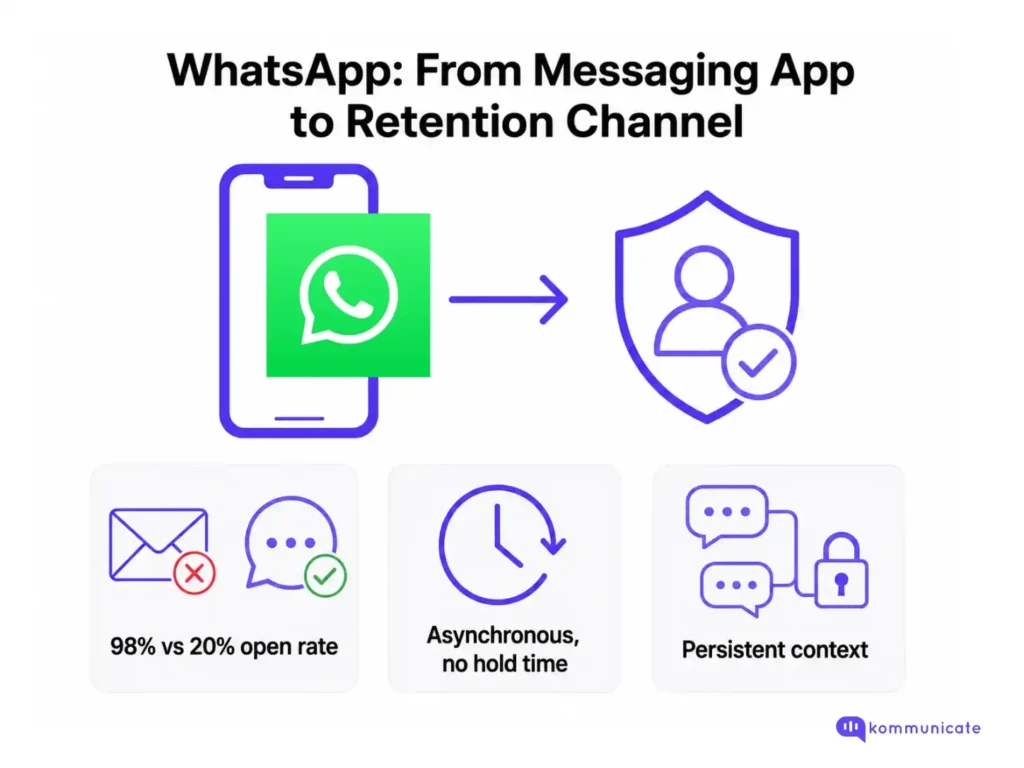
WhatsApp has 3.3 billion monthly active users as of early 2026, with approximately 2.3 billion of them opening the app every day.
The WhatsApp Business app has 764 million monthly active users, and around 175 million people message a business account daily. In markets like India, Brazil, and Indonesia, WhatsApp is not an alternative to the phone. It is the phone. It is where people:
- Communicate with family
- Pay bills
- Contact the companies they do business with.
For telecom specifically, that last point is significant. Even for Kommunicate’s telco customers, nearly 70% of our conversational AI conversations start on WhatsApp.
Additionally, outside adoption, the core theme for businesses on WhatsApp is engagement.
WhatsApp is the most effective platform for customer engagement
- WhatsApp messages reach customers with an open rate of 98% for opted-in broadcast messages, compared to around 20% for email.
- On customer preference, the same Meta-published research finds that 73% of consumers feel more comfortable communicating with customer service via live chat or messaging than email (61%) or phone (44%).
That preference is not arbitrary. Several factors make WhatsApp more attractive:
- It’s asynchronous, so customers do not wait on hold.
- It is persistent, so context carries across sessions.
- It is already on their phone, so reaching out requires almost no effort.
For churn reduction, that combination matters a great deal. Customers who can reach support easily, get a fast response, and resolve their issue without repeating themselves are less likely to start comparing competitors.
The problem is that most telecom WhatsApp deployments stop at presence. A number exists, a basic chatbot handles a few FAQs, and the rest gets routed to email or phone anyway. That is not a retention channel. It is a redirection loop.
The CX leaders making real progress are using WhatsApp to address the specific friction points that predict churn. And those friction points are well-defined.
5 churn moments that happen on WhatsApp
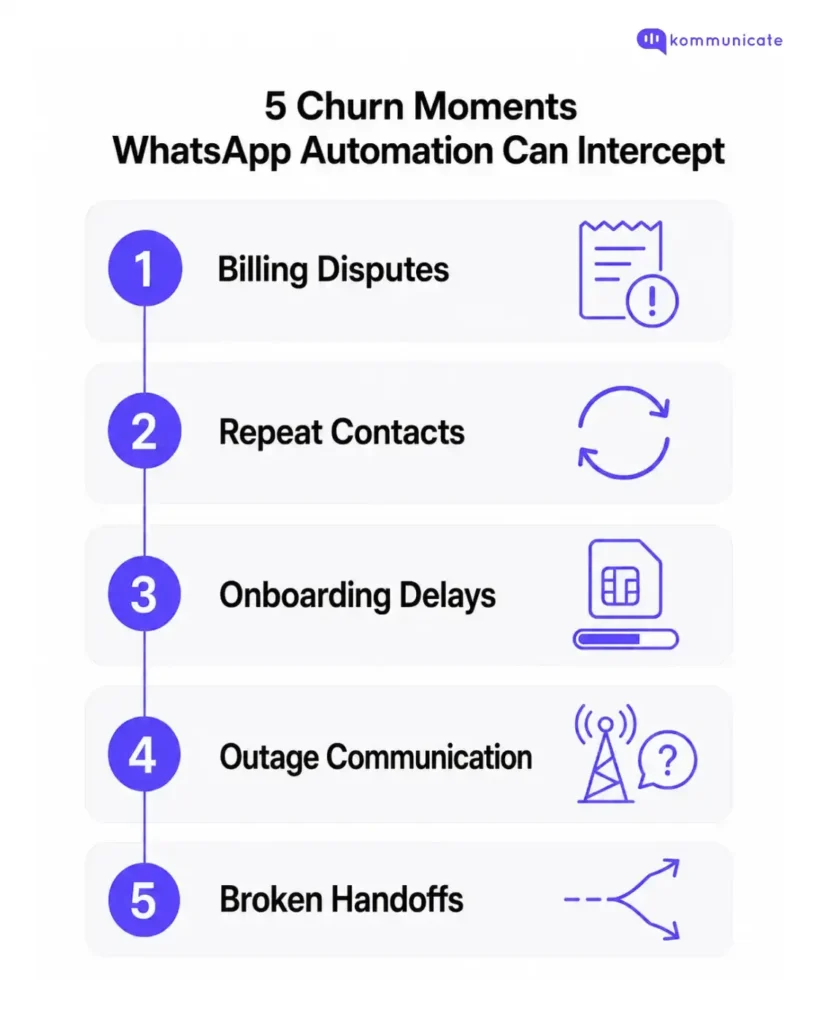
In our previous article on support-led churn reduction, we identified five support moments that most reliably predict customer churn. Each of these plays out differently on WhatsApp, and automation can address each one in specific ways.
1. Billing Disputes
Billing is the most trust-sensitive area in telecom support. When a customer sees a charge they do not understand, the conversation that follows will either restore their confidence or accelerate their exit. Most billing disputes are not really about the money. They are about whether the provider can explain the situation clearly and quickly.
On WhatsApp, an AI agent connected to the billing system can retrieve the customer’s current and previous bills, identify the change, and explain it in plain language. If the explanation is not enough, or if the dispute requires a credit or escalation, the conversation routes to a billing specialist with the full account context already populated.
The goal is not to answer billing questions. It is to restore confidence in the bill. WhatsApp’s speed and context-persistence make that goal more achievable than any of the channels it replaces.
What automation should handle: Balance comparisons, invoice retrieval, explanation of charges, and routing to billing specialists.
What should always reach a human: Disputed charges requiring account credits, suspected fraud, and customers who have contacted about billing more than once in 30 days.
2. Repeat Contacts
A customer who contacts support a second time for the same issue is already exhibiting a churn signal. Something failed in the first interaction: the resolution was incomplete, the explanation was unclear, or the follow-through did not happen.
Repeat contact is especially damaging in telecom because the issues are often urgent. A customer without data, without a working SIM, or without connectivity cannot afford to wait through multiple slow support cycles.
WhatsApp automation addresses repeat contact risk in two ways:
- It reduces the likelihood of a repeat contact by improving first-contact resolution. An AI agent resolves more issues completely, reducing the gap between “ticket closed” and “problem solved.”
- When a customer does contact support a second time, WhatsApp makes the repeat contact much less costly for the customer. An AI agent or a human agent can see immediately that this is a second contact, identify what happened in the previous session, and prioritize accordingly.
Customer service issues account for 30% of all telecom churn drivers, the single largest category ahead of price, competitor offers, or network quality. Repeat contact rate within that driver is a strong early indicator of churn risk.
Tracking it at the issue-type level on WhatsApp gives CX leaders a more granular early warning system than aggregate complaint volume ever can.
3. Onboarding Delays
The first 30 to 90 days are the period when a customer is most likely to churn silently. They have not yet built loyalty, and if the setup experience is slow or poorly communicated, many will simply wait until the contract window allows them to leave.
The challenge with onboarding churn is that customers often do not complain. SIM activation delays, number porting issues, KYC friction, and missed installation appointments accumulate quietly. By the time the customer formally cancels, the decision was made weeks earlier.
WhatsApp changes the economics of onboarding support significantly. Instead of waiting for the customer to call when something goes wrong, a WhatsApp flow can be triggered at each stage of the onboarding process: confirmation when activation begins, a status update at 24 hours, a proactive message if the activation takes longer than expected, and a simple check-in when everything is complete.
These are not marketing messages. They are operational communications that tell the customer: we know where you are in the process, and we are watching. That signal is enough to prevent many early-stage churn decisions.
Practical use cases: Activation status updates, porting timelines, KYC confirmation, router setup guidance, and post-activation check-ins.
4. Outage Communication
Customers understand that networks can fail.
Proactive communication during service failures builds up to 5x more trust than silent resolution, according to research on telecom customer experience. And when proactive notification is combined with automated restoration, inbound call volume during major outage events can drop by 30 to 50%.
WhatsApp is particularly well-suited for outage communication because it is already on the customer’s device, it does not require them to navigate to a website or app, and it supports rich messaging.
The workflow
- The network management system detects an outage and identifies affected customers by location and service type.
- A WhatsApp message goes to each affected customer, before most of them have noticed a problem or thought about calling in.
- The message confirms that the provider is aware, gives an estimated timeline, and closes the loop with a follow-up when service is restored.
For CX leaders, this workflow has a compounding benefit. Every customer reached proactively is a customer who does not call the contact center, does not sit on hold, does not interact with an IVR that does not know about the outage, and does not finish that interaction more frustrated than when they started.
Outage-related churn is almost entirely preventable. The customers who churn after outages leave because they felt abandoned while the failure happened.
5. Broken Handoffs
The most damaging support experience in telecom is not a slow response or a wrong answer. It is a customer who explains their problem three times to three different agents because the context never travels with them.
This is the broken handoff problem, and it gets worse as automation expands. Every additional layer is another potential point where the context drops.
WhatsApp automation, when built correctly, addresses this directly. An AI agent handling a conversation on WhatsApp should be building a structured summary in real time: customer intent, issue category, account context, steps already attempted, sentiment, and churn-risk level. When that conversation escalates to a human agent, the handoff should carry all of that context.
An AI chatbot with access to the company’s knowledge base and connected backend systems resolves between 55% and 70% of queries without requiring a human. The remaining 30–45% require human judgment.
As we point out throughout this section, WhatsApp automation can help you automate a lot of these problems. Let’s take a closer look at how that works in telecom.
What does WhatsApp automation look like in telecom support?
Theory is easy. The more useful question is what this actually looks like in production, across real telecom operators.
1. TelOne, Zimbabwe
TelOne is the largest telecom entity in Zimbabwe and has the second-largest fixed-line network in Southern Africa. When the company began selling broadband data packs, it ran into a problem that will be familiar to any telecom CX leader: customers were showing up in long queues at physical stores because there was no online purchase path.
TelOne built a website, but that created a different problem. A significant portion of their customer base was not browsing on laptops, and on mobile, loading a website consumed the data that those customers were trying to buy. The company needed a channel that was already installed on nearly every smartphone in Zimbabwe and cost nothing to open.
That channel was WhatsApp.
Working with Kommunicate, TelOne deployed a WhatsApp chatbot built on Dialogflow that gave customers self-service access to account balance checks, PIN recharges, broadband usage monitoring, and data pack purchases within the WhatsApp interface. When a customer needed something beyond the bot’s scope, the conversation was handed off to a human agent with full context intact.
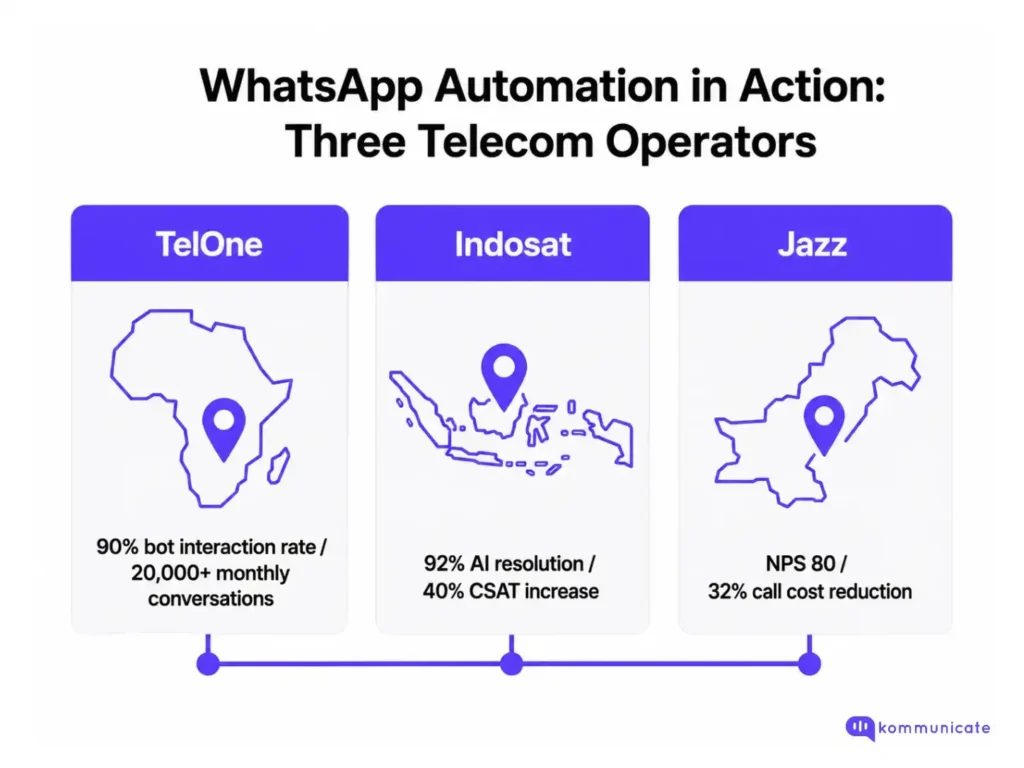
The operational impact was immediate. Of TelOne’s 20-person customer support team, 5 agents who had previously handled self-service queries were redeployed to handle more complex issues. 90% of customers now interact directly with the bot, and the deployment handles over 20,000 unique conversations per month.
The TelOne case is significant for a specific reason: it demonstrates that WhatsApp automation solves a channel access problem, not just a volume problem. The customers who previously stood in queues or avoided the website were not lost to a competitor.
2. Indosat Ooredoo Hutchison, Indonesia
Indosat Ooredoo Hutchison, one of Indonesia’s three largest telecoms with 94.6 million subscribers, deployed a WhatsApp chatbot to handle customer service across more than 200 individual use cases. These included checking data balances and remaining quotas, downloading bills, registering for value-added services, and troubleshooting common issues.
In Indonesia, calling customer service is not free, which means that many customers were inundating social channels looking for help rather than calling in. The WhatsApp deployment gave them a direct, cost-free path to resolution.
The results were significant. Customer satisfaction increased by 40%, with 70% of customers giving the chatbot the highest possible rating. Revenue directly attributable to WhatsApp grew fivefold in the first year. And 92% of customer queries were resolved without any human agent input across a user base that grew 168% during the same period.
The scale of that last number is worth sitting with: 92% resolution rate, no human input, across 200+ use cases, during a period of nearly 3x user growth. That is what a well-built, well-connected WhatsApp deployment looks like in practice.
3. Jazz, Pakistan
Jazz, one of Pakistan’s largest telecom operators, faced a different version of the same problem: long call center queues, slow ticket resolution, and customers who wanted self-service options on the channel they already used every day.
After deploying WhatsApp for customer service, Jazz reduced call costs by 32% while recording a Net Promoter Score of 80 out of 100: a strong signal that the shift to WhatsApp improved the customer relationship, not just the operational metrics.
The Jazz case is useful because it demonstrates a specific point: WhatsApp automation does not just deflect calls. When it resolves issues that previously required a call center agent, it produces satisfaction scores that legacy channels rarely achieved.
What All Three Cases Have in Common
TelOne, Indosat Ooredoo Hutchison, and Jazz did not deploy WhatsApp as a standalone chatbot.
In each case, WhatsApp was connected to the backend systems that matter, so the automation could retrieve and act on real customer information rather than serving generic responses.
And in each case, the human escalation path was preserved: when an issue exceeded the bot’s scope, the conversation moved to an agent with context intact. That combination is what makes the difference between a WhatsApp deployment that reduces churn risk and one that quietly increases it.
It’s important to note that while TelOne, Jazz, and IndoSat are success stories, there are several wrong ways to automate using WhatsApp. Since we’ve been deploying AI agents on the platform for nearly a decade, we can point out a few failure points in the next section.
What are the failure points in WhatsApp automation?
There is a version of WhatsApp automation that actively increases churn risk. It is worth describing clearly, because it is more common than the version that works.
The problem is usually not the channel. It is containment-focused thinking applied to a retention problem. There’s a significant gap between “ticket closed” and “problem solved.” On WhatsApp, that gap can be invisible in the aggregate data while causing increased churn.
There are three specific failure modes to watch for:
- Automation without backend access. A WhatsApp bot that cannot retrieve a customer’s actual account data cannot resolve billing questions, confirm plan details, or check real-time network status. It can only give generic answers to specific questions, which is worse than saying “I do not have access to your account” because it wastes the customer’s time before making them start over.
- Escalation without context. When a WhatsApp conversation hands off to a human agent without transferring the conversation history, intent, and account context, the customer starts their journey over. The channel looked efficient; the outcome was not. This failure is especially damaging for churn-risk customers.
- Automation during the wrong moments. A customer asking about cancellation, a customer whose second billing contact in 30 days has arrived, or a customer sending negative sentiment after an outage should not be greeted by an AI agent. They are retention conversations, and routing them through automation without a fast escalation path is exactly the kind of experience that converts a frustrated customer into a lost one.
The corrective is simple to describe, harder to implement: measure resolution rate, not containment rate. Track re-contact within 72 hours after any AI-handled conversation. Define specific trigger conditions that route directly to a human, and make sure those triggers fire reliably.
To maintain the reliability, let’s start talking about the implementation plan we’ve used across tens of telecom operators.
How to implement WhatsApp automation at telecom orgs?
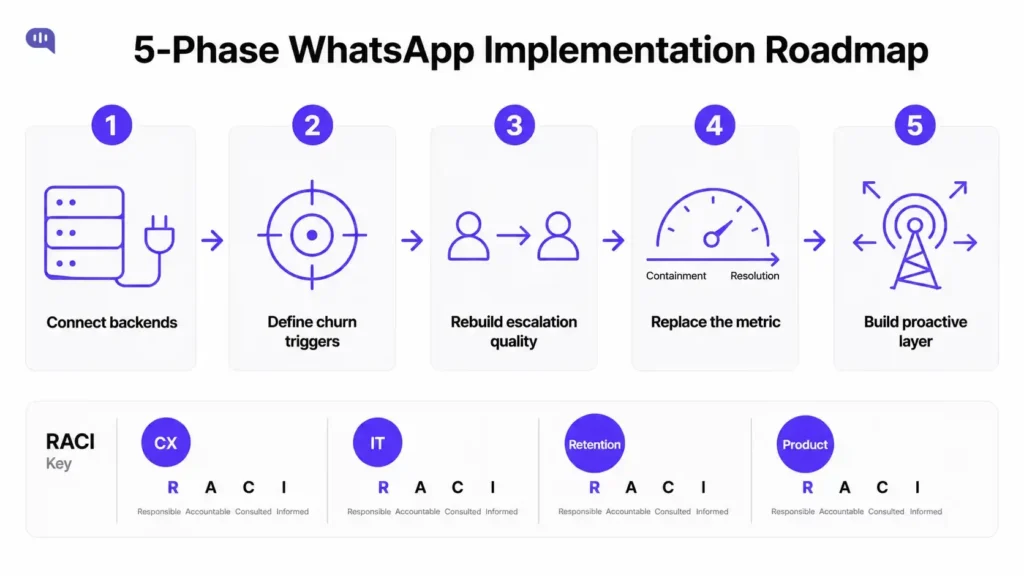
If you are starting from a basic WhatsApp presence, the path to a retention-oriented WhatsApp deployment has a few distinct phases.
Phase 1: Connect WhatsApp to your backend systems. A WhatsApp deployment that cannot access real account data cannot resolve real issues. The first investment is in connectivity: billing system, CRM, plan management, and network status. Without this, no amount of automation sophistication will produce the resolution rates that churn reduction requires.
Phase 2: Define your churn-risk trigger conditions. These are the conversation signals that should bypass automation and route directly to a human retention agent. They include: cancellation or number porting language, a second billing contact within 30 days, negative sentiment following an outage, and any customer identified in your churn-risk segment.
Phase 3: Rebuild your escalation quality. For every high-risk escalation path, define what the human agent receives: customer intent, issue category, account tier, conversation summary, steps already attempted, and sentiment. If the agent’s first message to the customer is a question about what happened, the handoff is broken and needs to be rebuilt.
Phase 4: Replace containment rate with resolution rate. Audit the WhatsApp flows that are currently measured by containment. Find the ones with high containment but high re-contact rates. Those flows are generating false positive data while failing customers. Rebuild them around a confirmed resolution.
Phase 5: Build the proactive communication layer. Once reactive support is working well on WhatsApp, the next layer is proactive: outage alerts by location, bill change notifications before the charge appears, and activation status updates during onboarding. These are the messages that reach customers before they decide to contact support.
RACI Matrix: Who Owns What
Across these five phases, four teams touch the work: CX/Support, Technology/IT, Retention/Commercial, and Product. The table below defines ownership clearly, because the most common reason WhatsApp deployments stall is not technical; it is accountability confusion between these functions.
R = Responsible (does the work) | A = Accountable (owns the outcome) | C = Consulted (input required) | I = Informed (kept up to date)
| Activity | CX / Support | Technology / IT | Retention / Commercial | Product |
|---|---|---|---|---|
| Map support interactions to churn data | A/R | C | C | I |
| Define churn-risk trigger conditions | A/R | C | C | I |
| Connect WhatsApp to CRM and billing systems | I | A/R | I | C |
| Build and maintain bot flows | C | A/R | I | C |
| Define escalation context requirements | A/R | C | I | I |
| Set and audit resolution metrics (vs containment) | A/R | C | I | C |
| Design proactive outage communication workflows | A/R | C | I | C |
| Integrate network status data for proactive alerts | C | A/R | I | C |
| Define retention actions by churn driver | C | I | A/R | C |
| Monthly cross-functional churn data review | A | I | R | R |
| Feed churn-correlated issues back to the product | I | I | C | A/R |
A few ownership points worth calling out explicitly:
- CX owns the trigger definitions, not IT. The conditions that route a conversation to a human retention agent need to be defined by the people who understand what churn looks like in a conversation. IT builds the routing logic; CX defines what it catches.
- IT owns connectivity, not the conversation design. Backend integration is a technical project. But what the bot says, how it escalates, and what context it passes to a human agent are CX decisions. Both need to be in the room when the handoff architecture is designed.
- Retention is consulted, not leading. In many telecom organizations, retention teams try to own the WhatsApp channel because it touches their KPIs. The RACI above reflects a better split: CX owns the support experience and the escalation quality; Retention owns the intervention actions once a high-risk customer is identified and routed to them. The two functions need a clean handoff point, not a shared ownership that creates conflicting priorities.
This is the model Kommunicate helps telecom CX teams implement: AI agents that resolve high-volume issues, detect churn signals in real time, and escalate complex cases with the full context human agents need to actually retain the customer.
There are also a few metrics that CX teams should look at after launching these automations.
What are the WhatsApp-specific metrics for CX leads?
Previously, we’ve covered the core support metrics for churn reduction: repeat contact rate, first contact resolution, customer effort score, churn after support contact, and escalation completion rate. Those all apply to WhatsApp, but there are additional metrics that matter specifically for a WhatsApp channel.
| Metric | What it shows | Why it matters for churn |
|---|---|---|
| Re-contact rate after AI interaction | Whether the chatbot actually resolved the issue | Prevents false confidence in containment numbers |
| Resolution without channel switch | How often do customers get a full resolution without moving to phone or email | High channel-switching indicates WhatsApp is deflecting, not resolving |
| Proactive message read rate | Whether outage and billing alerts are reaching customers | A low read rate means proactive communication is not working |
| Median response time on WhatsApp | How quickly customers get a first response | Response time above 5 minutes significantly reduces conversion |
| Escalation context completion rate | Whether human agents receive the full conversation context | Zero re-explanation from the customer is the benchmark |
| CSAT by issue type on WhatsApp | Whether satisfaction varies by issue category | Identifies which use cases are working and which need redesign |
| Sentiment at conversation close | Whether the interaction improved or worsened the customer’s mood | Surfaces high-risk conversations that closed without real resolution |
The most important principle behind all of these metrics is that a number that looks good but does not connect to retention outcomes is not a CX metric. It is an operations metric. The goal is not efficient conversations. The goal is to keep customers who stay.
Conclusion
Telecom customers are not on hold anymore. They are on WhatsApp. And the support experience they have there is shaping their retention decision in real time.
The CX leaders getting measurable results from WhatsApp are not treating it as a messaging tool. They are treating it as a support infrastructure question: which issues get resolved here, how does escalation work, what context travels with the customer, and how does the data feed back into the upstream decisions that cause the friction in the first place.
As we saw in the case of TelOne, WhatsApp can help you manage call volumes by routing as much as 90% of the conversation through the platform. The channel is performant and effective; you just need to take the first step to make it work for your use case.
If you need help adopting support AI agents into telecom, book a demo with us.
FAQ
WhatsApp is where telecom customers already spend a significant part of their day, which removes the friction of reaching support. More importantly, WhatsApp supports both automated and human interactions in the same thread, with persistent conversation history. That persistence is what makes it possible to catch churn signals early, escalate with full context, and communicate proactively.
The most reliable churn signals detectable on WhatsApp include: cancellation or number porting language, a second contact about the same issue within 30 days, negative sentiment following an outage or billing dispute, failed self-service attempts that end without resolution, and customers asking about contract terms or competitor comparisons. When these signals appear, the automation should route immediately to a human retention agent.
Backend connectivity is the most important factor. A WhatsApp chatbot that cannot access real account data cannot resolve the issues that drive telecom churn. It can only give generic answers, which adds friction rather than removing it. Effective telecom chatbots on WhatsApp are connected to CRM, billing, and network management systems, and they escalate to humans with full context when the issue exceeds their scope.
No. WhatsApp automation works well for high-volume, data-retrievable queries: balance checks, billing explanations, activation status, plan information, and troubleshooting common issues. It is not appropriate as the final handler for repeated billing disputes, cancellation intent, fraud reports, regulatory complaints, or emotionally escalated conversations. These should trigger fast escalation to a human agent, with the WhatsApp conversation history transferred as context.
The most important metrics are re-contact rate after an AI-handled interaction (did the chatbot actually resolve the issue?), resolution without channel switch (did the customer get an answer without moving to phone or email?), escalation context completion rate (did the human agent receive full conversation history?), and churn rate among customers whose support interactions happened on WhatsApp versus legacy channels. Open rate and containment rate are not churn metrics.
WhatsApp is the channel where the support-led churn reduction model described in our previous article is increasingly playing out in practice. The detect-diagnose-resolve-escalate-retain logic does not change. What changes is that more of those conversations are happening on WhatsApp, which means the automation, escalation triggers, and context transfer capabilities need to be built for that channel specifically.