Updated on July 28, 2026
TL;DR
Customers don’t expect every banking interaction to be instant, but they do expect timely answers when they need help. Long response times create unnecessary friction, leaving customers waiting for answers to routine questions and urgent issues alike. Over time, that response gap has become one of the biggest barriers to stronger customer engagement.
The opportunity is not to replace personalization, but to remove avoidable delays from common customer interactions. AI-powered conversational banking on WhatsApp allows banks to answer routine questions instantly, escalate complex issues to the right human agent, and maintain context throughout the journey.
Together, these capabilities improve customer satisfaction while supporting measurable business outcomes: higher engagement, better retention, and increased revenue.
| Challenge | Traditional Approach | AI + WhatsApp Approach |
|---|---|---|
| Long response times | Email queues and call centers | Instant messaging with AI support |
| Routine customer queries | Handled entirely by agents | AI resolves common requests in seconds |
| Complex issues | Multiple transfers between teams | AI summarizes context before human handoff |
| Customer engagement | Personalization campaigns | Continuous, responsive conversations |
| Compliance | Manual oversight | AI with consent management, audit trails, and human escalation |
Consider a customer who notices a declined debit card transaction while paying at a restaurant. Instead of calling the bank, they open WhatsApp and send a quick message asking why their payment failed.
Four hours later, they receive a reply asking for additional verification.
The issue wasn’t particularly complicated. It might have been a temporary fraud block, a daily transaction limit, or an expired card. An AI assistant with access to banking systems could have identified the cause in under a minute. Yet the customer spent hours waiting, growing increasingly frustrated.
Banks often describe their biggest customer experience challenge as personalization: better segmentation, richer customer profiles, more relevant recommendations. Those investments matter. But they overlook a simpler problem hiding in plain sight: customers disengage long before personalization has a chance to work if they cannot get timely answers.
This is where many conversations around banking customer engagement miss the mark. Engagement is not just about sending the right offer. It is about responding at the moment customers need help.
That makes response time one of the most practical and measurable engagement levers available today.
The combination of AI in banking customer service and WhatsApp banking gives financial institutions a realistic way to close that response gap without dramatically expanding support teams. AI handles routine interactions instantly while human agents step in when judgment, compliance, or empathy is required.
For banks looking to strengthen customer engagement, improving response times can deliver measurable results well before large-scale personalization initiatives begin to pay off. This article covers:
- Why banking’s engagement challenge is really a response-time challenge
- Why faster responses create measurable business value
- Why WhatsApp has become the preferred channel for conversational banking
- How AI closes the response gap while keeping humans in control
- Compliance considerations every bank should understand
- A practical example of AI-powered WhatsApp banking in action
- Key takeaways for banking leaders
Why banking’s engagement problem is really a response-time problem
Customer engagement has become one of banking’s favorite strategic priorities.
Annual reports, analyst presentations, and digital transformation roadmaps frequently focus on personalization, predictive analytics, and customer journeys. The assumption is straightforward: understand customers better, recommend more relevant products, and engagement will naturally improve.
The evidence supports part of that thinking. Gallup found that fully engaged customers represent a 37% premium in annual revenue compared to actively disengaged customers. Engaged customers are also more likely to stay loyal, purchase additional products, and recommend their financial institution.
While engagement is essential, many initiatives still fail to deliver expected returns because personalization is difficult to execute consistently. Most banks operate across multiple legacy systems, with customer information spread across separate databases for loans, savings accounts, insurance products, investments, and credit cards. Building a complete customer view requires significant integration work, governance, and ongoing maintenance.
Many organizations invest years improving customer data platforms, yet customers often notice something much simpler first: slow response times. Unlike personalization initiatives, delays are immediately visible. Every unanswered WhatsApp message, delayed fraud alert, or unresolved support request shapes how customers perceive the bank, causing engagement to break down before personalization can make an impact.
A customer who has spent six hours waiting for help with a blocked account isn’t thinking about personalized investment recommendations. They want the issue resolved. A customer who receives a quick response to a routine support request is far more likely to trust the bank and continue using its digital channels. Fast responses build trust, and trust makes personalization far more effective.
The hidden cost of response gaps
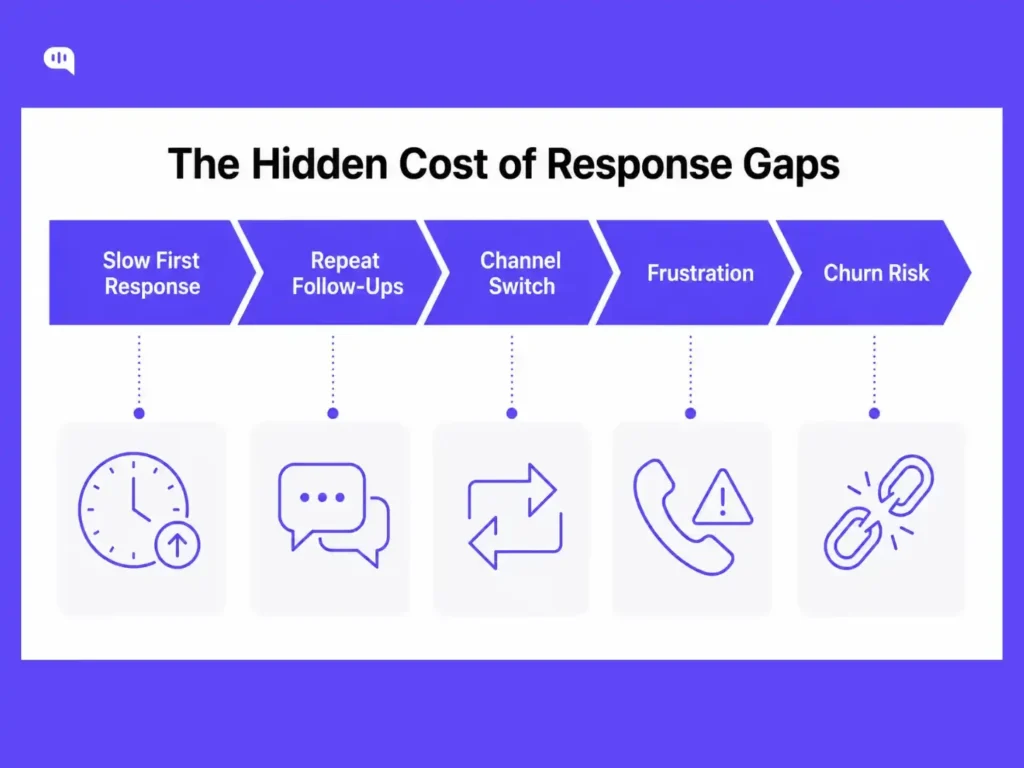
Response delays rarely appear on financial statements, but they influence several metrics banking leaders already monitor.
| Response Gap | Business Impact |
|---|---|
| Longer first-response times | Lower CSAT and customer satisfaction scores |
| Repeated follow-ups | Higher operational costs |
| Call center overflow | Increased support expenses |
| Channel switching | Poor omnichannel experience |
| Customer frustration | Reduced loyalty and churn risk |
These effects compound over time. When customers stop expecting quick responses through digital channels, they revert to phone calls or branch visits. That increases operational costs while reducing the effectiveness of digital transformation initiatives.
Closing response gaps therefore improves both customer experience and operational efficiency simultaneously.
Why faster responses create measurable business value
This shift becomes even clearer when viewed through an omnichannel lens.
McKinsey has reported that organizations delivering coordinated omnichannel experiences can double digital sales while increasing customer engagement by approximately 40%.
Many discussions frame this purely as a personalization challenge. It is equally a responsiveness challenge.
Customers move fluidly between mobile apps, websites, messaging platforms, and contact centers, and they expect conversations to continue regardless of channel. Every delay introduces friction. Every repeated explanation reduces trust. Every transfer without context increases customer effort.
Banks often measure digital adoption as a key success metric. Customers judge their experience more directly: whether someone answered their question quickly and effectively. Those two perspectives are more connected than they appear. When customers consistently receive immediate support through digital channels, they continue using them. Higher adoption increases opportunities for personalization, cross-selling, and self-service.
Response speed is therefore the first step toward stronger engagement, not the final optimization after personalization projects conclude.
Why WhatsApp has become the natural channel for conversational banking
Improving response times also requires meeting customers where they already communicate. For many markets, that place is WhatsApp.
Unlike email, customers expect WhatsApp conversations to feel immediate. Industry research consistently shows that around 80% of WhatsApp messages are read within 5 minutes.
Banks no longer need to persuade customers to download a dedicated support application or learn a new communication channel. Customers already use WhatsApp every day to coordinate work, communicate with family, and interact with businesses. Adding banking support to an existing habit reduces friction considerably.
Why this matters more in emerging markets
The opportunity is amplified in countries where WhatsApp has become the primary messaging platform. In India, millions of customers already communicate with retailers, healthcare providers, insurers, educational institutions, and government services through WhatsApp. Banks naturally become part of the same communication ecosystem.
Instead of asking customers to navigate complex IVR menus or log into online portals for every question, banks can support secure conversations within a familiar interface. This is one reason WhatsApp banking has expanded rapidly across Asia, Latin America, and parts of Europe.
Customers prefer messaging because it is asynchronous. They can send a question, continue their day, and return to the conversation without losing context. Banks benefit because messaging conversations are easier to automate than voice interactions.
Beyond notifications: The rise of conversational banking
Many banks initially viewed WhatsApp as another notification channel, using it to send transaction alerts, payment reminders, one-time passwords, and service announcements. Those use cases remain valuable but represent only part of the opportunity.
The bigger shift is toward conversational banking, where channels like WhatsApp support ongoing, back-and-forth customer interactions rather than one-way pushes. Examples include:
- Checking account balances
- Locating nearby branches or ATMs
- Blocking lost or stolen cards
- Tracking loan applications
- Explaining transaction declines
- Providing EMI information
- Updating KYC documentation
- Scheduling appointments with relationship managers
Modern AI can handle conversational flows that traditional rule-based chatbots often struggle to manage.
Why email and call centers are no longer enough
Email remains useful for formal documentation. Call centers remain essential for sensitive or highly regulated conversations. Neither is optimized for routine customer questions that make up a large share of daily support volume.
A balance inquiry should not require a phone call. A branch locator should not wait in an email queue. A card freeze request should not depend on office hours.
These are exactly the interactions where AI-powered messaging creates immediate value. Rather than replacing human advisors, it reduces the volume of repetitive work reaching them. When routine questions are resolved automatically, support teams gain more time for disputes, fraud investigations, lending decisions, and other conversations where expertise and empathy matter.
How AI in banking customer service closes the response gap
Speed alone doesn’t improve customer engagement. A chatbot that answers instantly but gives the wrong answer creates a different kind of frustration.
The goal of AI in banking customer service is to resolve routine interactions while recognizing when a conversation requires human judgment. That balance is typically measured through containment rate: the percentage of customer conversations AI resolves without agent intervention.
For banks, the highest-value automation opportunities are predictable, repetitive requests that follow well-defined workflows:
| AI Resolves Instantly | Human Agent Takes Over |
|---|---|
| Balance inquiries | Loan restructuring discussions |
| Card blocking | Fraud investigations |
| Branch and ATM locator | Investment advice |
| EMI schedules | Disputed transactions |
| Loan application status | Regulatory complaints |
| Credit card due dates | High-value relationship management |
When AI handles these Tier 1 interactions, support teams spend less time on repetitive questions and more time resolving issues that genuinely require expertise. The result isn’t fewer human conversations. It’s better ones.
The compliance guardrails that make WhatsApp banking work
Banking leaders are often less concerned about whether AI can answer customer questions than whether it can do so safely. That concern is justified.
Financial institutions operate under strict regulatory requirements around customer consent, authentication, record keeping, and data privacy. Introducing AI into customer conversations doesn’t remove those obligations.
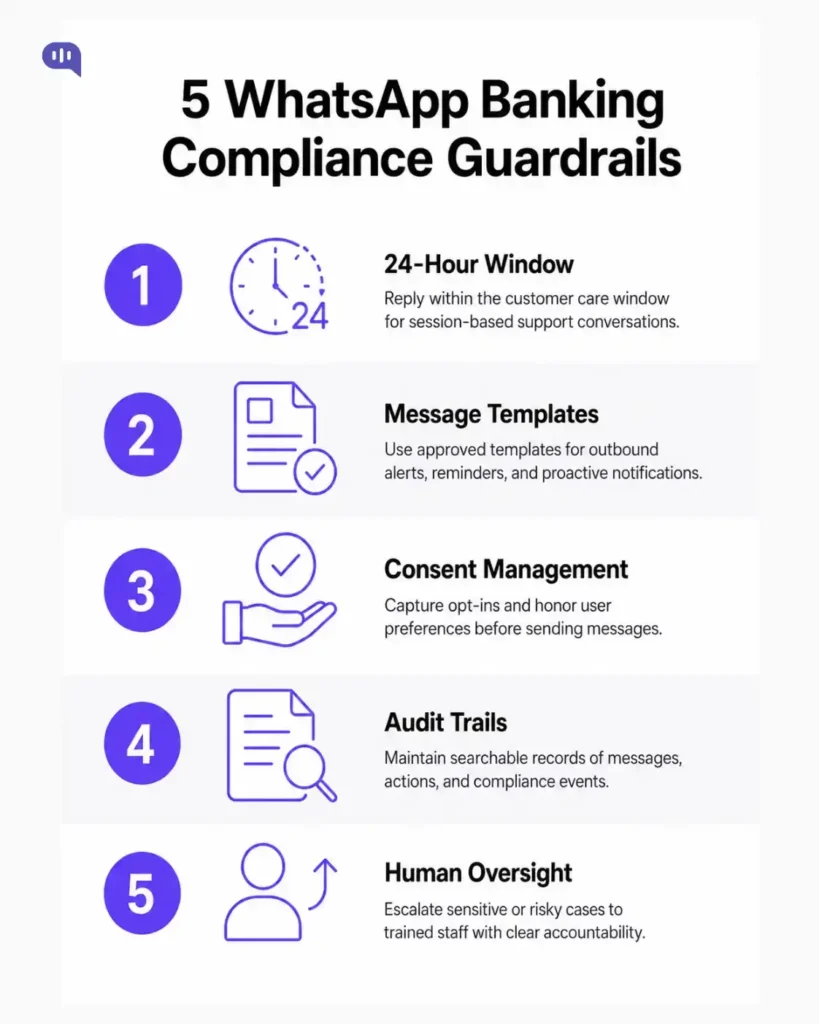
The WhatsApp Business Platform includes several built-in controls that support compliant customer communication when implemented correctly.
1. The 24-Hour customer service window
WhatsApp allows businesses to respond freely to customer messages during a 24-hour customer service window that begins when a user sends a message. Within that window, banks can conduct normal service conversations without requiring pre-approved message templates. Once the window closes, outbound communication generally requires an approved template unless the customer starts a new conversation.
For banking support teams, this structure encourages timely responses while limiting unsolicited messaging.
2. Message template governance
Outside the service window, businesses use Meta-approved templates across four categories:
| Template Category | Banking Example |
|---|---|
| Utility | Transaction confirmation, account updates |
| Authentication | One-time passwords, login verification |
| Marketing | New credit card offers, investment campaigns |
| Service | Customer support follow-ups where applicable |
Templates help ensure outbound communication remains predictable, auditable, and compliant with platform policies.
3. Consent management
Customers should explicitly opt in before receiving business messages on WhatsApp. Banks need clear processes for capturing consent, recording it, respecting opt-out requests, and managing communication preferences. Consent is not just a regulatory requirement in many jurisdictions. It is also fundamental to maintaining customer trust.
4. Audit trails
Financial institutions are expected to maintain records of customer interactions. AI-powered support platforms should therefore provide conversation history, escalation records, agent actions, AI-generated summaries, and customer authentication events. These records simplify internal reviews while supporting regulatory reporting requirements.
5. Human oversight
Meta requires businesses using the WhatsApp Business Platform to provide customers with a path to human assistance where appropriate. That expectation aligns naturally with banking operations. AI can resolve routine requests quickly, but humans remain responsible for exception handling, sensitive financial decisions, complaint resolution, regulatory disclosures, and relationship management.
Automation works best when customers never feel trapped inside it.
How Banks can close the response gap?
Closing the response gap takes more than adding AI to an existing support workflow. Banks need to rethink how customer conversations move from the first message to final resolution.
AI handles repetitive requests such as balance inquiries, card blocks, branch locators, and loan status updates. When a conversation becomes more complex, AI should recognize its limitations: gather the necessary information, summarize the interaction, and transfer the customer to the appropriate team. The handoff should carry the full conversation history and relevant context so customers don’t have to repeat themselves.
Over time, banks benefit from shorter response times, higher self-service adoption, lower support costs, and stronger customer satisfaction. More importantly, they build trust by consistently being available when customers need them.
Here’s what that looks like in practice.
Example: Resolving a potential fraud alert on WhatsApp
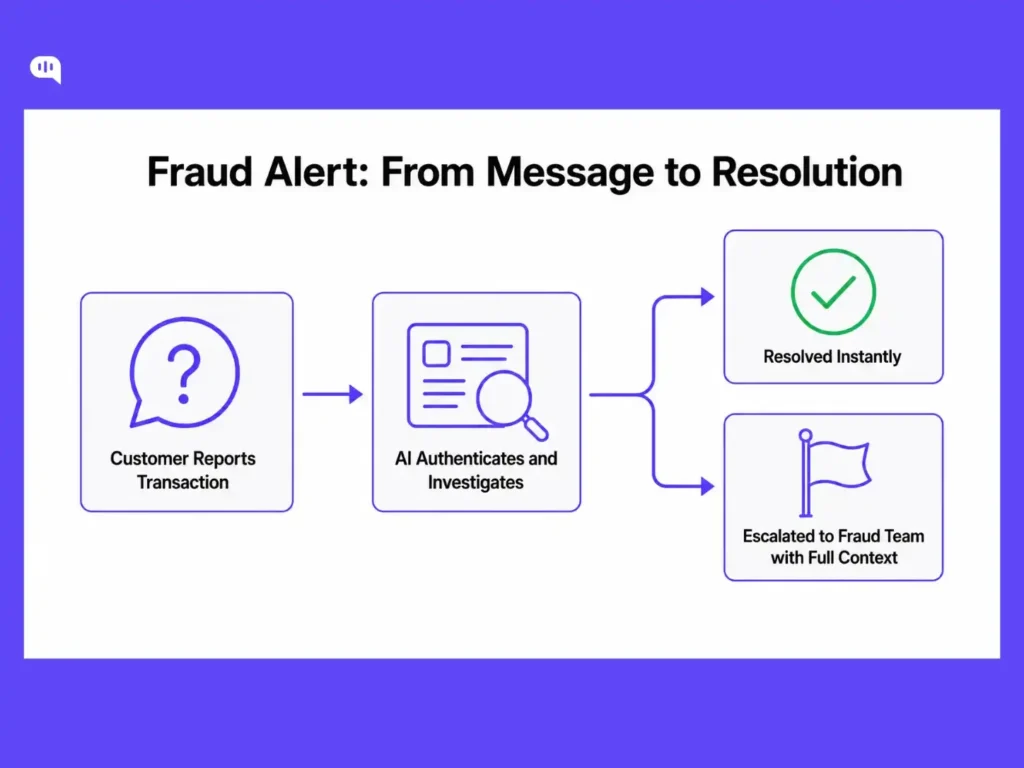
Step 1: Customer starts the conversation
“I don’t recognize this card transaction.”
The AI immediately authenticates the customer using the bank’s approved verification workflow.
Step 2: AI investigates
The assistant checks transaction history and identifies that the payment originated from an online merchant previously used by the customer. It explains the merchant descriptor and asks whether the customer still believes the transaction is unauthorized.
If the customer confirms the transaction is legitimate, the issue is resolved within minutes without human intervention.
Step 3: Escalation when necessary
If the customer replies: “No, I’ve never purchased from this merchant,” the AI recognizes a potential fraud scenario. Rather than continuing with scripted responses, it summarizes the conversation, collects relevant transaction details, flags the interaction as urgent, and routes it to the fraud investigations team.
The fraud specialist immediately receives the customer’s verification status, transaction details, AI findings, and the steps already completed. Because the full context is preserved, the customer doesn’t have to repeat their story, and the investigation can begin immediately.
Learning from early leaders
Several financial institutions have already demonstrated what AI-powered customer support can achieve.
Bank of America’s virtual assistant Erica has handled billions of customer interactions and now supports tens of millions of customers across everyday banking tasks: checking balances, reviewing transactions, tracking spending, and receiving personalized financial insights.
The significance isn’t simply the volume of conversations. It reflects a broader shift in customer expectations: AI has become a trusted service channel for routine banking interactions, not a novelty.
Banks don’t need to replicate Erica feature for feature. They should identify high-volume customer journeys where faster responses create measurable improvements in customer experience.
Case Study: HDFC Life’s WhatsApp-First Customer Support
A closer example is HDFC Life, which uses Kommunicate’s AI-powered chatbot to deliver policy support through one of India’s most widely used messaging platforms. Customers can access policy information, download documents, make premium payments, locate nearby branches, and receive answers to hundreds of policy-related queries without waiting for an agent. The chatbot also supports multilingual conversations and securely authenticates users before sharing account-specific information.
For HDFC Life, the chatbot handles everyday customer queries, freeing agents to focus on more complex requests such as claims and policy changes. Customers receive faster support while still having the option to speak with a human when needed.
Conclusion
Banks have invested heavily in personalization, but even the most tailored experience falls short if customers can’t get timely answers when they need help. Closing the response gap is one of the most effective ways to improve banking customer engagement.
This is where AI-powered conversational banking adds value. By instantly resolving routine requests, escalating complex issues with full context, and supporting customers on familiar channels like WhatsApp, banks can deliver faster, more seamless experiences. Platforms like Kommunicate combine AI automation with human handoffs to help financial institutions improve both operational efficiency and long-term customer trust. As digital banking evolves, the banks that respond fastest will be the ones that build stronger customer relationships.

Devashish Mamgain is the CEO & Co-Founder of Kommunicate, with 15+ years of experience in building exceptional AI and chat-based products. He believes the future is human and bot working together and complementing each other.