Updated on June 19, 2026
TL;DR
Full claims automation is a customer experience liability. The smarter model is:
- Use AI to apply clear policy rules verbatim
- Route ambiguous cases to human adjusters with AI support
- Flag suspicious submissions for professional review
Full automation looks good on paper, but human-augmented workflows drive better CX and efficiency.
The insurance industry has spent the last few years chasing full automation for claims processing. The pitch sounds good:
- You feed a document into a pipeline
- AI assesses it
- AI approves or denies it and closes the ticket
But this pitch often breaks in practice.
Full claims automation affects customer experience more than it affects operations. Completely replacing human judgment in the claims process can hurt policyholders when they’re going through a tough time. The better path is to use AI as a copilot that only automates what’s needed.
In customer support, this model already has a name: agent assist. It’s the idea that AI works best not as a replacement for human agents, but as a layer that handles retrieval, pattern-matching, and drafting, while the human stays in control of what actually gets decided and communicated.
In this article, we’re going to talk about why claims processing works better in the copilot model. We’ll cover:
- Full automation causes loyalty problems
- What is the cost of completely removing human judgment?
- Which claims should be routed to insurance agents?
- Why are the edge cases in claims important?
- How does the copilot model work?
- Conclusion
Full automation causes loyalty problems
When a claimant submits documentation for a serious loss, they admit that they’re facing some serious problems. So, the claims experience starts mattering more than the outcome of the claim itself.
Full automation removes the human from this moment. The workflow becomes:
- The claimant submits a claim
- The system processes it
- An approval or denial arrives
This makes the process opaque. The claimant can’t ask follow-ups, and they feel lost. They’ve experienced a serious problem and realized that the carrier isn’t ready to answer questions.
This is a retention problem
Customers who feel processed don’t renew. They don’t refer. They don’t extend coverage. And increasingly, they feel like they’ve lost control.
A recent study from the University of Kenbangsaan in Malaysia showed that customer harms from these kinds of AI processes play out in the following categories:
- Fairness concerns
- Anxiety
- Perceived loss of control
This is the same dynamic that happens with leads in the insurance marketing funnel: conversational AI that re-engages warm leads works precisely because it keeps a human-feeling conversation alive. This applies to retention as well: people buy from and stay with insurers who make them feel heard.
A copilot model helps preserve the human connection.
- The AI handles the legwork: Pulling the documents, checking the coverage, flagging inconsistencies, and surfacing the relevant policy language.
- The human makes the call: Communicates it, and owns the relationship.
For insurance carriers, this is the best of both worlds. AI is used to drive more accurate claims decisions at scale, while human insurance agents drive better retention. The marginal loss in speed is well-compensated through the retention rates.
To better understand the ROI, it makes sense to quantify how customers are hurt by the complete removal of human judgment.
What is the cost of completely removing human judgment?
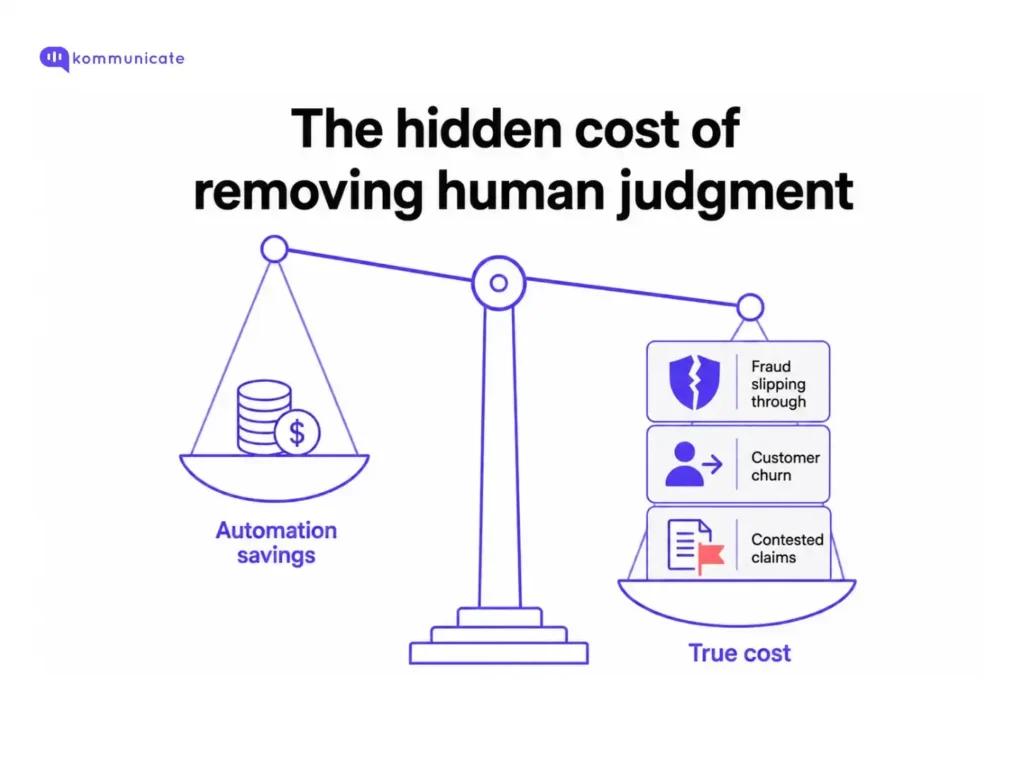
The argument for full automation is usually framed as cost reduction. Fewer adjusters. Shorter cycle times. Lower overhead per claim.
But the math misses a few line items.
- Contested claims cost more to resolve than claims where a human communicated clearly upfront.
- Fraud that slips through an automated gate costs more.
- Customers who churn because they feel underserved cost more in acquisition to replace.
This is also a trend we see reflected across the funnel: 84% of insurance prospects never complete a quote, often because the process felt impersonal or too friction-heavy to finish.
The cost of bad automation compounds across the entire customer journey, not just at the claims desk.
Humans should be an active part of the claims process because it acts as quality control and a way to build customer loyalty and retention.
The copilot model actively solves for this.
- It redirects human effort toward critical discussions & decisions.
- Routine claims are automated fast.
- Suspicious claims get flagged for deeper review
We’re advocating for human judgment in this process because it displays empathy and helps customers during tough times. So, which claims should be routed to human agents?
Which claims should be routed to insurance agents?
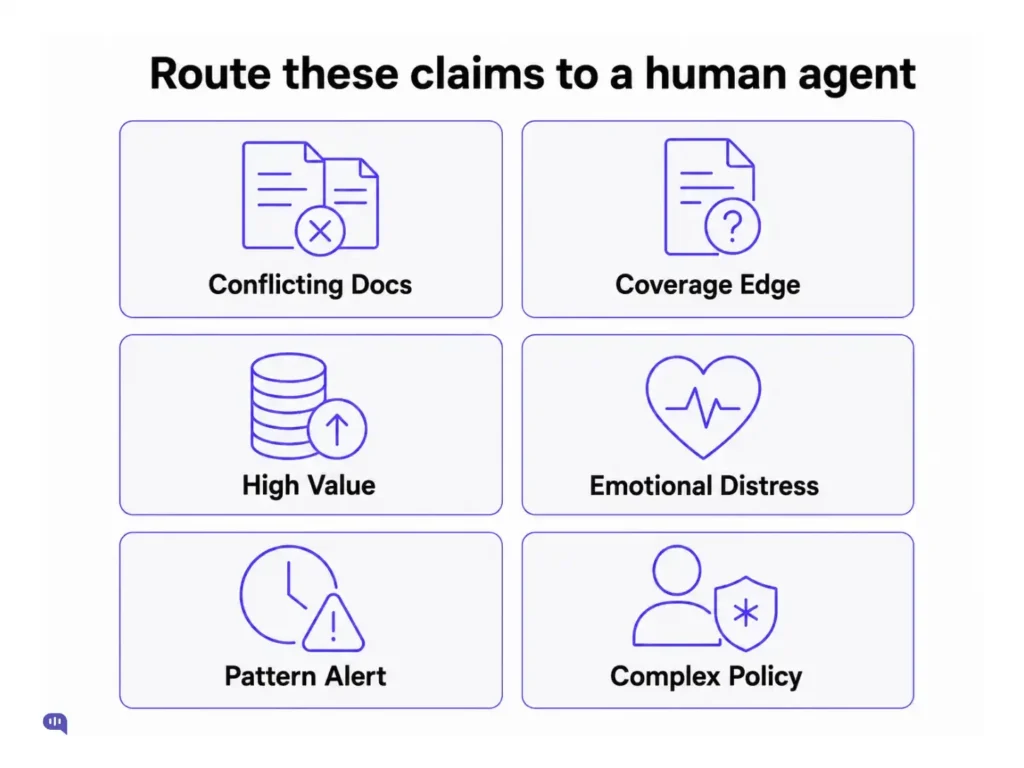
Not all claims are created equal. Some (like a standard auto claim where the repair invoice matches the coverage tier) are purely mechanical. AI automation should handle these processes.
But the moment ambiguity enters the picture, the calculation flips completely. These are the claims that should always reach a human agent:
- Claims with conflicting documentation. When the incident report, medical records, or repair estimates don’t tell the same story, a human needs to reconcile the discrepancy.
- Edge-case coverage questions. Policies have grey areas. When a claim sits on the boundary of what’s covered, the interpretation has real financial and legal consequences. That’s not a decision to delegate to a confidence score.
- High-value claims. The higher the payout, the higher the cost of a wrong decision in either direction. Claims above a defined value threshold warrant human review by default, regardless of how clean the documentation looks.
- Claims involving significant emotional distress. A house fire, a serious health event, the aftermath of a major accident. An automated response at this moment is a loyalty risk.
- Claims with an unusual submission pattern. Documents filed suspiciously fast after an incident, multiple claims from the same policyholder in a short window, or inconsistencies between the claim date and supporting records all warrant a second look from someone with judgment, not just pattern-matching logic.
- First-time claimants with complex policies. Someone navigating a claim for the first time, on a policy with multiple exclusions or riders, is likely to misunderstand what they’re entitled to. A human agent can prevent a bad outcome for both sides.
A claims copilot knows the difference between these categories and the clear-cut ones. Additionally, it’s important to account for edge cases in the claims process.
Why are the edge cases in claims important?
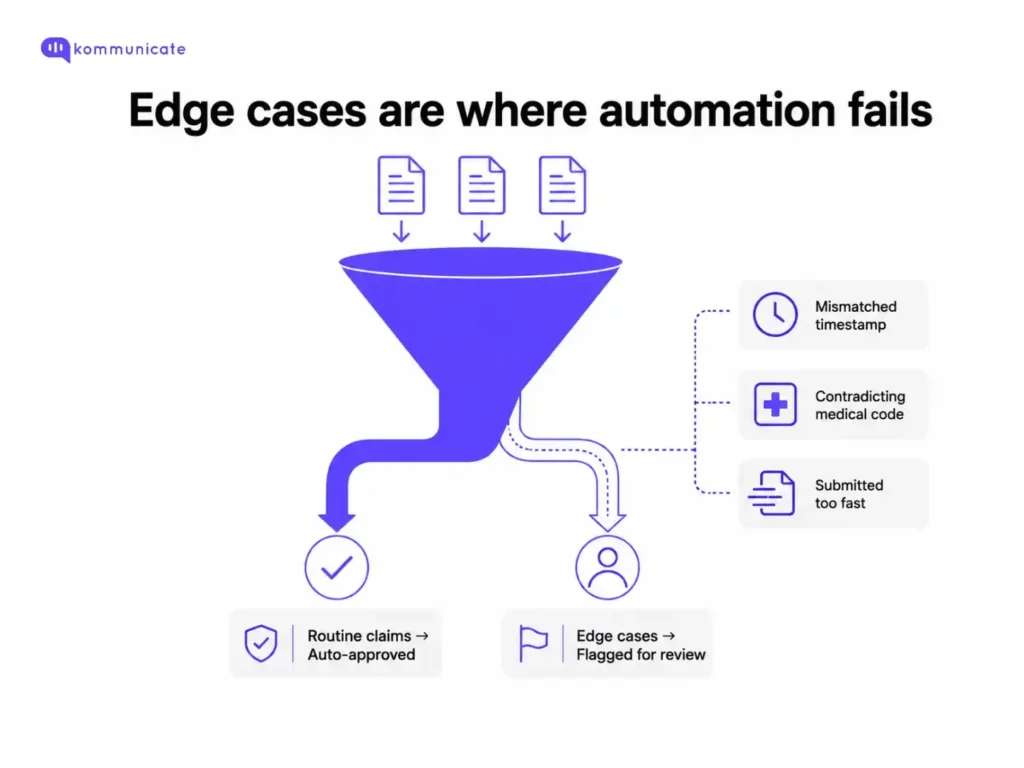
When you fully automate document review, the following things happen:
- The system either flags everything (creating noise that humans tune out)
- It flags nothing (because it’s optimized for throughput)
The document submission stage is the most susceptible to fraud
A claims copilot handles this differently:
- It reads the submission
- Matches it against expected patterns
- And when something doesn’t fit, it routes the file to a professional
This routing reduces AML fraud across the ecosystem. In doing this, the claims copilot is doing what it’s best at: pattern recognition at scale.
Which brings us to our next point: how to architect a claims copilot?
How does the copilot model work?
The mechanics are straightforward:
Tier 1 – Automated, verbatim policy application.
Claims that meet every criterion in a clear policy get processed automatically. The AI confirms document completeness, verifies coverage match, and approves. Speed without compromise.
If you’re evaluating which AI tools are actually accurate enough to operate at this tier, it’s worth looking at how the leading insurance chatbots perform on real policy documents, because Tier 1 is where you’re trusting the machine to apply the rule without a human check.
Tier 2 – AI-assisted human judgment.
Claims with any ambiguity go to an adjuster, but with AI support. This is the agent assist model in practice: the AI has already done the retrieval work, surfaced the relevant policy sections, flagged the inconsistencies, and drafted a read on likely outcomes.
The adjuster sees all of it in one place, makes the call, and owns the communication. They’re faster and more consistent because agent assist eliminated the search-and-stitch overhead that burns time and introduces error.
Tier 3 – Professional review.
Documents that trip any of the defined red flags go to a specialist. The AI job here is to spot what a human has to examine.
The customer experience across all three tiers is consistent:
- Simple claims are fast
- Complex claims are handled carefully
Additionally, each employee reviewing these claims also gets access to the full context of the claims, simplifying the whole process.
Conclusion
Conversational AI for insurance. However, it’s important to architect human judgment into every claim that requires it.
Our suggested process goes like this:
- Apply policy mechanically where the policy is mechanical
- Route judgment calls to people with judgment
- Flag red flags for professionals
A copilot makes your people better at their jobs. Automation removes them from the job entirely.
In an industry where trust is the product, that’s not a feature. It’s a liability. The carriers getting this right are thinking about lead generation, nurturing, and claims as one continuous experience, not three separate pipelines. The copilot model is what makes that continuity possible.
If you want to build a claims copilot with document handling, feel free to book a call with Kommunicate.

Devashish Mamgain is the CEO & Co-Founder of Kommunicate, with 15+ years of experience in building exceptional AI and chat-based products. He believes the future is human and bot working together and complementing each other.