Updated on January 2, 2026
The banking industry is becoming online-first with every passing day. Today, 84% of customers use online banking, and 78% use mobile apps to reach their primary bank accounts. As a result, customers expect more from these online experiences.
72% of customers expect immediate service, and 70% want an omnichannel experience where every agent is aware of the full context of their queries.
Conversational AI has played a crucial role in bridging the gap between digital and real-life experiences. In the absence of a dedicated banking RM, newer customers rely on conversational interfaces to find out information about products and services.
AI agents across banking work remarkably well. According to Juniper Research, chatbots in banking alone are saving the industry billions of dollars annually by deflecting routine interactions.
In this article, we’ll unpack what conversational AI actually means for financial services. We’ll cover:
- What Is Conversational AI in Financial Services?
- What are the Benefits of Conversational AI in Financial Services
- What are the Customer-Centric Use Cases of Conversational AI in Finance?
- What are the Operational Use Cases for Conversational AI?
- How do you Deploy Conversational AI for Financial Services?
- How can you Integrate Conversational AI in Financial Services?
- How to Manage Risk, Compliance, and Governance for AI Agents in Financial Services?
- How Can You Measure the ROI of Financial Services AI Agents?
- Conclusion
What Is Conversational AI in Financial Services?
Conversational AI in financial services refers to AI systems that can understand natural language, interpret customer intent, securely access backend financial systems, and deliver personalized responses or complete tasks in real-time. Unlike traditional scripted bots, conversational AI can handle contextual, multi-turn dialogues across various channels, including mobile apps, websites, and WhatsApp, providing customers with 24/7, high-accuracy support without requiring human intervention.
To understand how this interface layer works in the financial service ecosystem, we can look at some use cases that it can automate:
- Account & Balance Queries – Customers can instantly check balances, recent transactions, credit card dues, fixed deposit maturity dates, or statement summaries.
- Card & Payment Support – Bots can block/unblock cards, raise chargeback requests, share payment reminders, and guide customers through UPI or bank transfer troubleshooting.
- Loan & Credit Assistance – Conversational AI can pre-qualify borrowers, run eligibility checks, guide them through the documentation process, and provide instant updates on loan status, EMIs, and interest rates.
- Fraud Alerts & Security Verification – AI assistants can notify customers of suspicious activity, verify their identity using multi-factor workflows, and assist with dispute resolution—reducing risk and panic during fraud events.
- Personalized Money Insights – By analyzing transaction patterns, spending categories, and historical data, conversational AI can provide personalized nudges on budgeting, saving, investments, and financial well-being.
These use cases are significantly expanded when these AI systems also incorporate agentic AI.
How Does Agentic AI Improve Conversational AI?
Agentic AI is the next evolution of conversational AI. These are specialized AI systems that can act, reason, and plan autonomously. Instead of waiting for a user prompt, agentic AI can take multi-step decisions, initiate workflows, and coordinate across systems, such as CBS, CRMs, and payment rails, to achieve a defined goal.
Examples in financial services include:
- Continuously monitoring risk signals and taking preventive actions
- Auto-optimizing EMI schedules based on user cash flow
- Running multi-step KYC remediation workflows
- Suggesting investment rebalancing when a portfolio drifts
These systems function like proactive digital financial operators, which differentiates them from basic chatbots.
Agentic AI v/s Traditional Conversational AI (Chatbots)
| Traditional Conversational AI | Agentic AI |
| Responds to incoming queries | Can initiate actions without being prompted |
| Handles single-step tasks | Executes multi-step workflows end-to-end |
| Relies on predefined intents | Uses planning, reasoning, and autonomous decision-making |
| Operates primarily within chat UI | Operates across APIs, systems, and channels |
| Works reactively | Works proactively and continuously |
While both have their place, agentic AI is the next stage of AI evolution. This is where financial institutions can move from “chat assistants” to autonomous agents that reduce cost, improve compliance, and deliver personalized customer outcomes at scale.
Now that you understand conversational AI and its place in the financial services stack, let’s understand why businesses use these products.
What are the Benefits of Conversational AI in Financial Services?

Financial services operate in one of the most demanding customer environments. Conversational AI helps institutions bridge the widening gap between digital demand and traditional service models by delivering accurate, real-time support at scale. This happens in the following ways:
- Faster, Always-On Customer Support
Customers expect instant responses, regardless of time zones or branch hours. Conversational AI provides round-the-clock assistance across mobile apps, websites, WhatsApp, and voice channels. This eliminates long wait times, reduces call center load, and provides customers with immediate resolutions to everyday banking needs, eliminating the need for human agents.
- Significant Reduction in Operational Costs
A large portion of financial queries (60-80%) is repetitive, simple, and data-driven. By automating these interactions, conversational AI reduces dependence on human support teams, cuts call-center costs, and frees agents to focus on complex, revenue-generating, or regulatory-sensitive cases. Banks and NBFCs that utilize AI-driven assistants often experience a 20–40% improvement in agent productivity and a meaningful deflection of L1 workloads.
- Improved Accuracy, Compliance, and Reduced Error Rates
Unlike human agents who may vary in performance, conversational AI maintains consistent, compliant responses across every conversation. AI agents adhere to regulatory messaging, avoid mis-selling, and automatically log all interactions for audit purposes. With embedded guardrails, they can provide error-free information on rates, KYC steps, EMI schedules, and dispute processes.
- Hyper-Personalized Financial Guidance at Scale
Conversational AI can analyze spending patterns, transaction history, loan performance, and customer behavior to deliver contextual recommendations instantly. This enables financial institutions to offer personalized nudges tailored to each customer’s economic footprint. Personalization that once required a relationship manager is now accessible to every customer, 24/7.
- Seamless Omnichannel Experience Across Customer Touchpoints
Customers frequently move between channels—website → app → WhatsApp and expect a consistent experience. Conversational AI enables continuity by retaining context across channels, surfacing conversation history, and handing cases off to human agents without information loss. This reduces friction and builds a unified, predictable customer journey.
Conversational AI delivers quantifiable improvements across customer experience, cost efficiency, compliance, and personalization. Now that we understand its core benefits, the next step is to explore how these advantages translate into fundamental, everyday interactions.
What are the Customer-Centric Use Cases of Conversational AI in Finance?
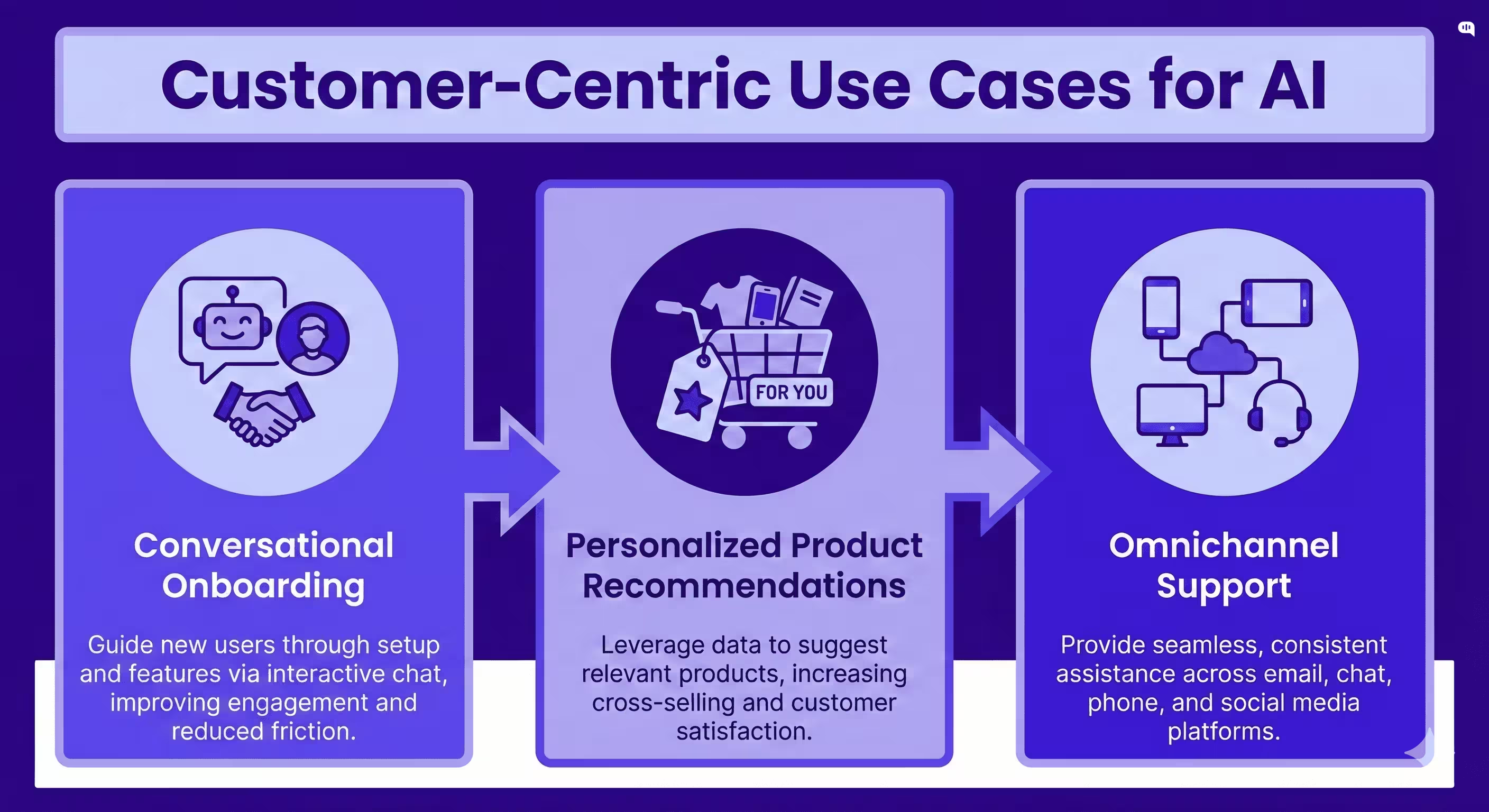
Customer expectations in financial services have shifted from transactional interactions to instant, guided, and intuitive experiences across every touchpoint. Whether a customer is opening an account, exploring a loan, or resolving an issue, the expectation is the same: fast, accurate, and personalized support.
Below are the three foundational customer-facing journeys where conversational AI delivers the most impact.
- Onboarding: Frictionless Digital Journeys
First impressions matter significantly in the financial services industry, and onboarding is often where customers encounter the most friction. They must handle document uploads, KYC checks, eligibility calculations, and form completion. Conversational AI removes this friction by acting as a guided, interactive onboarding partner.
- It walks customers through the KYC and verification step-by-step.
- Automates document collection (ID proofs, bank statements, photos).
- Runs real-time eligibility checks for loans, cards, or savings products.
- Provides instant explanations about terms, interest rates, and required steps.
This not only accelerates onboarding but drastically reduces drop-offs—especially for digital-first banks, NBFCs, and fintech lenders.
- Sales: Contextual Recommendations and Product Discovery
Financial products can be complex. Credit cards, BNPL, loans, and insurance all have different criteria attached to them, which is challenging to navigate for a new customer. Conversational AI streamlines decision-making by using your backend to analyze customer profiles and provide highly accurate recommendations.
- Suggests relevant products based on spending patterns and financial behavior.
- Provides instant comparisons (e.g., credit card tiers, loan offers, mutual fund categories).
- Helps customers understand pricing, fees, and benefit structures with zero wait times.
- Nudges customers toward taking the best actions—such as pre-approved offers, upgrades, and add-ons.
This approach makes product discovery conversational rather than transactional, enhancing conversion while maintaining transparency and regulatory compliance.
- Support: Fast Resolution for Everyday Banking Needs
Support remains the highest-volume area for conversational AI, with customers expecting immediate answers to time-sensitive issues. AI assistants manage the most common financial requests end-to-end without involving human agents unless necessary.
Typical automated support includes:
- Balance checks, mini statements, and EMI breakdowns
- Card activation, freezing, PIN resets
- Transaction clarifications and dispute initiation
- Fraud alerts and instant verification
- Updating personal details or preferences
- Payment reminders and due-date notifications
By resolving these queries instantly and consistently, conversational AI reduces call-center congestion, shortens wait times, and improves overall customer satisfaction.
As you can see, conversational AI drastically improves the customer journey across onboarding, sales, and support. However, these systems are also helpful for the back office, and we’ll see some use cases for them in the next section.
What are the Operational Use Cases for Conversational AI?
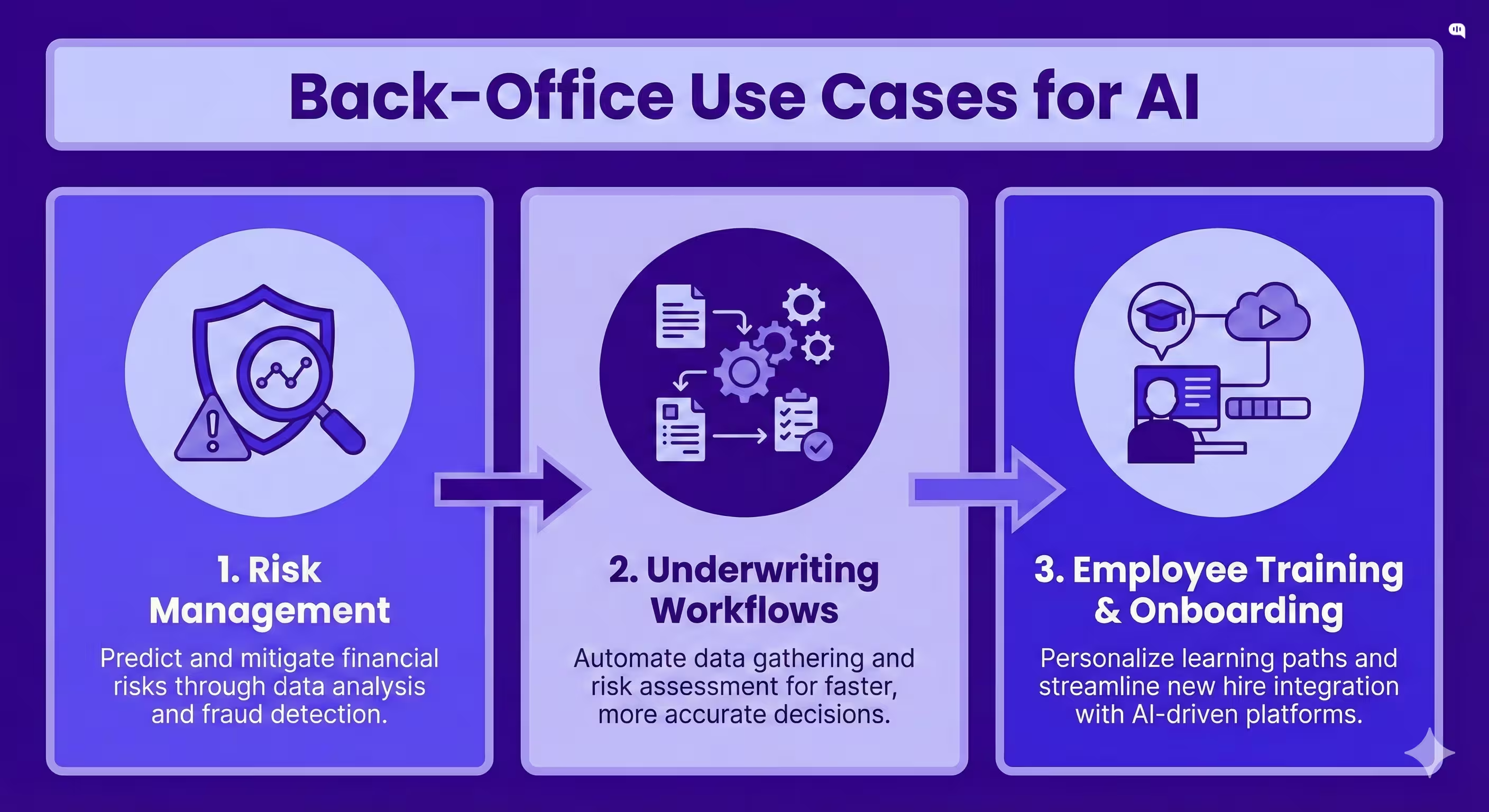
Beyond customer-facing conversations, some of the highest-impact applications of conversational AI in financial services sit inside the organization. Underwriting teams, risk analysts, compliance officers, and frontline employees deal with large volumes of repetitive queries, fragmented data, and time-sensitive decisions every day. Conversational AI serves as an internal intelligence layer, enabling teams to retrieve information more efficiently, analyze data more consistently, and standardize workflows across the institution.
Here are three core operational areas where conversational AI delivers measurable improvements in efficiency and accuracy.
- Underwriting
Underwriting is a document-heavy, information-dense process that often requires cross-referencing multiple internal systems. Conversational AI significantly reduces decision times by serving as an always-on, internal assistant for underwriters.
- Retrieves borrower data, credit history, income proof, and past loan behavior instantly.
- Summarizes customer profiles and highlights anomalies or missing documents.
- Answers policy and rule-book questions instantly (e.g., “What’s the LTV limit for this product?”).
- Helps calculate eligibility, ratios, and risk metrics during assessment.
By reducing manual back-and-forth and centralizing information access, conversational AI decreases underwriting turnaround time and improves decision quality.
- Risk Management
Risk teams must identify suspicious behavior, track regulatory changes, and react quickly to emerging threats. Conversational AI enhances this function by making risk monitoring more proactive and intelligence-driven.
- Surfaces real-time alerts from fraud engines, AML systems, or transaction monitoring platforms.
- Provides instant explanations, summaries, or “reason codes” for flagged cases.
- Allows analysts to query risk models conversationally (“Show me all anomalies in this customer’s history”).
- Standardizes escalation steps and ensures alignment with compliance policies.
This reduces the time analysts spend navigating dashboards and enables faster, more consistent first-level investigation.
- Employee Training & Knowledge Enablement
Large financial teams often struggle with new joiners, updated processes, product complexity, and compliance-heavy SOPs. Conversational AI becomes a 24/7 internal helpdesk that accelerates learning and reduces training overhead.
- Answers employee questions about policies, product features, scripts, and workflows.
- Provides conversational walkthroughs for tools, systems, and internal dashboards.
- Keeps teams up-to-date with compliance changes through interactive micro-learning.
- Reduces dependency on senior staff for repetitive, knowledge-based queries.
This leads to faster onboarding for new employees, more consistent knowledge levels across teams, and reduced errors in process execution.
Operationally, conversational AI revolutionizes the way financial institutions operate behind the scenes. By strengthening back-office efficiency, it directly supports the customer-facing outcomes described earlier.
With these internal gains established, the next step is to understand how to deploy conversational AI in real financial workflows. We’ll cover that in the next section.
How do you Deploy Conversational AI for Financial Services?
Financial institutions can no longer afford long, experimental AI timelines. With the exemplary architecture and integrated workflows, a fully functional conversational AI system can be deployed in as little as 30 days. The key is to focus on a tightly scoped initial use case, secure your compliance foundation early, and integrate with the systems that matter most: core banking, CRM, KYC, and risk engines. Below is a practical, step-by-step deployment timeline tailored for banks, NBFCs, and fintech lenders.
| Week | Focus Area | Actions | Output |
| Week 1 | Scoping & Compliance Alignment | – Identify 1–2 high-volume journeys (e.g., EMI queries, card support, onboarding). – Define success metrics (containment rate, TAT reduction, NPS uplift). – Finalize data handling, PII rules, audit logging, and regulatory constraints. | Approved scope, compliance checklist, and data governance plan. |
| Week 2 | Workflow Design & Knowledge Setup | – Map the exact flow of each journey (prompts, validations, fallbacks). – Upload/structure knowledge sources (FAQs, SOPs, policy docs). – Define escalation paths to human agents. | End-to-end conversation flows + knowledge base ready. |
| Week 3 | System Integrations & Testing | – Connect chatbot to core systems (CBS, CRM, loan engines, KYC APIs). – Implement authentication (OTP, JWT, OAuth). – Test responses for accuracy, compliance, tone. | Functional environment with integrated APIs and validated responses. |
| Week 4 | Pilot, Optimization & Launch | – Soft-launch to 5–10% of traffic or internal staff. – Analyze errors, refine responses, improve routing logic. – Roll out to all channels (web, app, WhatsApp, voice). | Full public launch with feedback loop and monitoring dashboard. |
Deploying conversational AI doesn’t require a multi-month transformation. With a focused scope and the right integrations, financial institutions can go live within a month, unlocking faster support, reduced costs, and improved customer experiences in a matter of weeks.
With deployment covered, the next step is understanding how to integrate conversational AI into your broader technology and data ecosystem.
How can you Integrate Conversational AI in Financial Services?
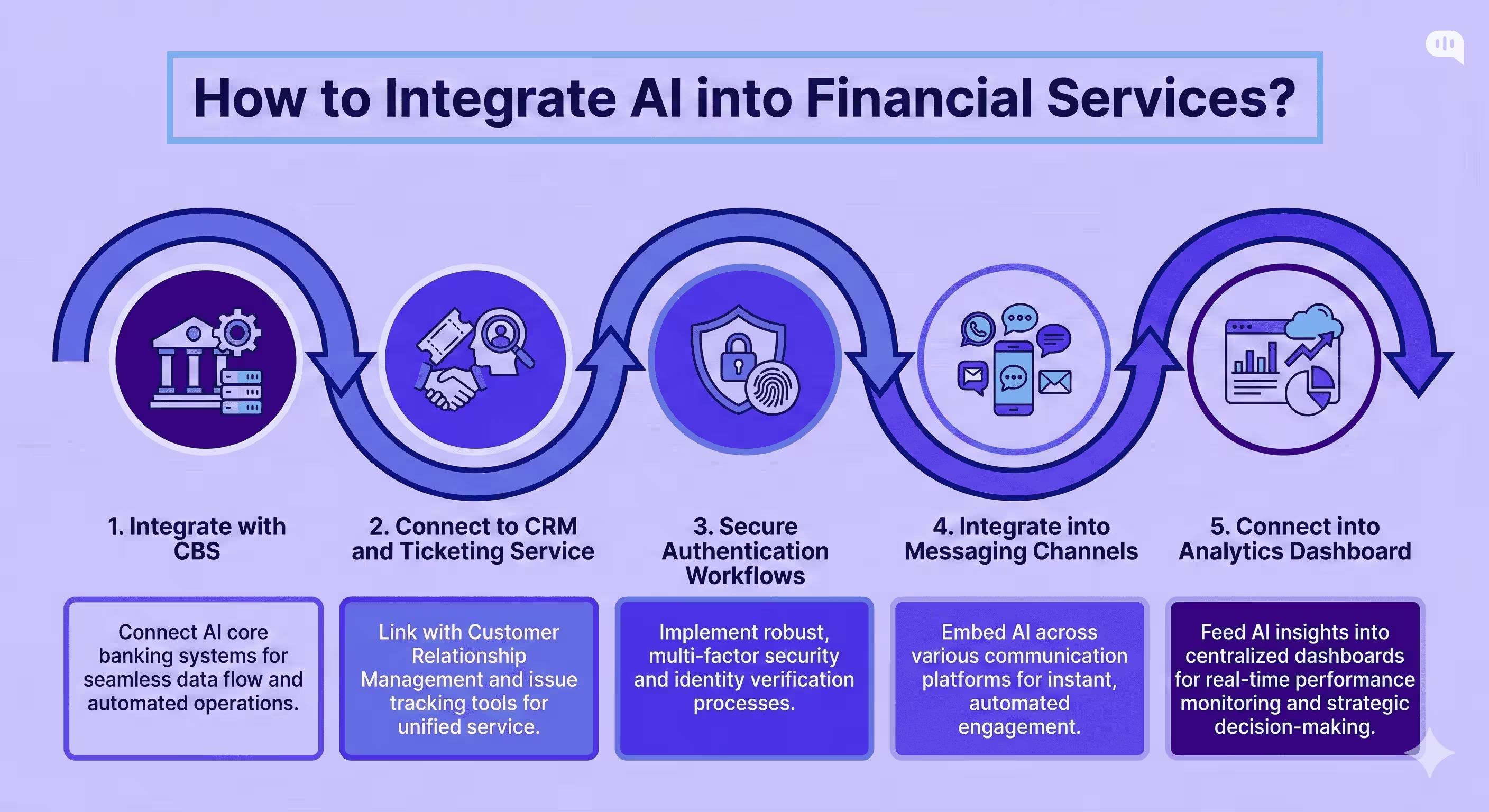
Deploying a chatbot or voicebot is the easy part. The real value of conversational AI in financial services lies in its seamless integration with your existing technology stack.
When done right, the AI assistant becomes a unified interface on top of complex legacy systems, not yet another siloed tool. Kommunicate simplifies this process by providing pre-built connectors into CRMs, support tools, and messaging channels, such as WhatsApp and web chat, thereby speeding up the secure integration work.
Below are the key integration layers you need to focus on as you deploy conversational AI:
- Integrate with Core Systems of Record
At the heart of every financial journey are your systems of record: core banking, loan management, card systems, and payment gateways. For conversational AI to move beyond FAQs and actually do things, it must be able to read and write to these systems securely.
- Read operations: fetch balances, transaction history, EMI schedules, limits, and due dates.
- Write operations: raise service requests, update contact details, initiate card blocks, trigger payment reminders.
- Design principle: always ensure least-privilege access, API-level throttling, and complete audit logging for all AI-initiated calls.
Without this layer, conversational AI is merely a more user-friendly FAQ. With it, it becomes a valid “digital frontline” capable of completing end-to-end tasks.
- Connect to CRM, Ticketing, and Agent Desktops
Human handoff is unavoidable in financial services. That’s why integration with your CRM and ticketing stack is critical.
- CRM integration: keep a unified customer view (previous interactions, products, segments, preferences).
- Ticketing integration: create, update, and close support tickets directly from AI flows.
- Agent desktop: pass conversation context, transcripts, and summary notes to agents when a case is escalated.
This ensures that when a conversation transitions from bot to human, the customer doesn’t need to repeat themselves, and agents are equipped with the necessary context to resolve the issue quickly.
- Secure Authentication, Authorization, and Identity Flows
Because money and sensitive data are involved, integration with your identity and access management layer is non-negotiable.
- Authentication: OTP-based login, app SSO, or secure session tokens before exposing account-level data.
- Authorization: role- and scope-based permissions that define which actions the AI can trigger (view-only vs transact).
- Session management: timeouts, device binding, and re-authentication for high-risk actions (e.g., card block, large transfers).
This is where you translate regulatory and infosec requirements into concrete guardrails around what the AI assistant is allowed to do and when it must step back.
- Orchestrate Omnichannel Experiences Across Web, App, and Messaging
Customers don’t think in channels; they believe in tasks. To support this, conversational AI has to be integrated consistently across:
- Web and mobile apps for logged-in experiences with full account access.
- Messaging channels like WhatsApp and SMS for lightweight, on-the-go interactions.
- Voice and IVR for users who prefer calling or when urgency is high.
The orchestration layer should preserve context across channels. If a user starts a loan query on the website and continues it on WhatsApp, the assistant should pick up where they left off, rather than starting from scratch.
- Close the Loop with Analytics, Monitoring, and Feedback
Finally, conversational AI must be integrated with your analytics and observability stack, allowing you to measure, improve, and govern it effectively.
- Product and CX analytics: measure containment, resolution rate, AHT, CSAT, drop-off points.
- Operational dashboards: track volumes, peak times, intent distribution, and agent-assist usage.
- Feedback loops: allow customers and agents to flag incorrect or unhelpful AI responses for retraining.
This layer transforms your AI assistant from a static tool into a dynamic system that learns over time and aligns with business and compliance objectives.
Effective integration is what transforms conversational AI from a standalone chatbot into a strategic layer that spans your entire financial stack.
Once these integration basics are in place, the next crucial question is how to keep AI agents safe, compliant, and well-governed in a heavily regulated environment.
How to Manage Risk, Compliance, and Governance for AI Agents in Financial Services?
AI agents in financial services touch sensitive data, influence economic decisions, and operate in a tightly regulated environment. That means risk, compliance, and governance cannot be an afterthought; they must be designed into the system from day one.
Here are some steps we implement for all our clients:
- Define Clear Guardrails for What AI Can and Cannot Do
Limit AI agents to specific, approved actions (e.g., viewing vs changing data, informational vs transactional flows) and hard-block anything outside those boundaries. - Enforce Strong Authentication and Session Controls
Require verified identity (OTP, app login, SSO) before exposing account-level data or allowing high-risk actions, such as blocking cards, transferring funds, or modifying loans. - Log Everything for Audit and Explainability
Maintain structured logs of prompts, responses, underlying actions, and escalations to facilitate the reconstruction of events for regulatory purposes, internal audits, and dispute resolution. - Build a Human-in-the-Loop Escalation Model
Route edge cases, ambiguous intents, high-value customers, and sensitive scenarios (e.g., restructuring, disputes) to human agents with full context and conversation history. - Govern Data Sources and Model Updates Centrally
Control which knowledge bases, APIs, and documents the AI can access, and review any model or prompt changes through a central risk/compliance review process. - Continuously Monitor, Test, and Retrain for Safety
Run regular red-teaming, bias checks, and QA on critical journeys, and use real-world feedback from customers and agents to refine responses and close risk gaps.
When guardrails, identity controls, logging, escalation paths, and continuous monitoring are in place, AI agents can operate safely in even the most regulated financial environments. Once that foundation is set, the next critical question is simple: how do you prove that all of this is actually creating value?
How Can You Measure the ROI of Financial Services AI Agents?
For most banks, NBFCs, and fintechs, AI agents start as a “cost-saving experiment” and quickly become a core part of the customer experience. To treat them as a strategic asset, you need a straightforward way to measure whether they’re actually creating value. Our approach to customer service ROI is a helpful starting point: track how service impacts revenue (via retention, NPS, CSAT, upsell) and compare that against the total cost of running your support function.
- Start With a Simple ROI Equation
ROI = (Incremental Value Created – Total AI Cost) ÷ Total AI Cost
- Incremental value = extra revenue (retention, NPS/CSAT uplift, upsell) + cost savings (deflection, faster handling).
- Total AI cost = platform + infra + integration + ongoing training/QA.
- This gives you a single number to track.
2. Quantify Revenue Impact (Retention, NPS, CSAT, Upsell)
- Compare NPS/CSAT for AI-led journeys vs non-AI journeys.
- Track churn/product closure for AI-served customers vs control groups.
- Attribute upsell/cross-sell (e.g., card upgrades, loan top-ups) where AI assisted or initiated the journey.
- Quantify Cost Savings (Deflection and Efficiency)
- Measure deflection: % of queries entirely handled by AI.
- Calculate cost per human interaction, then multiply by the number of interactions AI deflects or shortens.
- Include savings from reduced AHT and less after-call work for agents.
- Track the Right Metrics in an “AI Agent” Dashboard
- Containment rate and resolution rate for AI conversations.
- CSAT / NPS specifically for bot-led sessions.
- Cost per resolved interaction when AI is involved vs human-only.
- Conversion rate on AI-assisted sales journeys (loans, cards, investments).
- Build a Continuous Improvement Loop
- Measure monthly: ROI, deflection, CSAT, errors.
- Diagnose failure patterns using transcripts and analytics.
- Improve flows, training data, and guardrails; then re-measure.
- Continue until AI performance stabilizes and the ROI trend upward.
With a simple equation, a small set of metrics, and a basic improvement loop, you can quantify precisely how much value AI agents create for your financial institution.
Conclusion
Conversational AI in financial services provides customers with a fast and natural way to onboard, explore products, and receive support across all channels. When done well, AI agents become the first line of service for everyday tasks, while still handing off complex or sensitive cases to humans with full context.
Behind the scenes, the same AI layer makes your operations sharper: underwriting decisions become faster, risk teams receive a clearer signal with less noise, and employees spend more time resolving issues instead of searching for information. The real unlock comes from how you deploy, integrate, and govern these systems.
The final piece is discipline around ROI. By tracking deflection, resolution, NPS/CSAT, retention, and upsell against the total cost of your AI stack, you can show exactly how much value your agents create and decide where to scale next. Start with one or two high-volume journeys, integrate deeply, measure ruthlessly, and let the data tell you where conversational AI should go next in your financial services roadmap.
If you need help building a support tech stack for your financial services business, feel free to book a meeting with us.