Updated on June 29, 2026
Estimated reading time: 10 minutes
GLM 5.2 is Zhipu AI’s 753B-parameter open-weight model, released June 13, 2026, under an MIT license. It matched leading frontier models across several benchmarks while costing a fraction of the price.
On June 12, 2026, the US government issued an export control directive compelling Anthropic to take Fable 5 and Mythos 5 entirely offline for all users, citing a national security concern around a reported narrow jailbreak. The directive did not spare existing customers. Within hours, access was suspended globally.
On June 25, 2026, the Trump administration followed up with a separate request to OpenAI, asking it to stagger the rollout of GPT-5.6 and to approve enterprise access on a customer-by-customer basis, citing the model’s “Mythos-like” capabilities. Neither situation had a clear timeline for full resolution.
While both labs have framed their response as cooperative, the practical effect for teams that built workflows around these models is the same: your primary AI provider can go dark without warning, for reasons entirely outside your control.
This is the case for a multi-provider AI strategy as operational infrastructure. GLM 5.2, released by Chinese AI company Zhipu AI on June 13, 2026, is the most capable open-weight model currently available and a serious candidate for the “backup that isn’t really a backup” role in any AI stack.
We’re going to cover this new AI model and talk about:
- Why is model dependency a business risk?
- What is GLM 5.2?
- GLM 5.2 vs Claude Opus 4.8 and GPT-5.5
- Limitations of GLM 5.2
- Should you add GLM 5.2 to your stack?
Why is model dependency a business risk?
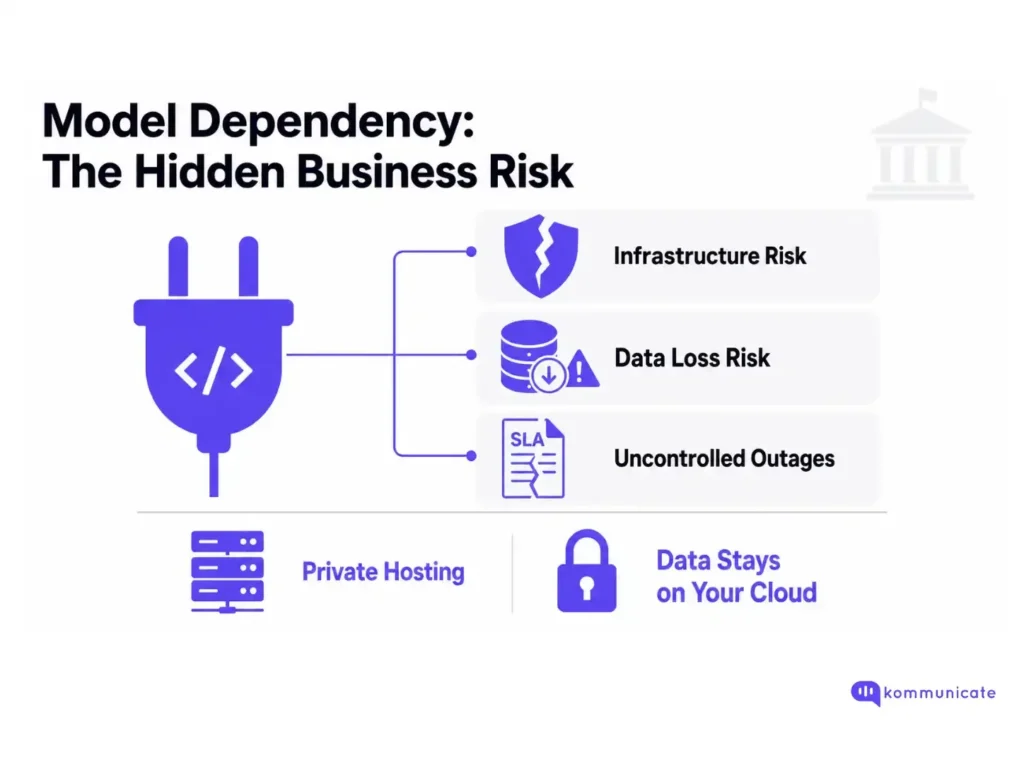
With governments now treating frontier AI models as national security and geopolitical risks, access to models is only going to get harder.
If you’re a business that uses this model, you’re:
- Adding significant business risk to parts of your tech stack
- Risk of losing significant data in the shared context if a model goes offline
- Exposing yourself to unexpected outages that are not tied to your SLA
This is why many startups and businesses are already using open-source models in their backend. This is beneficial in two ways:
- Open-source models can be privately hosted and are much more cost-efficient per token.
- Your data remains secure because the model lives on your cloud.
GLM 5.2 is the latest version of Z.ai‘s flagship LLMs. It offers the same price advantage and data security while being nearly as efficient as the frontier models from OpenAI and Anthropic.
Now, this model is not a silver bullet. But it is an open-weight model competitive enough on frontier benchmarks to function as a genuine fallback for your business.
What is GLM 5.2?
GLM 5.2 was released on June 13, 2026, by Zhipu AI, a Beijing-based AI company founded in 2019 as a spinout from Tsinghua University’s Knowledge Engineering Group, now operating its model platform under the Z.ai brand.
The model is the third release in a fast iteration cycle within the GLM-5 generation: GLM-5 launched in February 2026, GLM-5.1 in April, and GLM-5.2 in June.
Architecture of GLM 5.2
- Size and architecture – GLM 5.2 is a 753B-parameter Mixture-of-Experts model with approximately 40B active parameters per inference. MoE architecture means inference is more computationally efficient than with a dense model of equivalent total size, because only a subset of parameters is active per token.
- Context window. The model supports a 1-million-token context window, the primary upgrade over GLM-5.1’s 200K limit. This makes it relevant to repository-wide coding, long-document analysis, and multi-step agentic workflows in which context accumulates over many turns.
- License. GLM 5.2 is released under the MIT license. It is free to download from Hugging Face, free to self-host, and free to fine-tune or use commercially. Zhipu monetises through its hosted API and GLM Coding Plan; the weights themselves are unrestricted. This is not a conditional open-source release with commercial use clauses. For teams with data privacy requirements or regulated environments, self-hosted deployment keeps all data in-house without per-token cost.
For teams evaluating GLM 5.2 as a second-provider option alongside Claude or ChatGPT models, these three properties are the relevant foundation. The model is not just accessible on your own infrastructure, under terms you control.
GLM 5.2 vs Claude Opus 4.8 and GPT-5.5
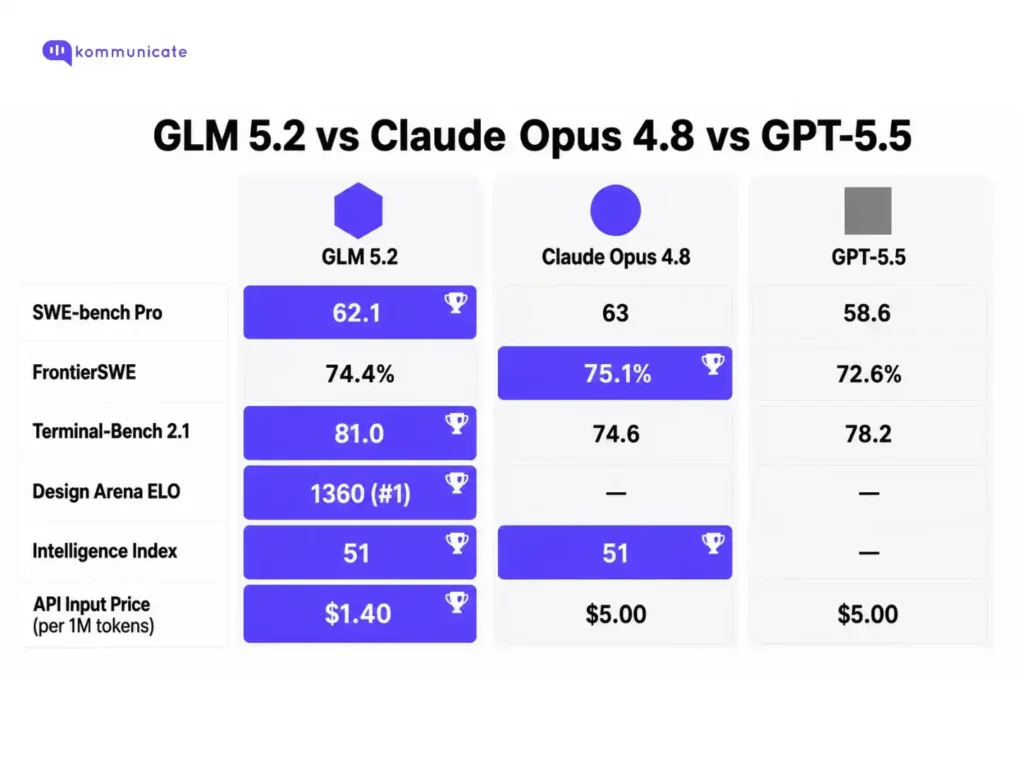
The benchmark picture on GLM 5.2 is worth reading carefully, because the results vary meaningfully by task type. Z.ai published no scores at launch on June 13 and released its full scorecard three days later on June 16.
The numbers below draw on that scorecard, as well as third-party trackers such as BenchLM, Artificial Analysis, and Lushbinary’s comparison.
Full benchmark comparison
| Benchmark | GLM 5.2 | Claude Opus 4.8 | GPT-5.5 | What It Measures |
|---|---|---|---|---|
| SWE-bench Pro | 62.1 | ~63 | 58.6 | Real software engineering tasks from GitHub-style repos |
| FrontierSWE | 74.4% | 75.1% | 72.6% | Long-horizon software engineering across complex tasks |
| Terminal-Bench 2.1 | 81.0 | 74.6 | 78.2 | Autonomous coding tasks in a terminal environment |
| MCP-Atlas | 76.8 | 77.8 | — | Tool-use and multi-step planning with external APIs |
| Design Arena ELO |
1360 (#1) | — | — | Crowdsourced human preference for frontend/HTML design |
| Artificial Analysis Intelligence Index | 51 (5th overall) | 51 (5th overall) | — | Composite across reasoning, coding, and knowledge |
| BenchLM Overall | #3-4 / 124 | — | — | Aggregated ranking across tracked benchmark categories |
| AIME 2026 | Leads under Max mode | — | — | Competition-level math reasoning |
| IMOAnswerBench | Leads under Max mode | — | — | International Math Olympiad-level proofs |
| Model | Input (per 1M tokens) | Output (per 1M tokens) |
|---|---|---|
| GLM 5.2 (Z.ai API) | ~$1.40 | ~$4.40 |
| Claude Opus 4.8 | ~$5.00 | ~$25.00 |
| GPT-5.5 | ~$5.00 | ~$30.00 |
| GLM 5.2 (self-hosted, MIT) | $0 | $0 |
API pricing comparison
What the numbers actually say
- Coding Tasks: SWE-bench Pro (62.1 vs 58.6) and FrontierSWE (74.4% vs 72.6%). On Terminal-Bench 2.1, the jump from GLM 5.1’s 62.0 to GLM 5.2’s 81.0 in a single generation is the most striking single number in the table, and it places GLM 5.2 ahead of GPT-5.5 (78.2) and Claude Opus 4.8 (74.6) on that benchmark specifically.
- Performance against Claude Opus 4.8: GLM 5.2 trails by about a point on FrontierSWE (74.4 vs 75.1) and MCP-Atlas (76.8 vs 77.8), while leading on Terminal-Bench and some math-heavy tests under its Max reasoning mode. The Intelligence Index places them at the same score (51), which tracks with the overall benchmark pattern: these are peer-tier models, not a leader-and-challenger pair.
- GLM 5.2 topped the crowdsourced HTML web design leaderboard with an ELO of 1360, surpassing Claude Fable 5, Opus 4.6, and Opus 4.7. Design Arena uses blind human preference votes rather than synthetic scoring, which makes this one of the harder results to attribute to benchmark gaming.
- With no scaffolding, GLM 5.2 placed third behind GPT-5.5 and Opus 4.8 (both with scaffolding), beating Claude Code at 39% vs 32%. At GLM 5.2’s pricing, the run cost approximately $0.17 per vulnerability found, a point that matters more than the absolute ranking for teams running detection at scale.
For context on how OpenAI’s model lineup compares at the product level, including API access and use case fit across the GPT family, see our guide to ChatGPT models. For a deeper look at the Claude family and Anthropic’s tier structure, see our Claude Sonnet guide.
Limitations of GLM 5.2
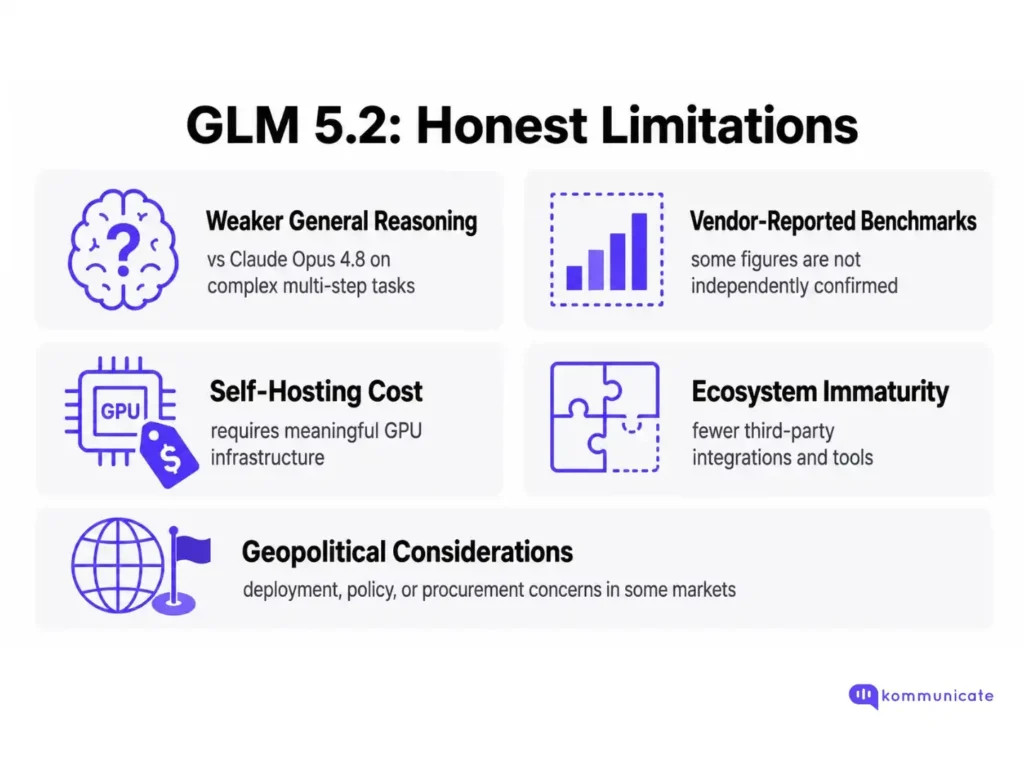
The benchmark numbers are real, but they come with context that matters for adoption decisions.
- General reasoning vs task-specific performance. Claude Opus 4.8 remains the stronger model for open-ended multi-step reasoning, particularly for high-stakes planning tasks that require generating novel strategies rather than executing a defined plan.
The benchmark gap on general reasoning tasks is wider than on coding-specific ones. Independent composites place GLM 5.2 competitively but below the open-weight leaders on the hardest general tasks. - Vendor-reported figures. Several of the strongest GLM 5.2 benchmark numbers, including the SWE-bench Pro score and Terminal-Bench figures, are self-reported by Z.ai.
Independent confirmation on some of the most aggressive claims is still catching up. A one-point benchmark gap rarely settles a real workload, and teams evaluating the model for production use should run it against their own task distributions. - Self-hosting infrastructure cost. The MIT license makes self-hosting legally unrestricted, but it does not make it cheap. A 753B MoE model requires substantial GPU infrastructure to serve effectively.
Teams without existing GPU infrastructure or ML engineering resources should factor in that cost before treating “free self-hosting” as a simple alternative to managed API access. - Tooling ecosystem maturity. GLM 5.2 is available on over 20 third-party coding environments and Z.ai’s API, but the integration ecosystem is less mature than the one built around OpenAI and Anthropic’s APIs.
Teams using Kommunicate’s AI agent platform can route to different model backends, which addresses some of this friction. Still, out-of-the-box integrations are more limited than those offered by Western Frontier Labs. - Geopolitical considerations. A Chinese company develops GLM 5.2. For some enterprise use cases, particularly those with data handling requirements tied to jurisdiction, that is a relevant factor. Self-hosting resolves the data residency question by keeping all inference on your own infrastructure, but the supply chain question is separate from the deployment question.
For teams comparing coding agents specifically, our hands-on comparison of Claude Code, Codex, and Antigravity covers how real-world task performance differs from benchmark rankings when scaffolding and agent architecture are factored in.
Should You Add GLM 5.2 to Your Stack?
The argument for GLM 5.2 is not that it is a better model than Claude Opus 4.8 or GPT-5.5 across every dimension. It is that provider lock-in now carries demonstrated risk, and GLM 5.2 is the first open-weight model capable of functioning as genuine insurance rather than a fallback with a significant capability downgrade.
The events of June 2026 made the risk concrete: two of the three dominant frontier providers became partially or fully inaccessible, for reasons unrelated to product or infrastructure decisions. The teams with multi-provider workflows or self-hosted models absorbed those events without disruption. The teams without them had to scramble.
GLM 5.2 offers something the closed frontier labs cannot: deployment that does not depend on:
- Any company’s commercial access policy
- Any government’s export control directive
- Any approval queue
For coding-heavy workflows, agentic pipelines, and long-context document tasks, the performance trade-off is minimal. For general reasoning and safety-critical deployments, Claude Opus 4.8 remains the reference point. A sensible multi-provider stack uses both, with routing logic that matches task type to model strength.
The cost arithmetic also favors adding GLM 5.2 to an existing stack rather than replacing anything with it. At one-sixth the API cost of GPT-5.5 and with zero marginal cost for self-hosted inference, the case for running coding and high-volume tasks through GLM 5.2 while reserving Opus 4.8 for deep reasoning is straightforward on its own, independent of the continuity argument.

A Content Marketing Manager at Kommunicate, Uttiya brings in 11+ years of experience across journalism, D2C and B2B tech. He’s excited by the evolution of AI technologies and is interested in how it influences the future of existing industries.