Updated on June 23, 2026
TL;DR
- 1 in 3 telecom customers churn within 12 months.
- Telecom churn is not only caused by price. It is often triggered by unresolved support friction.
- Billing disputes, repeat contacts, onboarding delays, outage silence, and poor handoffs are major churn signals.
- CX teams can reduce churn by treating support conversations as early warning data.
- AI agents can help by resolving repetitive issues, detecting churn risk, and escalating high-risk cases with full context.
- The right metric is not just ticket deflection. It is support-led retention: fewer repeat contacts, faster resolution, lower effort, and reduced churn after support interactions.
Telecom churn is often treated as a pricing problem. A customer finds a cheaper plan, switches providers, and the retention team tries to win them back with a discount.
But for CX leaders, this explanation is incomplete.
In telecom, churn usually starts long before a customer cancels. It begins when:
- An activation takes too long
- A billing dispute is not resolved
- An outage update arrives too late
- A customer has to repeat the same issue across three different channels.
Over time, these unresolved support moments become trust gaps. Once trust breaks, even a small competitor discount can be enough to make the customer leave.
That is why telecom churn should not be owned only by marketing, sales, or retention teams. It should also be owned by customer support and CX teams.
Industry research has long estimated telecom annual churn at roughly 30% to 35%. More recent research also shows that telecom remains one of the industries where churn risk is structurally high because customers have many alternatives and a low tolerance for poor service experiences.
There’s an opportunity here: CX leaders can reduce churn by identifying and fixing the support moments that make customers lose confidence. We’re addressing this opportunity through this article by covering:
- Telecom churn starts inside customer support
- 5 support moments that lead to customer churn
- Why does complaint volume underreport churn risk?
- The support-led churn reduction model
- How do AI agents work in the support-led churn reduction model?
- What CX leader should do – Implementation plan
- Metricx CX leaders should track
- Conclusion
Telecom churn starts inside customer support
A customer rarely churns because of one isolated issue. More often, churn builds over a series of unresolved experiences.
Telecom customers depend on their provider for connectivity, payments, work, family communication, entertainment, and business continuity. When something goes wrong, they expect fast and accurate support. If the support experience makes the problem harder to solve, the customer starts questioning the relationship.
This is why support teams are often the first to see churn risk.
They see:
- Customers are contacting them repeatedly for the same issue
- Billing complaints after plan changes
- Negative sentiment after outages
- Customers asking about cancellation or number portability
- Failed chatbot journeys that end in frustration
- Escalations where the customer has to repeat everything
- New customers struggling during activation or onboarding
These are not just support events. They are churn signals.
The problem is that many telecom companies still treat them as isolated tickets. We see a common pattern across most of our telecom clients:
- A ticket gets closed, but the customer’s frustration remains.
- A chatbot interaction gets counted as contained, but the customer calls again.
- A billing dispute gets marked as answered, but the customer still does not trust the charge.
Support-led churn reduction starts when you start looking at tickets as a signalling event.
The goal is not just to close tickets faster. The goal is to identify which support issues are damaging customer trust and fix them before they become churn events.
5 support moments that lead to customer churn
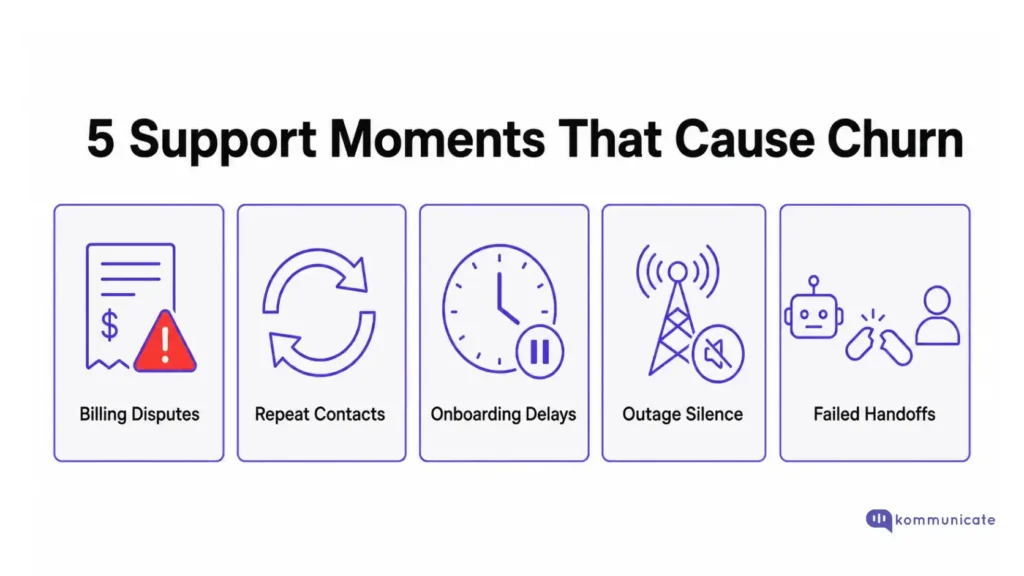
Enterprise telecom providers often see similar support moments repeatedly. And these support tickets might also be early indicators for churn. Some cases worth highlighting are:
1. Billing disputes
Billing is one of the most sensitive areas in telecom support.
A customer may tolerate a temporary network issue if communication is clear. But when they feel overcharged or misled, the issue becomes personal. It is no longer only about the amount. It becomes a trust problem.
Common billing-related churn triggers include:
- Unexpected roaming charges
- Promotional discounts not applied
- Plan upgrade charges that were not clearly explained
- Auto-renewal confusion
- Extra fees for add-ons or services
- Incorrect late payment charges
- Unclear taxes or usage-based charges
Billing disputes become especially dangerous when the customer has to contact support more than once. Every repeat interaction reinforces the idea that the company either cannot solve the problem or does not want to solve it.
For CX leaders, billing disputes should be treated as a churn-priority category. The goal should not be to simply answer billing questions. The goal should be to restore confidence in the bill.
2. Repeat Contacts
Repeat contact is one of the clearest signs of churn risk.
When a customer contacts support again for the same issue, something has failed. The issue may not have been solved. The explanation may not have been clear. The customer may not believe the promised resolution. Or the support journey may have created more confusion than confidence.
In telecom, repeat contact is especially damaging because many issues are urgent.
A customer without mobile data, broadband connectivity, or active service cannot wait through multiple disconnected support cycles. Every additional contact increases effort. Every repeated explanation increases frustration.
CX leaders should track repeat contact rate by issue type, not only at the overall support level.
For example:
| Repeat contact area | Why it matters |
|---|---|
| Billing disputes | Indicates trust and transparency issues |
| Activation delays | Shows the customer has not reached value yet |
| Network complaints | Suggests unresolved service reliability problems |
| Outage questions | Shows proactive communication is not working |
| Plan changes | Indicates confusion around pricing, benefits, or eligibility |
| Failed chatbot journeys | Shows automation may be increasing customer effort |
A high repeat contact rate is not just an operational problem. It is a retention problem.
3. Onboarding Delays
The first 30 to 90 days are critical in telecom.
A new customer has not yet built loyalty. They are still evaluating whether the provider was the right choice. If the setup experience is slow, confusing, or poorly supported, churn risk begins early.
Onboarding friction can include:
- SIM activation delays
- Number porting issues
- KYC or identity verification problems
- Missed broadband installation appointments
- Router setup confusion
- Lack of guidance after plan purchase
- Poor communication about activation status
- Customers not understanding plan benefits
This type of churn can be silent. The customer may not complain immediately. They may simply decide not to renew, not to add more lines, or to switch once the contract window allows it.
CX leaders should treat onboarding support as a retention lever, not just a setup process.
The goal is to help the customer reach value quickly. That means proactive status updates, simple setup guidance, easy escalation, and clear communication when activation is delayed.
4. Outage Communication That Arrives Too Late
Outages are unavoidable in telecom. Poor outage communication is avoidable.
Customers understand that networks can fail. What frustrates them is silence, vague responses, or being forced to contact support to learn something the provider already knows.
During outages, support volume can rise quickly. If every affected customer has to ask, “Is there a network issue in my area?” the support system is already reacting too late.
Outage-related churn risk increases when:
- Customers receive no proactive updates
- Support agents do not have accurate outage information
- The chatbot gives generic troubleshooting steps during a known outage
- Customers are asked to restart devices repeatedly when the issue is network-wide
- Resolution timelines are vague or missing
- Customers receive no follow-up after service is restored
A better experience is proactive and specific.
Telecom CX teams should be able to identify affected customers by location, service type, or account segment and send timely updates. Even when the exact resolution time is uncertain, customers should know that the provider is aware of the issue and is working on it.
For churn reduction, outage communication is not only about fixing the network. It is about protecting customer trust while the issue is being fixed.
5. Broken Handoffs From Automation to Human Support
Automation can reduce churn when it resolves issues quickly.
But bad automation can increase churn.
The problem is not that customers dislike automation. The problem is automation that blocks resolution. Customers get frustrated when a chatbot gives generic answers, an IVR repeats irrelevant options, or a human agent receives no context from the previous interaction.
Broken handoffs are common in telecom because customer issues often cross systems: billing, CRM, network status, plan eligibility, device information, and support history.
Customers become frustrated when:
- The chatbot cannot access account-specific information
- The IVR does not understand the issue
- The customer is transferred to the wrong team
- The human agent asks the same questions again
- The previous troubleshooting steps are not visible
- The customer has to restart the support journey on another channel
This is where automation should act as a bridge, not a wall.
If an AI agent cannot resolve the issue, it should pass the full context to a human agent. That context should include the customer’s intent, issue category, previous messages, attempted solutions, account details, sentiment, and urgency level.
This is especially important for churn-prone cases such as repeated billing disputes, cancellation intent, unresolved outages, and angry high-value customers.
However, before this is implemented, it’s important to understand that support volume often doesn’t directly correlate with churn risk. In fact, there are cases it might be under-representing the risk instead.
Why does complaint volume underreport churn risk?
Complaint volume is a weak proxy for churn risk.
Many customers who leave do not file a formal complaint. They simply stop trusting the provider. They compare plans, reduce usage, ignore renewal offers, move to another provider, or wait until the contract ends.
This is why telecom companies should not rely only on the complaint count to understand customer risk.
Complaint volume underreports churn for several reasons:
- Some customers do not believe complaining will help. If they have already had poor support experiences, they may decide that switching is easier than trying again.
- Many churn signals appear before a complaint. A customer may ask about contract terms, number portability, refund policies, or plan downgrades before they openly say they want to cancel.
- Support systems often miss cross-channel frustration. A customer may start with a chatbot, move to WhatsApp, call support, and then visit a store. If these interactions are not connected, the company may not see the full pattern.
- Closed tickets can hide unresolved frustration. A ticket may be marked as resolved because an agent responded, but the customer may still feel the issue was not fixed.
CX leaders should therefore monitor churn signals beyond formal complaints.
These include:
- Repeat contacts within a short period
- Negative sentiment in conversations
- Failed self-service attempts
- Escalation after chatbot failure
- Cancellation-related language
- Drop in usage after a support issue
- Long resolution time for high-value customers
The key idea here is that the intent of the conversation and the resolution timeline is just as important as the number of complaints. Those intents are central to how we can create a model for churn reduction that is truly support-led.
The support-led churn reduction model
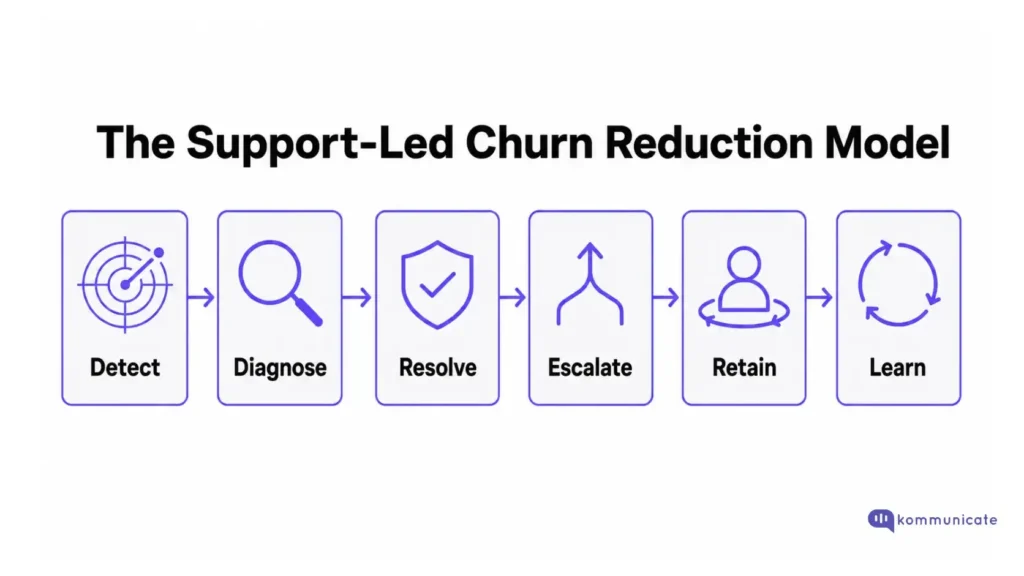
Support-led churn reduction means using customer support interactions as an early warning system for retention. Instead of waiting for customers to reach the cancellation stage, CX teams identify churn risk from support behavior and intervene earlier.
Here is how the model works:
| Stage | What happens | CX objectives |
|---|---|---|
| Detect | Identify churn signals from support conversations, repeat contacts, sentiment, and issue type | Find risk before cancellation intent becomes explicit |
| Diagnose | Understand the reason behind the risk, such as billing confusion, outage frustration, onboarding delay, or failed handoff | Avoid generic retention responses |
| Resolve | Fix the underlying support issue quickly and clearly | Restore trust before offering incentives |
| Escalate | Route complex or high-risk cases to the right human team with full context | Prevent customers from repeating themselves |
| Retain | Use issue-specific retention actions based on the customer’s actual problem | Make retention relevant, not random |
| Learn | Feed churn insights back into support workflows, knowledge bases, and automation flows | Reduce repeat churn drivers over time |
This model changes how CX teams think about support.
Support is not just the team that reacts when something goes wrong. It becomes the function that detects early churn risk, reduces customer effort, and protects revenue.
For example, a traditional support model may treat a billing question as a simple ticket. The customer asks why the bill increased, the agent explains the charge, and the ticket is closed.
A support-led churn model asks deeper questions and provides you with context that changes the response. This gives you a clear picture of customer intent to guide you towards better outcomes.
However, a grounds-up level redirection for support ops is difficult. We recommend that you use AI agents throughout the process.
How do AI agents work in the support-led churn reduction model?
AI agents can make support-led churn reduction more scalable.
But the goal should not be to automate every conversation. The goal should be to resolve common issues, detect risk early, and escalate complex cases intelligently.
1. AI agents resolve repetitive churn-driving issues
Telecom support teams receive high volumes of repetitive questions: An AI agent can handle many of these queries if it is connected to the right knowledge base and backend systems.
A useful AI agent should be able to retrieve the customer’s actual billing information, compare it with the previous cycle, explain the difference, identify plan changes, and escalate the case if a dispute is required.
That is how AI reduces churn: by removing effort from high-volume support moments.
2. AI agents detect churn signals in real time
Customers often reveal churn intent before they formally cancel. AI agents can classify these signals during the conversation and trigger the right workflow.
| Customer signal | AI classification | Recommended action |
|---|---|---|
| “I have complained three times already” | Repeat-contact churn risk | Escalate to priority support |
| “My bill is wrong again” | Billing trust risk | Retrieve bill details and route to dispute workflow |
| “I want to cancel” | Explicit churn intent | Route to retention-trained agent |
| “Your network is always down” | Service reliability risk | Check outage status and offer proactive update |
| “Nobody helped me last time” | Handoff failure risk | Summarize history before transfer |
This allows CX teams to move from reactive retention to proactive intervention.
3. AI agents improve escalation quality
Not every telecom issue should be automated.
Some cases should go to a human agent quickly, especially when they involve repeated disputes, emotional frustration, cancellation intent, regulatory complaints, fraud, vulnerable customers, or complex troubleshooting.
In those cases, AI should prepare the human agent.
A good AI-to-human handoff should include:
- Customer intent
- Issue category
- Account or plan context
- Previous troubleshooting steps
- Conversation summary
- Sentiment level
- Churn-risk indicator
- Recommended next action
This reduces average handle time, but more importantly, it reduces customer effort. The customer does not have to explain the same issue again.
4. AI agents can personalize retention actions
Retention actions should be based on the reason the customer is at risk.
A customer frustrated by billing errors does not need the same response as a customer affected by network outages. A new customer struggling with activation does not need the same offer as a long-term customer comparing competitor pricing.
AI can help identify the underlying churn driver and recommend a better next step.
| Churn driver | Weak response | Better response |
|---|---|---|
| Billing confusion | Generic discount | Clear bill explanation and correction if needed |
| Outage frustration | Standard apology | Location-specific update and proactive follow-up |
| Activation delay | “Please wait” | Priority activation support |
| Plan mismatch | Upsell script | Better-fit plan recommendation |
| Repeat complaint | New ticket | Escalation with full history |
This is how AI supports retention without turning every interaction into a discounting exercise.
These automations become easier to implement when you have Kommunicate’s telecom AI agents in place.
Where Does Kommunicate Fit In?
Kommunicate helps telecom CX teams automate high-volume support while keeping resolution, context, and escalation at the center of the experience.
For telecom providers, Kommunicate can support customer conversations across channels such as website chat, mobile apps, WhatsApp, and other messaging platforms. This matters because telecom customers do not use one channel consistently. They may begin on chat, continue on WhatsApp, and escalate to a human agent later.
Kommunicate can help AI agents answer common telecom queries related to:
- Billing questions
- Plan changes
- Activation support
- Outage FAQs
- Troubleshooting
- Account information
- Payment questions
- Service requests
- Human handoff
The stronger value is in how these conversations are handled.
When the AI agent can resolve the issue, the customer gets an immediate answer. When the issue is too complex, sensitive, or high-risk, the conversation can be routed to a human agent with context.
Kommunicate’s AI agents help CX teams in building a more resolution-first support model where automation, AI assistance, and human escalation work together.
To help you put this together, we’ve also put together a small model for the implementation process.
What CX leader should do – Implementation plan
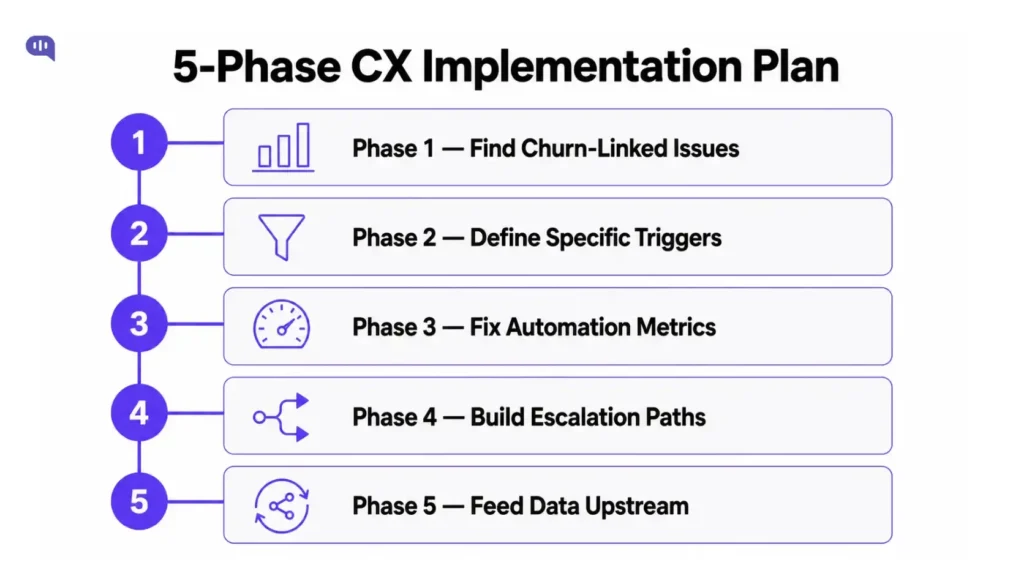
Here’s how we structure our implementation for enterprise telecom customers:
Phase 1: Find the support moments that predict churn
Pull every support interaction from the last 90 days and match it against your churn data. You’re not looking for complaint volume. You’re looking for correlation: which issue types, which channels, and which agent paths appear most often in the 30 days before a customer churned?
In our experience working with telecom CX teams, billing disputes with more than one contact and failed chatbot journeys that end in a call are typically the two strongest predictors.
The honest version of this phase takes two to three weeks and requires your support data sitting next to your churn data, probably for the first time.
Phase 2: Define churn-risk triggers with specificity, not intent
Vague triggers don’t fire reliably. “Cancellation language” is not a trigger. “Customer says ‘cancel’, ‘leave’, ‘switch’, or asks about number portability” is a trigger.
Set up the following:
| Trigger | Routing action |
|---|---|
| Cancellation or porting language | Route immediately to a retention-trained agent with the full conversation summary |
| Second billing contact within 30 days | Escalate to a billing specialist, add account history |
| Failed chatbot journey | Transfer to human with complete transcript, no restart |
| Negative sentiment after outages | Trigger proactive follow-up, not reactive queue |
The specificity matters because generic escalation paths get ignored by agents who are already handling volume. If the handoff arrives with clear context and a recommended next action, agents act on it. If it arrives as just another ticket, it disappears.
Phase 3: Fix your chatbot’s job description
Most telecom chatbots are measured by containment rate. That metric is quietly doing damage.
A chatbot that contains a billing dispute without resolving it has failed the customer and recorded a success internally. You won’t see the churn it caused until next quarter.
Rebuild the measurement model before you rebuild the bot. The metrics that matter:
| Old metric | Replace with |
|---|---|
| Containment rate | Resolution rate (confirmed by customer, not assumed |
| Tickets deflected | Recontact rate within 72 hours after AI interaction |
| Average handle time | Customer effort score post-interaction |
| Chatbot sessions | Percentage of handoffs that arrive with complete context |
Audit the flows that led to the most churn first, and then expand the audit to other areas.
Phase 4: Build escalation paths that agents will actually use
Escalation paths fail for two reasons: they’re too complex, or they arrive without enough context for the agent to act quickly.
For each high-risk segment, define a single escalation path with three things:
- Who receives it (role, not just queue)
- What context arrives with it (intent, sentiment, issue category, previous steps, account tier)
- What the agent should do in the first sixty seconds
Kommunicate’s handoff summary can be configured to surface all of this automatically before the agent types their first response. The goal is zero re-explanation from the customer. If your agents are still asking “can you tell me what happened?” at the start of an escalated conversation, the handoff is broken regardless of how good your routing logic is.
Phase 5: Make support data into an operations flywheel
This is the phase most CX teams skip, and it’s where the leverage is.
If your support data shows that customers are churning after plan upgrade confusion, the problem probably isn’t in support. It’s in how upgrades are communicated during the sale, or in what the confirmation email says, or in what the onboarding sequence does (or doesn’t do) in the first week.
Support sees these patterns first. But unless you’re sharing churn-correlated issue data with your retention, product, and billing teams on a regular cadence, nothing upstream changes.
Set a monthly review where support, retention, and product sit together over the same data. Bring the top three churn-correlated support issues.
Ask: is this fixable in support, or does the fix live upstream? That question, asked consistently, is how support-led churn reduction becomes a company-wide capability rather than a CX team initiative.
For mature teams we suggest that you track the following metrics.
Metrics CX Leaders Should Track
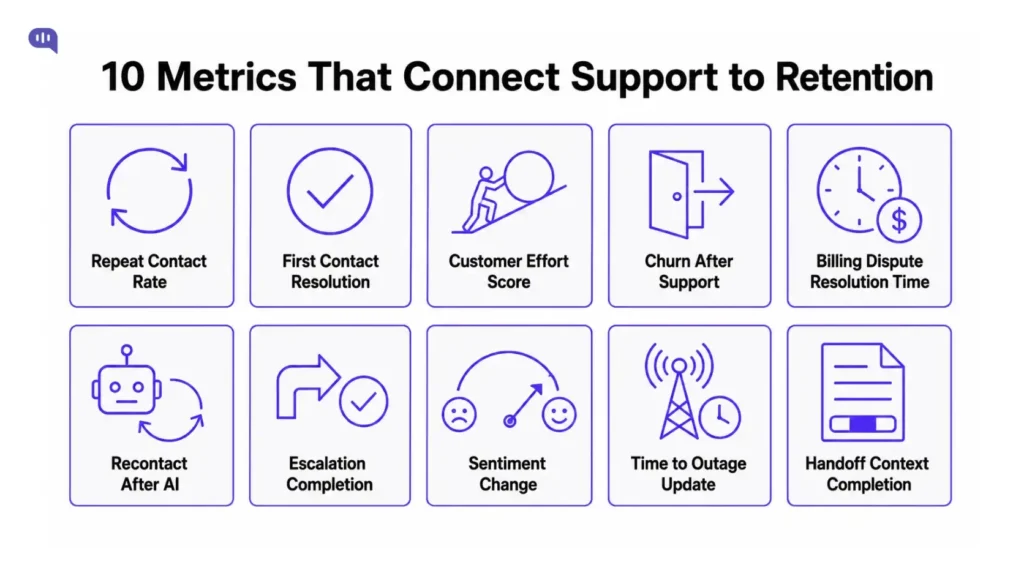
To reduce churn through customer support, CX leaders need metrics that connect support quality to retention outcomes.
| Metric | What it shows | Why it matters |
|---|---|---|
| Repeat contact rate | How often customers return for the same issue | Shows where resolution is failing |
| First contact resolution | Whether customers get help in one interaction | Strong indicator of support effectiveness |
| Customer effort score | How hard it is for customers to get help | High effort increases churn risk |
| Churn after support contact | How many customers leave after contacting support | Connects CX performance to retention |
| Billing dispute resolution time | How quickly billing issues are resolved | Billing confusion directly damages trust |
| Recontact after AI interaction | Whether AI actually solved the issue | Prevents false confidence in containment |
| Escalation completion rate | Whether handoffs lead to resolution | Shows if automation-to-human transfer works |
| Sentiment change during conversation | Whether the interaction improved or worsened customer confidence | Helps identify high-risk conversations |
| Time to proactive outage update | How quickly affected customers are informed | Reduces inbound volume and frustration |
| Handoff context completion | Whether agents receive full conversation context | Reduces repetition and customer effort |
The most important shift is moving from volume metrics to outcome metrics. Once you start seeing outcomes reflected in the data, you can take actions more confidently and influence more change.
Conclusion
Telecom customers do not churn only because another provider is cheaper.
They churn when they stop trusting their current provider to solve problems quickly, clearly, and fairly. That trust is often won or lost inside customer support.
Billing disputes, repeat contacts, onboarding delays, outage silence, and broken handoffs are not isolated service issues. They are churn signals. CX leaders who can identify these signals early can intervene before the customer reaches the cancellation stage.
That is the value of support-led churn reduction.
It turns customer support from a reactive ticket-closing function into an early warning system for retention. It helps CX teams understand why customers are frustrated, which issues create the highest churn risk, and where AI agents can reduce effort without blocking escalation.
The future of telecom churn reduction will not be built only around discounts and last-minute save offers. It will be built around faster resolution, smarter handoffs, proactive communication, and support systems that detect churn risk before customers decide to leave.
If you need help implementing this for your support team, feel free to book a call with Kommunicate.
Telecom customers often churn because of unresolved service friction, not just cheaper competitor plans. Common reasons include billing disputes, poor outage communication, repeated support contacts, activation delays, network issues, and broken handoffs between automation and human agents.
Customer support influences churn because it is often where customers experience the provider’s ability to solve problems. If support is slow, repetitive, generic, or disconnected across channels, customers lose trust. If support resolves issues quickly and clearly, it can reduce churn risk before the customer reaches the cancellation stage.
Support-led churn reduction is a CX strategy where telecom providers use support interactions as early warning signals for churn. Instead of waiting for cancellation requests, CX teams monitor repeat contacts, billing complaints, outage frustration, failed self-service journeys, and cancellation-related language to identify and retain at-risk customers earlier.
The strongest support-related churn signals include repeat contacts for the same issue, unresolved billing disputes, negative sentiment during conversations, failed chatbot or IVR journeys, questions about cancellation or number portability, delayed onboarding, and customer complaints after outages.
AI agents can reduce telecom churn by resolving repetitive issues faster, detecting churn-related language in customer conversations, routing high-risk cases to the right human agent, and passing full conversation context during handoff. This helps customers get faster answers without repeating the same issue across channels.
CX leaders should track repeat contact rate, first contact resolution, customer effort score, churn after support contact, billing dispute resolution time, recontact after AI interaction, escalation completion rate, sentiment change, and handoff context completion. These metrics connect support quality directly to retention outcomes.