Updated on April 7, 2026

The key to a well-crafted chatbot lies in not just ‘what’ it says, but ‘how’ it says it. It is a combination of its tone, language quirks, and emotional resonance.
Let’s look at a comparison to understand this:
“Hey Sam! Ready to tackle those expenses? (with an emoji) ” vs. “Hello, Samuel. Please submit your expense report.”
Here, the first sentence has a casual and conversational tone, whereas the second one sounds direct, cold, and distant.
This matters because a misaligned chatbot personality can frustrate users, and they are likely to abandon it if it sounds robotic. In fact, 30% of users abandon a company altogether after a negative customer experience.
Looking to solve this issue? Kommunicate can help you with that! It offers:
- No-code bot builder Kompose to create persona design in minutes.
- Generative AI for brand-aligned responses using RAG to pull answers from your knowledge base.
- Omnichannel consistency helps maintain tone across WhatsApp, email, and web chat.
In this blog, we see what constitutes a conversational AI personality, how you can design chatbot persona, and a quick checklist to ensure you hit the ground running.
What Makes a Strong Chatbot Personality
A chatbot’s personality isn’t just about sounding human; it’s about reducing friction, enhancing brand loyalty, and triggering desired user behaviors. These interactions solve problems and help build trust and loyalty.
Core Traits to Define
Chatbot personality should serve a strategic purpose. Define these non-negotiable traits to ensure consistency, trust, and brand recall in every interaction.
| Trait | Professional Brand | Casual Brand |
| Tone | Formal, precise | Warm, playful |
| Emotional IQ | Empathetic brevity | Humorous reassurance |
| Vocabulary | Industry jargon | Contractions, emojis |
Example: Bank of America’s Erica, the first widely available virtual assistant in financial services, serves 25M+ mobile users with text-based professionalism:
“I noticed an unusual $450 charge at ‘ELECTRONICCORP’. Would you like help reviewing your budget this month?”
A 3-Step Framework for Mapping Tone to Audience
Your chatbot’s tone shouldn’t guess; it should match.
This 3-step framework converts audience insights into conversational algorithms that drive higher message retention.
1. Identify User Personas
Forget age or job titles. Map personas to conversational intent and emotional triggers using hard data. High warmth scores resonate with the 73% of consumers who believe AI integration can improve the quality of customer service.
- Support seekers → Warm/patient.
- Gen Z shoppers → Casual/emoji-friendly.
2. Select Tone Traits
Quantify abstract traits into actionable settings using this science-backed scoring system. The tone matrix prevents tone drift by assigning measurable values to voice characteristics. Use a matrix like this one.
| Trait | Low to High | Your Score |
| Warmth | Clinical to Nurturing | High |
| Formality | Casual to Ceremonious | Low |
| Humor | Serious to Playful | Medium |
How to use it:
- Rate each trait (1-5) for your primary persona
- Benchmark this against competitors’ bots
3. Implement in Kommunicate
Transform your bot’s personality guidelines into actual conversations – no coding needed. With Custom Instructions, you define precise interaction rules:
- Tone of Voice: Specify exactly how it should sound (e.g., “Friendly but professional,” “Casual and enthusiastic”).
- Response Length: Dictate brevity or detail (e.g., “Keep answers under 2 sentences,” “Provide comprehensive explanations”).
- Critical Guardrails: Add essential rules (e.g., “Never give medical advice,” “Use plain language for beginners,” “Avoid legal terminology”).
The clearer your instructions, the more consistently your bot delivers brand-aligned, trustworthy responses instantly. The result? Brand-aligned responses in less than 3 minutes!
Designing Your Chatbot Persona
Persona profiles transform abstract brand values into actionable speech DNA. They are behavioral blueprints, not creative writing exercises. By defining name, role, and linguistic quirks upfront, you preempt the majority of tone inconsistencies that frustrate users.
Drafting Persona Profiles
Bots follow strict personality rules.
Earnest is a professional, reliable, and detail-oriented bot persona catering to audiences seeking trustworthy information, complex support, or handling sensitive matters.
Zippy is a fast-paced, playful, and concise bot persona designed for audiences prioritizing quick answers, entertainment, or casual engagement. ‘Earnest’ never uses slang, while ‘Zippy’ always uses emojis. These clear rules do two things:
- They help shape the bot’s training and scripts
- They turn brand guidelines into practical chat rules
The result is a consistent brand voice across thousands of daily chats.
For instance, take “Zara, Finance Health Coach”:
✅ Role: “Ex-financial advisor who simplifies jargon” (never “Bot 427”)
✅ Style: Uses 💡 for tips and no passive voice
✅ Error Handling:
❌ “Error: Invalid input” → ✅ “Whoops! I didn’t catch that. Try: ‘Transfer $50 to Alex’?”
Every rule, from emojis to error tones, scales your brand’s voice.
UX Considerations for Personality
UX is where chatbot personality transitions from words to a visceral experience. Every visual and temporal choice reinforces (or undermines) emotional alignment. Using typing indicators with a brief pause (1-2 seconds) makes helpful bots seem thoughtful. Instant replies make support bots feel urgent.
Color psychology matters, too. According to WebFX, colors increase brand recognition by 80%, and 62-90% of first impressions are made based on them. Fintech avatars utilize blue project trust, whereas e-commerce bubbles with orange accents spark excitement.
Crucially, these elements must persist across mobile, web, or WhatsApp to avoid hampering trust due to inconsistent channel experiences. Treat UX as your persona’s stagecraft or risk audience disengagement with it.
- Empathetic flows: “Hi there! How can I make your help you today?”
- Error handling: “My bad! I didn’t quite understand your question there. Could you please provide me with more details?”
- Visual cues:
- Avatars: Use illustrations matching brand colors (e.g., Bloom’s animated tutor).
- Chat bubbles: Round corners + brand-aligned colors (like HubSpot’s orange).
- Avatars: Use illustrations matching brand colors (e.g., Bloom’s animated tutor).
Kommunicate Tip: The Generative AI Chatbot automatically filters out robotic phrases, maintaining the brand’s voice using RAG and controlled responses.
Script Crafting & UX Testing
This phase transforms personality blueprints into behavioral reality. Without rigorous scripting and stress testing, even brilliant personas crumble under real-world user friction, where the majority of chatbot failures originate.
Writing Personality-Rich Dialogue
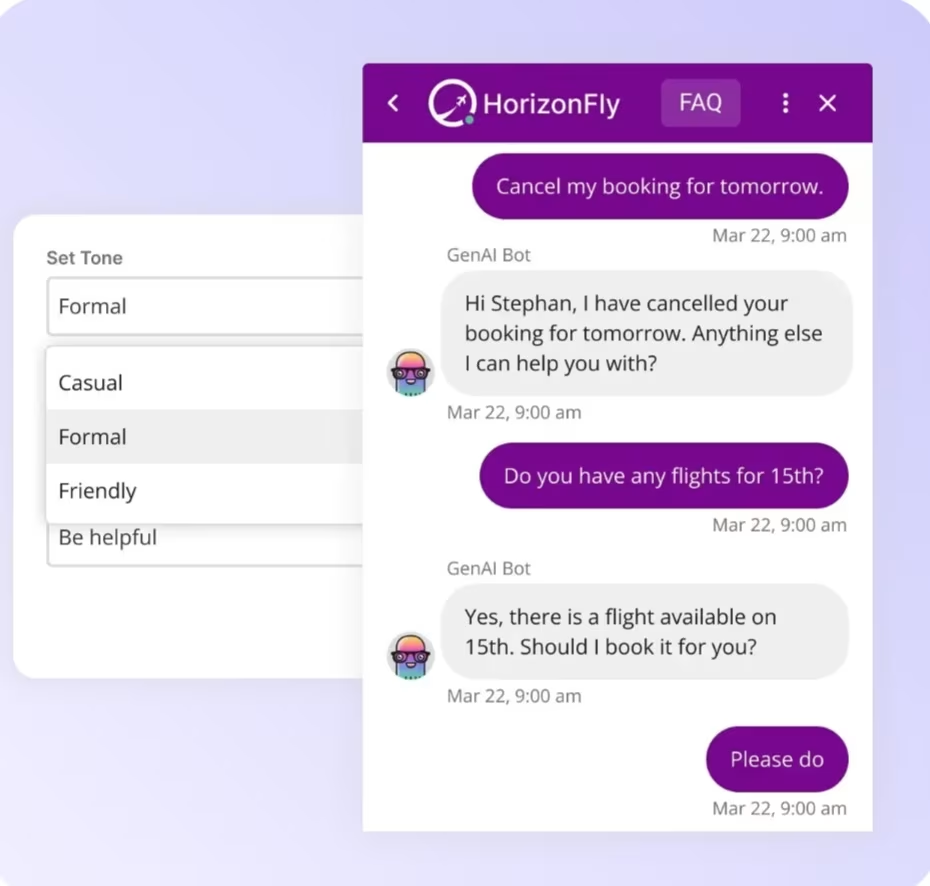
Words are your persona’s fingerprints. Strategic phrasing choices, such as contractions, mirror natural speech. Emojis replace overused exclamation points, converting robotic templates into emotionally intelligent exchanges.
The uncanny valley test measures how human-like robots or digital avatars trigger discomfort when they appear almost real but exhibit subtle imperfections. Every utterance must pass the “uncanny valley” test: Would a human say this?
- Do’s:
- Contractions (“You’re” vs “You are”).
- Strategic emojis (✅ not 💣).
- Tone tags (“Seriously though…” for gravity).
- Contractions (“You’re” vs “You are”).
- Sample Dialogue:
User: “My food order with order number (1234567) was supposed to arrive on Wednesday, but I have not received it yet. I want an update on it.”
Bot: “Okay, let’s fix this for you. Here’s the status for the order. Please let me know if you need any other help.”
UX Testing Playbook
Testing is risk mitigation, not validation. This playbook exposes personality issues before customers do, using quantifiable metrics that predict real-world fallout. The goal here is consistency across all interactions.
| Test | Tool/Metric | Goal |
| Flesch Readability | Hemingway App | Score > 70 |
| Tone Consistency | Kommunicate’s A/B Tests | 90% match |
| Response Timing | Botium (Load Testing) | < 2 sec/reply |
| Real-World Feedback | Internal Pilot Groups | CSAT > 85% |
These tests uncover the following hidden risks:
- Flesch Readability: Jargon burying key messages
- Tone Consistency: Brand voice drift across teams
- Response Timing: “Robotic” perception triggers
- Real-World Feedback: Edge-case emotional misfires
Pro Tip: Stress-test edge cases with Kommunicate Webhooks.
Simulate payment failures/errors by configuring your Webhook URL:
- Dashboard → Settings → Webhooks & Security
- Add a random Authentication Token (passed as base64-encoded header)
- Send JSON-triggered scenarios (e.g., “Card declined”) to expose emotional misfires before real users do.
Launching & Measuring the Success Of Your Chatbot Personality
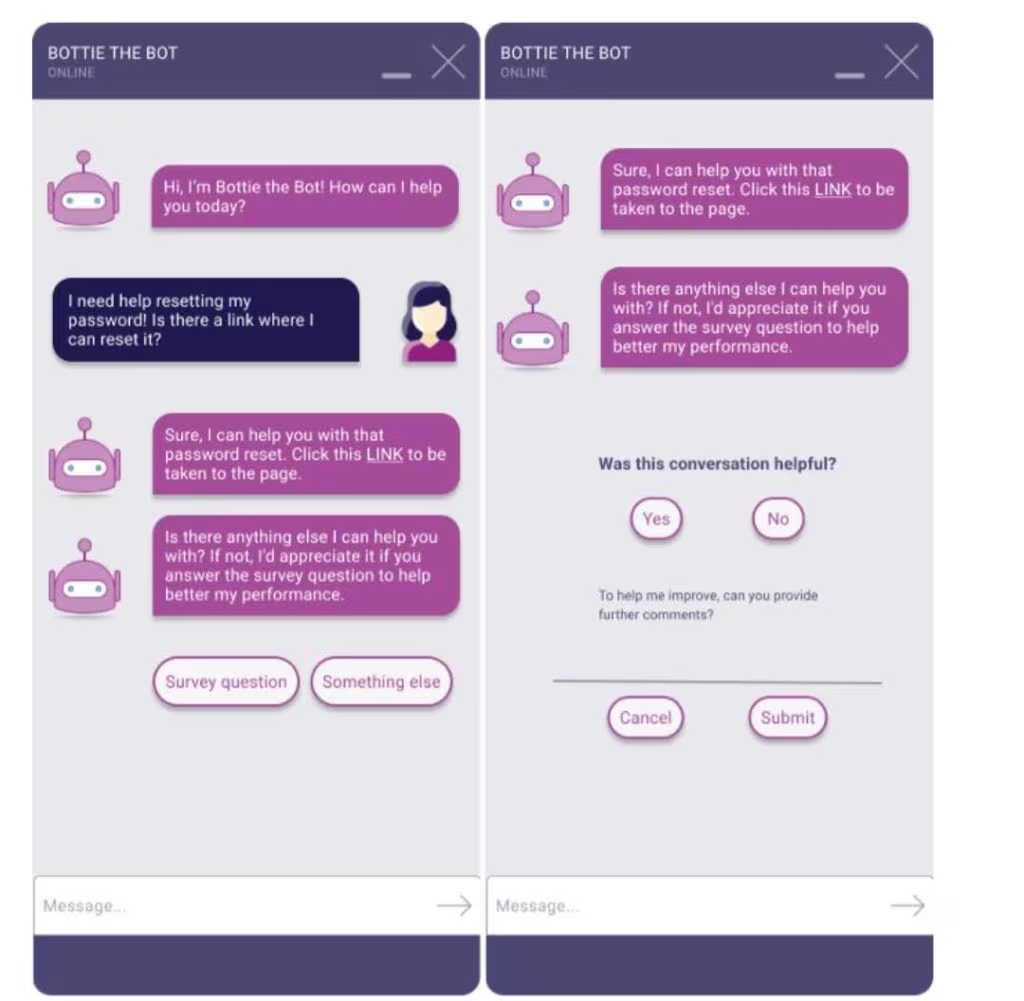
Successful chatbot deployment extends beyond initial development; it necessitates continuous monitoring and iterative refinement. A robust measurement framework ensures the chatbot consistently delivers value and meets its intended objectives.
This section outlines key metrics to track and an effective iteration cycle for sustained performance:
Key Metrics
Engagement Rate
This metric indicates the percentage of user sessions that involve meaningful interaction with the chatbot. Industry averages for chatbot engagement rates typically fall within the 35-40% range, and great experiences can generate up to 90% engagement.
A high engagement rate signifies that users find the chatbot helpful and are willing to interact with it beyond a superficial level.
CSAT
It measures the level of customer satisfaction with their chatbot interactions. This is typically captured via post-chat surveys, often using a simple rating scale.
The aim should be to achieve a score of 4.5+/5. The general CSAT scores across industries often range from 75% to 85% for chatbots. A score around 80% is generally considered great, with users feeling satisfied when the bot fully resolves their issues.
Regularly collecting and analyzing CSAT scores provides direct feedback on user experience, helping pinpoint areas where the chatbot may be falling short.
Task Completion
This metric assesses the chatbot’s ability to guide users through specific processes or achieve predefined goals successfully. A high score indicates that the chatbot is effectively designed to handle common user flows, minimizing the need for human intervention and providing a seamless user experience.
Monitoring task completion rates helps validate the chatbot’s utility and efficiency in automating routine tasks.
Iteration Cycle
Implement a structured iteration cycle to regularly review performance, identify trends, and deploy chatbot personality enhancements:
Monthly Reviews
Conduct comprehensive monthly reviews, including an audit of a sample of conversations. Reviewing around 50 random chats can help identify subtle shifts in tone, common user frustrations, or emerging topics that the chatbot might not be adequately addressing.
This qualitative analysis is crucial for detecting tone drift and ensuring the chatbot’s responses remain aligned with brand guidelines and user expectations.
A/B Test
Experiment with different conversational approaches to optimize engagement and effectiveness. For instance, A/B test greetings like “Howdy! 👋” versus “Hello” with 20% of traffic. A/B testing compares different chat replies (such as short vs. long versions) to determine which users prefer them. Use the results to make your bot more engaging.
The Kommunicate Advantage
Kommunicate offers significant advantages in managing and iterating on chatbot personas. Their ability to sync personas across multiple channels, such as WhatsApp and web chat, via centralized log streams streamlines the management process.
This guarantees consistent UX across all channels and centralizes interaction data for better analysis and improvements.
Quick Persona Development Checklist
The following checklist provides a straightforward approach to building and refining your chatbot’s personality, ensuring it aligns with your brand identity and user expectations.
Identify Brand/User Tone
Begin by thoroughly understanding your brand’s existing communication style and the preferred tone of your target users. Understand how your customers prefer to be addressed. Review your email template and social media to understand how your brand typically communicates.
Get this right first. A clear understanding of both aspects will ensure effective development of your chatbot’s voice.
Map Tone In A Matrix
This quantitative approach helps visualize the desired persona and ensures consistency across various conversational scenarios. The matrix serves as a tangible guide for all subsequent persona development efforts.
Make a quick chart scoring things like:
- Friendliness (Cold → Warm)
- Formality (Casual → Formal)
This keeps everyone on the same page.
Create Persona Profile
This humanizes the chatbot and makes it more relatable to users, fostering a stronger connection. A well-defined persona profile acts as a central reference point for content creators and developers.
Give it:
- A name (like “Zara” not “Chatbot 3.0”)
- A Context (“Ex-banker who explains things simply”)
- Speech quirks (uses 💡 for tips, avoids jargon)
Build Scripts
These scripts are vital for demonstrating the persona’s practical application and ensuring consistent communication.
Draft 10+ real chat examples like:
User: “I am unable to reach the delivery executive!”
Bot: “So sorry! Let me help you reach them. Here’s another number you can try – 12345678.”
Don’t forget to write nice, courteous error messages for any errors encountered.
Run UX Tests
Conduct user experience (UX) tests to evaluate the chatbot’s conversational flow and overall effectiveness. Utilize tools like the Flesch readability score to assess the clarity and ease of understanding of the chatbot’s responses.
- Check if responses are easy to read (like grade 8 English)
- Ensure replies stay on-brand every time
- Confirm it answers fast (<2 seconds) even when busy
Furthermore, perform Botium load tests to ensure the chatbot’s performance and responsiveness under various conditions, identifying any potential bottlenecks.
Integrate via Kompose and API
Utilize tools like Kompose and APIs to ensure your bot operates smoothly on your website, WhatsApp, and other platforms. This technical integration is key to expanding the chatbot’s reach and utility.
Monitor Metrics
Establish a continuous monitoring framework to track key performance indicators (KPIs) related to the chatbot’s persona and overall effectiveness.
Track:
😊 User satisfaction (CSAT)
✅ Completed tasks rate
🔁 How many users return
Adjust monthly according to these metrics.
“A good personality isn’t just for show; it’s what makes your bot useful and human.”
Conclusion
By following this playbook, you’ll boost engagement and turn bots into brand ambassadors. Kommunicate with no-code persona sculpting via Kompose lets teams deploy brand-aligned avatars in minutes.
Its generative AI engine then enforces tone consistency across millions of conversations using RAG architecture. Ultimately, this end-to-end system proves that chatbot personality isn’t polish—it’s the product”.
Kommunicate Assist allows you to book a demo with us and see how 80% of consumer queries resolve in no time.
FAQs
Q1: What’s a chatbot personality?
It’s the blend of tone, language, and emotional cues (e.g., humor/empathy) that makes your bot feel human.
Q2: How do I ensure a consistent tone?
Use tone matrices + test scripts with Kommunicate’s A/B testing tools. Avoid single-tone words like “friendly”—combine “friendly + clear”.
Q3: Can chatbot personality improve customer trust?
Yes. Users trust bots more when they use an empathetic error message.
Q4: How often should personality be updated?
Audit personality quarterly or after major product changes.
Q5: Which Kommunicate feature supports tone testing?
Generative AI Chatbot with RAG enforces brand voice dynamically.

Dhruv is an SEO Consultant specializing in SaaS and Customer Experience (CX). At Clickass, he shares actionable SEO and marketing strategies to help CX-driven SaaS brands grow organically. In his free time, he writes about SaaS growth, CX innovation, and practical tactics for improving digital visibility.