Updated on February 3, 2026
In his 2022 book, Jason Wingard, the former president of Temple University, raised a clarion call about the state of college education.
“As the skill demands for jobs began to increase in complexity significantly and to evolve more rapidly, it became progressively clearer that the college education failed to prepare graduates to meet employer expectations.”
This quote seems counterintuitive in 2025, as college enrollments have reached pre-pandemic levels. However, given the current state of the job market, it might be time to re-evaluate the current meta around increasing college enrollments.
This article will outline ten core strategies that have worked for our partner universities and colleges. It’ll cover:
- Why Do You Need to Re-evaluate the Current College Enrollment Programs?
- Ten Ways to Increase College Enrollment
- Craft a Compelling Narrative
- Personalize Engagement with AI Agents
- Enhance Student Support Processes
- Optimize Your Digital Presence
- Use Social Media and Short-Form Videos
- Use Data-Driven Marketing Processes
- Create an Active Alumni and Student Community
- Develop Industry, Inter-School, and Community Partnerships
- Provide Flexible and Blended Learning Pathways
- Conduct Market Research and Competitive Analysis
- Conclusion
Why Do You Need to Re-evaluate the Current College Enrollment Programs?
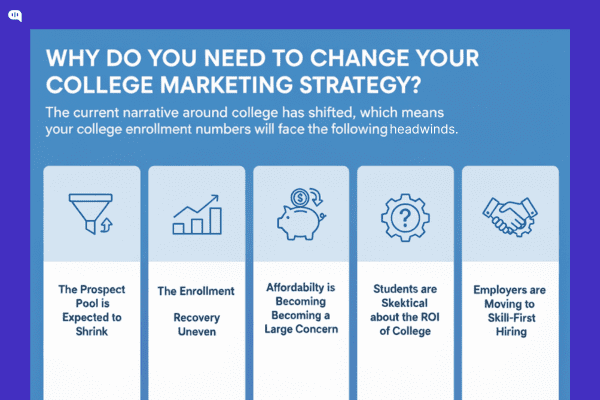
The current narrative around college has shifted, which means your college enrollment numbers will face the following headwinds.
1. The Prospect Pool is Expected to Shrink
WICHE (Western Interstate Commission for Higher Education) projects the total number of U.S. high-school graduates will peak in 2025 and then decline by ~13% through 2041 (with especially steep drops in CA, IL, MI, NY, and PA). That means fiercer competition for a smaller pool in many states and growing regional imbalances you’ll need to plan around.
2. The Enrollment Recovery is Uneven
Yes, the total college enrollment has recovered to pre-pandemic levels. But, 18-year-old first-years remain below 2019 levels, and growth is concentrated in community colleges and certificates—so the rebound doesn’t uniformly help every segment.
3. Affordability is Becoming a Large Concern
The troubled 2024–25 FAFSA rollout drove a sharp application shortfall (GAO notes a 9% decline among first-time filers and ~432,000 fewer FAFSAs overall by late August 2024), and experts linked freshman enrollment softness last cycle to the FAFSA chaos. You can’t assume “business as usual” timelines or messaging for aid.
4. Students are Skeptical about the ROI of College
Gallup finds confidence in higher ed has been volatile (42% express confidence in 2025, up from 36% in 2023–24). But, a fresh Gallup reading shows the share calling a degree “very important” has hit a new low, so value doubts persist.
5. Employers are Moving to Skill-First Hiring
As the World Economic Forum’s 2025 report states, “Skill gaps are categorically considered the biggest barrier to business transformation.” (63% of employers say so.)
Meanwhile, NACE reports that almost two-thirds of employers use skills-based hiring to identify candidates. Programs, pathways, and marketing must highlight skills, projects, badges, and work-integrated learning—not just majors.
Now that you understand why college enrollment is shifting, let’s discuss strategies to boost your competitiveness.
Ten Ways to Increase College Enrollment
You have heard this before, but today (more than ever) it’s necessary to meet your students where they are. The ten strategies below zero in on what works now: sharpen your story, personalize at scale, compete in short-form channels, and connect programs to fundamental skills and outcomes.
1. Craft a Compelling Narrative
If you’re from Harvard or Stanford, your positioning comes pre-built. However, the narratives need to be built and nurtured for the mortals from other universities.
Start by narrowing down your ICP and targeting students who fit. For example, you can create a community-focused narrative that makes first-generation students more comfortable, or create a skills-first presentation that appeals to students who want to fast-track their journey to the labor market.
Ensure that most of your content and advertising follows the simple formula of Promise → Proof → Path. A consistent narrative and storytelling are still some of the most effective tools in driving college admissions today.
2. Personalize Engagement with AI Agents
While AI is a contentious issue in classrooms and college campuses, it shouldn’t be controversial in marketing for the college.
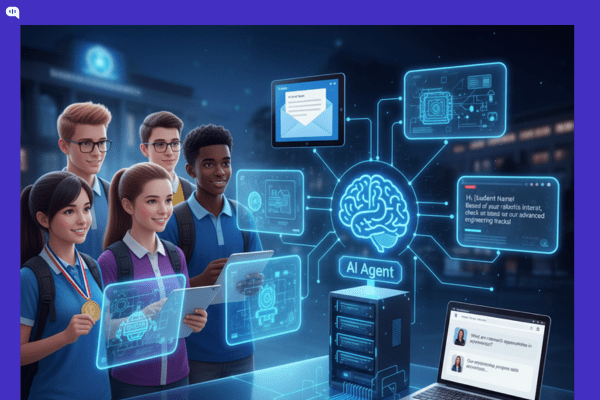
If you’re targeting particularly bright students (Olympiad winners, High-ranking SAT students), having a personalized approach will help. Students need help navigating the education system, and providing customized help that addresses their questions while engaging their interests is a game-changer, and AI agents can help.
You can build an AI agent that takes in academic signals and sends personalized emails, or set up an AI agent on your website to answer educational questions.
3. Enhance Student Support Processes
You should build a 24/7, AI-assisted helpdesk that lives where students already are (LMS, website, WhatsApp/SMS), routes smartly to humans, and publishes real SLAs. We’ll give you two real-life examples of why this matters:
- Oklahoma City Community College recently launched an AI agent in its Moodle app. The agent has already had 3,000+ student conversations since launch, 459 in the first months of 2025, peak 38/day, CSAT 8.33/10, and response times cut from hours to seconds with always-on availability.
- Bahamas Technical & Vocational Institute (BTVI): BTVI’s AI agent serves ~2,100 students spread across multiple islands. It answers common questions 24/7 and escalates to the correct department/operator when needed. This closes gaps from missed emails during peak periods.
A better pre-admit experience will allow prospective students to make better decisions. They can get quicker answers about their academic aspirations and choices, which boosts college enrollment.
4. Optimize Your Digital Presence
Your website makes the first impression on prospective students, so you must optimize it. Your site should load fast, work flawlessly on a phone, and get students to answers in two clicks: programs, costs & aid, deadlines, and a way to talk to a human (or AI) right now. Think “For You” hubs (Seniors, Transfers, Adult Learners, International) and clear micro-actions everywhere: calculate your real net price, check transfer credits, book a 15-minute advising call, or chat 24/7. If pages hesitate, bury info, or demand long forms up front, you’ll lose them.
Add short videos (lab tours, student projects), tangible outcomes, alum quotes, and keep the path obvious: apply, visit, or talk to an advisor. Behind the scenes, hit Core Web Vitals, keep accessibility to WCAG 2.2 AA, and make search smart enough to recognize “financial aid,” “scholarships,” and “fees” as the same intent.
Finally, treat this like a living product. Watch the journey from program page → net price → lead → application in GA4, replay sessions on your top pages, and A/B test one thing at a time (hero copy, form length, advisor CTA placement). After admission, send students to a clean “What’s Next” hub with checklists, status trackers, and proactive nudges via email/SMS/WhatsApp to prevent melt.
5. Use Social Media and Short-Form Videos
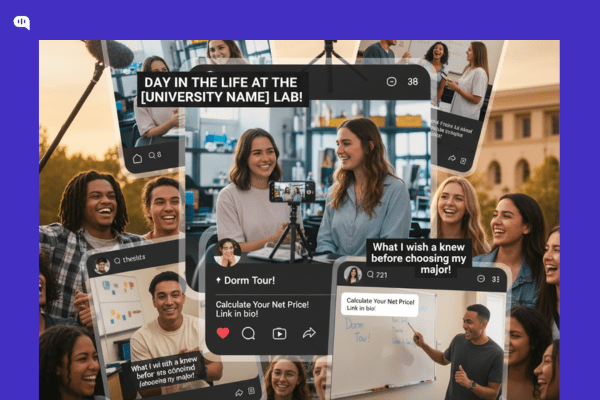
If you’re a millennial, working on short-form videos or using TikTok might feel cringe. However, students are overwhelmingly spending their time on the platform, and having a presence on these social media platforms is crucial. To extend the lifespan of high-performing content, enrollment teams often download TikTok videos to reuse student testimonials and campus highlights across other recruitment channels.
Lean into what works: scrappy, authentic clips that answer fundamental questions and show real people. Think 15–30 second Reels/TikToks/Shorts with hooks like “What I wish I knew before [major],” “Day in the life at [campus spot],” or “How I pay for college (net price, not sticker!).” Use subtitles, on-screen text, and vertical framing; film on a phone; ship fast. Rotate formats—student takeovers, advisor myth-busting, lab demos, micro-internship highlights, dorm tours—and repost natively across TikTok, Instagram Reels, and YouTube Shorts. Every video gets a clear micro-CTA: DM us, chat with an advisor, calculate your net price, or book a 15-minute call (link in bio/Linktree).
Tune into your alumni and students for creating content. This is something that the theatre or debate club might participate in as a part of their extracurricular activity. Track your performance across different platforms, and choose the formats that resonate with your audience.
6. Use Data-Driven Marketing Processes
You don’t need to spend hundreds of thousands on different SaaS platforms to drive data-driven marketing. Most of our clients are community colleges with small administrative teams focusing on community-led marketing.
Here, data-driven marketing can be as simple as doing small surveys at a community bookshop or cafe. You should track the metrics of how your emails and website are performing and tweak things to see if it moves the needle.
Note the current metrics across your marketing channels, and see what you can optimize to improve enrollment. Remember to keep changes small so you can pinpoint areas for further optimization.
7. Create an Active Alumni and Student Community
Make the community feel inevitable from Day 1. Set up a moderated Discord or Slack with channels by major, year, and “jobs and internships.” Pair each incoming student with a near-peer mentor and run monthly AMAs with alums in high-demand fields. Keep it lightweight, friendly, and always on so students get answers in minutes.
Turn alums into a visible advantage. Spotlight and enable quick wins with a job board where alumni post open roles and referral opportunities. Offer 30-minute career coffees, micro-internship briefs, portfolio reviews, and mock interviews—share who hired whom and which projects shipped to keep momentum high.
Use the community to boost recruiting. Invite prospects to open Discord hours, publish a public calendar of alum talks, and let admitted students join interest groups early. Capture student and alumni clips, project demos, and hiring stories, then repurpose them on program pages and short-form channels. When applicants feel the network before they enroll, college enrollment increases.
8. Develop Industry, Inter-School, and Community Partnerships
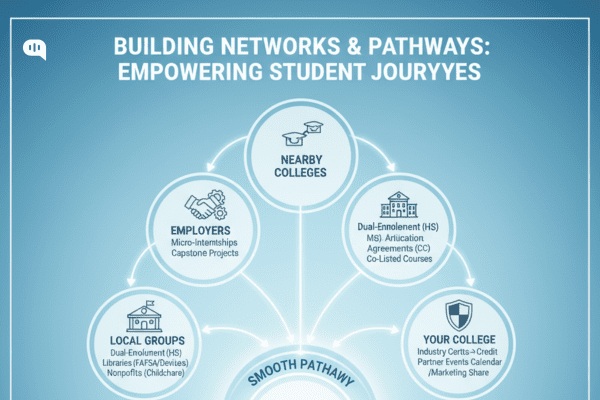
Build a small network of employers, nearby colleges, and local groups that create real student opportunities. Start with an employer advisory council for your top programs, and lock in micro-internships, capstone briefs, and site visits each term. Sign simple MOUs that spell out projects, mentor time, and hiring windows. Map industry certifications to credit so working adults and career switchers can finish faster. Publish a rolling calendar of partner events, career coffees, and on-campus demos so students see momentum.
Create smooth pathways into and through your college. Set up dual-enrollment with high schools, articulation agreements with community colleges, and co-listed courses with neighboring universities to expand choice. Team up with workforce boards, libraries, and nonprofits for FAFSA nights, device lending, and childcare support. Share facilities and marketing where it helps everyone, then report back on placements, transfer success, and employer satisfaction. Keep the paperwork light and the wins visible to increase college enrollment.
9. Provide Flexible and Blended Learning Pathways
Offer real-life flexibility: blend on-campus with online, add evening/accelerated terms, and make “asynchronous + lab/clinic days” a standard option. The evidence is on your side—multiple meta-analyses find blended formats outperform traditional classroom-only instruction on average, improving achievement and attitudes. And student behavior already reflects this shift: even after campuses reopened, ~61% of undergraduates took at least one online course, up sharply from pre-2020 levels.
Shorten time-to-degree for working adults and transfers. Grant credit for prior learning (PLA) and industry certifications raises adult completion likelihood by ~17 percentage points and can save 9–14 months and $1.5k–$10k, depending on sector. Pair PLA with clear competency-based checkpoints so students advance on demonstrated skills, not seat time.
10. Conduct Market Research and Competitive Analysis
Start with students and employers, not gut feel. Interview recent admits, non-matriculants, and alums to learn why they chose or passed. Tag every insight by theme: affordability, program fit, speed to job, and support. Pull your last 12 months of GA4 and CRM data to map the journey from first visit to deposit. Layer in search queries, on-site search logs, and counselor FAQs to spot content gaps. For programs, validate demand with job postings, certification trends, and local employer roundtables so you are building to fundamental skills needs.
Then study the field with a simple quarterly teardown. List your top 6–8 competitors by program and region. Capture their promises, proof points, aid calculators, chat availability, visit flow, and application friction. Run a keyword and content gap check to see where they win attention and where you can outrank. Secret shop their forms to time response and note nurture quality. Turn findings into a short action list: pages to build, messages to test, scholarships to feature, and service SLAs to match or beat. Keep it light, repeatable, and tied to enrollment metrics.
Conclusion
Growing enrollment in 2025 isn’t about one silver bullet; it’s about stacking small, compounding wins. Clarify your promise, prove outcomes with real data, and make the next step effortless across web, social, and advising. Pair that with AI-assisted support, flexible learning paths, and visible community momentum so students can see themselves succeeding before they apply.
Do the unglamorous work too: tighten forms, answer affordability questions quickly, measure the whole journey, and iterate weekly. When your institution meets students where they are with speed, clarity, and empathy, you convert more qualified interest into enrolled and retained graduates.
Ready to put this playbook to work?
Book a 15-minute demo with Kommunicate to see how AI agents and 24/7 student support can lift inquiries, applications, and enrollment.

Manab is the Head of Go-To-Market (GTM) at Kommunicate, with over 12 years of professional experience. He collaborates closely with the engineering, sales, and marketing teams to deliver and position Kommunicate’s AI solutions effectively in the market.
Prior to joining Kommunicate, he worked at Cvent, an enterprise event management software company, and Entropik, an emotion AI company that helps brands understand and interpret consumer emotions.