Updated on September 16, 2026
Estimated reading time: 19 minutes
TL;DR
Poor insurance customer experience is a direct revenue problem: it kills renewals, shrinks lifetime value, and forces expensive customer replacement. The fix starts with proactive communication, streamlined claims, and personalization at scale.
Insurance customer experience is the complete experience a policyholder has with an insurer across discovery, purchase, onboarding, servicing, claims, renewal, and support. It includes digital journeys, agent interactions, claims transparency, proactive communication, personalization, and how easy it is for customers to get help when they need it.
Insurers investing in conversational AI in insurance are seeing measurable gains in satisfaction and retention, while those still delivering generic, reactive service are losing customers who have more options than ever. Read on for the seven strategies that move the needle on insurance customer experience, and the metrics to know if they’re working.
Most people buy insurance and then hope they never have to think about it again. Insurance is built for moments of crisis, but you have to build the customer experience during the time in between.
The problem is that most insurers have spent decades optimizing for the crisis moments while neglecting everything else.
The onboarding is clunky. The communication is sparse. The renewal is a form letter. And by the time the customer needs to file a claim, there’s no reservoir of goodwill to draw from.
That’s changing. As comparison sites make price competition easier than ever, customer experience has become the real battleground. Being in front of the customer is easier now, but the pain lies in forming multi-policy, multi-decade revenue relationships.
This guide breaks down why poor CX is silently destroying renewal rates and lifetime value, what the industry’s biggest friction points are, and seven concrete strategies to fix them. We’re going to cover:
- How does poor customer experience reduce insurance renewals and lifetime value?
- What does customer experience in insurance actually cover?
- The biggest customer experience pain points in insurance
- How to improve customer experience in insurance — 7 strategies
- How to measure customer experience in insurance
- Real-world examples of good customer experience in insurance
- Conclusion
- Frequently asked questions about customer experience in insurance
How does poor customer experience reduce insurance renewals and lifetime value?
The link between customer experience and financial performance in insurance isn’t soft or theoretical. It’s direct, measurable, and significant.
Poor CX triggers a predictable sequence of value destruction:
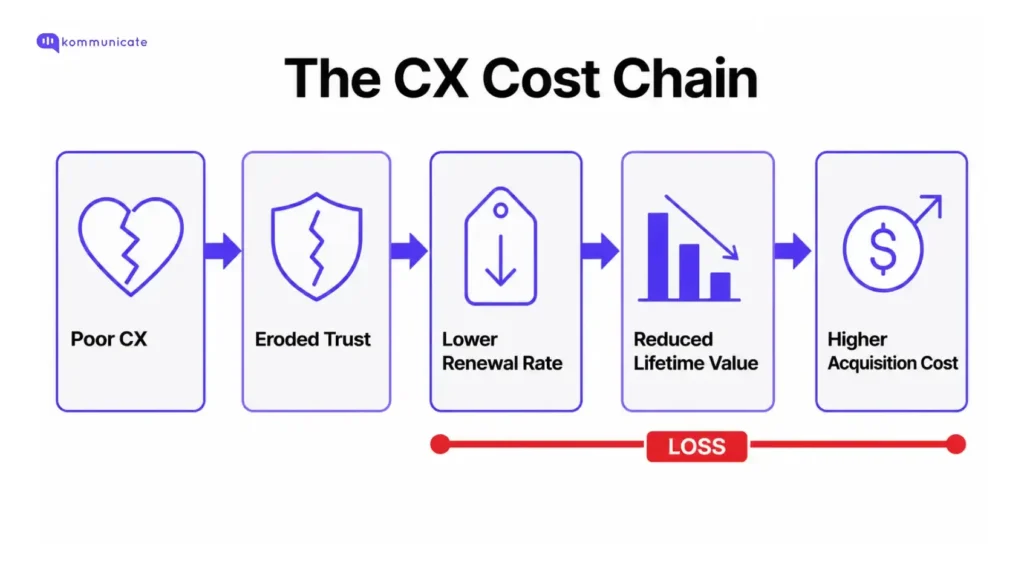
Each link in this chain compounds the next. An insurer who loses a customer at renewal loses every renewal, every add-on policy, and every referral that customer would have generated over a 10, 20, or 30-year relationship. Then they have to spend more of their budget on acquiring a replacement.
This predictable cycle is usually decided during renewals. The renewal process is the most consequential moment in the insurance customer relationship.
It’s where the experience of the past 12 months gets silently scored. Research shows that smooth claims processing, responsive support, and personalized service can increase renewal likelihood by 35%. The inverse is also true: friction at any touchpoint accumulates into a “no” at renewal time.
78% of policyholders say they’re more likely to renew their policies when they receive proactive support and communication throughout the year.
This friction before renewal causes some problems:
1. The lifetime value is reduced
The financial damage of poor CX extends well beyond the lost renewal. 55% of insurance providers acknowledge that improving customer experience leads directly to higher customer lifetime value, yet many treat CX as a cost center rather than a revenue driver.
We’ve seen this repeated across industries. Research from Forrester and Adobe found that businesses prioritizing excellent customer experience see roughly twice the annual growth in retention rates, repeat purchase rates, and customer lifetime value compared to those that don’t. In insurance, where a single customer can represent decades of premium revenue and multiple policy lines, that multiplier is enormous.
2. Churn is expensive to replace
49% of insurance customers have stopped using a service due to a poor digital experience alone. And because acquisition costs in insurance are high, each churned customer represents a substantial loss before you even factor in the LTV gap.
49% of insurance companies also acknowledge that improving CX directly reduces churn. The same lever that keeps customers also prevents the expensive cycle of constant replacement.
3. Cross-Sells and upsells are missed
Beyond renewals, poor CX forfeits the expansion revenue that makes long-term customers so valuable. 66% of insurers report that improved customer experience has led to better cross-sell and upsell opportunities. When customers don’t trust or engage with their insurer, they don’t answer the phone when the agent calls about adding a life policy or an umbrella policy. That lost conversation is lost revenue.
All of these problems expose a unique fragility in the insurance marketing process.
The unique fragility of the insurance touchpoint model
Unlike banking, insurers have very limited opportunities to demonstrate value or recover from a bad experience. A single poor interaction can define the entire relationship.
This asymmetry makes every touchpoint disproportionately high-stakes. Any of the following experiences can turn away a customer –
- A confusing renewal notice
- Slow claims acknowledgement
- A call center agent who asks the customer to re-explain their history
This makes it difficult to design the customer experience for insurance overall. So, before we start talking about how to fix customer experience for policyholders, we need to understand which parts we need to optimize for.
What does customer experience in insurance actually cover?
Customer experience in insurance isn’t just about how a claim is handled. It encompasses every interaction a policyholder has with their provider across the entire relationship lifecycle:
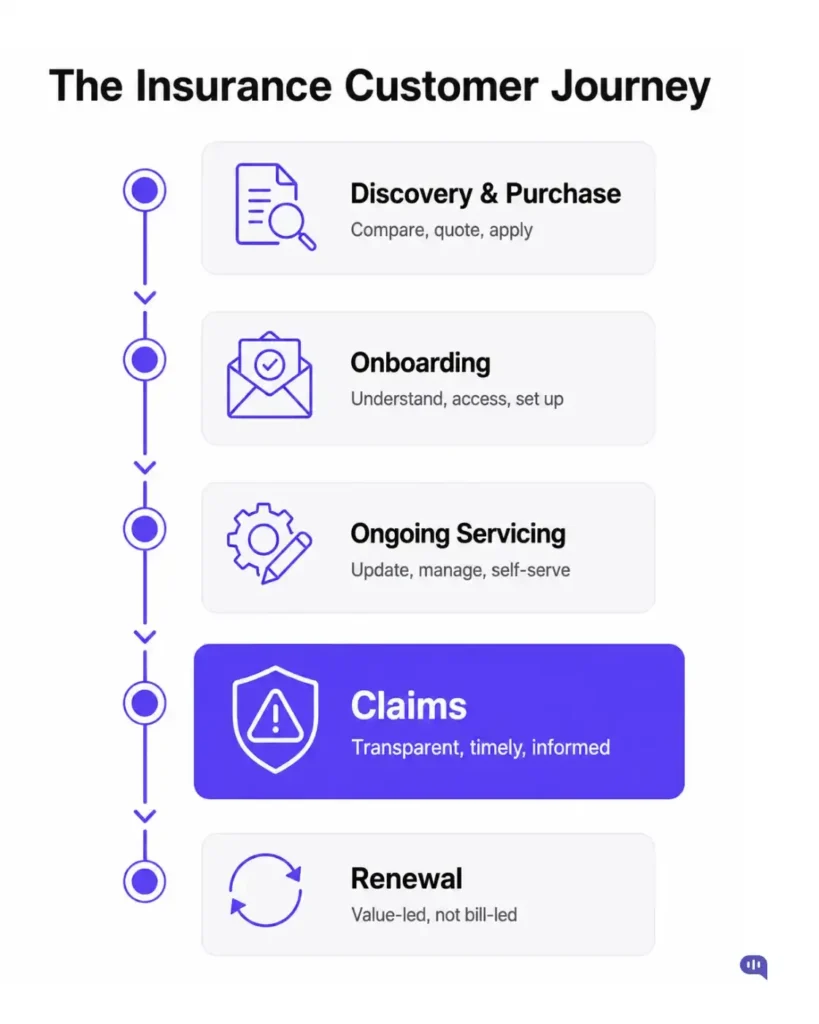
- Discovery and purchase: How easy is it to compare policies, get a quote, and complete the application? Is the language clear or buried in jargon?
- Onboarding: Does the customer understand what they’ve purchased? Do they know how to contact support, file a claim, or make changes to their policy?
- Ongoing servicing: Can they update their policy, add a driver, or change their address without calling a 1-800 number and sitting on hold?
- Claims: The highest-stakes moment in the relationship. Is the process transparent? Is the customer kept informed? Is the resolution timely?
- Renewal: Is the renewal proactive or just a bill? Does the insurer use this moment to re-demonstrate value or simply ask for money?
Different executive teams use different frameworks to capture the policyholder journey. Some common ones include the 4Ps of customer experience and the 3Cs of customer satisfaction.
The 4 P’s of customer experience in insurance
A useful framework for structuring CX efforts across the business:
- People: The agents, advisors, and service reps who interact directly with customers. Their training, empathy, and empowerment determine the quality of human touchpoints.
- Process: The workflows behind every customer interaction. Friction in any process becomes friction in the experience.
- Product: The policy itself needs to be understandable, relevant, and fairly priced. A product that confuses customers creates a CX problem before the relationship even starts.
- Platform: The digital and physical channels through which customers interact — apps, portals, call centers, agents. Each platform needs to be consistent, functional, and connected.
The 3 C’s of customer satisfaction in insurance
Three qualities define whether a customer feels satisfied with their insurer:
- Consistency: Customers should receive the same quality of service across every channel and every interaction. Inconsistency breeds distrust.
- Communication: Proactive, clear, and timely communication is the single most mentioned driver of satisfaction and retention in the industry.
- Care: Customers need to feel that their insurer is working for them, not against them. This matters most in claims, but it applies to every interaction.
While these frameworks are useful, the insurance industry does face some unique challenges that make the process challenging.
What makes insurance CX uniquely challenging?
Insurance has several structural features that make customer experience harder to deliver than in other industries:
- The product is intangible — Customers can’t see or feel what they’re paying for until something goes wrong
- Interactions are infrequent – There are fewer opportunities to build the relationship
- Claims are complex – Customers approach the claims process during times of crisis, which makes the process complex.
- Policy language is complex – Creating comprehension gaps from day one
- Policyholders communicate on different channels – The industry must maintain quality across multiple channels simultaneously
These complexity and challenges lead to customer frustration across policyholders. We have been serving enterprise insurance carriers since 2020, and we’ve observed some common customer pain points from them.
The biggest customer experience pain points in insurance
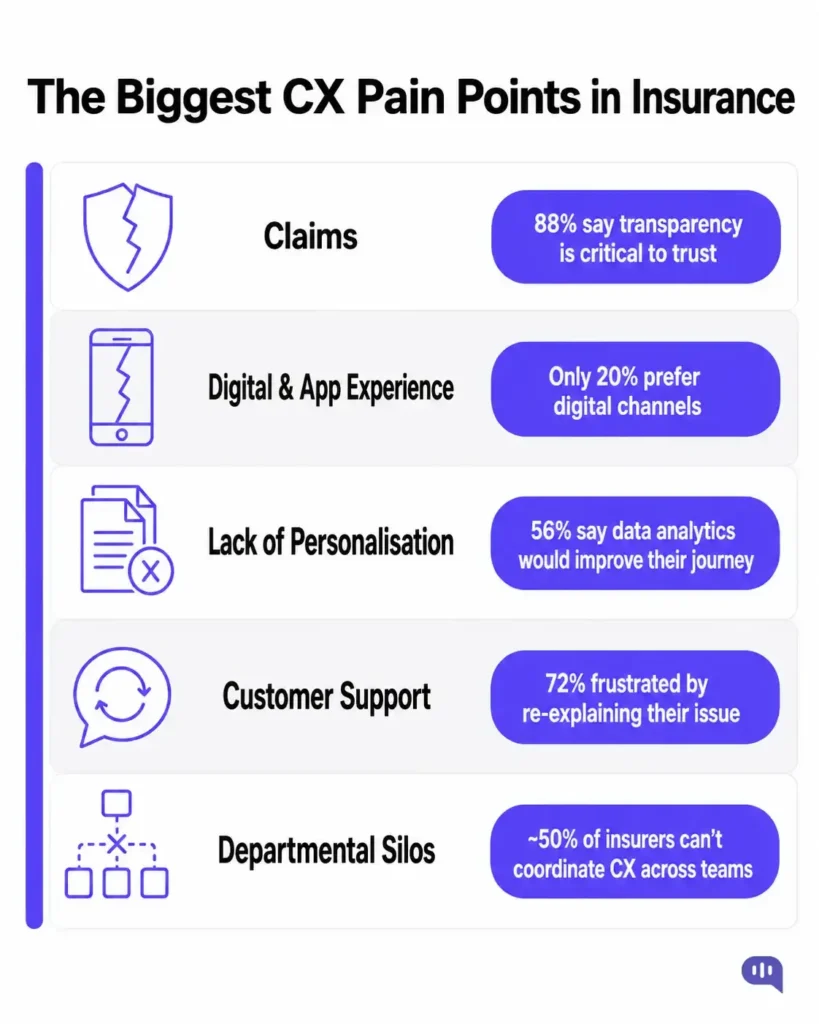
Before improving CX, it helps to understand where things break down most consistently. The journey touchpoints that we’ve noticed the most friction in are as follows:
| Journey Stage | Core Friction | Key Stat |
|---|---|---|
| Claims | Opaque, slow processes at the most vulnerable moment | 88% say transparency is critical to trust |
| Digital & App | Underperforming tools that customers don’t prefer | Only 20% choose digital as their top channel |
| Personalization | Generic communications across every touchpoint | 56% say better data analytics would improve their journey |
| Customer Support | No memory, no ownership, repeat contacts | 72% say re-explaining their issue signals poor service |
| Departmental Silos | Fragmented internal teams create a fragmented experience | Nearly half of insurers can’t coordinate CX across departments |
1. Claims
The claims process is the ultimate test of the insurance relationship. Customers file a claim during crisis: after an accident, a fire, a theft, a health crisis. If the process is opaque, slow, or requires them to chase updates, that vulnerability turns into resentment.
88% of customers say that clear and transparent claims processes are critical to building trust with their insurer. Yet the claims experience remains one of the most cited sources of dissatisfaction across the industry.
2. Digital and app experiences
By the time a customer opens their insurer’s app, they’ve already used their bank, their retailer, and their streaming service that day.
The comparison is instant and unforgiving.Insurance has largely failed to meet the standard those industries have set. Only 20% of customers identify digital channels as their preferred way to interact with their insurer.
A poor app or portal doesn’t just create friction; it signals to the customer that their insurer isn’t invested in the relationship. That signal accumulates quietly until renewal.
3. Lack of personalization across the journey
Insurance customers receive generic policy documents, generic renewal notices, and generic customer service. Meanwhile, every other subscription service they use knows their preferences, anticipates their needs, and communicates accordingly.
According to an EY survey, 56% of insurance respondents believe their customer journey can be significantly improved through better data analytics. Having comprehensive data pipelines that connect conversational AI with data from CRMs is key to solving this.
4. The customer support process
53% of insurance customers have had to contact customer support more than once to resolve the same issue. This shows that the company neither remembers the customer nor takes ownership of their problem.
Research shows 72% of customers say having to explain their problem to multiple people is a sign of poor service.
5. Departmental Silos
Nearly half of insurers struggle to coordinate CX efforts across departments. A claims team, a renewal team, and a digital team may all be pursuing separate agendas, with no unified view of the customer journey.
The customer experience the insurer as a single entity. When that entity gives inconsistent information, fails to carry context between interactions, or requires the customer to re-explain their situation at every touchpoint, the journey becomes fragmented.
That’s a hard impression to overcome at renewal time.
While these pain points are significant. There are some strategies we have employed for HDFC Life and Conte.it that might help.
How to improve customer experience in insurance – 7 strategies
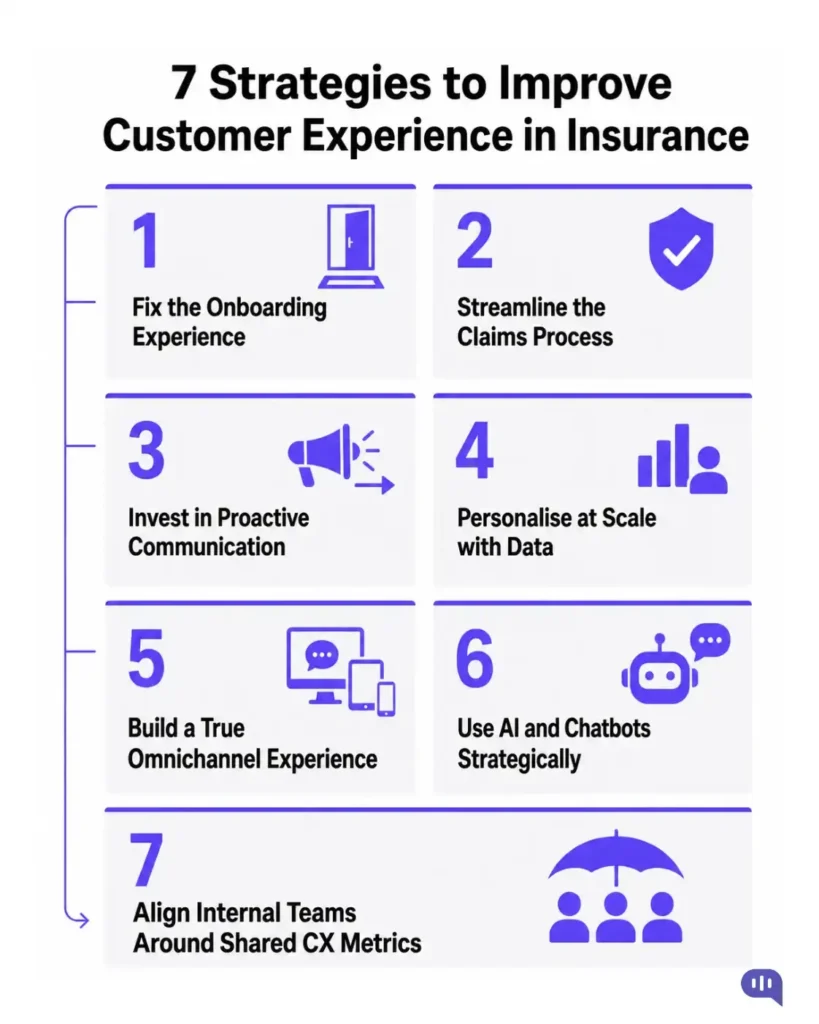
We often talk with insurers who find it difficult to strategize the difficult process of optimizing CX. Here are some strategies that have worked for our clients:
1. Fix the onboarding experience
The onboarding moment sets the tone for the entire relationship. It’s the first opportunity to show the customer that they made a good decision.
A strong onboarding process should do three things:
- Confirm what the customer has purchased in plain language
- Explain how to access support and file a claim
- Demonstrate that the insurer is reachable and responsive
Digital onboarding that’s well-designed is the first opportunity to gather the data needed for personalization throughout the relationship.
2. Streamline the claims process
Claims transparency is non-negotiable in insurance. The minimum bar:
- Customers should know the status of their claim at every stage without having to call and ask.
- Proactive status updates via SMS or email
- A clear timeline from first notice to resolution, and a dedicated point of contact if things get complex
Insurers who optimize the process can do more. They can win the claims process by offering:
- Digital-first FNOL (First Notice of Loss)
- Real-time adjuster tracking
- Fast-pay options for small claims
3. Invest in proactive communication
The biggest gap between what customers want and what insurers deliver is proactive communication. Most insurers are reactive: they wait for the customer to call, then respond. Customers want the opposite.
Proactive outreach can improve this. Actions like:
- Checking in before renewal,
- Sending a policy review reminder
- Notifying customers of coverage gaps relevant to their situation.
78% of policyholders say they’re more likely to renew when they receive proactive support and communication. That’s a fundamental shift in the renewal outcome.
4. Personalization at scale
Insurers collect an enormous amount of data, but, most of it is underutilized.
Personalization in insurance doesn’t have to mean dynamic pricing (which can feel adversarial). It means using what you know to communicate with them in relevant, timely ways.
For example:
- A customer who just had a baby may be underinsured on life.
- A customer approaching retirement may need to rethink their auto policy.
These conversations, prompted by data, are welcomed rather than resented.
5. Build a true omnichannel experience
Customers don’t experience channels. When they start a conversation online and call to finish it, they don’t want to start over. When they switch from the app to the agent, the agent should know their history.
Building genuine omnichannel capability means unifying customer data across every channel so that every interaction is informed by the full relationship history. But this is only possible when digital and human channels work together rather than in parallel.
Having a shared inbox across WhatsApp, Facebook Messenger, Telegram and other platforms really helps in this process.
6. Use AI and chatbots strategically
AI has a real role to play in insurance CX, but only when deployed thoughtfully. The broader use of AI in insurance can improve the customer experience by analyzing sentiment, simplifying self-service, and directing urgent requests to the right team more quickly.
Chatbots that:
- Answer simple FAQs
- Allow customers to check claim status
- Update policy details without hold times
Chatbots that force customers into a frustrating loop before connecting them to an agent are worse than no chatbot at all.
AI also has a powerful role in equipping agents:
- Real-time prompts
- Customer history summaries
- Sentiment analysis
Using AI carefully can improve your CX immediately, which translates to improved relationships across the entire customer lifecycle.
7. Align internal teams around shared CX metrics
Most CX problems in insurance are coordination failures. Claims doesn’t know what renewals are doing. Digital doesn’t know what the agent is telling customers. The customer experiences the gaps.
The fix is organizational: define shared CX metrics (NPS, CSAT, First Contact Resolution, Customer Effort Score, CLV) and make them visible and accountable across every team. When claims, renewals, product, and digital share the same scorecard, they start making decisions that benefit the full customer journey rather than their siloed function.
The 2026 insurance CX landscape is clear: collecting feedback is no longer enough. The organizations that win are those that act on it: systematically, and across departments. Which brings us to the KPIs and OKRs we recommend for insurance executives.
How to measure customer experience in insurance?
You can’t improve what you don’t measure. The metrics that matter the most in insurance are:
| Metric | What It Measures | Why It Matters |
|---|---|---|
| Net Promoter Score (NPS) | How likely customers are to recommend the insurer to others | A strong leading indicator of renewal and growth |
| Customer Satisfaction Score (CSAT) | Satisfaction at specific touchpoints such as post-claim, post-service call, or post-onboarding | Helps identify where the customer journey breaks down |
| Customer Effort Score (CES) | How hard it was for the customer to get something done | High effort scores are strong predictors of churn |
| First Contact Resolution (FCR) | The percentage of issues resolved in a single interaction | Every unresolved first contact creates a repeat contact and increases dissatisfaction |
| Customer Lifetime Value (CLV) | The total revenue expected from a customer over the full relationship | Combines average premium value, number of policies, and expected tenure |
| Retention Rate | The percentage of customers who renew | The most direct measure of whether CX is working |
Beyond surveys, digital engagement metrics reveal friction in the online experience. The ones we measure are:
- Drop-off rates during claims submission
- Self-service completion rates
- Average session duration on key pages.
A customer who abandons a claims form halfway through is a CX failure that never shows up in a satisfaction survey. The difference between qualitative feedback (Voice of the Customer) and quantitative CX metrics is that the latter reveals patterns at scale. Together, they provide a complete picture of what’s working and what isn’t.
Now that we’re aligned on how to improve CX in insurance, and what we can do to measure it well. Let’s talk about some examples.
Real-world examples of good customer experience in insurance
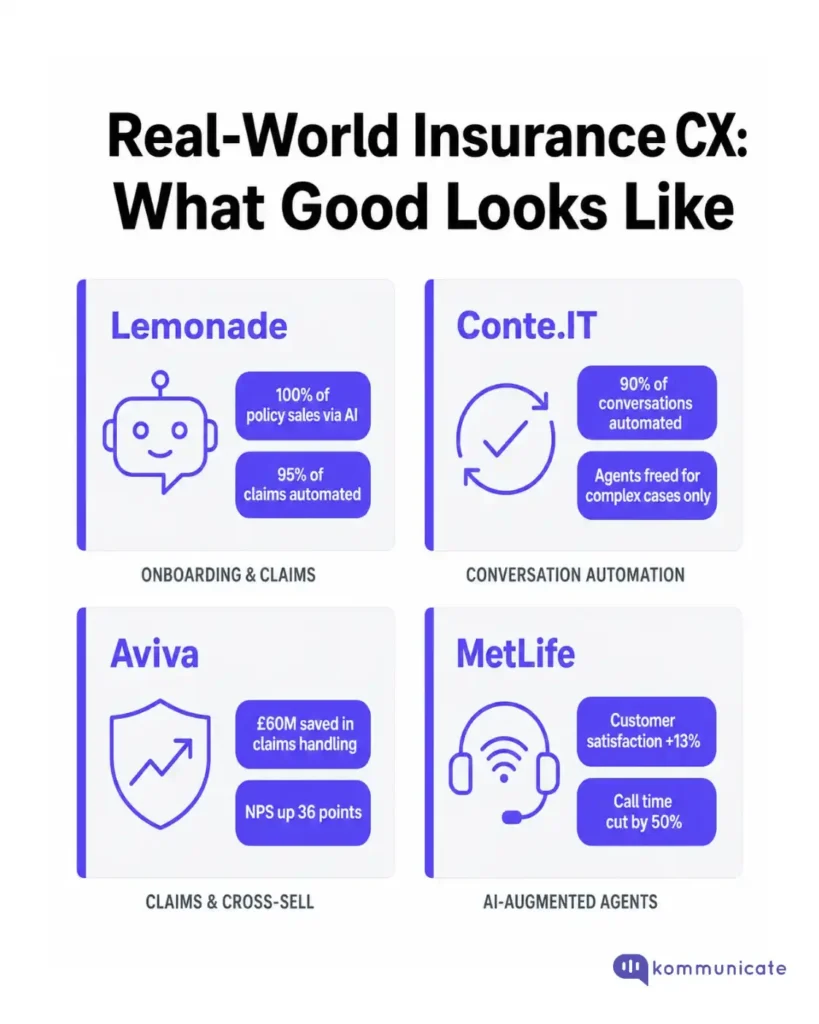
The clearest way to understand what good insurance CX looks like in practice is to look at the insurers who are already delivering it, and the measurable outcomes they’ve achieved.
1. Lemonade: Reinventing onboarding and claims end-to-end
Lemonade is the most cited example of insurance CX done differently, and for good reason. Their AI chatbot Maya handles 100% of policy sales and has managed over 180,000 customer conversations — allowing customers to get coverage, update billing, and modify policies entirely through chat, without ever speaking to an agent.
On the claims side, their AI (Jim) automates approximately 95% of First Notice of Loss (FNOL) interactions and instantly settles around 55% of claims. The company famously paid out over $1 million in claims in seconds. What Lemonade demonstrates is that removing human bottlenecks from routine interactions doesn’t degrade the experience — it dramatically improves it, because speed and transparency are what customers actually want in those moments.
2. Conte.IT: Automating 90% of conversations without sacrificing satisfaction
Conte.IT, an Italian car insurer with 500+ employees, deployed Kommunicate’s conversational AI to handle inbound policyholder queries and automated 90% of conversations, exceeding the industry average for chatbot containment. Rather than routing customers to agents for routine queries, the chatbot handled policy questions, claims filing steps, and document requests end-to-end. Agent time was freed for the 10% of interactions that genuinely required human judgment.
The Conte.IT case is particularly instructive for mid-sized insurers who assume AI-driven CX transformation is only viable at enterprise scale. The architecture is accessible, and the containment rates are replicable.
3. Aviva: AI transforming claims and cross-sell
Aviva used AI to transform its motor claims operation and the results were substantial. According to McKinsey, Aviva saved over £60 million ($82M) in 2024 through AI-assisted claims handling, while simultaneously cutting customer complaints by 65%. On the commercial side, moving 80% of transactions online lifted their Net Promoter Score by 36 points.
Aviva’s example illustrates the compounding effect of CX investment: operational savings moves together with customer satisfaction when the underlying experience is genuinely improved.
4. MetLife: AI-Assisted agents delivering better human conversations
MetLife implemented Cogito AI to analyse customer conversations in real time, providing agents with live coaching signals during calls. The outcome: first-call resolution improved by 3.5%, customer satisfaction rose 13%, and average call time was cut by half.
This is a strong example of AI augmenting human support rather than replacing it. The agent still leads the conversation and the AI ensures they’re better equipped to handle it. The result is a customer who gets a faster, more informed interaction without losing the human element that high-stakes insurance conversations often require.
Conclusion
Customer experience in insurance is the primary lever for:
- Renewal rates
- Lifetime value
- Competitive differentiation
In a market where every insurer offers roughly the same product at roughly the same price, the experience is the product.
The evidence is clear: proactive communication drives renewals, personalization drives retention, and every point of friction is a point of potential defection. Insurers who treat CX as a cost center will continue to lose customers to those who treat it as a growth strategy.
The place to start is an honest audit of your current touchpoints against the seven strategies above. Where are customers having to work too hard? Where is your communication reactive rather than proactive? Where are your teams coordinating around the product rather than around the customer?
Fix those gaps systematically, measure what changes, and the renewal and LTV numbers will follow.
If you need a conversational AI for insurance that helps you improve CX, feel free to book a demo with Kommunicate.
Frequently asked questions about customer experience in insurance
Customer experience (CX) in insurance refers to the sum of every interaction a policyholder has with their insurer.
It encompasses digital channels, phone support, agent relationships, onboarding, and claims handling. Unlike customer service (which is reactive), CX is the holistic perception the customer develops over the entire relationship.
In insurance, the 4 P’s of customer experience are People (the agents, advisors, and service staff who interact with customers), Process (the workflows behind onboarding, claims, and renewals), Product (the policy itself: how understandable, relevant, and fairly priced it is), and Platform (the digital and physical channels customers use to interact with the insurer). Weakness in any one of the four creates friction across the experience.
The 3 C’s in insurance customer satisfaction are Consistency (delivering the same quality of service across every channel and interaction), Communication (being proactive, clear, and timely rather than reactive and opaque), and Care (making customers feel the insurer is working in their interest, especially in high-stakes moments like claims).
The five core components of customer experience in insurance are:
(1) Accessibility — how easy it is to reach the insurer and get things done;
(2) Reliability — whether the insurer delivers what it promises;
(3) Empathy — whether customers feel understood and valued;
(4) Transparency — whether policies, processes, and pricing are clearly communicated;
(5) Personalization — whether the experience reflects who the customer is and what they actually need.
Customer service is a subset of customer experience: it’s the support a customer receives when they reach out with a problem.
Customer experience is broader: it includes every impression formed across every touchpoint, most of which happen without any direct service interaction. A confusing renewal notice is a CX failure even if no one calls to complain about it.

Devashish Mamgain is the CEO & Co-Founder of Kommunicate, with 15+ years of experience in building exceptional AI and chat-based products. He believes the future is human and bot working together and complementing each other.