Updated on August 17, 2026
Summarize this blog post with: ChatGPT | Perplexity | Claude | Grok
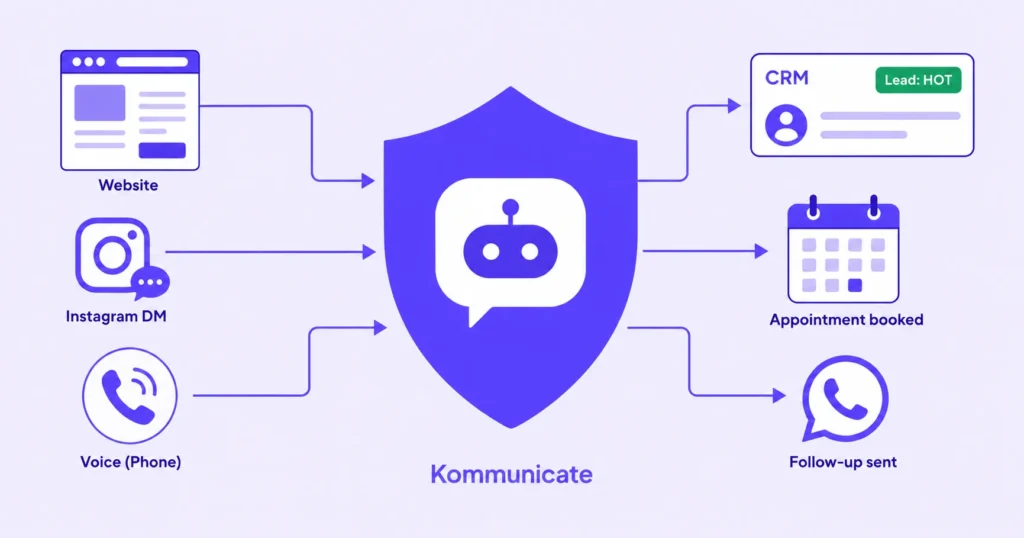
You have probably already invested heavily in insurance lead acquisition: paid search, social ads, aggregator feeds. But most carriers are losing those leads not because their targeting is wrong, but because of what happens in the seconds after a prospect lands on the page. In this guide, we cover how insurance chatbots fix that problem, including the pre-qualification workflow, channel deployment differences, agent handoff, and what TCPA actually requires in 2026.
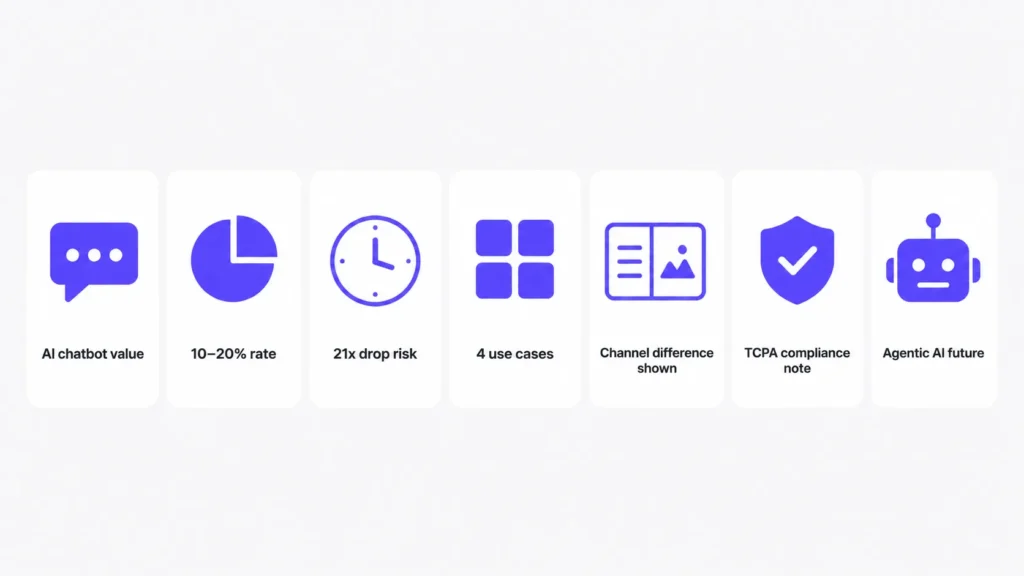
Key Takeaways
- Insurance chatbots are AI-powered virtual assistants that engage prospects instantly, collect eligibility data conversationally, and route qualified leads to agents without a human in the loop at the first contact stage.
- The average insurance quote-to-bind rate sits between 10% and 20% industry-wide depending on line and channel. Slow follow-up is the primary cause of unconverted quotes, not insufficient traffic volume.
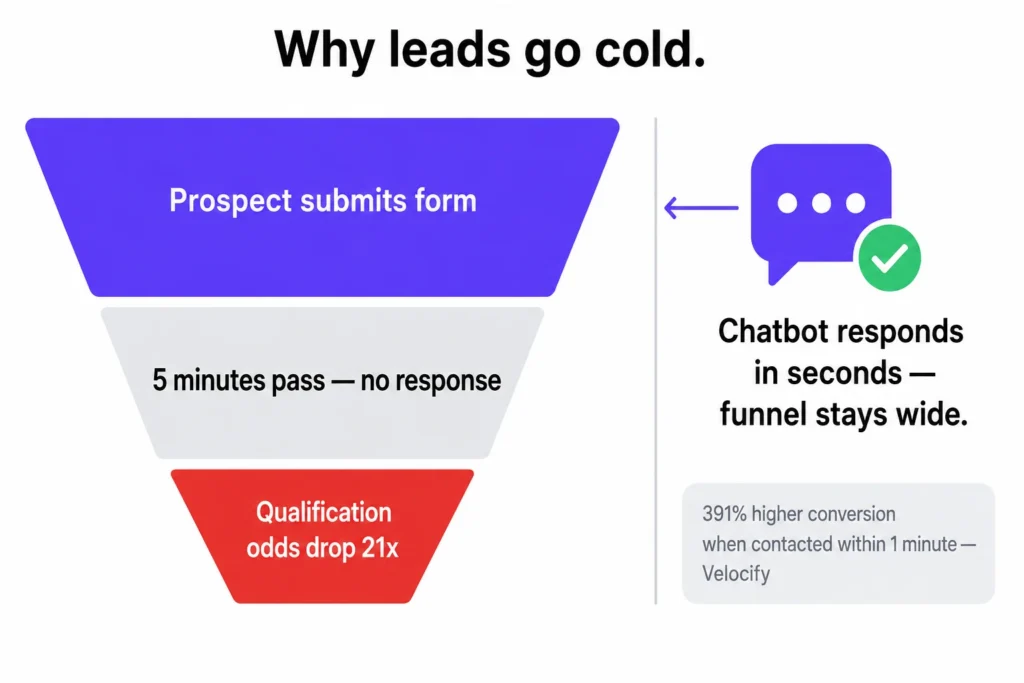
- Waiting just 30 minutes to contact a new lead drops your odds of qualifying them by 21 times compared to calling within five minutes, which is why instant response is an operational requirement, not a nice-to-have.
- Insurance chatbot use cases go well beyond lead capture: claims triage, policy renewal reminders, and 24/7 FAQ deflection all run on the same platform deployment.
- Landing page chatbots and social media chatbots require different configurations because prospect intent and channel capabilities differ meaningfully between the two surfaces.
- TCPA compliance for automated insurance outreach requires written consent, calling hour restrictions, and DNC scrubbing built into the system at deployment, not added afterward.
- Agentic AI goes further than a standard chatbot: it can check eligibility in real time, book appointments into agent calendars, and send follow-ups autonomously.
What is an insurance chatbot?
An insurance chatbot is an AI-powered virtual assistant built specifically for the insurance sector that automates conversations across the policyholder journey, from first contact through claims resolution, without requiring a human agent at every step. Unlike a rules-based bot that breaks when a prospect deviates from a fixed script, a modern insurance chatbot uses natural language understanding to interpret intent, handle follow-up questions, and still capture the data it needs regardless of how the conversation unfolds.
The practical scope is wider than most carriers expect when they first evaluate the category. The same chatbot that qualifies a new prospect at 11 PM also handles a renewal inquiry from an existing policyholder at 7 AM. It files a claims FNOL at any hour, deflects routine policy questions without agent involvement, and pushes every interaction as a formatted CRM record the moment the conversation ends. One deployment, four distinct use cases.
Insurance chatbots are AI-powered tools that engage prospects in real time, collect qualification data, and route leads to agents, with no human involvement before the agent conversation begins.
For a broader look at how conversational AI for insurance is reshaping the sector beyond lead qualification, including claims automation and policyholder retention, that companion article covers the full scope.
Why the response time gap is costing carriers more than they realize
The core problem in insurance lead conversion is not acquisition volume. Most carriers have the traffic. The problem is the dead interval between when a prospect submits a form and when a human agent reaches them.
Calling a lead within one minute of their inquiry increases conversion rates by 391%. Traditional follow-up infrastructure, which routes leads to agents working a queue during business hours, structurally cannot solve this. The math does not work at any staffing level.
The financial cost is concrete. The average cost per lead in insurance is $424 across organic and paid channels, with paid CPL reaching $460. At that price, every lead that sits uncontacted for more than a few minutes is a measurable loss against a number someone paid to generate.
Insurance chatbots eliminate the interval by responding the moment a prospect engages, asking the right questions while intent is live, and holding the conversation until either a human agent joins or a callback is scheduled. The agent enters the conversation with context already built, not a cold name and number.
Chatbots are projected to save insurers $2.3 billion annually through automation efficiency across claims management and customer service. In the UK alone, 83% of insurers had already implemented or were actively implementing AI chatbots or generative AI by 2024. The industry has already made the decision. The question is now whether your deployment is configured correctly.
What are the use cases for insurance chatbots?
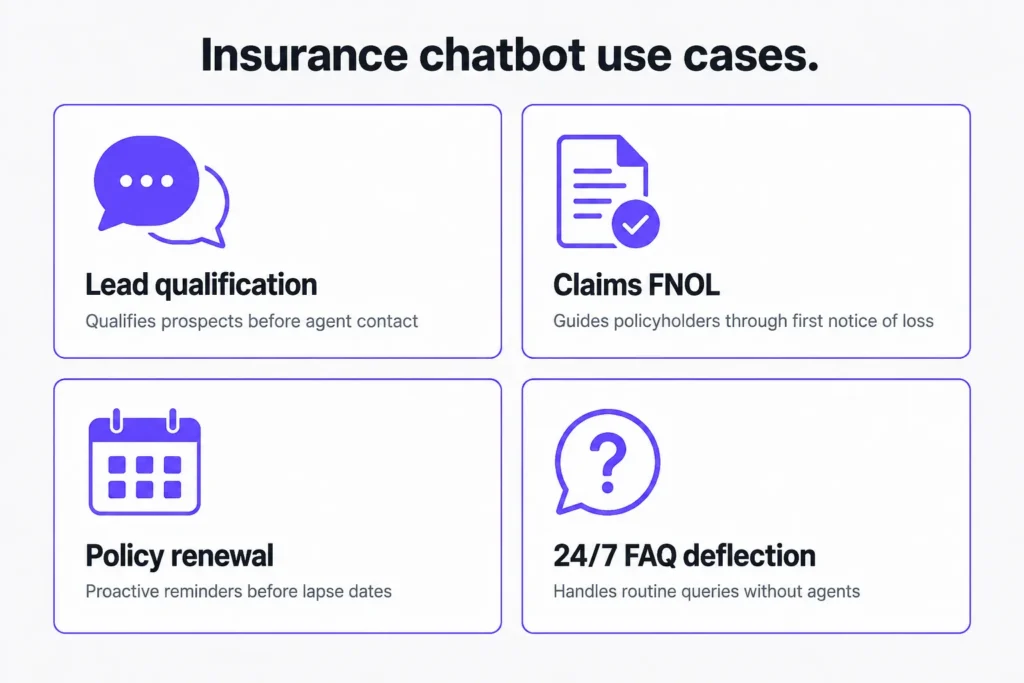
Insurance chatbot use cases include lead qualification, claims triage, policy renewal reminders, and 24/7 FAQ deflection. Each operates at a different point in the customer lifecycle. A well-deployed chatbot covers all four from a single integration, which means the ROI compounds as adoption deepens beyond the initial lead capture use case.
Lead qualification and capture
The highest-value starting point for most carriers is pre-qualifying inbound prospects before a licensed agent is involved. An AI chatbot deployed on a landing page or social profile can collect the six data points that determine whether a lead is worth agent time, conversationally, in under three minutes:
- Policy type and coverage need: is this a product you offer?
- Geographic eligibility: are they in a serviced region?
- Current coverage status: existing policyholder or new prospect?
- Renewal or purchase timeline: are they actively shopping, or six months from decision?
- Budget range: does the conversation make sense for the product tier?
- Decision authority: are they the buyer, or gathering information for someone else?
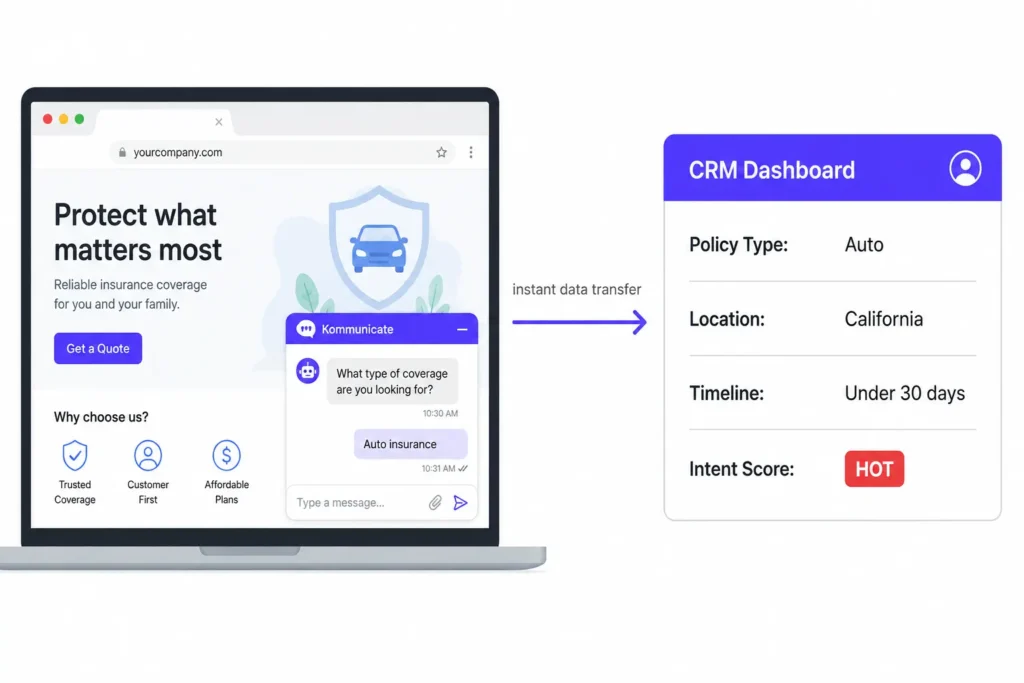
These are the same questions a good agent asks in the first three minutes of every qualifying call. The chatbot collects them inside the conversation, on the landing page or in the DM, before a call is ever scheduled. The answers feed directly into the CRM as a formatted contact record, with assignment and follow-up workflows triggering automatically from that data.
Claims triage and FNOL
Insurance chatbots guide policyholders through the First Notice of Loss process without a live agent on the line. The chatbot collects incident details, supporting documentation, and contact information, creates a populated claims record, and routes it to the right adjuster. AI-assisted claims processing has reduced overall resolution time by 75%. For a carrier fielding high FNOL volume, this is a significant operational shift.
Policy renewal reminders
Renewal is one of the most predictable and highest-value moments in the policyholder lifecycle. A chatbot sends proactive WhatsApp or SMS reminders ahead of lapse dates, answers coverage change questions, and captures a renewal confirmation, all without agent involvement unless the policyholder requests a material change to the policy. The WhatsApp chatbot integration handles this channel natively.
24/7 FAQ deflection
Routine questions about coverage details, deductible amounts, payment schedules, and document requirements account for the large majority of inbound insurance support volume. A chatbot handles these at any hour without adding headcount. Insurance carriers using AI chatbots report up to 40% increased agent productivity and up to 40% reduction in customer service costs, because agents redirect their capacity from repetitive questions to conversations that require genuine human judgment.
How does an insurance chatbot qualify leads?
An insurance chatbot qualifies leads by running a conversational eligibility sequence that mirrors what a licensed agent would ask in the first minutes of a discovery call, then pushing the collected data to the CRM as a populated contact record the moment the conversation ends.
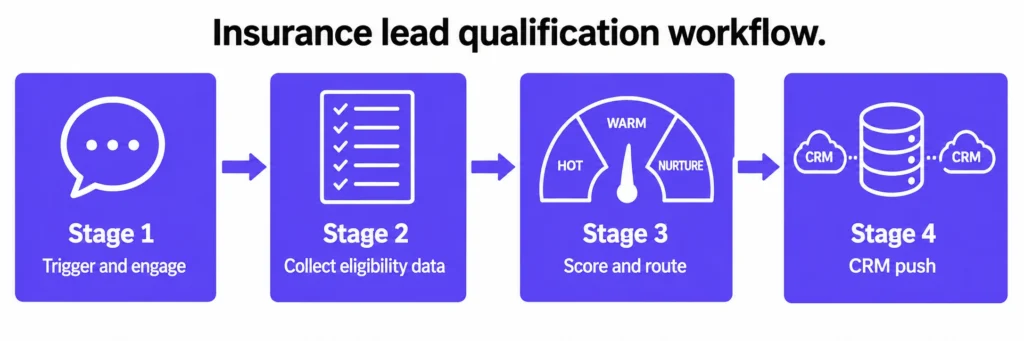
The four-stage pre-qualification workflow
Stage 1: Trigger and engage. The chatbot activates when a prospect lands on the page after a configurable dwell period, or when a prospect responds to a social ad or DM. It opens with a value-first message rather than a data request. For example: “I can help you get a quote in under two minutes. What type of coverage are you looking for?” This framing converts at higher rates than opening with a form request.
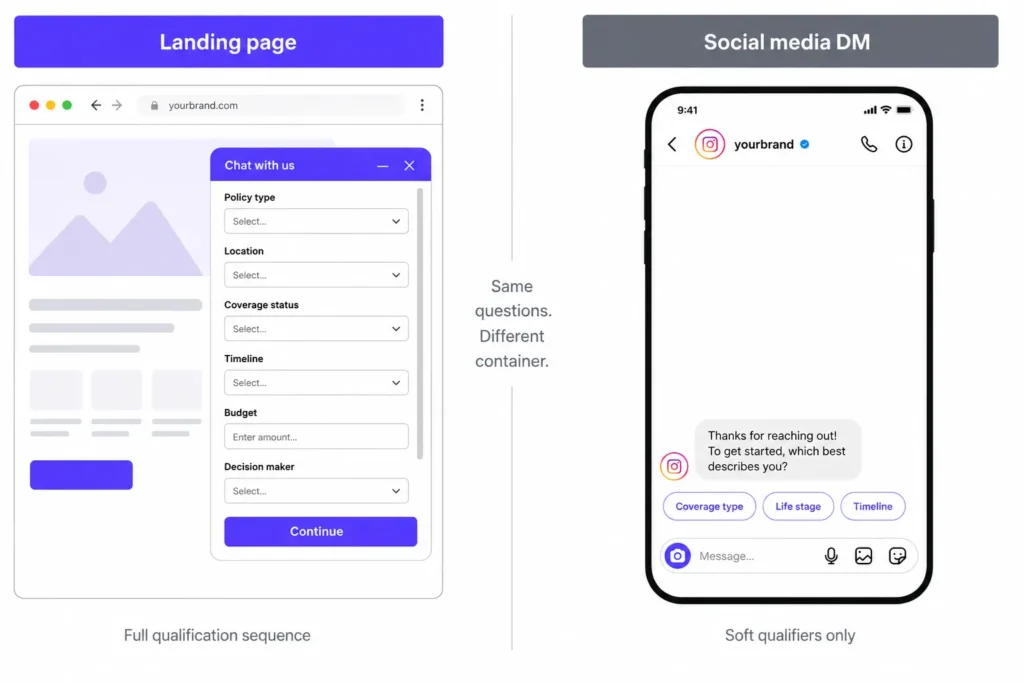
Stage 2: Collect eligibility data. The chatbot works through the six qualification questions above. On channels that support rich messaging, including landing pages, Facebook Messenger, Instagram, and WhatsApp, it uses embedded form fields, dropdown selectors, and quick-reply buttons directly inside the chat widget. On channels with limited formatting support, it uses guided branching with free-text fallback. The questions are the same regardless of channel. Only the container changes.
Stage 3: Score and route. When the conversation concludes, the platform scores the lead based on timeline, budget fit, and decision authority. High-intent prospects are flagged for immediate agent assignment. Lower-intent prospects enter an automated sequence and resurface when their timeline becomes active.
Stage 4: CRM push. The contact record is pushed to Salesforce, HubSpot, or your existing CRM via native integration or webhook in real time. No manual data entry. No transcript that requires someone to process it later.
How Kommunicate handles this in practice
Kommunicate’s AI Agent Builder lets you build this sequence without custom development. The Form feature embeds structured input fields including policy type, location, renewal date, and contact details directly inside the chat widget. Prospects complete them as part of the conversation rather than on a separate form page. Submissions are validated on entry and routed to your CRM through native integrations or webhooks.
The eligibility check happens inside the conversation. There is no separate form submission event and no gap between data collection and CRM entry.
See how Kommunicate handles insurance lead qualification end to end. Book a demo.
How does a landing page chatbot differ from a social media chatbot?
The deployment surface determines how you configure the pre-qualification sequence. Landing pages and social media channels have different intent levels, different channel capabilities, and different handoff targets. Using the same bot configuration across both surfaces is one of the most common deployment mistakes carriers make.
| Category | Landing pages | Social media profiles |
| Prospect intent | High: arrived via search or paid click | Medium: engaged with content or ad |
| Primary objective | Immediate conversion or callback scheduled | Nurture sequence entry |
| Qualification depth | Full sequence: all six eligibility questions | Soft qualifiers: coverage type, life stage, timeline |
| Rich message support | Full: forms, carousels, input fields | Platform-dependent (see below) |
| Handoff target | Licensed agent, same session | Automated sequence, then agent |
| Bot activation timing | Proactive after dwell period | Reactive to DM or ad click |
Landing page configuration
Landing pages receive the highest-intent visitors. Someone arriving from a paid search click or programmatic ad has already done the work of expressing intent. The chatbot’s job is to not waste it. On a landing page you have the full toolkit: embedded form fields, input validation, dropdown selectors, and complete data capture inside the conversation.
The chatbot should activate after a short dwell period, typically 10 to 15 seconds, open with a value statement rather than a form request, and complete the full pre-qualification sequence before the prospect navigates away. This session is the single best conversion opportunity the carrier has. Treating it as a form with a chat skin rather than a genuine conversation is the most common reason landing page chatbots underperform.
Social media configuration
Social media prospects did not search for you. They saw an ad, clicked on a post, or opened a DM after seeing a Reel. Their intent is softer, and the right objective is getting them into a follow-up sequence rather than pushing for an immediate conversion. That shift in objective should be reflected in the bot configuration.
Kommunicate’s Form message type works natively on Facebook Messenger, Instagram, and WhatsApp. On these platforms, you can run a soft qualifier inside the DM: coverage type, life stage, and rough timeline in structured fields. On channels without rich message support, quick-reply buttons serve as the fallback. The data still arrives, but it requires more cleanup before it is useful to an agent.
Build a single sequence that degrades gracefully: form fields on supported channels, quick replies as the fallback, free text as the last resort. Three questions inside a DM feels like a conversation. Eight questions feels like a form that someone forgot to make look like a form. Keep social media flows to three or four soft qualifiers and save the full six-question sequence for the landing page or a scheduled callback.
What is the difference between a chatbot and an AI agent in insurance?
An AI agent in insurance is a system that takes autonomous actions on behalf of a prospect or policyholder, not just collects information and waits for a human to act on it. A rules-based chatbot follows a configured script. An AI agent queries backend systems, makes decisions, and completes tasks without requiring a human trigger at each step.
Agentic AI in insurance can check eligibility in real time against underwriting rules, schedule callbacks directly into a licensed agent’s calendar, and send follow-up messages autonomously. These are capabilities a rules-based chatbot cannot replicate.
The operational difference is significant for lead qualification specifically:
- A chatbot asks “are you located in California?” and records the answer. An AI agent queries your product availability database and tells the prospect whether they are eligible for the specific policy they asked about, in real time, during the conversation.
- A chatbot collects a preferred callback time and adds it to a lead record. An AI agent books the appointment directly into the licensed agent’s calendar and sends a confirmation to the prospect’s phone without any human trigger.
- A chatbot flags a high-intent lead for follow-up. An AI agent sends a personalized WhatsApp message 30 minutes after the conversation ends with a direct booking link, triggered by the intent score threshold being crossed.
Does voice AI work for insurance lead qualification?
Voice AI works for insurance lead qualification on inbound call flows, and this matters more than most carriers initially account for. Many insurers still receive a significant share of their inbound leads by phone rather than via a web form. Kommunicate’s Voice AI conducts the intake conversation, works through the eligibility questions, and either transfers to a live agent with a full context brief or schedules a callback. Insurance phone leads convert to 10 to 15 times more revenue than web-only leads, and callers convert 30% faster. Voice AI captures that channel without requiring an agent on every inbound call.
How do you hand off a qualified lead to an agent?
The measure of a good pre-qualification system is not what the AI collects. It is what the agent receives.
When a high-intent prospect completes the eligibility sequence, the agent picks up a conversation that already has answers to every question they would normally spend the first three minutes asking. The conversation starts at the point where a manual discovery call would usually end, without the agent spending any time getting there. This is the correct framing for what AI does in a qualification context: it frees agents to close. The routine collection of eligibility data is fully automatable. The consultative exchange that follows, where an agent explains coverage nuance, handles objections, and earns the trust that converts a prospect into a policyholder, is not.
For prospects who complete the sequence but are not ready for an immediate call, the CRM data drives the long-cycle follow-up workflow. The lead is tagged with eligibility context and timeline and resurfaces at the appropriate moment. Nothing is lost. The lead is not marked as cold. It is queued with full context for when its timeline becomes active.
Agent handoff checklist
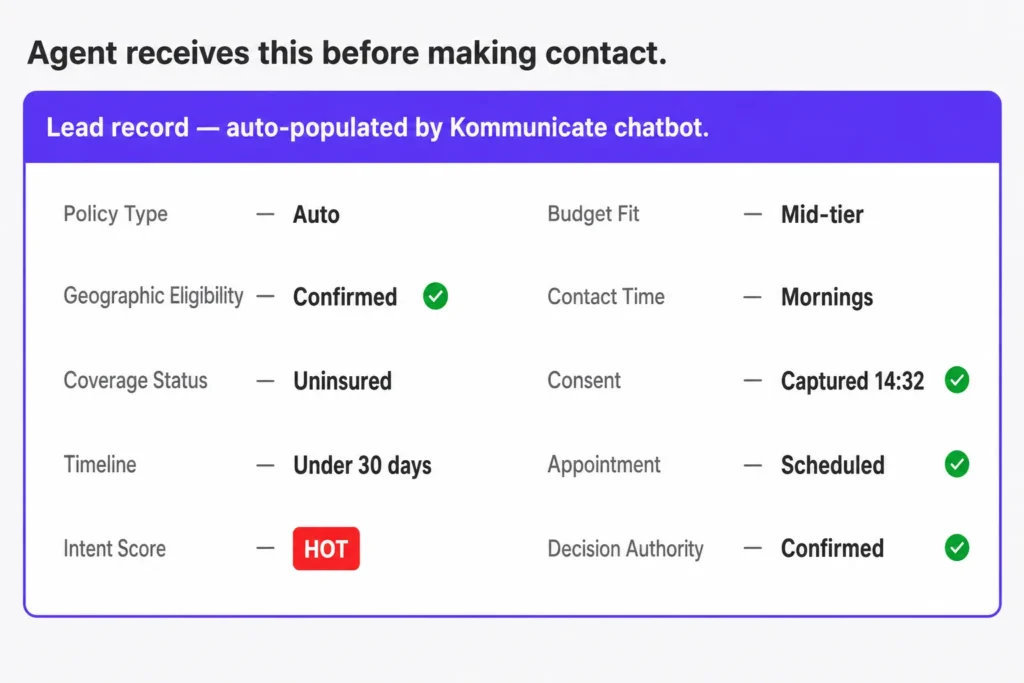
Before an agent makes contact, the CRM record should contain every field below. A missing field means the pre-qualification sequence needs a gap closed.
- Policy type requested
- Geographic eligibility confirmed
- Current coverage status (insured or uninsured)
- Renewal or purchase timeline
- Intent score: hot, warm, or nurture queue
- Budget range or product tier fit
- Preferred contact time
- Consent captured, with timestamp
- Appointment scheduled (yes or no)
- Decision authority confirmed
In practice, insurance carriers using chatbots see measurable gains across both efficiency and conversion. AA Ireland slashed missed web chats by 81%, reduced agent handling times by 40%, and increased out-of-hours quote conversion rates by 11% after deploying a chatbot across its omnichannel stack.
What does TCPA compliance require for insurance chatbots in 2026?
TCPA compliance for insurance chatbots requires prior express written consent, calling hour enforcement, and DNC registry scrubbing integrated into the system architecture before deployment. These are not items to add during a compliance review after launch.
Core requirements that apply to all automated insurance outreach
Consent must be captured before any automated outreach begins. For outbound AI calls or texts using an autodialer or prerecorded voice, prior express written consent is required. A consent checkbox embedded in the first step of the lead capture flow, with clear language identifying your company by name, satisfies this requirement. The language must be specific: vague acknowledgments of “marketing communications” are not sufficient.
Inbound social DMs satisfy consent for that session. When a prospect initiates the conversation on Instagram, Messenger, or WhatsApp, the inbound nature of that contact covers the exchange. Sending outbound AI messages to cold lists sourced from a third party is a materially different compliance situation and requires separate written consent obtained directly.
Calling hours apply to automated systems exactly as they apply to human agents. TCPA restricts outreach to between 8 AM and 9 PM in the prospect’s local time zone. Your AI system needs to enforce these windows automatically, not rely on an operator to check.
DNC scrubbing is non-negotiable. Federal and state Do Not Call registries apply to automated outreach. This must be integrated into the outreach workflow, not run manually at irregular intervals. At scale, manual scrubbing will eventually be skipped.
The current TCPA landscape for insurance lead generators
The FCC’s lead generator rules have been in flux. In January 2024, the FCC passed a one-to-one consent rule requiring carriers to obtain individual written consent from each prospect, ending the practice of a single checkbox on a comparison site authorizing dozens of insurers to contact the same consumer. That rule went into effect in January 2025.
In January 2025, the Eleventh Circuit Court of Appeals vacated the rule, finding the FCC had exceeded its statutory authority. The FCC subsequently reinstated the original prior express written consent standard in August 2025.
The practical position for carriers: even though the one-to-one rule was vacated, plaintiff’s attorneys and state regulators continue to argue for individual consent on calls to numbers listed on the DNC Registry. The safest build is a consent capture that names your company specifically and is obtained directly from the prospect at the point of lead capture. That standard survives any further regulatory movement in either direction, and it is good practice regardless.
Design consent capture, calling hour enforcement, and DNC scrubbing into the system on day one. None of these requirements become a barrier to deployment when they are architecture decisions rather than afterthoughts.
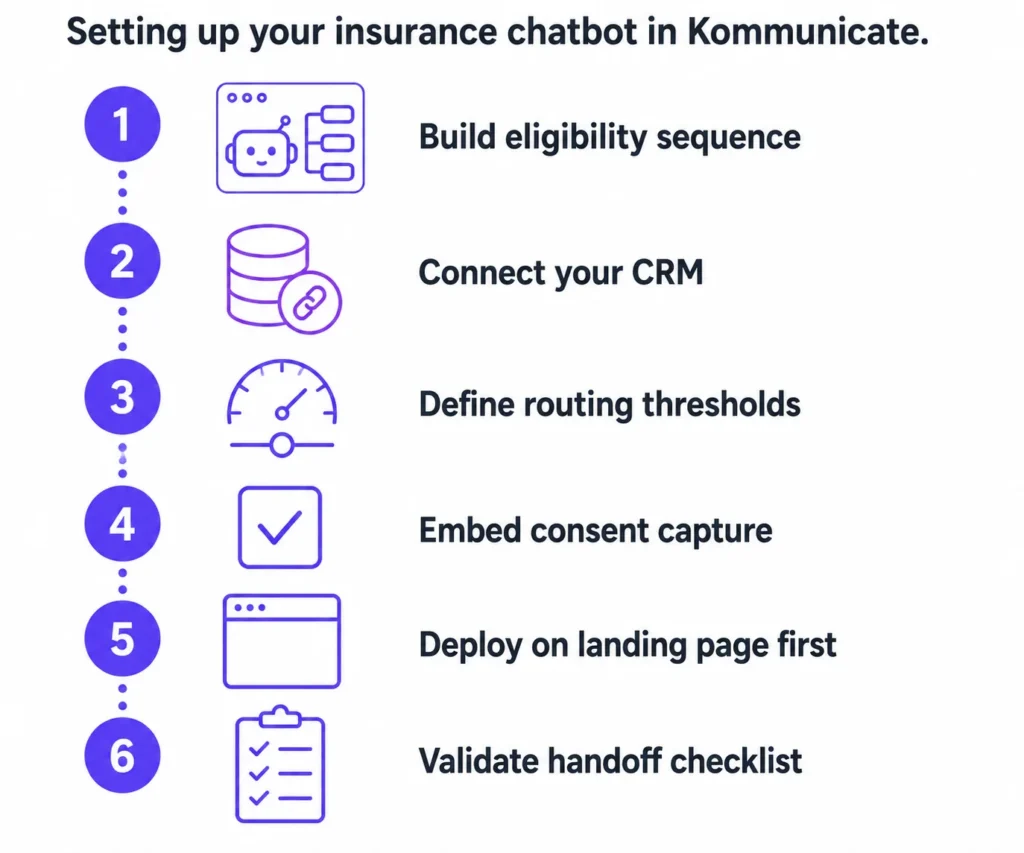
How to set up an insurance chatbot with Kommunicate
Kommunicate supports insurance chatbot deployments across website, WhatsApp, Instagram, Facebook Messenger, and mobile app channels from a single platform. Here is what the setup sequence looks like for a lead qualification deployment:
Step 1: Build the eligibility sequence in the AI Agent Builder. Map the six qualification questions to form fields for channels that support them. Configure quick-reply button fallbacks for channels that do not. Set the opening message as a value statement rather than a data request.
Step 2: Connect your CRM. Use native integrations for Salesforce or HubSpot. For other platforms, configure a webhook. Map each eligibility question to its corresponding CRM field at this stage so data arrives in the correct format, not as a freeform transcript.
Step 3: Define your routing thresholds. Decide what makes a lead hot in your specific product context: for example, in-market timeline under 30 days, decision authority confirmed, and geographic eligibility cleared. Set the intent score threshold that triggers immediate agent assignment versus entry into a long-cycle re-engagement sequence.
Step 4: Embed consent capture. Add the consent checkbox to the first or second step of the sequence with company-specific disclosure language. This step must precede any data collection that will feed an automated outreach workflow.
Step 5: Deploy on your highest-intent surface first. Launch on the landing page before social channels. Landing page traffic has the clearest intent signal, and it produces the most reliable ROI data for calibrating the system before expanding.
Step 6: Validate against the handoff checklist. Before going live, run a test conversation and check whether the resulting CRM record populates every field on the agent handoff checklist above. Any gap means a question is missing from the sequence or a CRM field mapping needs adjustment.
Conclusion
Insurance carriers are not losing leads because their acquisition strategy is wrong. They are losing leads because the window after a prospect engages is structurally undefended by anything in the traditional follow-up stack. Insurance chatbots defend that window by responding instantly, qualifying conversationally, and handing agents a pre-built context package rather than a cold lead record.
The use cases compound over time. A carrier that starts with lead qualification on landing pages, then extends to social DMs, then adds renewal automation and FNOL triage, is running a materially different operation than one still routing every inbound inquiry to a queue. The gap in conversion outcomes reflects that difference.
If you want to see how Kommunicate configures this for insurance carriers specifically, book a demo and we will walk through the deployment relevant to your product lines and channel mix.
Frequently asked questions
An insurance chatbot is an AI-powered virtual assistant built for the specific workflows of the insurance sector: lead qualification, claims FNOL, policy renewal, and compliance-aware outreach. The difference from a general-purpose chatbot is that an insurance chatbot is pre-configured for insurance-specific qualification logic, integrates with insurance CRM and policy management systems, and is built to respect TCPA and DNC requirements by design rather than as an add-on.
The recovery rate depends on the baseline response time and the volume of after-hours traffic. Carriers with long average response times, over an hour, typically see the largest gains because the chatbot is capturing prospects who would have been unreachable by the time a human agent got to them. The MIT/InsideSales Lead Response Management Study found that waiting 30 minutes to contact a lead drops qualification odds by 21 times compared to calling within five minutes. Any leads arriving outside of business hours and not immediately engaged represent the direct recovery opportunity.
Lead qualification generates the fastest measurable ROI because it directly affects quote-to-bind rate, the most tracked conversion metric in the industry. Claims triage and FAQ deflection generate ROI through cost reduction, specifically reduced agent handle time and headcount requirements, which shows up on a longer measurement timeline.
A Kommunicate insurance chatbot runs on website, WhatsApp, Instagram, Facebook Messenger, and mobile app. Rich message support, including form fields and quick replies, is available on Messenger, Instagram, and WhatsApp. Voice AI handles inbound phone call flows separately. The qualification sequence and CRM routing are consistent across channels even when the message format changes.
Deployment cost depends on the platform, the number of channels, and the CRM integrations required. Most enterprise conversational AI platforms, including Kommunicate, price on a monthly subscription basis with volume-based tiers. The relevant comparison is not platform cost against zero but platform cost against the cost of the leads currently being lost to slow follow-up. In a sector where average CPL runs well above $400, recovering even a small number of additional conversions per month typically covers the platform cost many times over.
Prior express written consent must be captured before any automated outreach, including AI-initiated calls or texts. The consent must name your company specifically and be obtained directly from the prospect. Calling hour restrictions apply: 8 AM to 9 PM local time. DNC scrubbing must be integrated into the outreach workflow automatically. For inbound conversations initiated by the prospect on social channels, consent is satisfied for that session.
A basic lead qualification deployment on a single channel, typically a website landing page with CRM integration, takes one to two weeks from configuration to go-live when using a no-code platform like Kommunicate. Multi-channel deployments with custom routing logic and voice AI integration take four to six weeks depending on the complexity of the CRM mapping and compliance review process.

Devashish Mamgain is the CEO & Co-Founder of Kommunicate, with 15+ years of experience in building exceptional AI and chat-based products. He believes the future is human and bot working together and complementing each other.

Aditi is an MBA candidate at IIM Bodhgaya, specializing in Marketing and Strategy. As a dedicated marketer, she brings practical experience in market research, data analytics, and B2B execution to her work. Her expertise in refining product positioning and driving go-to-market strategies consistently supports insight-driven business growth.