Updated on August 30, 2026
Quick verdict
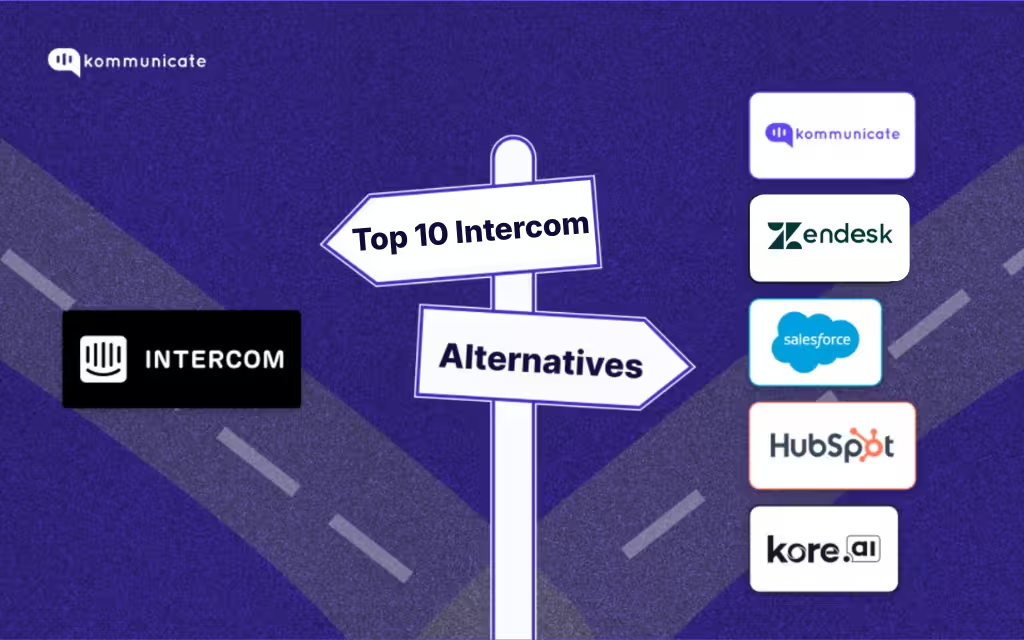
Intercom is now Fin, and in June 2026 Salesforce agreed to acquire it, with the deal expected to close in early 2027 and Fin becoming part of Salesforce’s Agentforce platform. The acquisition doesn’t automatically make Fin the wrong choice. For enterprise organizations already committed to Salesforce, it could become an even stronger option. For companies that prioritize predictable pricing, faster deployment, and flexible AI support across multiple channels, it’s worth comparing alternatives before making a long-term decision. This guide covers the main options and where each one fits.
| Tool | Best For | AI Capability | Human Handoff | Key Strength |
|---|---|---|---|---|
| Kommunicate | AI customer support with human handoff | Advanced AI agents with knowledge grounding | Built-in, context-rich escalation | Resolution-first support across channels |
| Zendesk | Enterprise-scale support operations | AI + automation with strong workflows | Robust ticket-based routing | Scalable enterprise support infrastructure |
| Freshdesk | Mid-sized teams | Freddy AI for basic automation | Available across plans | Good balance of features and pricing |
| LiveAgent | Budget-conscious teams | Limited AI capabilities | Basic live chat handoff | Affordable multi-channel support |
| Tidio | E-commerce businesses | AI chatbot for sales and support | Available with limitations | Strong Shopify and store integrations |
Intercom, now rebranded as Fin and with a Salesforce acquisition pending, has long been a popular choice for customer messaging. But many teams start running into limitations as they grow. Costs can climb quickly, workflows can feel restrictive, and automation often struggles when conversations become more complex. The change of ownership gives those teams one more reason to look around.
That is usually when teams begin exploring alternatives, not just to reduce costs, but to handle support more effectively. As more teams adopt AI driven support, things like smooth handoffs, reliable answers, and flexibility across channels become much more important.
In this guide, we will walk through the best Intercom alternatives based on different needs, whether you are focused on automation, scaling support, or controlling costs. More importantly, we will help you identify which tools actually solve customer problems end to end and not just manage conversations.
Here are the topics you’ll see:
- Intercom (Fin) – A personal review)
- Fin (formerly Intercom): What the Salesforce acquisition means
- Why Most Intercom Alternatives Still Fail Support Teams
- Best Intercom Alternatives in 2026
- Comparison of Top Intercom Alternatives
- Migration plan: moving off Intercom
- Conclusion
Intercom – A Personal Review

Intercom has established itself as a powerhouse in customer experience, holding approximately 6.71% of the market share. The platform’s strength lies in its comprehensive ecosystem of integrations and robust support processes.
Their recent release of Fin, an AI-powered chatbot, demonstrates their commitment to innovation. However, several challenges have emerged from user feedback:
Strengths
1. Feature Depth – Extensive capabilities including A/B testing, outbound marketing, personalization, and detailed customer segmentation
2. Integration Ecosystem – Vast array of integrations connecting virtually every tool in your tech stack
3. Scalability – Proven ability to handle various use cases at any scale with automated playbooks and funnels
Limitations
1. Inflexible Customization – Major complaint across G2 reviews; company reluctant to adapt product to specific customer needs
2. Unresponsive Support – Multiple reports of delayed or inadequate customer service responses
3. Rigid Pricing – Year-long contracts required; customers frequently face unexpected overages
Pricing
- Essential: Starting at $39/seat/month
- Advanced: Starting at $99/seat/month
- Expert: Starting at $139/seat/month
Important Note: Actual costs often exceed listed prices due to overages and additional charges. Fin AI Agent costs an additional $0.99 per resolution.
Fin (formerly Intercom): What the Salesforce acquisition means
What changed
In May 2026, Intercom renamed itself Fin, after its AI agent. In June 2026, Salesforce agreed to acquire the company for about $3.6 billion, a deal expected to close in early 2027 and subject to regulatory approval. Once it closes, Fin will become part of Salesforce’s Agentforce platform. Until then, Fin operates independently and its existing leadership remains in place.
What probably won’t change in the near term
For current customers, nothing changes today. Contracts, pricing, and the product continue as they are while the deal moves through approval. Teams already using Fin do not need to act on the news immediately.
What may change over time
- Enterprise focus: Salesforce framed the deal around strengthening Agentforce for large, complex service operations, which points to a stronger tilt toward enterprise accounts.
- Pricing and packaging: acquisitions commonly influence how products are licensed and bundled, though nothing has been announced.
- Roadmap: product priorities may shift toward alignment with the wider Salesforce ecosystem.
- Integration priorities: deeper Salesforce and Agentforce integration is likely to take precedence.
- Support priorities: attention and resources may concentrate on enterprise Salesforce customers.
Who benefits
Organizations already standardized on Salesforce stand to gain the most. A tighter Fin and Agentforce integration could make Fin a stronger fit for enterprises consolidating their stack around Salesforce.
Who should compare alternatives
Teams whose priorities are predictable pricing, faster deployment, and flexible AI support across channels have a clear reason to evaluate options now. This applies most to SMBs, mid-market companies, and independent SaaS businesses that are not moving onto the Salesforce stack.
Should you stay on Fin or compare alternatives?
The acquisition doesn’t change how Fin works today, but it does change the long-term roadmap, making this a natural time for teams to evaluate whether Fin still aligns with their business over the next three to five years. Here is a simple way to think about it.
Fin is probably the better fit if
- You are a product-led SaaS company that wants the deepest in-app messaging, marketing, and AI agent stack in one platform.
- You are already invested in, or moving toward, the Salesforce and Agentforce ecosystem.
- You can work with variable, resolution-based pricing and have someone owning AI training and knowledge upkeep.
You should evaluate Kommunicate if
- You run SMB or mid-market customer service and want predictable pricing without per-resolution surprises.
- You need to deploy quickly, with a no-code builder your support team can manage.
- You want AI resolution with context-rich human handoff across web, mobile, and WhatsApp.
Why Most Intercom Alternatives Still Fail Support Teams
Switching away from Intercom does not automatically fix your support problems. In many cases, teams end up facing the same issues, just in a different tool.
The reason is simple. Most alternatives optimize for managing conversations, not actually resolving them.
1. Broken handoffs between AI and humans
Many tools can automate basic queries, but they fall apart when a conversation needs to move to a human agent. Context gets lost, customers have to repeat themselves, and resolution slows down. Instead of reducing effort, the experience becomes more frustrating.
2. Too much focus on deflection
A lot of platforms measure success by how many tickets they can deflect. On paper, this looks efficient. In reality, it often leads to unresolved issues, repeat contacts, and lower customer satisfaction. Deflection reduces volume, but it does not guarantee resolution.
3. AI that is not grounded in real data
Many AI chatbots generate answers that sound correct but are not based on your actual knowledge base or systems. This creates inconsistency, incorrect responses, and a lack of trust, especially in more complex or sensitive queries.
What actually matters instead
If you are evaluating Intercom alternatives, the focus should shift from features to outcomes. The tools that work best are the ones that can:
- Resolve queries end to end, not just respond quickly
- Escalate conversations with full context intact
- Provide accurate answers grounded in your data
- Support multiple channels without fragmenting the experience
This is where the gap between tools becomes clear, and where most alternatives still fall short.
Best Intercom Alternatives in 2026
1. Kommunicate
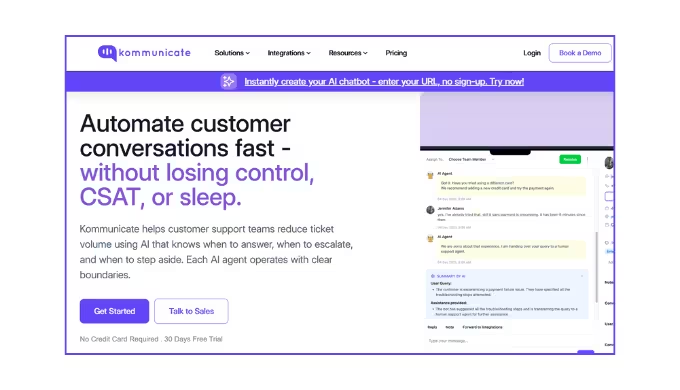
Kommunicate stands out as a strong Intercom alternative for businesses that want to automate customer support using AI while maintaining transparency and operational control. Built primarily for support and operations teams, Kommunicate focuses on resolving high volume customer queries through no code AI agents, while ensuring smooth escalation to human agents for complex or sensitive conversations.
Although newer compared to some legacy platforms, Kommunicate has quickly built a diverse customer base that includes both fast growing startups and global enterprises such as Rakuten, Crunch, Amgen, and Bridgestone. The platform is designed for teams that want predictable pricing, faster time to value, and flexibility in how AI is deployed across their support stack.
Pros
1. Generative AI expertise – Kommunicate integrates with leading AI providers such as OpenAI, Anthropic, and Google. The platform supports contextual conversations and allows teams to design, train, and manage AI agents using a no code interface.
2. Flexible product evolution – Kommunicate works closely with customers to support real world use cases. The platform allows teams to configure workflows, escalation rules, and integrations based on operational needs rather than rigid product constraints.
3. Native integrations – Most integrations are built in and easy to configure. Teams can connect Kommunicate with popular tools such as WhatsApp, Zendesk, Freshdesk, HubSpot, and other business systems without complex implementation.
4. Responsive customer support – Kommunicate’s solution engineering and support teams are known for fast response times and hands on assistance during setup and ongoing operations.
Cons
1. Limited lifecycle marketing features – Kommunicate is focused on customer support and service automation and does not include outbound marketing or campaign based engagement features.
2. Smaller integration ecosystem – While Kommunicate supports the most commonly used business tools, its ecosystem is smaller compared to older, more established platforms in the market.
Pricing
Kommunicate offers three pricing plans designed to scale with support volume and business needs.
- Starter plans start at $34 and are suitable for teams beginning with AI powered customer support and WhatsApp automation
- Professional plans start at $167 and support advanced integrations, higher automation volume, and growing support teams
- Enterprise plans offer fully customizable pricing based on security, data hosting, and scale requirements
Kommunicate follows a transparent pricing model with no hidden charges and provides flexibility for enterprises that need custom deployments.
2. Zendesk – Best for Enterprise Operations

Zendesk is the heavyweight champion of customer service platforms, holding the #1 spot on G2 across multiple categories. With over 200,000 customers worldwide and 1,500+ integrations, Zendesk processes billions of customer interactions annually.
Pros
1. Sophisticated Ticketing – Advanced routing capabilities based on skill, priority, and availability
2. Extensive Customization – Create unique workflows tailored to complex business requirements
3. Enterprise Analytics – Powerful reporting tools with Zendesk Explore add-on for data-driven decisions
4. Omnichannel Excellence – Seamlessly manage email, chat, phone, and social media from one hub
5. Proven at Scale – Trusted by enterprises and organizations with complex, global support operations
Cons
- Complex Setup – Steep learning curve; many enterprises hire consultants for implementation
- Higher Costs – Premium pricing with multiple add-ons can reach $3,900/user/year
- Tiered Support – Level of customer support varies by subscription tier
Pricing
- Suite Team: $55/agent/month
- Suite Growth: $89/agent/month
- Suite Professional: $115/agent/month
- Suite Enterprise: $169/agent/month
Best suited for enterprises with dedicated technical resources and complex support requirements.
3. Freshdesk – Best Value for Mid-Sized Teams

Freshdesk by Freshworks serves over 60,000 companies globally, positioning itself as the user-friendly alternative to complex enterprise platforms. The platform excels at balancing powerful features with intuitive design. See how Kommunicate compares vs Freshdesk Omni on pricing, AI agents, and ticketing.
Pros
1. User-Friendly Interface – Modern, intuitive design with faster implementation than competitors
2. Native AI Integration – Freddy AI built contextually within the platform, not bolted on
3. Unified Omnichannel Inbox – Manage all support channels without juggling tabs or tools
4. Transparent Pricing – Straightforward tiered plans with no hidden costs
5. Quick ROI – Simple configuration helps teams realize impact rapidly
Cons
1. Limited Advanced Features – Some enterprise-level capabilities require higher-tier plans
2. Growing Pains – Teams handling extremely high volumes may need additional configuration
Pricing
- Free Plan: Up to 10 agents with basic features
- Growth: $15/agent/month
- Pro: $49/agent/month
- Enterprise: $79/agent/month
Freshdesk’s Growth plan saves startups up to 47% compared to equivalent Zendesk tiers.
4. HubSpot – Best for Unified CRM Integration

HubSpot Service Hub integrates seamlessly with HubSpot’s CRM ecosystem, making it ideal for companies seeking unified sales, marketing, and support operations. The platform offers exceptional value for businesses already using HubSpot products.
Pros
1. Unified Customer Journey – View and support the entire lifecycle from a single platform
2. Deep CRM Integration – Seamless data flow between sales, marketing, and support teams
3. Comprehensive Analytics – Track CSAT, email open rates, agent performance, and custom KPIs
4. Free Plan Available – Generous free tier with shared inbox, live chat, and basic features
5. Breeze Copilot AI – AI assistance for agent productivity starting in lower-tier plans
Cons
1. Complex at Scale – Can become unintuitive for advanced use cases
2. Missing Basic Features – Lacks bulk downloading of attachments and parent-child ticket creation
3. Ticket Management Bugs – Some users report issues with ticket status changes
4. Long Conversation Threads – Tracking specific conversations can become cumbersome
Pricing
- Free Plan: Basic features for up to 2 users
- Starter: $15/user/month
- Professional: $100/user/month
- Enterprise: $150/user/month
Ideal for businesses wanting to consolidate their tech stack around HubSpot’s ecosystem.
5. LiveAgent – Best Budget-Friendly Option

LiveAgent provides comprehensive help desk functionality at remarkably affordable prices. The platform combines live chat, ticketing, and customer service features in one accessible package.
Pros
1. Affordable Pricing – Plans start at just $9/agent/month
2. Multichannel Support – Email, live chat, phone, social media, and WhatsApp integration
3. Gamification Features – Leaderboards and badges to motivate support teams
4. Universal Inbox – Manage all customer communications from one centralized location
5. Less Than 300 Integrations – Focused integration ecosystem covering essential tools
Cons
1. Limited Advanced Features – Fewer customization options than premium platforms
2. Basic Analytics – Reporting capabilities may not satisfy data-intensive organizations
3. Occasional Performance Issues – Some users report platform slowdowns during peak usage
Pricing
- Free Plan: Available for up to 3 agents
- Small Business: $9/agent/month
- Medium Business: $29/agent/month
- Large Business: $49/agent/month
- Enterprise: $69/agent/month
14-30 day free trials available across all plans.
Ideal for small to medium businesses seeking comprehensive features without premium pricing.

6. Zoho Desk – Best for Zoho Ecosystem Users

Zoho Desk is a comprehensive omnichannel help desk solution with strong AI capabilities through Zia, their AI assistant. With over 19% market share in help desks, Zoho Desk is trusted by 100,000+ companies worldwide.
Pros
1. Deep Zoho Integration – Seamless connectivity with Zoho CRM and entire Zoho ecosystem
2. Zia AI Assistant – Automated knowledge base suggestions, direct customer responses, and auto-tagging
3. Comprehensive Features – Ticket management, instant messaging, multi-brand help center, call center, social media integrations
4. Competitive Pricing – Strong feature-to-price ratio compared to competitors
5. Multichannel Support – Email, live chat, phone, social media, and WhatsApp in unified dashboard
Cons
1. Cluttered Interface – Users report confusing UI requiring support intervention for setup
2. Integration Glitches – Some third-party integrations experience errors
3. Support Response Time – Customer support team can be slow to respond
Pricing
- Free Plan: Up to 3 agents with basic features
- Express: $14/agent/month (5-agent minimum)
- Standard: $23/agent/month
- Professional: $40/agent/month
- Enterprise: $52/agent/month (includes Zia AI)
Note: Premium support costs an additional 20-25%, which can significantly increase costs for large teams.
Best for organizations already using Zoho products or seeking affordable omnichannel support.
7. Tidio – Best for E-commerce Businesses

Tidio specializes in e-commerce customer engagement with live chat, chatbots, and AI messaging. Over 300,000 businesses use Tidio to provide real-time support and boost conversions on platforms like Shopify, WooCommerce, and WordPress.
Pros
1. E-commerce Optimization – Purpose-built for online retailers with cart abandonment prevention
2. Lyro AI Agent – Resolves up to 64% of repetitive issues automatically without manual setup
3. Easy Setup – Quick integration with popular e-commerce and CMS platforms
4. Unified Communications – Manage email, Messenger, Instagram, WhatsApp from single view
5. Generous Free Plan – Suitable for small businesses starting out
Cons
1. Conversation-Based Pricing – Can become expensive as chat volume increases
2. Mobile App Issues – App less smooth than desktop version; notification inconsistencies
3. Limited Ticketing – Less robust help desk capabilities compared to dedicated platforms
Pricing
- Free Plan: Available with basic features
- Starter: $24.17/month (100 conversations)
- Growth: $49/month (higher conversation limits)
- Growth Plus: Custom pricing for high-volume businesses
Note: Lyro AI conversations are charged separately, potentially doubling monthly costs.
Ideal for small to mid-sized e-commerce businesses prioritizing live chat engagement.
8. Kore.ai – Best for Easy No-Code AI

Kore.ai has gained traction across APAC and Europe as a new entrant focused on intuitive AI automation. The platform emphasizes no-code setup and comprehensive documentation.
Pros
1. Intuitive UI – Easy-to-use interface for conversation design and automation
2. Comprehensive Documentation – Regularly updated guides enable self-service exploration
3. Customizable Dashboards – Live dashboards for tracking customer data in one place
4. No-Code Setup – Build automation without technical expertise
Cons
1. Slow AI Training – AI systems can take considerable time to train on documents and websites
2. Development Delays – Support ticket resolution can face steep delays
3. Newer Platform – Less established than competitors with smaller user base
Pricing
- Essential: $50/month
- Advanced: $150/month
- Enterprise: Custom pricing
Additional add-ons available for extended functionality.
Best for businesses seeking simple AI automation with minimal technical overhead.
9. Olark – Best Simple Live Chat Solution

Olark takes a refreshingly simple approach to live chat, focusing on doing essential functions exceptionally well rather than overwhelming users with complexity.
Pros
1. Straightforward Implementation – Minimal setup time with clean, intuitive interface
2. Transparent Pricing – Clear per-agent pricing at $29/agent/month
3. Customizable Widget – Tailor chat appearance with colors, greetings, and CSS
4. Automated Messaging – Trigger greetings based on visitor behavior and page time
5. Searchable Transcripts – Full chat history and performance insights readily available
Cons
1. Limited Advanced Features – No cutting-edge AI chatbots or complex automation
2. Basic Analytics – Reporting may not satisfy data-intensive organizations
3. Growth Limitations – Businesses with ambitious expansion plans may outgrow capabilities
Pricing
- Standard Plan: $29/agent/month (annual billing)
PowerUps Add-ons: Available for bots, co-browsing, and translation
Ideal for small to mid-sized teams seeking reliable, straightforward live chat without complexity.
Comparison of Top Intercom Alternatives
We’ve listed our reviews on a table to make it easier for you to select the best Intercom alternatives out there in the market. We’ll grade the applications according to customization, integration ecosystem, depth of features, and pricing.
| Platform | Best For | Channels | AI Capability | Integration Ecosystem | Ease of Use | Starting Price |
| Kommunicate | AI customer support with human handoff | Web, Mobile, WhatsApp, Instagram, Telegram | Advanced AI agents with knowledge grounding | 40+ plug and play integrations | Very Easy | $34/month |
| Zendesk | Enterprise-scale operations | Web, Email, Voice, Social | AI + automation workflows | 1,500+ integrations | Hard | $55/agent/month |
| Freshdesk | Mid-sized teams seeking value | Web, Email, Social, Phone | Freddy AI (basic automation) | 1,000+ integrations | Easy | $15/agent/month |
| HubSpot | Unified CRM + support | Web, Email, CRM | Basic AI + automation | Very extensive | Moderate | $15/user/month |
| LiveAgent | Budget-conscious teams | Web, Email, Call center | Limited AI | 300+ integrations | Easy | $9/agent/month |
| Zoho Desk | Zoho ecosystem users | Web, Email, Social | AI-assisted workflows | Zoho ecosystem | Moderate | $14/agent/month |
| Tidio | E-commerce businesses | Web, Messenger, Instagram | AI chatbot for sales and support | E-commerce focused | Very Easy | $24.17/month |
| Kore.ai | No-code AI automation | Web, Voice, Messaging | Advanced AI-first platform | Smaller plug and play ecosystem | Easy | $50/month |
| Olark | Simple live chat needs | Web chat | Minimal AI | Moderate integrations | Easy | $29/agent/month |
Migration plan: moving off Intercom (Fin)
If the Salesforce direction is not right for your team, a move is more manageable than most people expect. For most teams it is a one to four week process. Here is a practical sequence.
- Export your data. Pull contacts, conversation history, and tags from Fin. Decide what history you actually need to carry over rather than moving everything by default.
- Audit your knowledge base. List the help articles and saved replies that power your current automation. This is the content your new AI agent learns from, so prune anything stale before you import it.
- Review your analytics. Record baseline metrics like CSAT, resolution rate, response time, and ticket volume before migrating so you can objectively measure whether the new platform performs better.
- Rebuild AI agent flows. Recreate your automation and escalation logic. With a no-code builder, your support team can own this directly instead of waiting on an engineer, which is where most migrations stall.
- Reconnect integrations. Map your existing connections to the new platform: WhatsApp, your CRM, your helpdesk, and internal systems. Confirm each one in a test environment first.
- Run in parallel. Keep Fin live while you validate the new setup on a slice of real traffic. Compare resolution and escalation quality before you commit.
- Cut over and monitor. Switch fully, then watch first response time, resolution rate, and CSAT closely for the first few weeks and tune as you go.
Conclusion
Intercom has been the go-to choice for many enterprises over the years, primarily due to its wide-ranging integrations and comprehensive features. However, as both established players enhance their offerings and innovative newcomers introduce specialized functionalities, businesses are increasingly reassessing their options.
Key takeaways
- For AI automation with predictable cost: Kommunicate keeps pricing tied to seats and volume, not per-resolution fees.
- For the Salesforce-bound enterprise: Fin fits teams consolidating on Agentforce and the wider Salesforce stack.
- For enterprise ticketing: Zendesk remains the option for complex, multi-team operations. See our full Zendesk comparison for a detailed look at pricing and AI capabilities.
- For balanced value: Freshdesk suits mid-sized teams that want usability at a fair price.
- For e-commerce: Tidio is purpose-built for online retail.
Our recommendation
- SMB and mid-market service teams: Kommunicate
- Salesforce-standardized enterprises: Fin on Agentforce
- Complex enterprise ticketing: Zendesk
- Balanced value: Freshdesk
- E-commerce focus: Tidio
Ready to Explore a Better Alternative?
Sign up with Kommunicate today to experience seamless customer support powered by AI. Start improving your customer interactions with proven 80%+ automation rates and transparent pricing!
Yes. In June 2026, Salesforce signed a definitive agreement to acquire the company, now called Fin, with the deal expected to close in early 2027. Fin will become part of Salesforce’s Agentforce platform. Until the deal closes, Fin continues to operate as an independent product. For teams that are not moving onto the Salesforce stack, it is a sensible moment to compare alternatives.
Nobody knows yet. Salesforce hasn’t announced any pricing changes. But acquisitions often influence packaging, licensing, and roadmap priorities over time, which is one reason some buyers are comparing alternatives now.
The best Intercom alternative depends on your use case. For AI-driven customer support with human handoff, tools like Kommunicate are often considered. Zendesk is commonly used for enterprise ticketing, while Freshdesk works well for mid-sized teams. The right choice depends on how you balance automation, scalability, and support complexity.
Companies typically switch from Intercom due to rising costs, limited flexibility in workflows, and challenges with scaling automation. As support operations grow, teams look for tools that offer better AI capabilities, smoother handoffs to human agents, and more predictable pricing. Some platforms, including Kommunicate, focus more on resolving queries rather than just managing conversations.
Several alternatives offer lower starting costs than Intercom, including Freshdesk, LiveAgent, and Tidio. These tools provide core support features at a more affordable price point. However, when comparing costs, it is important to consider how well the platform handles automation and escalation. Some tools like Kommunicate combine affordability with AI-driven support, which can improve overall efficiency.
For AI customer support, platforms like Kommunicate and Kore.ai are often evaluated. Kommunicate focuses on combining AI automation with human handoff and knowledge-based responses, while Kore.ai offers more advanced AI workflows for complex automation. The best option depends on whether you prioritize control, accuracy, or depth of automation.
Startups often look for tools that are easy to set up and cost-effective. Options like ManyChat, Freshdesk, and Tidio are popular because they offer simple workflows and quick deployment. Some startups also explore platforms like Kommunicate if they want to introduce AI-driven support early while still maintaining human fallback as they scale.
Enterprise teams typically prioritize scalability, integrations, and workflow control. Zendesk is widely used for these needs due to its advanced ticketing and ecosystem. At the same time, some enterprises are evaluating newer AI-first platforms like Kommunicate when they want to automate large volumes of queries while maintaining consistent support quality.
For small businesses, the right answer depends on whether you’re looking to automate support or just manage it. If you want to automate, Kommunicate is our top pick. It resolves up to 80% of repetitive queries automatically, takes days rather than weeks to set up, and costs $34/month with no engineering work required. If you’re not ready for AI yet and just need organised ticketing, Freshdesk’s Growth plan at $15/agent/month is solid value. And if budget is genuinely tight, LiveAgent at $9/agent/month covers the basics reliably. But most small businesses find that automating early saves them from having to hire as they grow.
To choose the right alternative, focus on how well the platform handles real support scenarios. Look for tools that can resolve queries end to end, provide seamless human handoff with full context, and deliver accurate answers based on your knowledge base. Some platforms, including Kommunicate, are designed specifically around this resolution-first approach.
Less than you might fear, with some planning. You will move contacts and conversation history, knowledge base content, your AI agent flows, and third-party integrations, and the step where teams usually stall is rebuilding the flows. Kommunicate’s no-code builder lets your support team rebuild them without an engineer, and our team runs the move with you. See the full migration plan above for the step-by-step.

A Content Marketing Manager at Kommunicate, Uttiya brings in 11+ years of experience across journalism, D2C and B2B tech. He’s excited by the evolution of AI technologies and is interested in how it influences the future of existing industries.