Updated on July 16, 2026
- GPT-5.6 Sol leads agent-harness coding tasks, while Claude Fable 5 leads real-repository resolution and overall intelligence composites. Neither win translates directly into “better for IT service management.”
- ITSM work spans two very different jobs: high-volume classification and routing on one end, and unsupervised, multi-step incident or change remediation on the other. The two models fail differently at each end.
- Pricing tiers matter more than headline rates. GPT-5.6’s Terra and Luna tiers undercut Fable 5 by a wide margin for routine triage, but Fable 5’s persistence on long-running tasks can lower the real cost of complex remediation despite a higher per-token rate.
- The honest answer for most IT organizations isn’t “pick one.” It’s routing cheap-tier models to volume work and reserving frontier reasoning for the tickets that would otherwise eat an engineer’s afternoon.
GPT-5.6 and Claude Fable 5 are being marketed the same way every frontier release has been marketed since 2023:
- A chart
- A green bar
- A claim of state-of-the-art
Both OpenAI and Anthropic are scoring highly on different benchmarks. However, that doesn’t really clarify whether these models can automate significant parts of specific jobs.
For ITSM, the job is not “write good code” or “score well on a reasoning exam.” It’s closing tickets correctly, without a human re-checking every step, at a cost per resolution that doesn’t blow the IT budget. In this article, we’ll try to answer that question. We’re going to talk about:
- What does a model need to be good at ITSM?
- GPT-5.6 v/s Claude Fable 5: Benchmark comparison
- Cost comparison: GPT-5.6 v/s Claude Fable 5
- Which model works the best for ITSM?
- Conclusion
What does a model need to be good at ITSM?
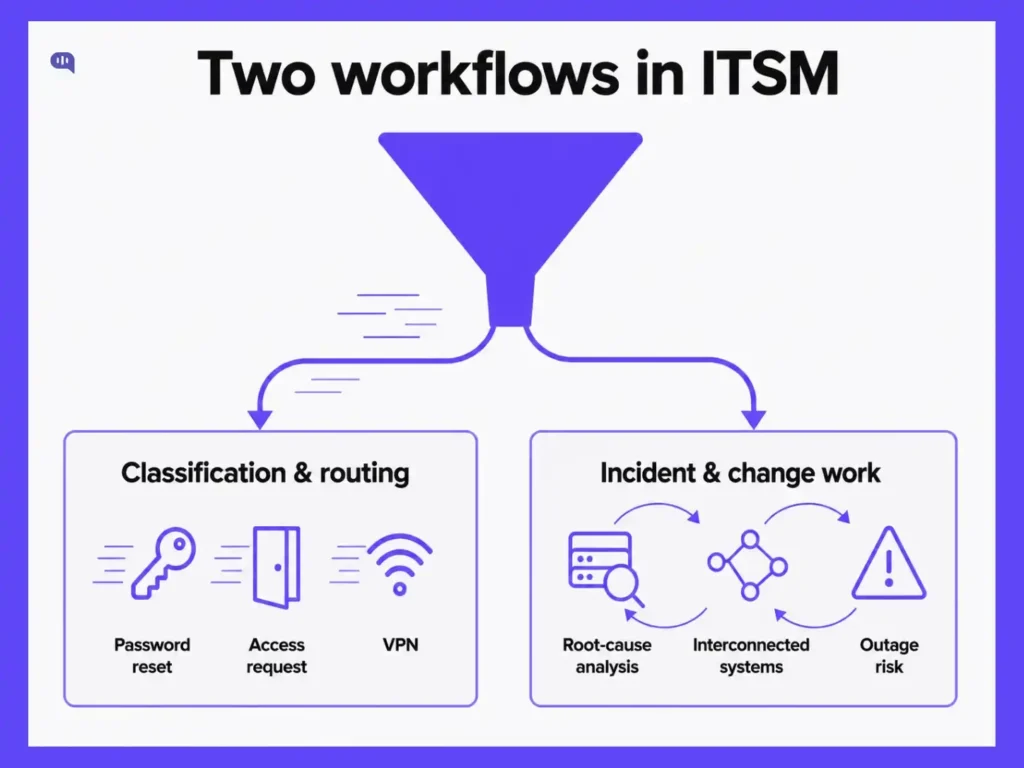
Most IT service desks run two very different workloads through the same queue.
Workload one: high-volume, low-complexity
Password resets, access requests, “why can’t I connect to VPN,” software provisioning.
- This is classification and routing work, not deep reasoning.
- A model needs to read a ticket, match it to a known pattern, and call the right tool: reset the password, open the access request, route to the right queue.
- It has to be fast and cheap because password resets, access requests, and common questions alone account for 40-60% of ticket volume at most enterprises.
Workload two: multi-step incident diagnosis and change-risk work.
Root-cause investigation across interconnected systems, where a wrong move creates an outage.
- This looks a lot more like the agentic coding tasks these models are actually benchmarked on.
- It requires holding context across a long investigation, calling multiple tools (CMDB lookups, log queries, monitoring APIs, remediation scripts), and recovering gracefully when the first three attempts at a fix don’t work.
- The cost of a wrong autonomous move here isn’t a reopened ticket. It’s downtime.
Treating these two problems as one problem is why ITSM AI rollouts often stall. The model that’s cheap and fast enough for workload one is usually not the model you want when making an unsupervised change to a production system at 2 a.m.
GPT-5.6 v/s Claude Fable 5: Benchmark comparison
Independent scoring from Artificial Analysis, run the same way across vendors, gives a cleaner read than either company’s own launch page.
| Benchmark | What it measures | GPT-5.6 Sol | Claude Fable 5 |
|---|---|---|---|
| Artificial Analysis Intelligence Index | Broad composite: reasoning, coding, science, agentic work | ~59 | ~60 |
| Artificial Analysis Coding Agent Index | Agent-harness performance across implementation, terminal use, and real codebases | 80 (leads) | 77 |
| SWE-Bench Pro | Autonomous patch resolution on real, unseen GitHub issues | Not officially published | 80.3% |
| Terminal-Bench 2.1 | Complex command-line, multi-step terminal workflows | 88.8% (Ultra: 91.9%) | 83.4% |
The pattern that matters for ITSM sits in the gap between the second and third rows:
- GPT-5.6 Sol wins when the task is scored inside an agent harness with continuous feedback (it can see whether a command succeeded and try again).
- Fable 5‘s advantage widens on tasks graded only at the end, where a model has to get an entire multi-step trajectory right without a scorer correcting it along the way. Incident diagnosis and change execution look much more like the second case.
Implication for ITSM:
- Ticket triage, classification, and routing get scored the same way agent-harness benchmarks do: every step has an immediate right or wrong answer (correct queue, correct priority, correct category), and a model can course-correct within the same interaction. That favors GPT-5.6 Sol’s strength.
- Root-cause investigation and change execution get scored the way SWE-Bench Pro does: nobody checks each intermediate step, only whether the final fix actually worked. That favors Fable 5’s strength.
- A benchmark chart that treats these as the same skill will point you toward the wrong model for at least half of your ticket queue.
Cost comparison: GPT-5.6 v/s Claude Fable 5
Per-token pricing is where GPT-5.6 makes its strongest case, and it’s a real one for volume work. But two things get lost when a comparison stops at the rate card: what the frontier tier costs relative to a human doing the same work, and whether you need the frontier tier at all for the cheap half of the queue.
| Model | Input (per million tokens) | Output (per million tokens) | Best-fit ITSM workload |
|---|---|---|---|
| GPT-5.4-mini | $0.75 | $4.50 | Routine, scripted responses |
| Claude Haiku 4.5 | $1 | $5 | Routine, scripted responses |
| GPT-5.6 Luna | $1 | $6 | High-volume classification, routing, password/access requests |
| GPT-5.6 Terra | $2.50 | $15 | Everyday ticket handling, knowledge-base drafting, standard fixes |
| GPT-5.6 Sol | $5 | $30 | Complex agentic coding and structured, tool-heavy remediation |
| Claude Fable 5 | $10 | $50 | Long-horizon incident investigation, high-stakes change work |
This pricing has two important implications:
1. Frontier long-running work has to beat the human alternative
MetricNet’s benchmarking puts a Tier 1 ticket resolution at around $22 and a Tier 3 escalation at $85 or more, and that’s before counting a senior engineer’s fully-loaded hourly cost, which typically runs $100-125 in the US.
A Sol or Fable 5 agent that burns $10-15 in tokens working through a root-cause investigation is still cheap next to a Tier 3 escalation, as long as it actually closes the ticket.
The comparison that matters isn’t Sol’s price against Fable 5’s price. It’s either the model’s price against the Tier 2 or Tier 3 engineer whose time it’s meant to free up.
If the agent fails and the ticket escalates anyway, you’ve paid twice: the token bill and the engineer’s hour.
2. The cheap tier for routine work doesn’t have to be the frontier vendor’s cheap tier.
Reading a password reset ticket and calling a known API doesn’t require GPT-5.6 or anything close to it. Smaller, older, genuinely inexpensive models like Claude Haiku 4.5 ($1/$5) or GPT-5.4-mini ($0.75/$4.50) handle pattern-matched, well-defined requests reliably and cost less than GPT-5.6 Luna on output tokens, which is where the volume-work bill actually accumulates.
For an IT department running on a budget that gets cut before it gets protected, that gap compounds fast across tens of thousands of routine tickets a year. There’s no reason to route a password reset through a frontier-tier model just because it happens to have a “cheap” tier of its own.
Implication for ITSM
Luna and Terra existing at a fraction of Fable 5’s rate is still a genuine advantage over Fable 5 or Sol for the classification-and-routing half of ITSM.
We’d just push the question one step further: before defaulting to a frontier vendor’s budget tier, check whether a smaller model built for exactly this kind of task closes the ticket just as reliably for less.
Which model works the best for ITSM?
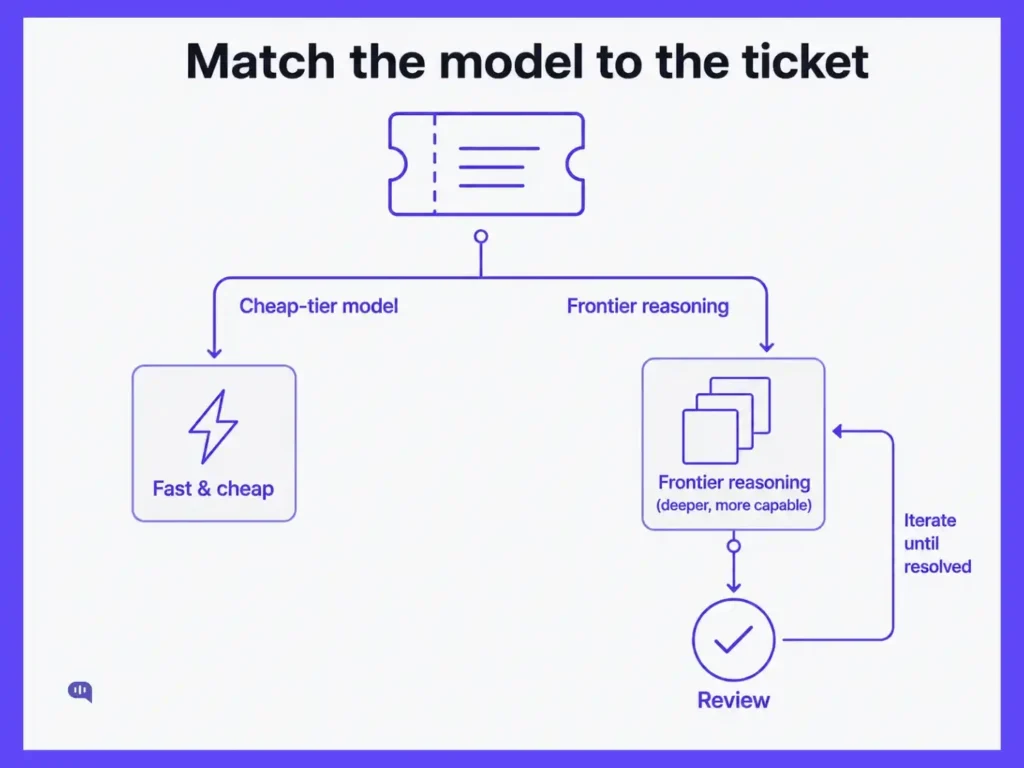
This is not a “pick a winner” decision, and we’d be skeptical of any ITSM vendor who tells you it is. Match the model to the stage of the ticket lifecycle instead:
- Route the high-volume, well-defined bulk of the queue to a cheap, fast tier. GPT-5.6’s Luna or Terra fits that job well, and the failure mode is cheap.
- Reserve frontier-tier reasoning, whichever model you land on, for the incidents and changes where an unsupervised multi-step trajectory actually needs to hold together end to end, and where the cost of a wrong autonomous action is measured in downtime, not a misrouted ticket.
That’s also, practically, why model flexibility belongs in the platform layer rather than getting hard-coded into your ITSM automation. The right model for a password reset and the right model for a cross-system root-cause investigation are rarely the same, and they won’t be the same model again after the next release cycle either.
If you want a customer service AI platform with AI flexibility, Kommunicate might fit your needs.
Conclusion
GPT-5.6 and Claude Fable 5 are both genuinely capable, and the benchmark chart depends entirely on which task you point it at.
For ITSM specifically, that split maps cleanly onto the two halves of the job:
- Cheap-tier models for the volume work
- The model with better long-horizon persistence for the incidents you can’t afford to get wrong on the first unsupervised attempt
Buy for the failure mode you’re actually exposed to, not for the model with the most green bars on launch day.

A Content Marketing Manager at Kommunicate, Uttiya brings in 11+ years of experience across journalism, D2C and B2B tech. He’s excited by the evolution of AI technologies and is interested in how it influences the future of existing industries.