Updated on July 9, 2026
On June 15, 2026, Salesforce signed a definitive agreement to acquire Fin, the AI customer service company that was called Intercom until May 2026, for approximately $3.6 billion. Fin brings more than 30,000 business customers and Apex, its proprietary support model. The deal is expected to close in Salesforce’s fiscal Q4 2027, which ends January 31, 2027.
If your support stack runs on Intercom, it now runs on a Salesforce company. On June 15, 2026, Salesforce signed a definitive agreement to acquire Fin, as Intercom renamed itself in May, for approximately $3.6 billion. The deal brings Fin’s 30,000 business customers, its Apex support model, and its AI agent under Agentforce.
On paper, it’s a strong deal. Salesforce gets a category-defining product to bolt onto Agentforce. Fin gets distribution it “could never have achieved on its own,” in the words of co-founder and CEO Eoghan McCabe. Wall Street will call it smart consolidation.
By joining forces with Salesforce, we can deploy it far and wide at a rate far faster than we could have ever achieved on our own
Eoghan McCabe, co-founder and CEO, Fin
Salesforce has been using acquisitions as a primary vehicle for growth for quite some time, and looking at that history might clue us in on the possible changes that Fin might face.
A brief introduction to Salesforce acquisitions
Salesforce has a long track record of acquisitions, with 78 companies acquired to date. Some of its largest deals include:
- Slack ($27.7B, 2020)
- Tableau ($15.7B, 2019)
- MuleSoft ($6.5B, 2018)
- Demandware ($2.8B, 2016)
While Salesforce has often used acquisitions as a vehicle for growth, its recent acquisitions (Informatica and Fin) signal that it’s trying to build a consolidated AI and data layer for enterprise operations. This plays well with their current product strategy, which is heavily focused on Agentforce and Marketing Cloud.
Now, the above acquisitions have had widely divergent results. We can understand this by looking at ExactTarget and Slack as examples.
ExactTarget
Salesforce acquired ExactTarget in 2013, and over time, the platform was integrated into Salesforce’s broader product portfolio. Today, it is part of the Salesforce Marketing Cloud (SFMC) rather than operating as a standalone brand.
Slack
Following Salesforce’s acquisition of Slack, it stayed as a standalone product while becoming more deeply integrated into Salesforce’s ecosystem.
Over time, Slack added tighter connections with products like Sales Cloud, Service Cloud, and Marketing Cloud, enabling users to access customer records, receive notifications, update opportunities, and collaborate on cases without leaving Slack.
While these previous acquisitions offer us some clues into Fin’s probable future, it’s not set in stone. Remember that the deal is expected to close in the fourth quarter of Salesforce’s fiscal year 2027, which ends January 31, 2027. Multiple questions still need to be answered before then:
- Will Fin preserve its current pricing structure?
- Will the product direction remain the same?
- Will the product be available individually or only as a bundle with Agentforce?
These questions will only be answered when the deal is closed, but we can map out the possibilities by looking at past SaaS acquisitions and the resultant changes.
What changes should customers watch out for?
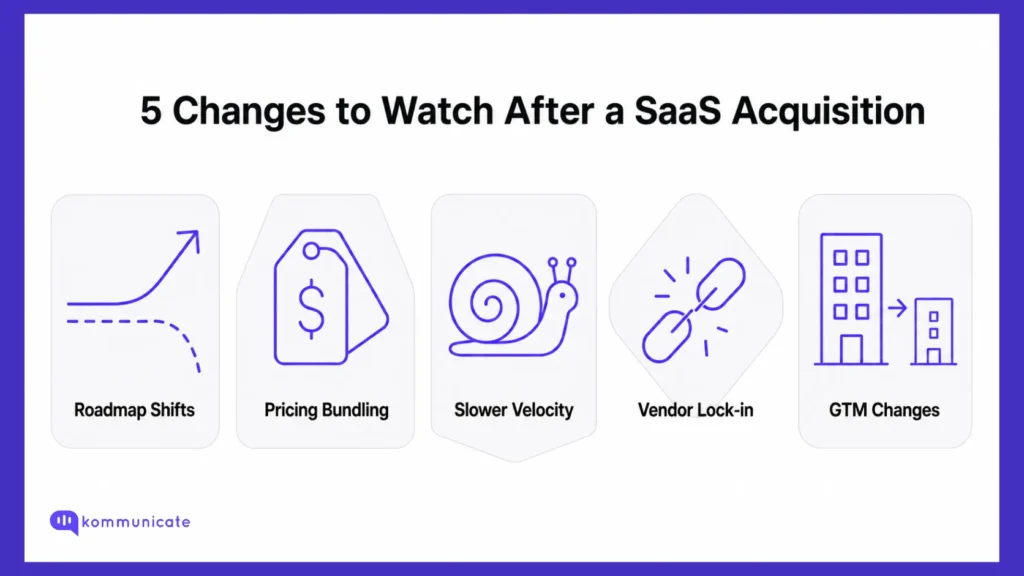
When independent SaaS businesses are acquired by enterprise tools, some changes are fairly common:
- The roadmap realigns with the parent’s strategy – The roadmap priorities of most acquired products get retooled and aligned with the parent company’s. This means that deep integration with enterprise tools might get higher priority than the existing roadmap.
- Pricing shifts toward platform bundling – Acquired products are frequently repositioned as an on-ramp to the parent’s ecosystem. That can mean pressure to adopt the wider Salesforce stack, tiered pricing that assumes you’re already a Salesforce shop, or a slow migration away from the standalone plans you signed up for. If you want a baseline to measure against, here is what Intercom’s pricing looks like today. Save a copy. You will want it at renewal.
- Product velocity slows during integration – Integrating a new tool into a large platform needs significant engineering hours. Integration work and compliance alignment tend to slow feature shipping at the acquired company, at least temporarily.
- You lose vendor independence – If your support stack now runs through Fin (formerly Intercom), you’re increasingly exposed to Salesforce’s pricing decisions, contract terms, and platform direction, even if you never signed up to be a Salesforce customer in the first place.
- The sales motion may move upmarket – Salesforce has framed this acquisition as a way to reach SMB and mid-market buyers, and Fin’s packaged, pre-trained agent genuinely serves that segment better than Agentforce does. But the surrounding organization is built for enterprise. The risk is not that Fin gets worse. It is that smaller accounts stop being the accounts that get attention.
None of this means Fin is about to fall apart. The team, the technology, and the customer base are all real assets, and Salesforce has every reason to keep the product strong in the near term to justify the price tag. But “near term” is doing a lot of work in that sentence.
What should Fin/Intercom customers do?
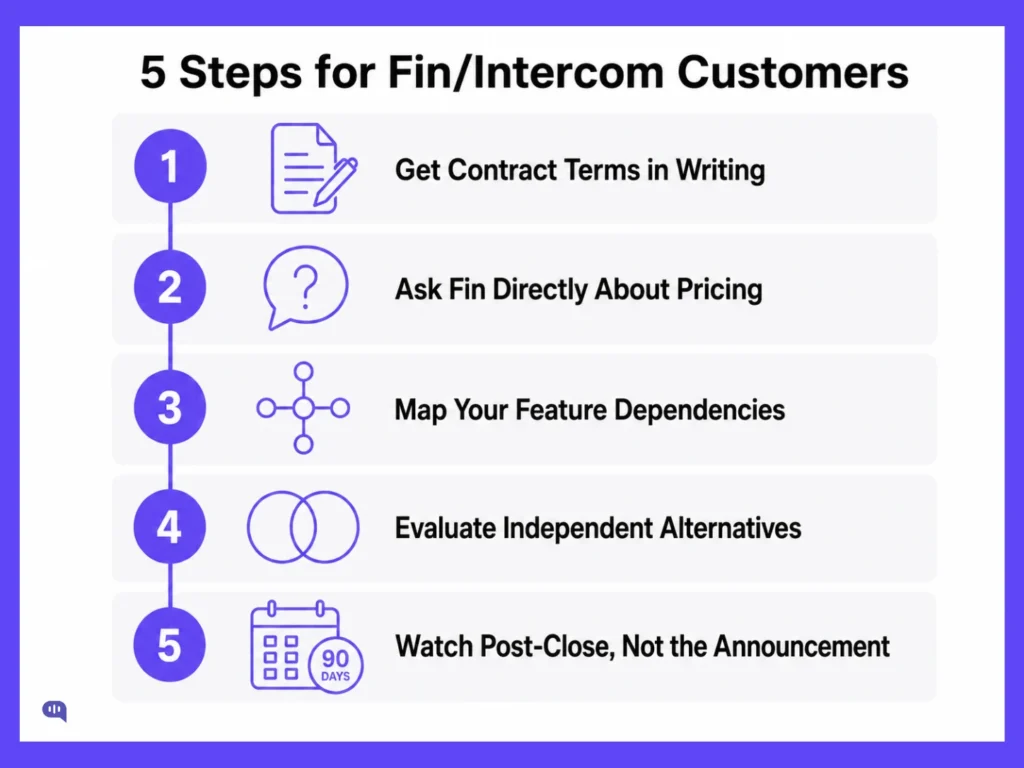
You have a real runway here, the deal won’t close until Salesforce’s Q4 FY2027 at the earliest. That’s time to be deliberate, not reactive.
1. Get your contract terms and renewal date in writing – Know exactly when your current agreement renews and what your termination or downgrade clauses look like. Don’t let a renewal auto-lock you in right as integration begins.
2. Ask Fin directly, in writing, about pricing and roadmap commitments post-close – Vague reassurance in a blog post isn’t the same as a commitment in your contract. If your account team can’t answer specifics about pricing after close, that’s information too.
3. Map your dependency on Fin-specific features – Which workflows, integrations, and automations are you deeply reliant on? If those get deprioritized or re-architected into Agentforce after close, what’s your exposure, and how long would a migration take?
4. Look at independent alternatives – While Fin might undergo a lot of changes after the acquisition, similar platforms exist. If the product strategy changes to something your business isn’t aligned with, knowing the independent Intercom alternatives already on the market, Kommunicate among them, might help before your next renewal.
5. Watch the first 90 days after close, not the announcement – Acquisition announcements are always calm. The real signal comes from what happens to pricing, support responsiveness, and release velocity in the months right after the deal actually closes.
The independent alternative
Product velocity, pricing stability, and tight SLAs are often top priorities for mid-market teams that are looking to automate customer service. These are exactly the metrics that can undergo the most changes after an acquisition.
If you are looking for an independent platform, we think Kommunicate might be a fit. We’ve built it as an AI agent focused on resolving customer queries instantly and escalating the complex ones intelligently, not as a module bolted onto a CRM roadmap.
Happy to talk through what a side-by-side evaluation could look like if that’s useful as you think through your options.

Manab is the Head of Go-To-Market (GTM) at Kommunicate, with over 12 years of professional experience. He collaborates closely with the engineering, sales, and marketing teams to deliver and position Kommunicate’s AI solutions effectively in the market.
Prior to joining Kommunicate, he worked at Cvent, an enterprise event management software company, and Entropik, an emotion AI company that helps brands understand and interpret consumer emotions.