Updated on June 24, 2026
Estimated reading time: 12 minutes
- Most website visitors leave because of the experience, not bad traffic. Static pages give generic answers, demand too much information upfront, and never respond to hesitation in real time.
- An AI chatbot for lead generation captures more leads than a static form by engaging visitors instantly, answering their questions, and qualifying intent inside the conversation.
- A lead generation chatbot qualifies leads by asking natural questions about the visitor’s goal, team size, and timeline, then routing high-intent prospects to sales.
- Generative AI reads vague, loosely worded answers that break rule-based bots, so conversations keep moving and fewer leads hit a dead end.
- A lead generation chatbot captures full lead data without a form, collecting name, email, company, and timeline naturally and syncing them to your CRM.
Ads running, content published, budget spent. People are clicking through, landing on your site, and then just leaving. No form filled out. No demo booked. Not even an email address.
Does it sound familiar?
This is the part nobody warns you about when they talk about website traffic. Getting people there is one problem. Getting them to do something once they arrive is a completely different one, and honestly, the harder one.
An AI chatbot for lead generation fixes exactly this gap: instead of leaving visitors to figure things out alone, a lead generation chatbot meets them in the moment, answers what they came to ask, and turns the visit into a conversation.
According to a 2026 Scalify report, websites using an AI chatbot pull in 20 to 35% more leads than those still relying on static forms.
This article walks through how AI chatbots are capable of turning website visitors into qualified leads.
What is an AI chatbot for lead generation?
An AI chatbot for lead generation is a conversational tool that engages website visitors in real time, answers their questions, qualifies their intent, and captures contact details, without a static form. Unlike a rule-based bot that follows fixed scripts, it uses generative AI to understand how real buyers actually phrase things, so the conversation keeps moving instead of breaking on the first unexpected answer.
Why Website Visitors Don’t Convert Easily
Most businesses assume low conversions mean bad traffic. More often, the traffic is fine. The experience is the problem. Here is what pushes visitors away before they convert:
1. Visitors arrive with specific questions, and your website gives generic answers
They land on your pricing page with one specific question, like whether your product works with the CRM their team already uses. Your pricing table has tiers and columns, but nothing that answers that question. So, the visitors open a new tab. Gone.
2. Static forms ask for too much before giving anything back
Hand over your name, job title, company size, and phone number to a brand you stumbled across ten minutes ago? Most people are not doing that. It feels less like a form and more like a background check before you have even seen the product. So, they scroll back up, close the tab, or just move on.
3. Without a chatbot, every visitor gets the same impersonal silence
Someone lands on your site, and there is no one there to greet them, understand what brought them in, or point them toward what actually matters to them. Whether it is Tuesday afternoon or Sunday morning, a static page treats every visitor identically: here is the content, figure it out yourself. No acknowledgment of what they came looking for, no tailored nudge toward the right resource, and no moment where the experience feels like it was built for them specifically. Visitors who never feel recognized rarely stick around long enough to convert.
4. Visitors at different stages of the buying journey all get the same treatment
Someone who just discovered your product and someone who has already shortlisted you both see the same homepage and the same CTA. One needs education. The other needs a nudge to book a call today. Treating them identically means you lose both.
5. Nothing on the page responds to hesitation in real time
A visitor might be sitting there thinking, “This looks like it could work, but I am not totally sure it fits what we do.” Thirty seconds later, the tab closed. Once that moment of doubt passes without anything meeting it, the lead is gone with it.
How AI Chatbots Improve Visitor Engagement
Most engagement problems on websites are not design problems. They are timing problems. A chatbot solves that by being there the second a visitor needs something, before they have had time to talk themselves out of it.
1. They greet visitors with context-aware messages instead of generic pop-ups
A chatbot on your pricing page opening with “Comparing plans? I can help you figure out which fits your team best” gets replies. A bland “Hi there, how can I help?” does not. Context is what earns a response.
2. They answer specific questions instantly, without sending visitors to dig through help docs
A well-trained AI chatbot responds to the question right there in the window. No “please browse our knowledge base.” Just a straight answer at the moment friction usually kills the conversation.
3. They guide lost visitors to the right resource
Plenty of visitors leave not because they lost interest but because they gave up trying to find what they came for. The right case study was buried. The integration page was hard to get to from the navigation menu. A chatbot that steps in and says, “Here, let me point you there,” turns that frustration into forward movement.
4. They keep visitors on the page longer by making it a two-way experience
A visitor who is actively chatting is not bouncing. The conversation gives them a reason to stay and invest a few more minutes in figuring out whether your product is worth a closer look. This kind of real-time, context-aware engagement also ties into how businesses are rethinking their entire digital visibility strategy. For example, generative engine optimization structures your website content so that AI-powered search and answer engines can accurately interpret and surface it. When your site is optimized for both human visitors and AI systems simultaneously, chatbots become even more effective because the visitors arriving are already better matched to what you offer.
How AI Chatbots Qualify Leads Automatically
Chasing unqualified leads takes up more of your sales team’s week than anyone wants to admit. A well-configured chatbot quietly handles that sorting before a human ever gets involved.
1. A chatbot asks qualifying questions naturally within the conversation
Nobody likes a questionnaire the moment they land on a site. But a question inside a conversation feels different entirely. “What are you hoping to solve?” does not feel like a gate. It feels like the start of a real exchange. Visitors answer willingly because it makes the conversation more useful to them.
2. It captures lead data without a form anywhere in sight
Five minutes into a chatbot conversation, your CRM is already looking pretty full. Name, email, company, what they are trying to fix, and rough timeline. They shared all of it, not because a required field made them, but because the conversation remained useful to them.
3. Generative AI tools handle vague answers far better than rule-based bots
Let’s say someone types, “We are around 40 to 50 people, give or take.” A rule-based bot from five years ago would have choked on that. A chatbot running on modern generative AI just reads it, and keeps the conversation going as if nothing happened.
That matters because real buyers rarely speak in neat dropdown answers. They describe problems loosely, change their wording halfway through, and ask follow-up questions in the same sentence. Traditional bots depend on exact triggers, so conversations break the moment phrasing gets messy.
Generative AI tools work differently. They interpret intent, recognize context, and respond in a way that feels natural instead of scripted. If a visitor says they need something “for a small remote team that might scale fast,” the AI chatbot can understand both the current need and the growth signal behind it.
The result is fewer dead ends, smoother conversations, and more leads reaching the point where they are ready to talk to sales.
4. Your sales team stops starting from scratch on every call
What usually shows up in your CRM after a contact form submission? A name and an email, maybe. Your rep goes in cold. When that same lead came through an AI chatbot first, your rep already knows what problem they are trying to solve, where they are in their decision, and what they said yes to during the chat. First calls go somewhere instead of circling in introductions.
Key Features That Help Convert Visitors Into Leads
There are a lot of AI chatbots out there, and most of them are forgettable. The ones that drive conversions are not just faster versions of a contact form. They do a few specific things well, and those things work together.
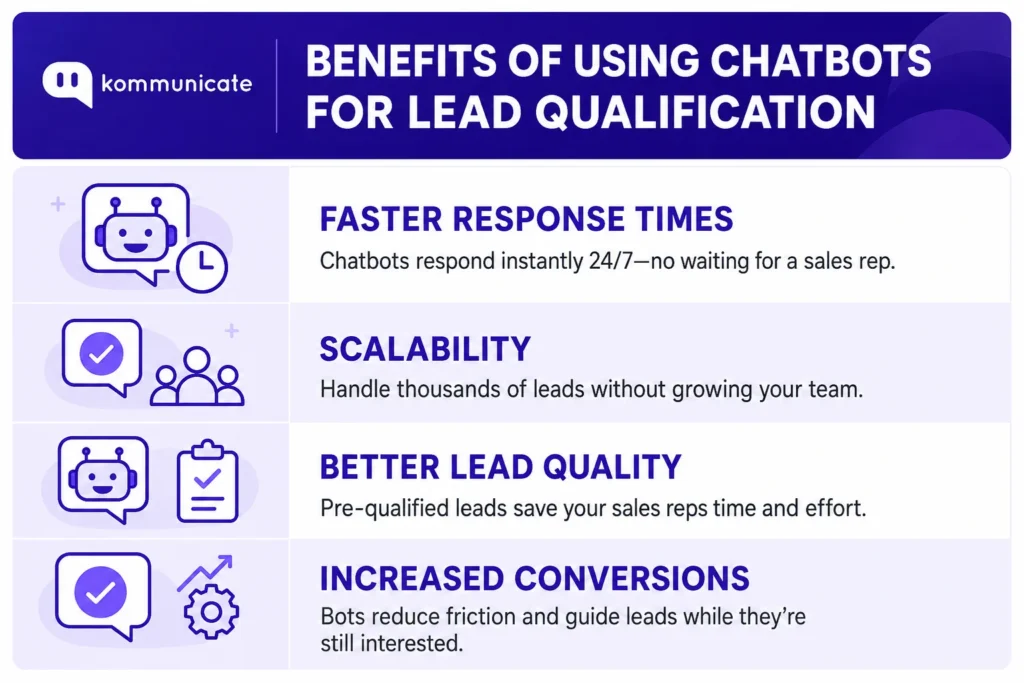
1. 24/7 availability means you never miss a lead because of timing
A contact form promising a reply in two business days is a lead killer, plain and simple. People research on their own schedule. An AI-powered chatbot available on a Friday midnight gives that visitor the same real response as someone who showed up on a Tuesday afternoon.
2. Instant responses keep the momentum alive
There is a short window between the moment someone gets curious and the moment they talk themselves out of it. A response in seconds keeps that window open. A response the next morning finds them already moved on.
3. Personalization based on behavior makes visitors feel seen
Consider a chatbot that knows you have been on the enterprise pricing page for a few minutes. Now, it’ll start the conversation with something related to this instead of something generic. When the conversation feels built for you, you stay in it.
Best Practices for Using AI Chatbots for Lead Generation
Getting a lead generation chatbot live is honestly the easy part. What separates the ones that quietly build your pipeline from the ones that sit there doing nothing is almost always how they were set up before they ever talked to a visitor.
1. Match the chatbot script to the intent of each page
Someone landing on your blog for the first time and someone sitting on your demo request page, ready to book, are not having the same experience. One needs context. The other just needs one clear reason to hit confirm. Sending them the same opening message is a waste of both their time and yours.
2. Make the first message specific, not generic
“Hi, can I help?” earns a quick close. “Are you comparing plans for a growing team?” on a pricing page earns a reply. The difference is that one message sounds like it could have been sent to anyone. The other sounds like it was written for them.
3. Place CTAs inside the conversation, not just at the end
The moment a visitor shares their challenge is your best opportunity. Offer the demo or the trial right then. Most people never reach a CTA sitting at the end of a long scripted conversation.
4. Start simple and build from what you learn
A clean and simple flow that works beats a complicated one that half-works every time. Get one path running well, see how visitors move through it, and then expand.
Your Visitors Are Ready. Is Your Website?
Traffic without conversion is just a number. You grow your business when you turn the right visitors into people your sales team can talk to.
A well-built AI chatbot starts real conversations, figures out who is worth pursuing, and collects everything your team needs to follow up well, all while you are in meetings or completely off the clock. That is the part most people underestimate until they see it running.
The businesses getting the most out of this are the ones that treated lead generation chatbots like a real part of their sales process and got the conversations right.
If you want to see what that looks like for your site, start your free trial with Kommunicate and set up your first lead generation flow today. No coding needed.
Frequently Asked Questions
In most cases, yes. A static contact form asks visitors to hand over their details before they get anything back, which is why many abandon it. An AI chatbot for lead generation engages first, answers the visitor’s question, and gathers details inside the conversation, so it typically captures more leads from the same traffic, especially outside business hours.
A lead generation chatbot qualifies leads by asking natural questions inside the conversation, such as what the visitor is trying to solve, their team size, or their timeline. Generative AI interprets loosely worded answers, captures the details into your CRM, and routes high-intent prospects to sales while filtering out poor-fit visitors.
The best AI chatbot for lead generation runs on generative AI rather than rigid scripts, integrates with your CRM, qualifies and routes leads automatically, and lets non-engineers edit flows. Evaluate tools on conversation quality, integrations, and time to launch. Platforms like Kommunicate offer these capabilities with a no-code setup.
To set up an AI chatbot for lead generation, define one clear goal per page, write an opening message that matches the page’s intent, add a few natural qualifying questions, and connect it to your CRM so captured leads reach sales. Start with one simple flow, see how visitors move through it, then expand.
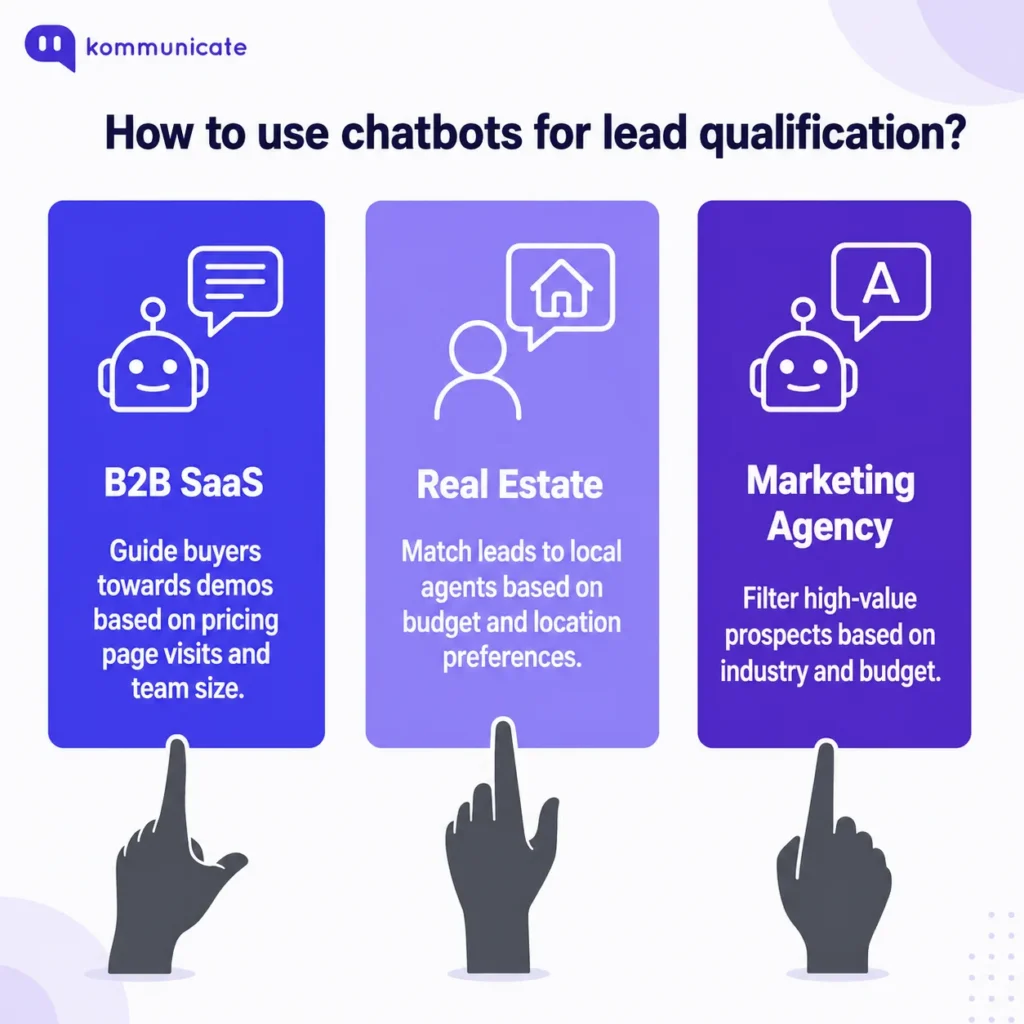
Yes. It can be tailored to any field by matching its questions to what qualifies a lead there. A real estate chatbot might ask about budget, location, and timeline; a B2B SaaS chatbot might ask about team size and the problem being solved; an agency chatbot might filter by industry and budget.
Yes. Instead of a form, it collects a visitor’s name, email, company, and needs naturally over the course of the conversation. Because the visitor shares details while the exchange stays useful to them, the chatbot often captures more complete lead data than a form would, without the friction that makes people abandon.

Himaan Chatterji is a B2B SaaS content strategist and co-founder of Confiscore.com. When AFK, he is either latin dancing or cooking.