Updated on September 21, 2026
The fear isn’t automation itself. It’s deploying a bot that confidently tells a customer the wrong refund policy, or invents an account status that doesn’t exist, and tanks your CSAT scores before anyone on the team notices. That scenario is exactly why so many support leaders have been burned by chatbot rollouts: the bot guessed when it should have escalated.
How do you automate customer support without losing quality? It comes down to sequencing and architecture, not technology. You need to know which workflows are safe to automate first, what technical guardrails prevent bad answers from reaching customers, and how to measure quality before a single customer notices the difference. Those principles apply across platforms, though platforms like Kommunicate are designed specifically around that architecture.
This guide gives you a prioritized plan: the workflows to automate first, the confidence threshold decisions that separate quality-preserving automation from the kind that quietly destroys CSAT, a handoff architecture that keeps context intact, and a 90-day pilot structure with real KPIs to prove value before you scale.
Which support workflows to automate first (and why sequence matters)
The biggest mistake support teams make is automating the wrong things first. Starting with complex, emotionally charged issues before your automation is calibrated is exactly where CSAT collapses. The smarter approach is to begin with workflows that share three characteristics: high inbound volume, clear resolution criteria, and recoverable mistakes.
Five workflows consistently produce the fastest ROI across SaaS and e-commerce environments:
- Password resets and account access. Extremely common, standardized, and low-risk, with little ambiguity in the resolution path.
- Order status and shipment tracking. Among the most frequent contact types in e-commerce and straightforward to automate once connected to order and tracking data.
- Returns, refunds, and compensation requests. Follow clear, policy-driven decision rules, making them high-volume and fast to resolve.
- Ticket triage and routing. Improve speed across all tickets, not just one type, delivering some of the highest operational ROI of any workflow.
- FAQ deflection for your top 20 inquiry types. This category typically accounts for a disproportionate share of total ticket volume.
Before adding any workflow to your automation scope, apply a simple two-part test. First: can the mistake be corrected before it affects the customer? Second: does the resolution have clear, verifiable success criteria? Any workflow that fails either condition stays with a human agent until your AI is better calibrated. This frames automation as a deliberate, phased process rather than a feature rollout.
How to automate customer support without losing quality: training and confidence thresholds
Training determines the ceiling of your automation quality. A general-purpose language model trained on the open web will confidently fabricate answers about your specific return window, your SLA commitments, or your product limitations. That’s not a theoretical risk; it’s the most common reason support teams abandon AI customer support tools after the first wave of customer complaints.
The fix is training your AI agents on your own verified documentation: help docs, internal policy documents, FAQs, and your website. Agents trained on business-specific sources can trace their answers back to a document, which makes their reasoning auditable. The practical setup involves uploading structured documentation, connecting to your live knowledge base, and defining which sources count as authoritative. When an answer can be traced to a specific document, your team can review and correct the knowledge source rather than chasing individual bad responses.
The architectural decision that separates quality-preserving automation from the kind that destroys CSAT is the confidence threshold. This is a defined score below which the AI routes to a human instead of generating an answer. For low-risk queries like store hours or shipping status, a threshold around 60 to 70 percent is workable. General support queries typically need 80 to 85 percent. Sensitive or compliance-heavy topics, such as refunds, account security, or financial questions, warrant 90 to 95 percent or a hard human-handoff rule regardless of score.
Some platforms are designed around this “refuse to guess” principle: when a query falls outside the agent’s confidence range, the system declines to answer rather than fabricate a plausible-sounding response. The practical upside is that every answer reaching a customer has cleared a confidence check, and low-confidence queries route to a human with full context intact. That architecture is what makes automated helpdesk workflows safe to scale in regulated industries, where a wrong answer carries real consequences. Kommunicate is built around this approach, routing uncertain queries to human agents rather than risking a confident but incorrect response.
Building a human handoff flow that preserves customer experience
Even well-trained AI agents with strict confidence thresholds will encounter queries that require a human. The handoff is where most automation implementations fail silently: the customer gets transferred, repeats their entire situation from scratch, and leaves frustrated regardless of how well the AI performed before the escalation.
Define your escalation trigger rules before the first customer interaction, not after a complaint. Four conditions should trigger automatic escalation without hesitation: the confidence score falls below your defined threshold; the query involves irreversible or high-stakes actions like financial transactions, security changes, or legal matters; the customer has expressed frustration or repeated the same question; or the request falls outside the agent’s approved scope. Writing these rules down in advance forces your team to think through edge cases before they become incidents.
Context preservation is what separates a smooth handoff from a frustrating one. Operationally, this means the full conversation transcript, the customer’s history, the AI’s attempted resolution, and the trigger reason for escalation all travel with the ticket to the human agent. When this works, the agent picks up mid-conversation without asking the customer to start over. When it doesn’t, CSAT drops regardless of everything the AI did correctly. When evaluating vendors, require a documented reliability target for handoff context retention and get it in writing, the marketing copy about “seamless escalation” is not a substitute for a measurable SLA.
Quality metrics to track after your automation goes live
Deploying automation without a measurement framework is how teams miss slow CSAT erosion for weeks. You need a metric mix that catches both efficiency gains and hidden quality damage at the same time. Tracking only handle time and resolution volume is how automation looks successful on paper while customers quietly stop returning.
Structure your measurement stack across three categories. For efficiency, track time to resolution, average handle time, and labor minutes per ticket. For quality, watch first-contact resolution rate, rework rate, escalation rate, and incorrect-response rate. For customer experience, monitor CSAT, repeat-contact rate, complaint rate, and abandonment rate. Repeat-contact rate deserves particular attention: a customer who contacts you twice about the same issue had a failed resolution the first time, even if the CSAT survey never fired.
Set realistic expectations using benchmarks drawn from recent deployments. Well-tuned AI automation typically produces CSAT improvements of 10 to 25 percentage points, NPS gains of 10 to 20 points, and AHT reductions of 30 to 60 percent for routine request types. A more specific pattern from recent deployments shows CSAT rising from the 78 to 82 percent range to 88 to 92 percent, NPS from 35 to 45 up to 50 to 60, and chat AHT falling from 8 to 12 minutes down to under 3 minutes for AI-handled queries. Treat these as directional targets for your 90-day pilot, not guarantees. Actual gains depend heavily on which workflows you automated and how precisely you set your confidence thresholds.
A 90-day pilot plan to test automation without risking customer experience
A pilot is how you prove value on a small slice before committing the full queue. The goal is to contain risk while generating enough data to make a confident go or no-go decision. The structure below is designed specifically to protect customer experience during the test period.
Days 1 to 30: baseline and build. Pick one workflow and freeze the pilot scope. Capture baseline metrics, including current ticket volume, handle time, first-contact resolution, CSAT, and escalation rate. Complete your security and data review. Build the automation in a staging environment and confirm escalation paths with a working fallback before a single live customer sees it. End this phase with a signed-off pilot charter, not a verbal agreement.
Days 31 to 60: controlled live pilot. Launch to a small cohort of 5 to 20 agents or one queue. Run human-in-the-loop for the first two weeks so agents can approve or override outputs before they reach customers. This is not a lack of confidence in the AI; it’s the fastest way to catch failure modes before they compound. Track daily incidents and quality flags. Run weekly KPI snapshots and compare them to your baseline every seven days.
Days 61 to 90: expand or pause. Compare current metrics to baseline across all three categories: efficiency, quality, and customer experience. If CSAT, repeat-contact rate, and escalation rate are within acceptable thresholds, cautiously expand scope. If any guardrail metric is degrading, pause and diagnose before widening the pilot. Produce a documented recommendation at day 90 with supporting data. Based on pilot design guidance from recent support automation deployments, a deflection rate of 20 to 30 percent for the pilot workflow is a reasonable minimum bar for a go decision.
Keep the pilot team lean but accountable. You need five roles: a business owner who holds the go or no-go decision, a technical steward who manages integrations and logging, a pilot lead who runs the weekly cadence, a cohort of agents using the automation in live work, and a part-time QA reviewer sampling outputs for quality. Run a 30-minute weekly review with the business owner, technical steward, and pilot lead. Add a daily quick check for broken handoffs and escalation issues so problems don’t compound across the week before anyone surfaces them.
Choosing a platform built to protect quality at scale
Not all platforms approach quality the same way, and the technical architecture of your chosen tool determines whether automation scales well or quietly degrades CSAT as volume grows. Automating customer support without losing quality starts with selecting a platform whose design enforces guardrails by default, not one that leaves quality controls as an afterthought. Four criteria are worth evaluating on any shortlist.
- Escalation reliability: Does the platform guarantee context-preserving handoffs, and at what reliability level? Get this in writing, not just in a demo.
- Confidence threshold controls: Can you define what the AI declines, and can you audit the reasoning behind each answer? If you can’t see why the AI responded the way it did, you can’t fix it when something goes wrong.
- Training flexibility: Can you train on your own documentation rather than relying on generic model knowledge? This is non-negotiable for support automation that touches policies, pricing, or compliance.
- Audit trail: Can you see exactly what the AI said, why it said it, and what triggered an escalation? Without this, quality review is guesswork.
One pricing consideration worth flagging: per-resolution pricing models can create perverse incentives where the AI resolves queries it shouldn’t, because unresolved tickets cost the vendor money. Predictable, usage-aligned pricing removes that conflict.
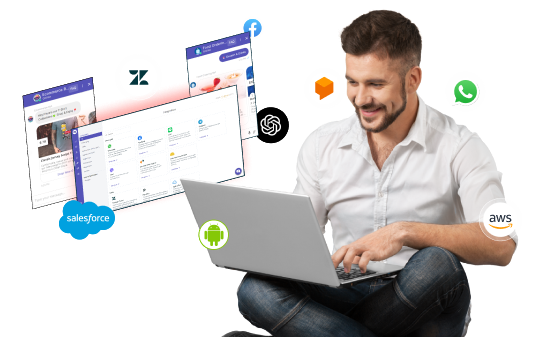
Kommunicate is built around the “refuse to guess” principle. Its agents recognize the limits of their own confidence and decline out-of-scope queries rather than produce a plausible-sounding but incorrect answer. Every interaction is logged with transparent reasoning so support teams can audit the logic. The platform supports multi-model flexibility and omnichannel deployment across web chat, WhatsApp, email, and voice, capabilities that matter particularly for regulated industries, high-volume SaaS support, and fast-scaling operations where a wrong answer carries real cost.
The path forward: automating customer support without sacrificing quality
This guide has covered a lot of ground, from workflow sequencing and confidence thresholds to handoff architecture and pilot design. The through-line is that automating customer support without losing quality is fundamentally a planning and architecture problem. The teams that get it right don’t deploy faster; they deploy more deliberately.
Start with the right workflows: high volume, low complexity, recoverable if something goes wrong. Train on your own verified documentation. Set confidence thresholds that force the AI to decline rather than guess. Build handoff flows that preserve full conversation context. Measure quality metrics weekly from day one, not after CSAT has already slipped.
The 90-day pilot structure is the lowest-risk path to proof. It gives you real data on automation rate, CSAT impact, and escalation behavior before you commit to scale. That data turns an internal automation conversation from a bet into a business decision.
If you want to run that pilot on a platform architecturally designed not to guess, Kommunicate offers a 30-day free trial with no credit card required. Reach out to the Kommunicate team to get started.

Manab is the Head of Go-To-Market (GTM) at Kommunicate, with over 12 years of professional experience. He collaborates closely with the engineering, sales, and marketing teams to deliver and position Kommunicate’s AI solutions effectively in the market.
Prior to joining Kommunicate, he worked at Cvent, an enterprise event management software company, and Entropik, an emotion AI company that helps brands understand and interpret consumer emotions.