Updated on May 28, 2026
TL;DR
Conversational AI improves insurance conversion rates by:
- Recovering abandoned quote journeys
- Re-engaging warm leads on channels like WhatsApp
- Qualifying prospects in real time
- Handing high-intent buyers to agents when they are ready
The biggest opportunity is in helping agents spend less time chasing cold leads and more time closing warm, qualified prospects.
The prospect who requested a home insurance quote last Tuesday is now a dead end in your CRM. Acquiring that single lost lead costs your firm somewhere between $60 and $200. Multiply that by the thousands of drop-offs per month, and you can see the problem.
The real conversion problem in insurance is the revenue loss due to poor re-engagement.
The quote-to-bind conversion rate stays flat. The team cycles through the same cold list every quarter. And the prospect eventually buys from whoever followed up first with something that felt relevant.
Conversational AI fixes this by recovering the intent you already paid to generate. In this article, we’ll talk about how AI-based re-engagement is one of the best tools for an insurance marketer. We’ll cover:
- The five places prospects abandon the journey
- How does conversational AI re-engage dropped insurance leads?
- How does WhatsApp change the re-engagement equation?
- Why should qualification happen during re-engagement?
- Metrics to track after adding conversational AI
- Conclusion
The five places prospects abandon the journey
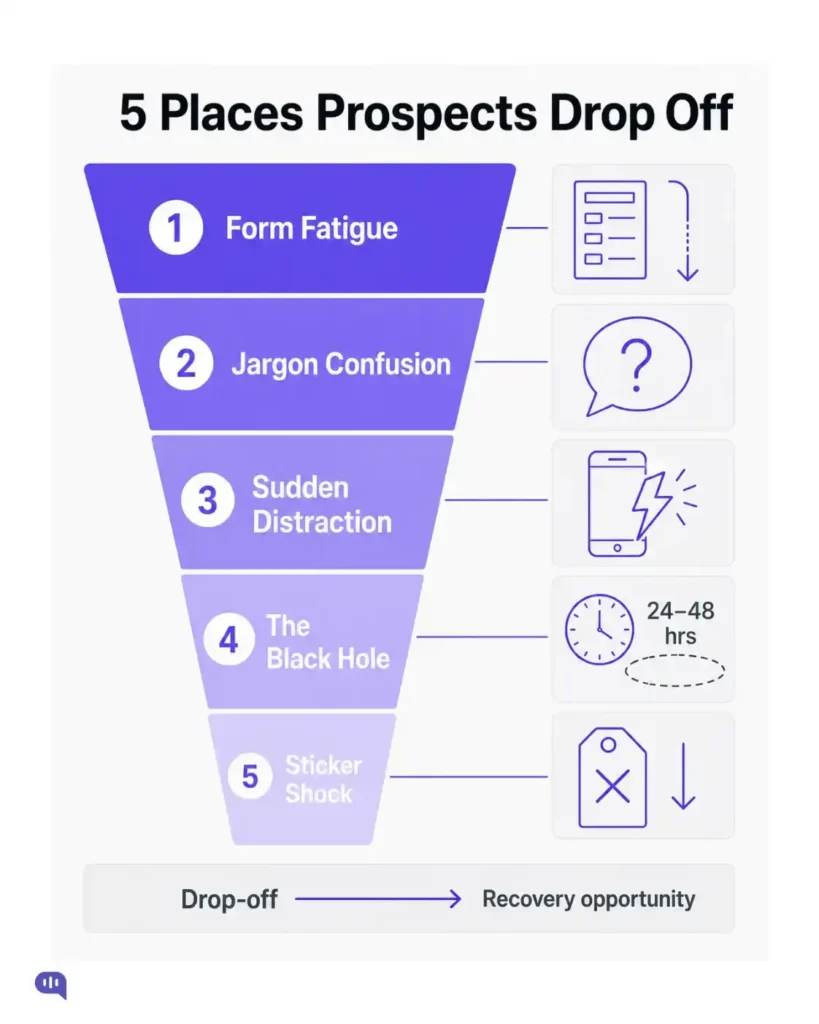
Most quote abandonment is not random. It clusters around five predictable failure points — each one recoverable with the right intervention.
| Failure Point | Why Prospects Drop Off | How Conversational AI Recovers Them |
|---|---|---|
| 1. Form fatigue | The quote form has too many steps. | Replaces static forms with a frictionless, question-by-question chat that feels lighter. |
| 2. Jargon confusion | Prospects do not know what to pick, and no one is there to explain. | Provides instant, plain-English clarification mid-conversation without leaving the flow. |
| 3. Sudden distraction | A phone call, arriving at work, or a child needing attention interrupts the flow. | Sends a follow-up 15–30 minutes later: “Need to pause? Reply ‘Resume’ anytime.” |
| 4. The black hole | They submit and receive a “We’ll call you in 24–48 hours” message. | Instantly qualifies the lead and routes to a live agent in under 60 seconds. |
| 5. Sticker shock | The initial premium is higher than expected, so they close the tab. | Dynamically offers deductible adjustments or bundled options to bring the number down. |
Conversational AI addresses all five of these failure points in the quote journey. It can help you make the form itself, but the moments before and after it, where most of the attrition actually happens.
How Conversational AI Re-Engages Dropped Insurance Leads
Re-engagement is where conversational AI earns its place. The leads in your CRM already have intent behind them. They just need less resistance. You can facilitate it in two ways:
1. Ensuring that the AI restarts from the drop-off point
If a prospect abandoned a quote at step 3, the AI reaches back out and resumes from that exact point.
Something like: “You were comparing home insurance plans and had a question about flood coverage. Want to continue from there?”
2. Timing the follow-up to behavior
Static drip campaigns follow a fixed schedule. Conversational AI follows behavior. A prospect who visits your pricing page twice in one week is showing intent. One who opens a policy email but does not click is showing hesitation.
AI-driven re-engagement should respond to these signals.
3. Segmenting re-engagement by drop-off stage
A prospect who abandoned at step 1 needs a different message than one who made it to coverage comparison. Conversational AI can segment by where the drop-off happened and tailor the re-engagement accordingly, increasing the chance the follow-up feels relevant rather than generic.
4. Re-engaging across multiple touchpoints without repetition
If a prospect does not respond to a WhatsApp nudge, the AI can follow up via SMS or trigger an email without repeating the same message. Each touchpoint advances the conversation rather than restarting it, so the prospect never feels chased.
5. Reactivating long-cold leads around life events.
A lead that went cold six months ago is not necessarily a dead lead. Policy triggers can create fresh intent. Conversational AI can monitor for those signals and re-engage at the right moment rather than waiting for the prospect to come back on their own.
These re-engagement triggers become more concrete when combined with WhatsApp.
How does WhatsApp change the re-engagement equation?
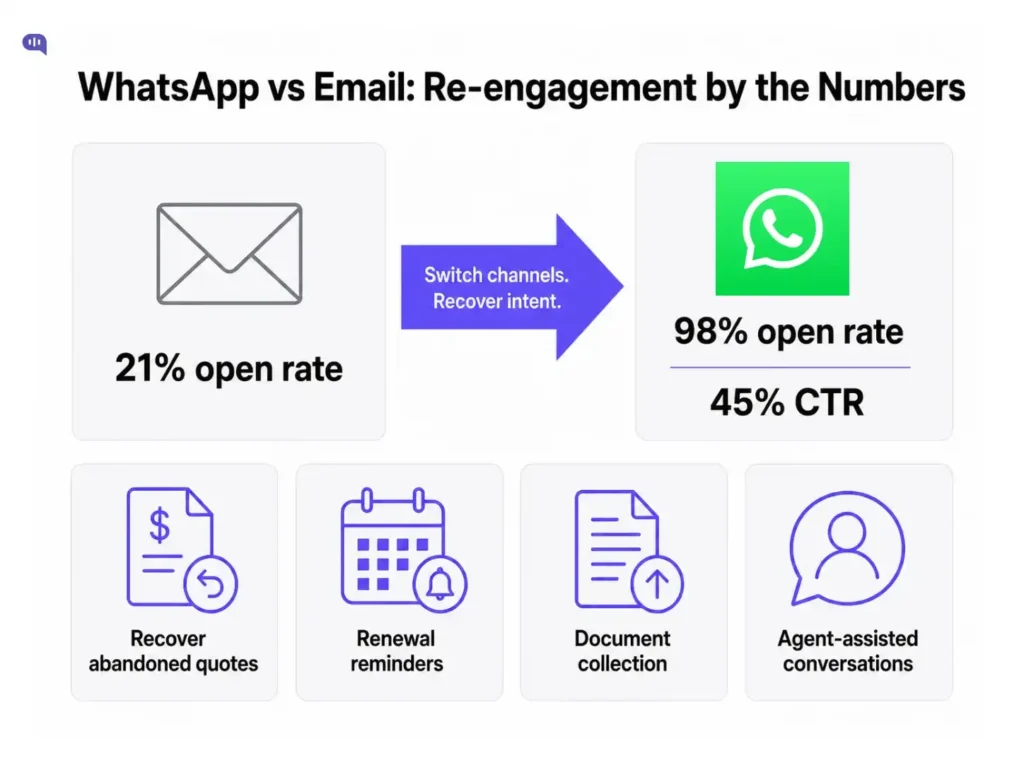
Email is the default re-engagement channel for most insurance teams. The numbers make that hard to defend.
Insurance marketing emails average around a 21% open rate. WhatsApp reaches up to 98% open rates and 45% click-through rates. For a prospect who went quiet after abandoning a quote, the channel difference alone changes whether re-engagement happens at all.
WhatsApp automation for insurance works particularly well for:
- Abandoned quote recovery – Reaching prospects within hours of drop-off, while the intent is still warm
- Renewal reminders – Reaching customers before a policy lapses rather than after
- Document collection – Requesting proof of address or vehicle details inside the same conversation thread
- Agent continuity – Letting agents continue a conversation without losing context between sessions
A well-written AI re-engagement message on WhatsApp does not feel like spam:
“Hi Sarah — we noticed you were looking at the SafeDriver Comprehensive plan, but did not finish customizing your deductible. Reply 1 to pick up where you left off, or 2 to speak to an agent right now.”
That specificity is what separates a message that earns a reply from one that gets ignored. We can look at this process in more detail with one example:
Example: How AI Recovers an Abandoned Insurance Quote
Here is what the full re-engagement flow looks like end-to-end:
| Stage | What Happens | AI Action |
|---|---|---|
| Quote started | Prospect enters details for home insurance. | AI captures intent and product interest. |
| Drop-off | Prospect abandons at the coverage comparison step. | AI logs the abandoned stage. |
| Re-engagement | Prospect receives a WhatsApp follow-up 24 hours later. | “Want to continue comparing home insurance plans?” |
| Qualification | Prospect asks about the premium difference between the two tiers. | AI answers from plan data in real time. |
| Human handoff | Prospect signals intent to bind. | AI routes to a licensed agent with a full conversation summary. |
The handoff is where most systems lose the thread. The agent should not receive a name and a phone number. They should receive a cheat sheet: “Sarah, 34, looking for home insurance, abandoned at coverage limits, primary concern is premium cost.”
The insurance agent should only pitch in to close. In fact, to reduce the ad-hoc workload for insurance agents, you need to introduce lead scoring that works during re-engagement.
Why should qualification happen during re-engagement?
Most insurance teams qualify leads first and nurture them later. With conversational AI, both happen in the same conversation, and re-engaged leads are better candidates for qualification than cold inbound because their intent is already demonstrated.
When a prospect returns via a re-engagement nudge, the AI does not restart from zero. It already knows what products they explored and where they hesitated. It can qualify the lead in real time by surfacing the right plan, flagging high-intent signals for routing, and moving the conversation forward without friction.
For insurers, this means better-qualified leads reach agents at exactly the right moment. And the right moment should be determined autonomously by AI.
When should AI hand off the lead to a human agent?
The handoff point is the most crucial part of any AI-led conversation.
AI should route to a human agent when:
- The prospect is ready to bind a policy
- They ask for pricing exceptions, discounts, or custom adjustments
- The query involves regulatory, underwriting, or legal complexity
- The prospect expresses frustration or repeated confusion
- High-value coverage is involved: commercial insurance, bundled policies, and life insurance
This is also where the role of conversational AI becomes clear relative to human agents: the question is about the division of labor. Conversational AI is used to handle the volume, while human agents handle the conversion itself.
To measure this, we recommend that you constantly keep a track of a few metrics.
Metrics to Track After Adding Conversational AI
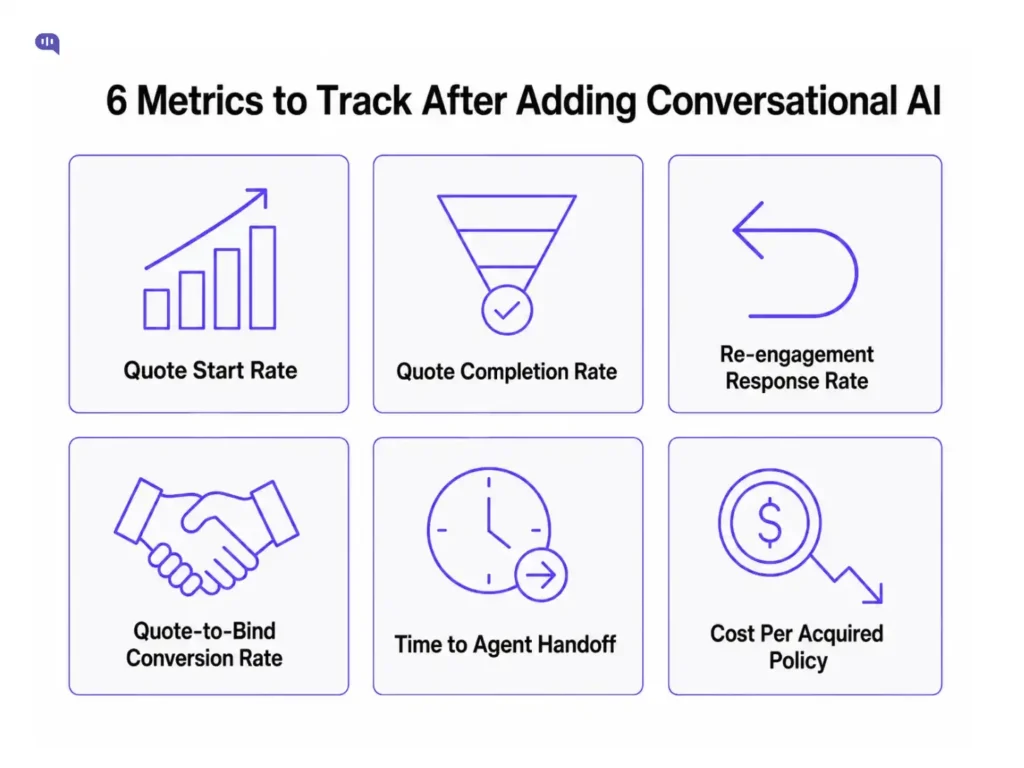
| Metric | Why It Matters |
|---|---|
| Quote start rate | Shows whether AI is helping more visitors begin the quote process. |
| Quote completion rate | Measures the reduction in form abandonment. |
| Re-engagement response rate | Shows how many dropped leads return and continue. |
| Quote-to-bind conversion rate | Measures actual revenue impact. |
| Time to agent handoff | Shows whether high-intent leads reach agents faster. |
| Cost per acquired policy | Measures efficiency compared with manual follow-up. |
Insurance customer experience metrics belong in this stack, too. A prospect who feels confused or underserved at any step is unlikely to respond to re-engagement regardless of channel or timing.
In fact, the customer experience should be central to any AI deployment.
Conversion Should Not Come at the Cost of Trust
Conversational AI in insurance needs guardrails. It should not guess on policy specifics, coverage exclusions, premium calculations, or eligibility rules.
The right setup includes source-grounded answers (the AI only quotes from approved policy documentation), clear escalation paths (the AI always knows when to defer to a human), audit logs for regulatory review, and explicit disclosures where required.
A conversational AI built for insurance respects these constraints. Prospects trust insurers more when the AI is honest about what it can and cannot answer, and that trust is part of what drives conversion in the first place.
Conclusion
Look at your CRM. If more than 50% of quotes are being abandoned after the initial step, you have a conversion problem.
The biggest conversion opportunity for most insurers is not more traffic. It is recovering the intent they already paid to generate. Abandoned quotes, unanswered questions, and silent CRM records represent prospects who showed up and were not met where they were.
Platforms like Kommunicate help insurers build AI agents that capture leads, answer policy questions, recover abandoned conversations, and hand qualified prospects to human agents with full conversation context. Schedule a demo to see how conversational AI can plug the leaks in your quote-to-bind funnel.

Devashish Mamgain is the CEO & Co-Founder of Kommunicate, with 15+ years of experience in building exceptional AI and chat-based products. He believes the future is human and bot working together and complementing each other.