Updated on August 30, 2026
TL;DR
| Our Ranking | Software | G2 Rating |
| 🥇 1 | Kommunicate | ⭐ 4.6 |
| 🥈 2 | Rasa | ⭐ 4.4 |
| 🥉 3 | LivePerson | ⭐ 4.3 |
| 4 | NICE CXone Mpower | ⭐ 4.3 |
| 5 | Genesys Cloud CX | ⭐ 4.3 |
| 6 | Zendesk | ⭐ 4.3 |
| 7 | Freshdesk + Freshchat | ⭐ 4.4 |
| 8 | Ada | ⭐ 4.6 |
| 9 | Kore.ai | ⭐ 4.6 |
| 10 | Intercom | ⭐ 4.5 |
A telecom company’s worst nightmare isn’t a network outage. It’s the spike in customer queries that follows one
Telecom is the most demanding industry in customer support. Every interaction (Billing disputes, plan changes, SIM activations, outage status checks, device troubleshooting) is high-stakes, often emotional, and almost always repetitive.
Customer service reps are expensive. Queues are long. Churn is brutal.
That’s why telecommunications now leads all industries in AI customer service adoption, with 95% adoption in 2026. The math is simple: inbound calls cost $2.70–$5.60 each, labor consumes 60–75% of operational budgets, and billing complaints are rising 52% year-over-year. AI customer service in telecom are a part of the survival infrastructure.
But not all AI chatbot platforms are built for what telecom actually demands. Requirements for accuracy on billing data, compliance audit trails, BSS/OSS integration, and the ability to absorb sudden volume spikes without degrading eliminate most generic platforms from the conversation.
We’ve reviewed each platform against telecom-specific criteria to give you a clear, decision-ready comparison for 2026. We’ll talk about:
- How did we Choose the Best Chatbot Platforms for Telecom Customer Support?
- The Best AI Chatbot Platforms for Telecommunications
- What Telecom-Specific Features Should you Prioritize For?
- Which AI Chatbot Platform is Right for Your Telecom Team?
- Conclusion
- FAQs
How did we Choose the Best Chatbot Platforms for Telecom Customer Support?
Every platform on this list was evaluated across six criteria that matter specifically to telecom customer support operations:
- Telecom-specific integrations – BSS/OSS, CRM, billing systems, and ticketing connectivity
- Accuracy and hallucination risk – Can the AI reliably surface billing amounts, plan details, and outage status without fabricating information?
- Omnichannel coverage – Web, mobile app, WhatsApp, IVR, SMS, and social
- Human handoff quality – How cleanly does the AI escalate to agents, with what context? A customer service QA scorecard helps you evaluate this consistently across your team.
- Compliance and audit readiness – Especially for PUC oversight, GDPR, and billing accuracy requirements
- Scalability under volume spikes – Outage events can flood support with 3,000–7,000% volume surges overnight
We also factored in G2 and Capterra ratings, documented deployment outcomes, and publicly available pricing transparency.
The Best AI Chatbot Platforms for Telecommunications
According to the above criteria, we’ve ranked the best AI chatbot platforms as follows:
| Platform | Best For | Starting Price | G2 Rating | Channels | Human Handoff |
| Kommunicate | Mid-market & enterprise telecom teams | $34/mo | 4.6 | Web, Mobile, WhatsApp, Telegram, Instagram | ✓ Built-in |
| Rasa | Enterprise telco teams needing full AI control | From $35K/yr | 4.4 | Voice, Chat, IVR, Messaging | ✓ |
| LivePerson | Enterprise messaging-first telecom CX | Custom | 4.3 | WhatsApp, SMS, Web, Apple Messages | ✓ |
| NICE CXone Mpower | Contact center AI + workforce management | Custom | 4.3 | Voice, Chat, Email, Social | ✓ |
| Genesys Cloud CX | Full-stack telecom contact center | ~$75/agent/mo | 4.3 | Voice, Chat, Email, SMS, Social | ✓ |
| Zendesk | Telecom teams scaling support ops | $55/agent/mo | 4.3 | Email, Chat, Voice, Social, SMS | ✓ |
| Freshdesk + Freshchat | Growing telecom brands on Freshworks stack | $19/agent/mo | 4.4 | Chat, Email, Voice, WhatsApp | ✓ |
| Ada | Digital-first telecom self-service | Custom | 4.6 | Web, Mobile, Messaging | ✓ |
| Kore.ai | Telecom-specific AI agent deployment | Custom | 4.6 | Voice, Chat, Email, IVR | ✓ |
| Intercom | SaaS-adjacent telecom and MVNOs | From $29/mo | 4.5 | Web Chat, Email, In-app | ✓ |
To help you assess better, we’ve also provided short reviews of all the contenders below:
1. Kommunicate
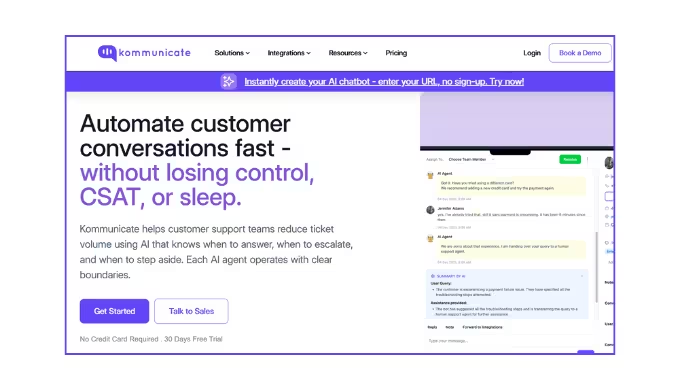
Kommunicate is an AI-powered customer service platform built around a human-in-the-loop philosophy, where AI confidence thresholds matter and getting billing information wrong has real consequences. Before deploying, formalise your response time commitments with a customer support SLA template.
For telecom teams, Kommunicate’s strength is in how it handles the boundary between automation and escalation. The platform auto-resolves high-volume, repetitive queries (plan FAQs, outage status, SIM activation steps) while maintaining a clear handoff path to agents when interactions require judgment, verification, or empathy.
Its no-code bot builder (Kompose) lets telecom support teams configure AI agents for specific channels and use cases without engineering involvement. The live dashboard gives supervisors real-time visibility into where AI is answering and where it’s handing off: a key operational control most platforms bury in reports.
Pros
- Built-in human handoff with full conversation summary and transcript passed to agents
- Supports web, mobile, WhatsApp, Telegram, Instagram and more from a single platform
- No-code bot builder with AI intents and workflows
- Real-time conversation dashboard with First Response Time, Average Resolution Time, and Agent Login Time
- Auto-resolve repetitive queries; convert unresolved conversations into tickets automatically
- Multilingual support across channels
Cons
- Not designed for fully autonomous, no-human-intervention AI deployments
- Advanced integrations with legacy BSS/OSS systems require the Enterprise tier
- Better suited for teams that treat support as a core function, not a passive channel
Pricing
- Starter – $34/month: 1 AI agent, 1 team member, 250 conversations/month across web, mobile, WhatsApp, Telegram, Instagram
- Professional – $167/month: Expanded capacity, additional AI agents and seats, deeper analytics, agent assist, phone call AI, integrations, campaign messaging
- Enterprise – Custom: Custom seats and AI agents, discounted conversation pricing, SSO, advanced governance, dedicated success management, SLA-backed support
Best For:
Mid-market to enterprise telecom teams that need to automate repetitive queries at speed, maintain human oversight on complex or sensitive issues, and deploy quickly across messaging channels like WhatsApp without a lengthy implementation project.
What Customers Say:
★ “The chatbot-human handoff is smooth and the live dashboard gives our team full visibility.” — G2 Reviewer
✗ “Some integrations can be slow to configure and there is a learning curve on advanced flows.” — G2 Reviewer
Verdict
Kommunicate is the right fit for telecom teams that want fast deployment, clean human handoff, and omnichannel coverage. If you’re an MVNO, regional carrier, or a telecom brand that’s scaling support operations, Kommunicate is worth starting with.
2. Rasa
Rasa is the open-source-rooted, enterprise-grade conversational AI platform that serious engineering teams in regulated industries reach for when they need full control over their AI stack. It’s used in production by Deutsche Telekom and hundreds of other enterprises in financial services, healthcare, and government.
Where most platforms on this list are SaaS products you configure, Rasa is a platform you build on. Its CALM (Conversational AI with Language Models) dialogue engine is LLM-native, combining the conversational flexibility of large language models with the predictability that telecom’s billing accuracy and compliance requirements demand. You can self-host it entirely, which matters a lot for telcos operating under strict data residency and regulatory constraints.
The trade-off is that this power comes with engineering overhead. Rasa rewards teams with strong developer resources and punishes teams without them.
Pros
- Self-hosted deployment option (full data sovereignty, critical for regulatory compliance)
- CALM dialogue engine combines LLM flexibility with deterministic guardrails for accuracy-sensitive flows
- Pro-code and no-code options: engineers can go deep, non-technical teams can still build flows
- Multi-agent orchestration across voice and chat channels
- Open-source core means no vendor lock-in. Enterprise tier adds premium support and security
- Strong community and documentation; well-established in regulated industries
Cons
- Developer-heavy; teams without dedicated engineering resources will struggle
- No turnkey, plug-and-play deployment
- Enterprise contracts start around $35K/year and scale significantly with conversation volume
- Less suited for teams that want a managed SaaS platform with minimal internal ownership
Pricing
- Developer Edition – Free: Full access to Rasa Pro and CALM for individual developers; community support
- Growth – From $35K/year: Up to 500,000 conversations/year, full platform access, basic support, no-code UI
- Enterprise – Custom: Large-scale deployments, premium support, advanced security, self-hosted options
Best For:
Enterprise telecom operators with strong engineering teams who need full control over their conversational AI stack. Especially suited for teams with data residency requirements, complex IVR modernization projects, or regulatory constraints that make a fully managed SaaS platform difficult to adopt.
Verdict
Rasa occupies a unique position on this list: it’s the platform for teams that want to own their AI infrastructure, not rent it. If you’re a Tier-1 or Tier-2 carrier with in-house AI engineering capability and meaningful compliance requirements, Rasa’s combination of open-source transparency, self-hosted flexibility, and LLM-native dialogue management is hard to beat.
If you want the power of the Rasa architecture without the engineering overhead, Kommunicate works as a no-code deployment layer on top
3. LivePerson
LivePerson is one of the longest-standing enterprise conversational AI platforms, with particular strength in messaging-first customer engagement. It’s commonly deployed by large telecom, retail, and financial services companies, and its architecture is purpose-built for blending automation with human agents at high volume.
For telecom, LivePerson’s strength is its channel depth. Its Intent Manager identifies customer intent from incoming messages and routes them to the right automation or agent, and its Conversational Cloud has documented deployments handling millions of monthly interactions.
Pros
- Strong multi-channel messaging infrastructure: WhatsApp, SMS, Apple Messages, web, voice
- Intent detection and automated conversation routing across channels
- Seamless human handoff with agent assist and full conversation history retention
- Robust analytics for conversation outcomes, agent performance, and automation ROI
- Proven in high-volume telecom contact center deployments
- Integrates with major contact center platforms, CRMs, and backend systems
Cons
- Requires significant enterprise investment
- Platform complexity can require a specialist onboarding and ongoing configuration
- Some customers report that the admin interface has a steep learning curve
- Pricing model based on interactions can be hard to predict at scale
Pricing
Custom. Contact LivePerson sales for a quote based on interaction volume and channel requirements.
Best For
Large telecom enterprises with high-volume messaging support operations that need a mature, proven platform and can commit to an enterprise deployment process.
Verdict
LivePerson brings serious messaging infrastructure and a proven track record in telecom. It’s not the fastest or cheapest to deploy, but for large-scale omnichannel support operations, it’s one of the most capable platforms in the market.
4. NICE CXone Mpower
NICE CXone Mpower is a full-stack cloud contact center platform that combines AI-powered chatbots, workforce management, interaction analytics, and quality management in one system. With the acquisition of Cognigy, NICE is aggressively building toward an AI-native contact center stack.
For telecom, CXone’s strength is its breadth. Workforce forecasting, quality monitoring, real-time agent assist, and customer journey analytics all sit alongside its AI chatbot capabilities. Telecom operators using CXone can manage their entire support operation from one platform.
Pros
- End-to-end contact center platform: AI chatbots, workforce management, quality monitoring
- Real-time agent assist surfaces relevant information during live calls
- Strong analytics and reporting across voice, chat, and digital channels
- SOC 2, PCI DSS, GDPR compliant — meets telecom’s regulatory requirements
- Integration with Cognigy AI (post-acquisition) adds voice and chat AI agent depth
- Proven at scale in telecom, banking, and insurance verticals
Cons
- Custom pricing; typically positioned for large enterprise budgets
- Platform breadth can be overwhelming — many features require specialist setup
- Smaller telecom teams may find they’re paying for capabilities they don’t need
- Implementation timelines often range from 3 to 6 months for full deployment
Pricing
Custom. NICE does not publish public pricing. Enterprise contracts vary by seat count, channel mix, and module selection.
Best For
Mid-to-large telecom operators that want to consolidate their contact center infrastructure onto a single platform.
Verdict
NICE CXone Mpower is a serious platform for serious telecom operations. If your challenge is managing the entire contact center lifecycle, not just automating chatbot interactions, it deserves serious consideration.
5. Genesys Cloud CX
Genesys Cloud CX is a cloud-based contact center platform that combines AI-powered virtual agents, predictive routing, and workforce engagement management. It’s one of the most widely deployed contact center platforms globally and has a strong presence in telecom.
Genesys’s differentiator for telecom is its predictive routing engine. Combined with its native digital channels (web, SMS, social, WhatsApp) and voice capabilities, it’s a comprehensive choice for telecom providers that need both AI automation and intelligent human routing.
Pros
- AI-powered predictive routing improves first-contact resolution
- Native support for voice, digital, and messaging channels
- Voicebot and chatbot capabilities with intent recognition
- Workforce engagement management is built into the same platform
- Strong global presence with documented telecom deployments
- REST APIs for integration with BSS/OSS and CRM systems
Cons
- Pricing starts around $75/agent/month and scales significantly with add-ons
- Full AI capabilities often require higher-tier plans
- Platform complexity is high — substantial onboarding and training investment required
- Some users report that the reporting interface is less intuitive than competitors
Pricing
Starts from approximately $75/agent/month for the core platform. AI, workforce management, and analytics modules add to this base cost.
Best For
Mid-to-large telecom providers that need a comprehensive contact center platform with strong predictive routing, workforce management, and both voice and digital channel automation.
Verdict
Genesys Cloud CX is a market leader for a reason. For telecom providers running complex, high-volume contact centers across voice and digital channels, it’s one of the strongest platforms available.
6. Zendesk
Zendesk is one of the most widely adopted customer support platforms globally, and its AI capabilities have expanded significantly through its acquisition of Ultimate.ai and its own AI Agent (formerly Answer Bot).
For telecom, Zendesk works best as a support operations backbone with AI chatbot capabilities layered on top. Its AI Agent can deflect common queries on web and messaging channels, and its ticketing system handles the complex, multi-touch issues that require agent involvement.
Pros
- Well-established platform with a large ecosystem of integrations (700+ apps)
- AI Agent handles common queries across web and messaging channels
- Strong ticketing and SLA management for complex, multi-step telecom issues
- Unified agent workspace with full context for every conversation
- Accessible starting price for teams scaling from mid-market to enterprise
- G2 rating: 4.3 | Capterra: 4.5
Cons
- AI capabilities are solid but not as advanced as purpose-built AI platforms
- Full omnichannel and AI features require higher-tier plans
- Per-agent pricing can become expensive as teams grow
- Less suited for teams that need deep BSS/OSS integration out of the box
Pricing
- Suite Team – $55/agent/month
- Suite Growth – $89/agent/month
- Suite Professional – $115/agent/month
- Suite Enterprise – Custom
Best For
Telecom brands that already run their support operations on Zendesk, or mid-market telecom teams that need a solid, well-integrated helpdesk with AI chatbot capabilities layered on top.
Verdict
Zendesk is a reliable, scalable choice for telecom support teams that value breadth of integrations and a familiar helpdesk interface. It’s not the most advanced AI platform, but it’s a dependable backbone for support operations of almost any size.
You can also try Kommunicate’s Zendesk integration to layer advanced conversational AI on top.
7. Freshdesk + Freshchat
Freshdesk and Freshchat together form Freshworks’ customer support offering — a helpdesk and AI-powered conversational platform designed to work natively together. For growing telecom brands already in the Freshworks ecosystem, the integration between ticketing, live chat, and AI automation is a genuine advantage.
Freddy AI, Freshworks’ AI layer, can deflect over 53% of queries in documented deployments, reducing first response times from 12 minutes to 12 seconds in some cases. That kind of automation potential is directly applicable to telecom’s high-volume, repetitive query profile.
Pros
- Freshdesk + Freshchat integration means ticketing and chat work natively together
- Freddy AI deflects repetitive queries with strong documented performance
- Omnichannel coverage: web, WhatsApp, email, phone, social
- Freshdesk’s free plan makes it accessible for teams starting with helpdesk automation
- Strong value-for-money at entry and mid-tier pricing
- G2 rating: 4.4 | Capterra: 4.1
Cons
- AI add-ons can inflate the total cost beyond the base tier pricing
- Per-agent pricing becomes expensive for large telecom contact center teams
- Advanced AI features require Freshworks’ higher tiers
- BSS/OSS integrations require custom development
Pricing
- Free plan available for Freshdesk
- Growth – $15/agent/month (Freshdesk) | $19/agent/month (Freshchat)
- Pro – $49/agent/month
- Enterprise – $79/agent/month
Best For
Growing telecom brands, MVNOs, or telecom-adjacent companies that want an affordable, well-integrated helpdesk and chat platform with solid AI capabilities and room to scale.
Verdict
Freshdesk + Freshchat is one of the best value-for-money combinations in telecom customer support, especially if you’re scaling from a small team and want AI automation without a six-figure implementation budget. See our Freshdesk Omni pricing breakdown for a full comparison against Kommunicate.
8. Ada
Ada is an AI-first customer service automation platform that focuses specifically on deflecting support tickets in digital channels. Its philosophy is automation-first, the platform is built around maximizing the percentage of queries the AI resolves without human involvement, with human handoff as a designed fallback rather than a primary path.
For telecom, Ada works best in digital-first customer journeys: web chat, mobile app, and messaging. It’s particularly strong for telcos or MVNOs that have a large volume of FAQ-style queries (how do I check my data usage, how do I port my number, where is my bill) that don’t require backend system integration.
Pros
- Purpose-built for high deflection rates
- Ada Glass (human handoff feature) provides a clean escalation path when needed
- No-code automation builder, support teams can own the bot without engineering
- Strong performance on digital-first customer journeys
- G2 rating: 4.6 | Capterra: 4.5
Cons
- Custom pricing only — no self-serve plans
- Better suited for digital channels than voice; less suited for IVR-heavy telecom contact centers
- Deep backend integration (billing systems, account lookups) requires custom development
- Less suited for telecom providers that need voice AI as a primary channel
Pricing
Custom. Contact Ada for pricing based on query volume and channel requirements.
Best For
Digital-first telecom brands, MVNOs, and telecom companies with high volumes of web and mobile app support queries that want to maximize automated deflection before routing to agents.
Verdict
Ada is excellent at what it does, deflecting FAQ-style queries in digital channels. For telecom operators whose customers primarily interact through web or mobile app, it can deliver meaningful deflection rates and reduce ticket volume significantly.
9. Kore.ai
Kore.ai is an enterprise conversational AI platform with specific, documented deployments in the telecom vertical. Its XO Platform supports building AI agents for both customer-facing support and employee assistance, with deep voice and chat capabilities and a pre-built library of industry-specific templates, including telecom.
Kore.ai’s telecom templates cover billing inquiries, plan changes, outage notifications, device troubleshooting, and SIM management. For enterprise telecom operators, this pre-built depth accelerates deployment significantly.
Pros
- Industry-specific telecom templates that reduce custom development time
- Supports both voice and digital channels, including IVR modernization
- Strong natural language processing with context retention across multi-turn conversations
- Pre-built connectors for Salesforce, ServiceNow, and major CRM/BSS systems
- Enterprise-grade security and compliance (SOC 2, ISO 27001, GDPR)
- G2 rating: 4.6
Cons
- Enterprise contracts only
- Complex platform; requires implementation expertise and typically 2–4 months to deploy
- Not suitable for SMBs or teams without dedicated AI/CX implementation resources
- The reporting and analytics interface can feel dated compared to newer platforms
Pricing
Custom. Contact Kore.ai for enterprise pricing.
Best For
Enterprise telecom operators that want deep voice and chat AI agent capabilities with pre-built telecom-specific workflows, and have the budget and resources for a proper enterprise deployment.
Verdict
Kore.ai’s telecom vertical focus is a genuine differentiator. If you’re a Tier-1 or Tier-2 carrier looking for a platform that has already solved for your use cases in deployment templates, Kore.ai is worth a detailed evaluation.
10. Intercom
Intercom is a messaging-first customer communication platform best known in SaaS and tech circles, but its Fin AI Agent and recent capability expansions make it a viable option for smaller telecom operators, MVNOs, and digital-first telcos.
Intercom’s Fin AI Agent uses Claude (Anthropic’s AI) under the hood to resolve customer queries using your help content. Setup is fast, the interface is modern, and the product has strong integrations with popular CRMs and product tools. For telecom brands that operate more like tech companies, Intercom is a strong fit.
Pros
- Fin AI Agent can be live within hours using your existing help content
- Modern, clean interface that support teams find easy to use
- Strong integrations with Stripe, Salesforce, HubSpot, Segment, and others
- Fin AI Agent has strong accuracy on knowledge base-driven queries
- Good fit for digital-first, app-first telecom products
- G2 rating: 4.5 | Capterra: 4.5
Cons
- Less suited for traditional telecom contact centers with heavy voice requirements
- Pricing can scale significantly with conversation volume
- Not built for deep BSS/OSS integration
- Better for smaller teams and MVNOs than large-scale carrier operations
Pricing
- Essential – $29/seat/month
- Advanced – $85/seat/month
- Expert – $132/seat/month
- Fin AI resolution is billed per resolved conversation on top of the base price
Best For
MVNOs, digital telcos, and smaller telecom operators that run app-first products and want a modern, fast-to-deploy customer messaging platform with solid AI automation.
Verdict
Intercom is the best option on this list for MVNO operators and digital-first telecom brands that need a modern, well-designed support platform without the complexity or cost of enterprise contact center software.
What Telecom-Specific Features Should You Prioritize?
Not all AI chatbot features matter equally in telecom. Here’s what to look for beyond the standard feature checklist:
- Billing accuracy and hallucination prevention — Any AI handling billing queries needs to pull from a verified data source, not generate an answer. Look for platforms that integrate directly with billing systems via API, and ask vendors specifically how their AI handles unstructured billing disputes.
- Outage volume absorption — Your platform needs to handle 50× normal query volume without degradation. Ask vendors for documented peak load handling, and check whether their architecture is elastic or capacity-constrained.
- Omnichannel consistency — Customers expect the same experience whether they contact you via WhatsApp, web chat, or IVR. Platforms with unified conversation management (one flow, deployed everywhere) are significantly easier to manage than those that require separate bots per channel.
- Human handoff with context — When the AI escalates, does it pass the full conversation transcript, customer account data, and the reason for escalation? Or does the customer have to repeat themselves? The latter is one of the fastest ways to destroy CSAT in telecom.
- Multilingual support — Regional carriers and international telecom operators need AI that can handle queries in multiple languages without deploying separate bots. Check language coverage and whether the same flow handles multilingual conversations automatically.
Which Platform Is Right for Your Telecom Team?
The right answer depends on your team size, channel mix, and deployment timeline:
- Fast deployment, SMB to mid-market, omnichannel messaging → Start with Kommunicate
- Large enterprise, need to own your AI stack, compliance-critical → Evaluate Rasa, NICE CXone Mpower, or Kore.ai
- Enterprise messaging-first operations → Consider LivePerson
- Full contact center consolidation → Look at Genesys Cloud CX or NICE CXone Mpower
- Digital-first MVNO or tech-adjacent telco → Kommunicate or Ada
- Already on Freshworks or Zendesk → Build on what you have with Freshdesk or Zendesk (with Kommunicate)
If you’re not sure where to start, Kommunicate’s free trial lets you deploy a working AI agent across web and WhatsApp in under 48 hours.
Conclusion
AI chatbot platforms have moved past the “proof of concept” phase in telecom. The question in 2026 is which platform gives you the right balance of automation depth, human control, and telecom-specific capability for your organization.
Telecom customers are demanding. They call when they’re already frustrated. They escalate when they feel unheard, and the telecom customer experience gap is exactly where churn begins.. The platforms that succeed in the telecom industry are the ones that make the AI-to-human handoff feel effortless.
Choose a platform that respects that dynamic, and your CSAT scores will reflect it.
Looking to automate your telecom customer support? Try Kommunicate for free or book a demo with our team.
Frequently Asked Questions
An AI chatbot for telecom is a conversational software layer that automatically handles customer queries across channels like web chat, WhatsApp, IVR, and SMS. Unlike older rule-based bots, modern AI chatbots use large language models to understand natural language, pull from live backend systems, and escalate to a human agent when confidence drops or the issue requires judgment.
Documented deployments show AI automation reducing cost-per-interaction by 50–84%, depending on query complexity and automation depth. Inbound calls to a human agent typically cost $2.70–$5.60 each. AI-handled interactions cost $0.25–$0.50. For a contact center handling hundreds of thousands of monthly interactions, that gap adds up quickly, most telecom deployments see positive ROI within the first quarter.
Only if the platform is built for it. The risk with pure LLM-based bots is that they can generate plausible-sounding but incorrect billing figures. The platforms that succeed in telecom either integrate directly with billing systems via API (so the AI surfaces real data rather than generating it) or use deterministic logic layers for sensitive financial queries. Always ask vendors specifically how their AI handles billing-related questions before committing.
A chatbot follows scripted flows and handles simple, predefined queries. An AI agent can understand context, access backend systems, take multi-step actions (like processing a plan upgrade or issuing a credit), and decide when to escalate — all within a single conversation. Most platforms on this list sit somewhere on the spectrum, with Rasa, Kore.ai, and Cognigy-powered NICE CXone closer to the agentic end, and tools like Intercom and Ada better suited to high-deflection chatbot use cases.
It depends heavily on the platform and the complexity of your use cases. No-code platforms like Kommunicate can have a working AI agent live across web and WhatsApp in 48 hours. Mid-complexity deployments with CRM integration typically take 2–6 weeks. Full enterprise contact center deployments on platforms like NICE CXone, Genesys, or Rasa commonly take 3–6 months, especially when legacy BSS/OSS integration is involved.
Yes, but only if the platform’s architecture is elastic. During an outage event, contact volume can spike 3,000–7,000% overnight. Platforms built on cloud-native, auto-scaling infrastructure (most SaaS platforms on this list) can absorb this. If you’re self-hosting or using an on-premise deployment, you’ll need to account for peak capacity explicitly. Proactive outage notifications are an increasingly common tactic to pre-empt volume spikes altogether.
For MVNOs and smaller telecom brands, the best starting options are Kommunicate (fast deployment, omnichannel, human handoff built-in, starts at $34/month), Intercom (modern interface, excellent for app-first products), or Freshdesk + Freshchat (strong value-for-money if you also need helpdesk ticketing). Enterprise platforms like Genesys, NICE CXone, or Rasa are disproportionate for smaller operations — the implementation cost and complexity will outweigh the benefit.
At minimum: web chat, mobile app, and WhatsApp (the primary digital support channel in most markets). For full coverage: SMS, IVR (voice), email, and social messaging (Facebook Messenger, Instagram DM, Telegram). The best platforms manage all of these from a single flow rather than requiring separate bot configurations per channel — that unified approach dramatically reduces maintenance overhead as your support operation scales.
What is an AI chatbot for telecom customer support?
An AI chatbot for telecom is a conversational software layer that automatically handles customer queries across channels like web chat, WhatsApp, IVR, and SMS. Unlike older rule-based bots, modern AI chatbots use large language models to understand natural language, pull from live backend systems, and escalate to a human agent when confidence drops or the issue requires judgment.
How much can AI chatbots reduce telecom support costs?
Documented deployments show AI automation reducing cost-per-interaction by 50–84%, depending on query complexity and automation depth. Inbound calls to a human agent typically cost $2.70–$5.60 each. AI-handled interactions cost $0.25–$0.50. For a contact center handling hundreds of thousands of monthly interactions, that gap adds up quickly, most telecom deployments see positive ROI within the first quarter.
Can AI chatbots handle billing queries accurately without hallucinating?
Only if the platform is built for it. The risk with pure LLM-based bots is that they can generate plausible-sounding but incorrect billing figures. The platforms that succeed in telecom either integrate directly with billing systems via API (so the AI surfaces real data rather than generating it) or use deterministic logic layers for sensitive financial queries. Always ask vendors specifically how their AI handles billing-related questions before committing.
What’s the difference between a chatbot and an AI agent in telecom?
A chatbot follows scripted flows and handles simple, predefined queries. An AI agent can understand context, access backend systems, take multi-step actions (like processing a plan upgrade or issuing a credit), and decide when to escalate — all within a single conversation. Most platforms on this list sit somewhere on the spectrum, with Rasa, Kore.ai, and Cognigy-powered NICE CXone closer to the agentic end, and tools like Intercom and Ada better suited to high-deflection chatbot use cases.
How long does it take to deploy an AI chatbot for telecom?
It depends heavily on the platform and the complexity of your use cases. No-code platforms like Kommunicate can have a working AI agent live across web and WhatsApp in 48 hours. Mid-complexity deployments with CRM integration typically take 2–6 weeks. Full enterprise contact center deployments on platforms like NICE CXone, Genesys, or Rasa commonly take 3–6 months, especially when legacy BSS/OSS integration is involved.
Do AI chatbots work for outage management — when call volume spikes suddenly? Yes, but only if the platform’s architecture is elastic. During an outage event, contact volume can spike 3,000–7,000% overnight. Platforms built on cloud-native, auto-scaling infrastructure (most SaaS platforms on this list) can absorb this. If you’re self-hosting or using an on-premise deployment, you’ll need to account for peak capacity explicitly. Proactive outage notifications are an increasingly common tactic to pre-empt volume spikes altogether.
Which AI chatbot platform is best for a small telecom or MVNO?
For MVNOs and smaller telecom brands, the best starting options are Kommunicate (fast deployment, omnichannel, human handoff built-in, starts at $34/month), Intercom (modern interface, excellent for app-first products), or Freshdesk + Freshchat (strong value-for-money if you also need helpdesk ticketing). Enterprise platforms like Genesys, NICE CXone, or Rasa are disproportionate for smaller operations — the implementation cost and complexity will outweigh the benefit.
What channels should a telecom AI chatbot support?
At minimum: web chat, mobile app, and WhatsApp (the primary digital support channel in most markets). For full coverage: SMS, IVR (voice), email, and social messaging (Facebook Messenger, Instagram DM, Telegram). The best platforms manage all of these from a single flow rather than requiring separate bot configurations per channel — that unified approach dramatically reduces maintenance overhead as your support operation scales.

A Content Marketing Manager at Kommunicate, Uttiya brings in 11+ years of experience across journalism, D2C and B2B tech. He’s excited by the evolution of AI technologies and is interested in how it influences the future of existing industries.