Updated on February 24, 2026

With Google’s AI Mode and ChatGPT, many websites have lost a significant portion of their traffic. This means every visitor is more valuable.
Considering this, it’s necessary to build customer engagement into your website. Most websites are creating more innovative demos, more interactive landing pages, and chat widgets. While building interactive sections and demos for your landing pages may require more effort and cost, a chat widget is a done-for-you, inexpensive module that you can add to any website.
This is why AI agents and chat widgets have become ubiquitous across most websites. It’s an inexpensive way to add interactions to otherwise static websites, increasing engagement and opening up a channel for customer support.
In this article, we will list down 10 chat widgets that we’ve seen across the internet. We’re going to cover:
- Why Should You Use Chat Widgets on Your Website?
- What is Our Methodology for Ranking Chat Widgets?
- Top 10 Website Chat Widgets
Why Should You Use Chat Widgets on Your Website?
As attention spans continue to shrink, you have less and less time to engage a customer who lands on your website.
If they can’t find what they need fast, they’ll likely move on, and you’ll lose a potential customer. This is where chat widgets can be beneficial. An AI-powered chat widget can transform your site’s experience and make it more interactive.
1. Deliver Instant, Human-Like Support
Customers today expect instant responses, which are made accessible by a chat widget. It makes it easy to answer questions in real time, guide users through your products or services, and remove friction from the buying process.
- Reduce response times from hours to seconds
- Keep visitors engaged instead of bouncing away
- Turn confusion into conversion opportunities
2. Stay Available 24/7
An AI-powered chat widget can greet visitors at any hour. It can answer FAQs, capture leads, and even route complex queries to the right team member.
- Convert traffic outside business hours.
- Increase leads and form submissions automatically.
- Learn from every interaction to improve over time.
3. Personalize Every Visitor’s Experience
Modern chat widgets can perform actions and collect information from your visitors. They can recognize returning visitors, track browsing behavior, and deliver messages tailored to user intent. This type of intelligent personalization fosters trust and keeps users engaged for extended periods.
4. Gain Powerful Customer Insights
Every chat conversation can assess users’ needs. By analyzing chat data, your company can gain valuable insights.
- Common customer pain points
- Gaps in your content or product information
- Real-time feedback on what’s working and what’s not
These insights can inform your marketing strategy, improve UX, and help you continuously optimize your conversion funnel.
5. Build Trust and Credibility
A chat widget reassures visitors that help is just a click away, which builds confidence and strengthens your brand’s credibility.
6. Reduce Bounce Rates & Boost Conversions
When visitors interact with a chat widget, they stay longer, explore more, and are more likely to take action. That engagement leads to:
- Lower bounce rates
- Higher conversion rates
- Better SEO performance
So, you can understand why we recommend chat widgets for your website. Now, let’s talk about how we’re judging our list of chat widgets.
What is Our Methodology for Ranking Chat Widgets?
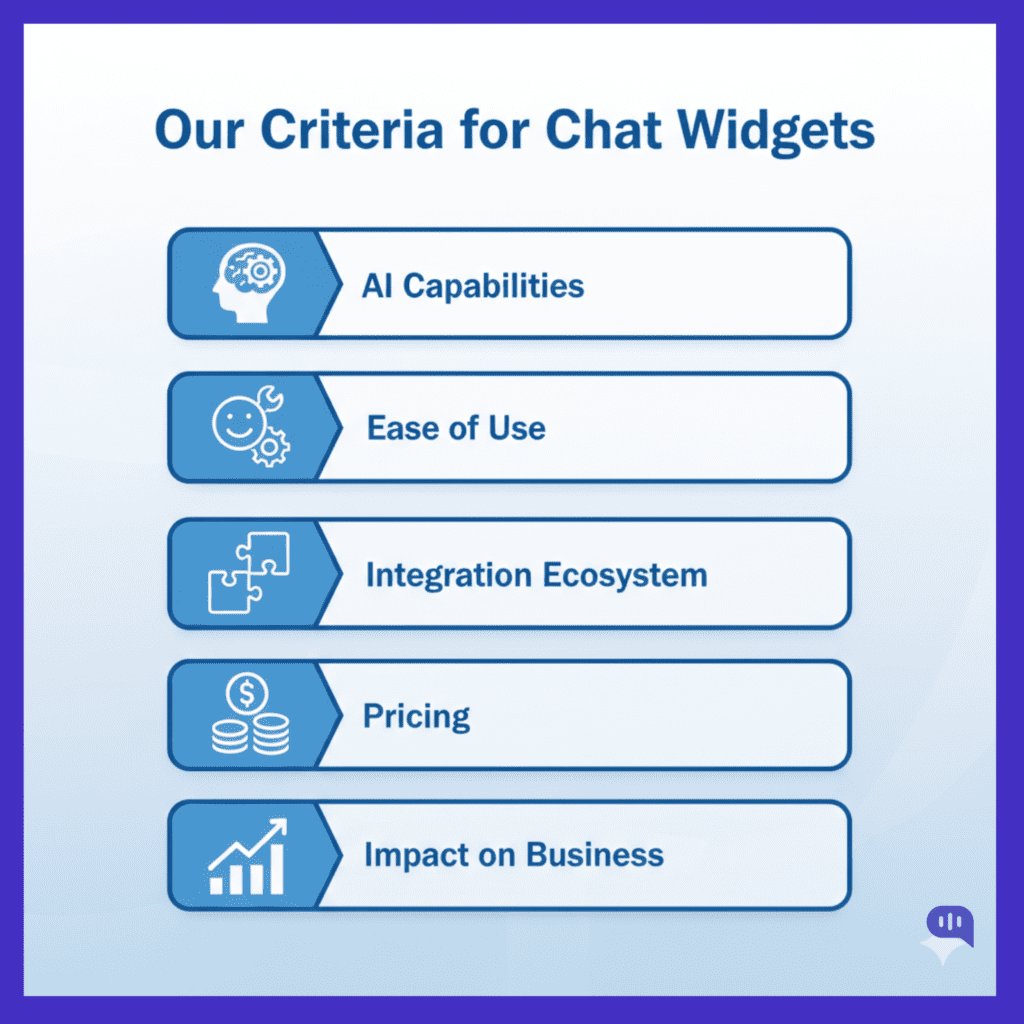
Our Criteria
We evaluated each platform based on five key factors:
1. AI Capabilities (Heavily Weighted)
In 2026, a basic live chat is no longer what customers expect. We looked at whether each platform offers:
- Generative AI that can actually understand context
- The ability to train on custom business data
- Natural language processing quality
- Automation rates (like Tidio’s Lyro resolving 70% of inquiries)
2. Ease of Use (Critical for Adoption)
Here’s something people often overlook: the most potent tool is worthless if your team won’t use it. I prioritized platforms with:
- No-code builders (Kommunicate, Landbot, YourGPT)
- Intuitive interfaces
- Quick setup times
- Visual workflow builders
We specifically highlighted when something has a steep learning curve (like Zendesk) because that’s a real cost—not just in money, but in time and training.
3. Integration Ecosystem
No business uses just one tool. Your chat widget needs to play nice with your CRM, helpdesk, eCommerce platform, and other tools. So we looked at:
- Native integrations
- Quality of integrations
- Ecosystem lock-in (The platform is excellent for HubSpot customers)
4. Pricing and Value
Not everyone has an enterprise budget, and not everyone needs enterprise features. So we categorized platforms into:
- Budget-friendly: Tidio, Freshdesk (best for startups)
- Mid-market: Kommunicate, LiveChat (best value for growing businesses)
- Enterprise: Ada, Zendesk, Intercom (when you need serious scale)
5. Real-World Business Impact
We tried to understand the actual impact of these chat widgets on businesses and looked at:
- Support ticket deflection rates
- Customer satisfaction improvements
- Conversion rate impacts
- Cost reduction potential
So, which tool is the best? We’ll provide a ranking in the next section.
Top 10 Website Chat Widgets
To make your decision easier, we’ve put together a quick summary of our top tool evaluations in the table below.
| Tool | AI Capabilities | Ease of Use | Integration Ecosystem | Pricing & Value | Business Impact | Best for |
| YourGPT | Excellent Custom AI training, voice automation, multi-LLM support | Strong No-code builder, visual workflows | Good Multi-platform, solid API coverage | Good Mid-range pricing, 7-day trial | Excellent 70%+ cost reduction, scalable | Businesses want a comprehensive AI platform |
| Kommunicate | Strong Multi-LLM support, custom training, 30-day trial | Excellent Zero-code builder, quick setup | Excellent 40+ integrations, omnichannel | Strong Affordable tiers, fast payback | Strong High deflection, global support | Fast no-code automation across web & WhatsApp |
| Intercom | Strong Fin AI with reasoning, agentic behavior | Good Fast for PLG teams, some learning curve | Strong Product/data-friendly APIs | Moderate $0.99/resolution can be pricey | Strong Proven enterprise impact | Product-led SaaS with in-app support needs |
| Ada | Excellent Enterprise-grade NLP, 100+ languages | Good Powerful, needs thoughtful setup | Strong Deep APIs, enterprise connectors | Moderate Higher cost, strong ROI at scale | Excellent 80%+ ticket deflection | High-volume enterprise automation |
| Zendesk | Strong Mature AI assist + workflows | Moderate More admin depth, learning curve | Excellent Rich ecosystem, SSO, exports | Moderate Higher base, scales well. | Strong Proven ROI, complete solution | Complex teams needing governance & SLAs |
| Tidio | Good Lyro resolves 70% inquiries. | Excellent Very quick to launch | Good Strong eCommerce integrations | Excellent Budget-friendly, great free plan | Good Good for SMBs, cart recovery | SMB teams wanting quick deflection |
| Freshchat | Good Freddy AI, basic automation | Strong Simple, intuitive interface | Good Freshworks ecosystem | Strong Very affordable, free tier | Good Solid for growing teams | Small-mid businesses needing simple AI |
| LiveChat | Moderate Basic AI, 70% automation | Strong Reliable, proven interface | Strong 200+ eCommerce integrations | Good Mid-range pricing | Good Stable performance | eCommerce businesses prioritizing reliability |
| HubSpot Chat | Good CRM-native AI, lead qualification | Strong Easy if using HubSpot | Moderate Limited to the HubSpot ecosystem | Strong Free tier available | Good Excellent lead capture | HubSpot users wanting unified lead capture |
| Landbot | Basic Focus on conversation flows. | Excellent Drag-drop builder, no coding | Moderate Campaign-focused integrations | Good Reasonable pricing, free tier | Moderate Good for campaigns | Marketing teams focused on lead generation. |
1. YourGPT
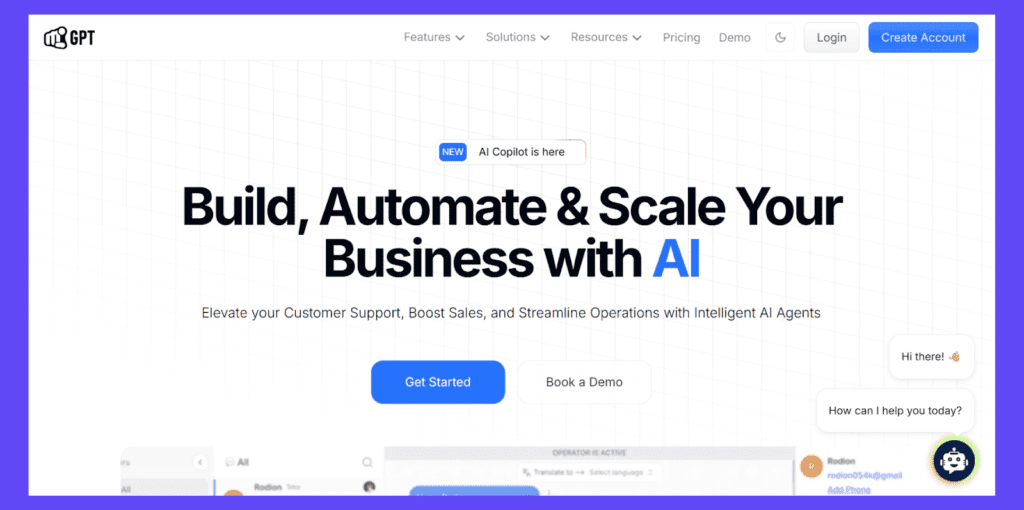
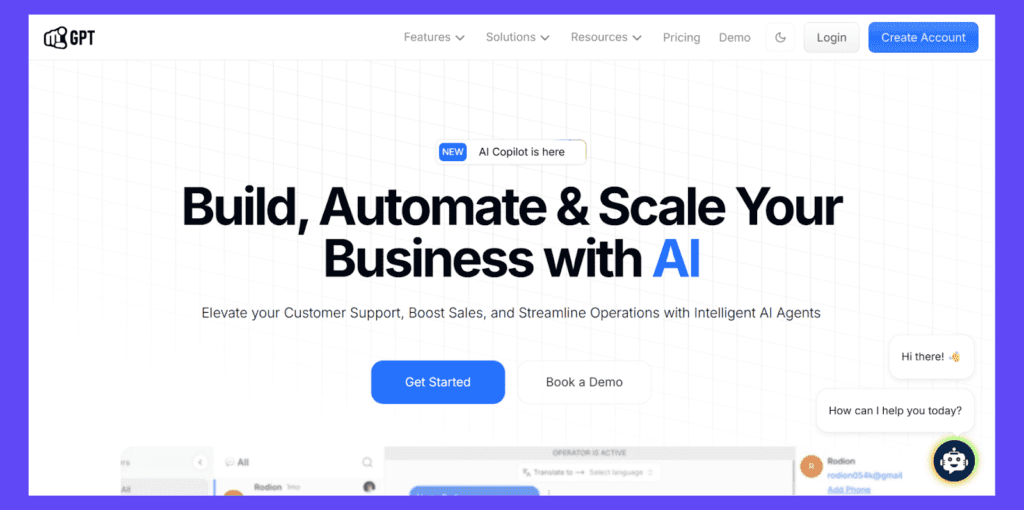
YourGPT is an AI-first platform designed for businesses that need more than just basic live chat functionality. It combines AI chatbots, voice automation, and multi-channel messaging into a complete solution for support, sales, and operations.
Why It Stands Out: YourGPT is highly customizable and provides advanced AI that can be trained on your own data, including PDFs, websites, and internal documents. This makes responses incredibly accurate and contextually relevant to your business.
Best For: Businesses that want one comprehensive AI-powered platform for multi-channel customer engagement across all departments.
Key Features:
- AI chatbots trained on custom business data
- Voice automation capabilities
- Multi-channel support (web, mobile, social media)
- No-code bot builder
- Advanced analytics and insights
Pros: Reduces support costs significantly, highly scalable across departments, offers true AI with voice capabilities, and provides extensive customization options.
Cons: The free trial is limited to 7 days, which may not be sufficient for a thorough evaluation.
Pricing:
- 7-day free trial (no credit card required)
- Essential plan – $59/ per month
- Professional plan – $129/ per month
- Advanced plan – $499/ per month
2. Kommunicate
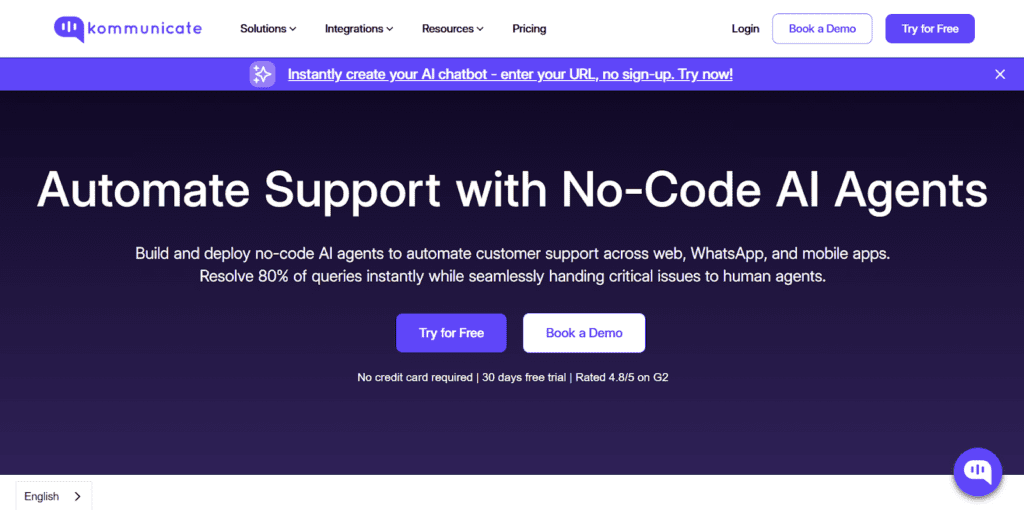
Kommunicate is a no code customer service automation platform that helps support teams automate interactions across websites, web apps, WhatsApp, and mobile applications. Built for support and operations teams, it enables controlled AI automation where routine conversations are handled by AI agents and complex or sensitive issues are escalated to human agents with full context.
With a broad set of native integrations and support for multiple AI model providers, Kommunicate fits teams that want to reduce repetitive ticket volume while keeping workflows, handoff rules, and customer experience consistent across channels.
Why It Stands Out:
Kommunicate’s no code AI agent builder reduces the need for engineering support, which makes it accessible to teams that want to go live quickly. Teams can train AI agents using website pages, documents, or help center content, then refine performance over time using conversation analytics.
It is also well suited for global support because it supports multilingual experiences and agent productivity features such as conversation summaries and suggested responses. These capabilities help teams scale without forcing customers into dead ends, since bot to human escalation is built into the platform.
Best For: Small to mid sized businesses and enterprises that want a comprehensive chat widget and automation solution with strong AI capabilities, multichannel support, and a practical path to scaling support without heavy implementation effort.
Key Features:
- No code AI agent builder for customer support automation
- Native integrations with tools such as Zapier, Zendesk, Salesforce, Freshdesk, HubSpot, Slack, WhatsApp, Telegram, and more
- Training AI agents on website content, documents, and knowledge base articles
- Multilingual support for global customer service
- Conversation summaries and AI suggestions for support agents
- Customizable and brandable chat widget
- Routing, escalation, and ticketing workflows for support teams
Pros:
- Quick setup without engineering dependence
- Strong automation with built in bot to human handoff and context preservation
- Broad multichannel deployment across web, mobile, and messaging apps
- Integrations that fit common support stacks for growing teams
Cons:
- Advanced workflows may require additional configuration during initial rollout
- Some teams may need time to optimize training data for consistent answer quality
Pricing:
Kommunicate offers flexible pricing designed to scale with usage and team size.
- 30 day free trial available
- Starter plans start at $34/month
- Professional plans start at $167/month
- Enterprise plans offer fully customizable pricing based on security, data hosting, and scale requirements
3. Intercom
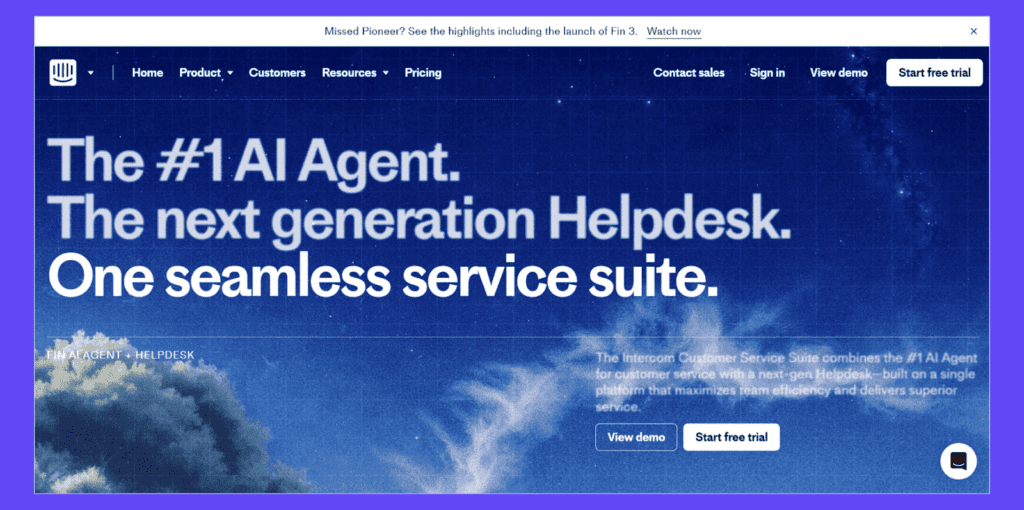
Intercom is a widely recognized name in customer communication, particularly popular among SaaS and enterprise businesses. It blends live chat, automation, and product integrations to support customer engagement at scale.
Why It Stands Out: Intercom’s AI assistant “Fin” significantly improves efficiency by automatically handling frequently asked questions, while its extensive analytics help businesses optimize onboarding and support workflows.
Best For: SaaS companies and enterprises that need advanced customer communication tools with strong analytics.
Key Features:
- AI assistant Fin for automated responses
- Advanced analytics and reporting
- Product tours and onboarding flows
- Custom bots for lead qualification and meeting booking
- Resolution Bot for handling FAQs
Pros: A robust feature set for enterprise needs, excellent for SaaS onboarding, strong analytics capabilities, and seamless product integrations.
Cons: Can be expensive for small businesses, and some features have a learning curve.
Pricing:
- Essential plan – $39/ per month
- Advanced plan – $99/ per month
- Expert plan – $139/ per month
- Every conversation Fin resolves is priced at $0.99
4. Ada
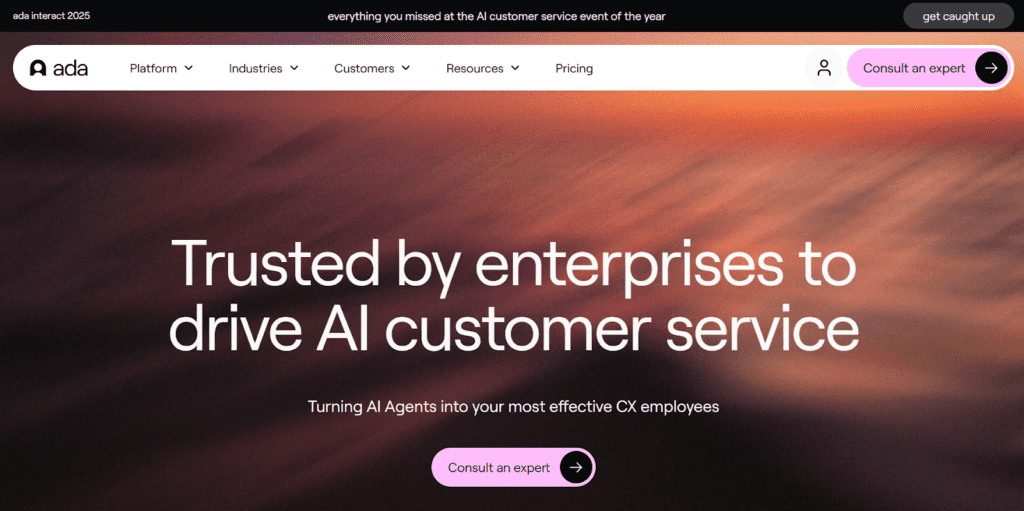
Ada is specifically built for enterprises that need to automate customer support at a massive scale. With powerful natural language processing capabilities, Ada significantly reduces the need for large agent teams.
Why It Stands Out: Ada is renowned for high-volume ticket deflection, helping global companies manage thousands of customer conversations efficiently while maintaining quality.
Best For: Large enterprises with high support volumes that need advanced automation.
Key Features:
- Advanced NLP for understanding complex queries
- High-volume ticket deflection
- Ada Glass for smooth bot-to-human handoff
- Ada Engage for proactive customer messaging
- Ada Translate supports over 100 languages
Pros: Exceptional automation capabilities, scales effortlessly, multilingual support, and reduces operational costs.
Cons: May be overkill for small businesses, requires significant setup investment.
Pricing: Usage-based enterprise pricing (contact for quotes).
5. Zendesk
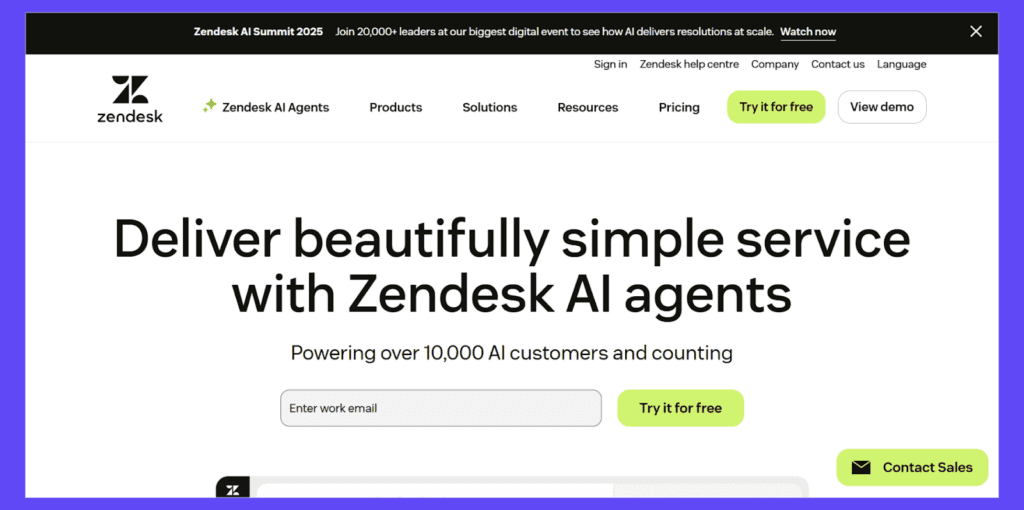
Zendesk AI Agents are a part of the Zendesk customer service suite. It’s a natural choice for companies already using Zendesk’s ticketing and helpdesk tools.
Why It Stands Out: Zendesk’s ecosystem ensures that your customer service agents have complete customer histories readily available, enabling them to provide more informed and personalized support.
Best For: Enterprises already invested in the Zendesk ecosystem.
Key Features:
- Answer Bot for automated responses
- Content Cues for Knowledge Base Optimization
- Satisfaction Prediction
- Seamless ticketing integration
- Agent analytics and performance tracking
Pros: Deep integration with Zendesk tools, comprehensive feature set, reliable performance, strong analytics.
Cons: Best value only for existing Zendesk customers; can be expensive, with a steeper learning curve.
Pricing:
- Support Team – $19/ per month
- Suite Team – $55/ per month
- Suite Professional – $115/ per month
- Suite Enterprise – $169/ per month
6. Tidio
Tidio is one of the most popular chat widgets for small businesses and e-commerce stores, offering a combination of live chat and automation in an affordable and accessible package.
Why It Stands Out: Its generous free plan and seamless Shopify integration make it the go-to choice for online retailers just starting with chat support.
Best For: Small businesses, startups, and eCommerce stores on a budget.
Key Features:
- Lyro AI chatbot (resolves up to 70% of inquiries)
- Email automation and AI-powered ticket routing
- Pre-built templates for lead generation and cart recovery
- Visual workflow builder
- Integrations with Shopify, WordPress, Squarespace, Messenger, and Instagram.
Pros: Very affordable with a functional free plan, easy to set up, excellent for e-commerce, and a multichannel dashboard.
Cons: Advanced features are only available with higher-tier plans, and customization options are limited on the free plans.
Pricing:
- Lyro AI Agent – $39/month
- Flow – $29/month
7. Freshchat (From Freshworks)
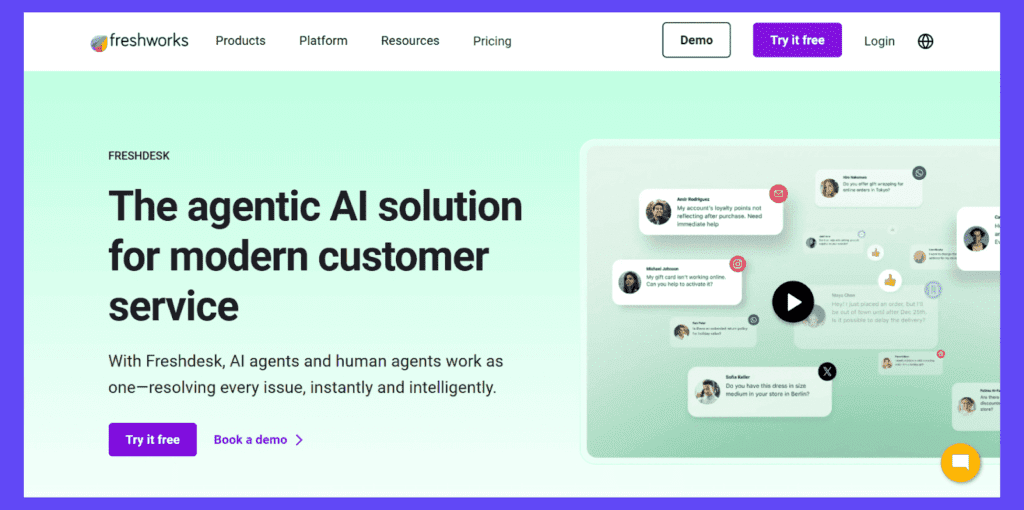
Freshchat is part of the Freshworks platform, focusing on simplicity and affordability to help small and mid-sized businesses quickly adopt AI-powered chat.
Why It Stands Out: The built-in AI agent, Freddy, makes automation accessible without a complex technical setup, making it perfect for teams without dedicated IT resources.
Best for: Small to mid-sized businesses seeking affordable AI automation.
Key Features:
- “Freddy AI” chatbot
- Multi-channel support
- Simple, intuitive interface
- Integration with the Freshworks ecosystem
Pros: Very user-friendly, affordable pricing, good integration options, reliable performance.
Cons: Less powerful than enterprise solutions, limited advanced features.
Pricing:
| Free – ₹0 (forever up to 10 agents)Growth – ₹1,499/monthPro – ₹3,999/monthEnterprise – ₹6,399/month |
8. LiveChat
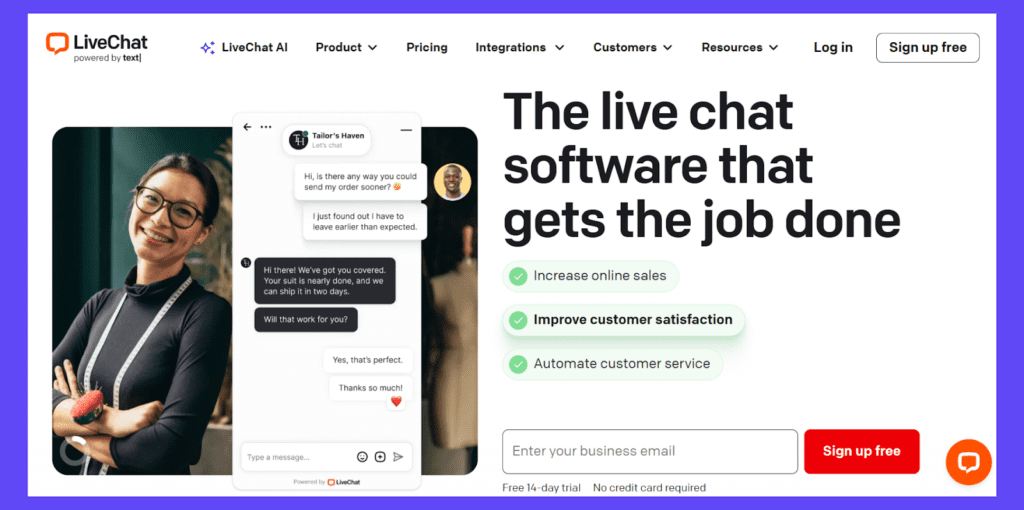
LiveChat is one of the most established providers in the space, known for its reliability and over 200 strong eCommerce integrations, including WhatsApp, Mailchimp, Squarespace, HubSpot, and Shopify.
Why It Stands Out: It offers stable, proven performance and extensive customization options for businesses seeking a dependable solution with a proven track record.
Best For: Businesses prioritizing reliability and seeking proven eCommerce integrations.
Key Features:
- Reliable live chat functionality
- Extensive eCommerce platform integrations
- Customizable chat widgets
- Advanced routing and analytics
Pros: Proven reliability, strong eCommerce focus, highly customizable, excellent uptime.
Cons: Limited AI features compared to newer competitors, and it can be pricey.
Pricing:
- Starter plan – $19/month
- Team plan – $49/month
- Business plan – $79/month
- Enterprise plan: Custom pricing
9. HubSpot Chat
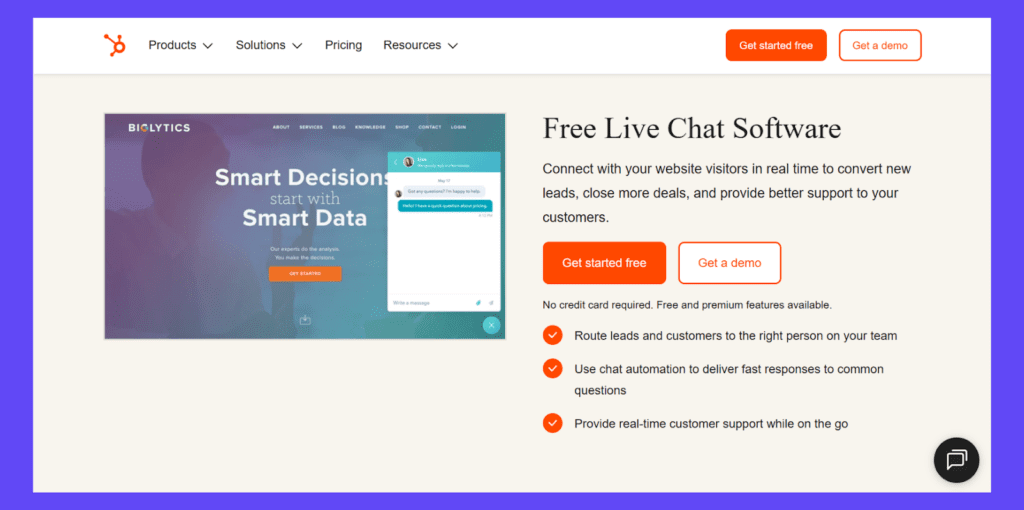
HubSpot Chat is a natural fit for businesses already using HubSpot CRM, designed to capture leads and nurture them within HubSpot’s marketing ecosystem.
Why It Stands Out: Seamless integration with HubSpot CRM makes it incredibly powerful for inbound marketing teams focused on lead generation.
Best For: Companies using HubSpot CRM who want unified lead capture and nurturing.
Key Features:
- CRM-native chatbots
- Lead qualification and routing
- Meeting scheduling automation
- Conversations are automatically saved in CRM
Pros: Ideal for HubSpot users, featuring excellent lead capture capabilities, a free tier, and easy setup.
Cons: Limited value outside the HubSpot ecosystem, fewer advanced features.
Pricing:
- Service Hub Starter – $9 per month (annually) or $15 per month (monthly)
- Advanced tiers, such as Service Hub Professional and Enterprise, require contacting a product specialist for pricing information.
10. Landbot
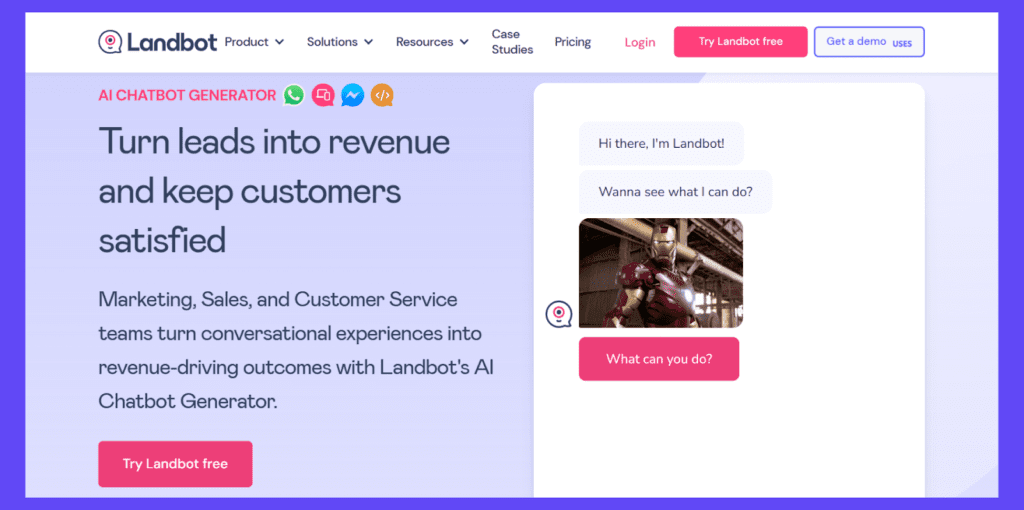
Landbot is a no-code chatbot builder that excels at creating engaging conversation flows, particularly for marketing campaigns and lead generation.
Why It Stands Out: Its intuitive drag-and-drop interface allows marketers to design personalized chat experiences without needing developers, making it ideal for campaign-driven businesses.
Best For: Marketing teams and businesses focused on lead generation campaigns.
Key Features:
- Drag-and-drop no-code builder
- Engaging conversational flows
- Lead generation templates
- Landing page integration
Pros: Straightforward to use, excellent for marketing campaigns, no coding required, engaging user experience.
Cons: Less suitable for complex customer support scenarios, limited advanced automation.
Pricing:
- Sandbox – Free Forever (100 Chats included per month)
- Starter plan – €40/month
- Pro plan – €100/month
- WhatsApp Pro – €200/mo
- Business plan – €400/month
Conclusion
As AI continues to redefine how people interact online, static websites are quickly being replaced by interactive, intelligent experiences. In 2026, a chat widget isn’t just a nice-to-have; it’s a vital tool for engaging visitors, securing leads, and delivering real-time support when attention spans are shorter than ever.
The best part is that you don’t need to rebuild your website or hire an engineering team to make it happen.
- Tools like YourGPT and Kommunicate offer powerful AI-driven automation
- Platforms like Tidio, Landbot, and Freshchat make it easy for small teams to launch fast and scale as they grow
- For larger enterprises, solutions like Ada, Intercom, and Zendesk bring the sophistication and integration depth needed for complex operations.
No matter your business size or tech stack, the right chat widget can transform your website from a passive experience into a responsive channel that listens, engages, and converts 24/7.
If you’re looking for an AI-first chat widget for customer service on your platform, feel free to book a demo with us.

A Content Marketing Manager at Kommunicate, Uttiya brings in 11+ years of experience across journalism, D2C and B2B tech. He’s excited by the evolution of AI technologies and is interested in how it influences the future of existing industries.