Updated on February 27, 2026
Canned responses have a branding problem.
In many support teams, the phrase “canned reply” is shorthand for robotic, impersonal, low-effort service. Customers associate them with copy-paste apologies, irrelevant troubleshooting steps, and conversations that feel automated in the worst way. But that perception confuses bad execution with the tool itself.
In reality, canned responses are among the most critical operational assets in modern customer service. They are structured, pre-approved message templates that enable teams to respond faster, maintain policy accuracy, and reduce agent cognitive load in high-volume environments.
The shift toward AI-assisted support hasn’t made canned responses obsolete. If anything, it has made them more critical. Platforms like Kommunicate position structured templates and controlled responses as foundational to scalable automation. In other words, templates are no longer just shortcuts; they are safety rails.
This article breaks down what canned responses actually are, why they still matter in AI-first support environments, and how to design them with tone, clarity, and safe automation in mind. It covers:
- What Canned Responses Really Are (and Why They Still Matter)?
- Why Customers React Negatively to Poor Canned Responses?
- The Three Principles of Customer-Safe Canned Responses
- The Anatomy of a High-Quality Canned Response
- Tone and Language Best Practices for Modern Support Teams
- Evil vs. Good: Real Canned Response Examples (With Commentary)
- How to Use Canned Responses Safely With AI?
- When to Replace Canned Responses With AI-Generated Replies?
- Conclusion
What Canned Responses Really Are (and Why They Still Matter)?
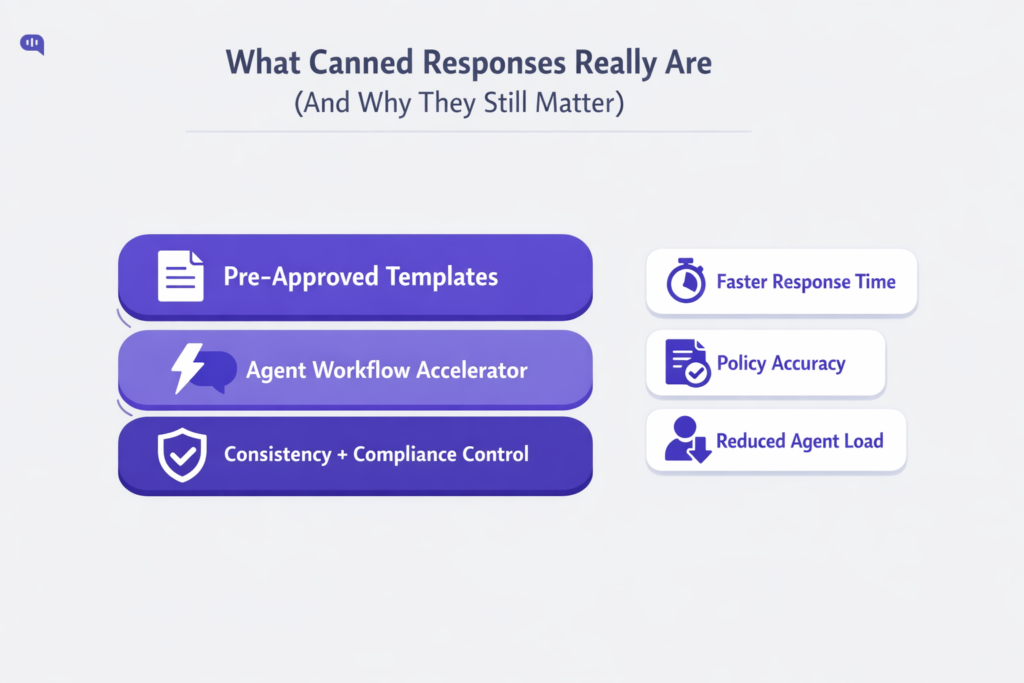
Canned responses are structured, pre-written message templates that agents can quickly insert into live chat, email, or ticket replies to handle recurring questions and predictable workflows.
Why Do Canned Responses Matter?
When designed intentionally, canned responses are control mechanisms that improve support performance at scale.
- Reduced Response Time: Agents can respond instantly to common queries, improving First Response Time (FRT) and queue velocity.
- Policy Accuracy and Compliance: Pre-approved language ensures refunds, security steps, SLAs, and legal statements are communicated correctly every time.
- Consistency Across Teams and Regions: Customers receive aligned messaging regardless of agent tenure, shift, or geography.
- Lower Cognitive Load for Agents: Removing repetitive drafting allows agents to focus on complex, high-value interactions that require judgment.
- Scalable Onboarding: New agents ramp faster when high-frequency responses are standardized and documented.
- Quality Control at Volume: Structured templates reduce tone drift, misinformation, and improvisation errors in fast-paced environments.
Used correctly, canned responses improve operational discipline without sacrificing customer experience.
However, when written poorly or deployed unthinkingly, they create the exact frustration they’re meant to prevent, which brings us to the real problem.
Why Customers React Negatively to Poor Canned Responses?
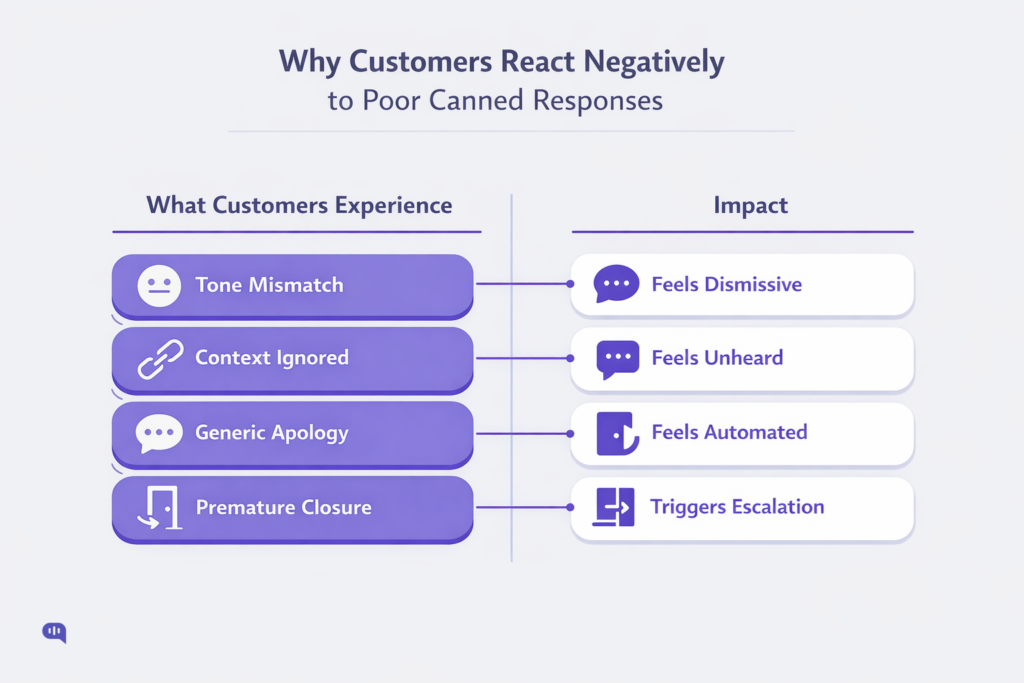
Customers rarely object to speed. They object to feeling unseen.
When a canned response ignores context, misreads tone, or delivers generic language to a specific problem, it signals low effort. The issue isn’t that the message was pre-written; it’s that it feels disconnected from the actual conversation.
Why Do Poor Canned Responses Backfire?
When templates are poorly written or improperly deployed, they create operational drag instead of efficiency.
- Tone Mismatch: Using neutral or overly cheerful language in serious situations (such as billing disputes, outages, or security concerns) makes the reply feel dismissive.
- Context Blindness: Repeating troubleshooting steps the customer already tried or asking for information already provided signals that no one is actually listening.
- Generic Apologies: “We’re sorry for the inconvenience,” without naming the specific issue, feels automated and insincere.
- Information Overload: Long, dense paragraphs with multiple instructions create confusion rather than clarity.
- Premature Closure Language: Phrases like “Let us know if this helps” subtly shift the burden back to the customer.
- Over-Standardization: When every reply follows the same visible pattern, customers recognize the template and disengage.
Poor canned responses increase repeat contacts, unnecessarily escalate tickets, and lower CSAT. The solution isn’t abandoning templates. It’s redesigning them around principles that protect tone, clarity, and context.
The Three Principles of Customer-Safe Canned Responses
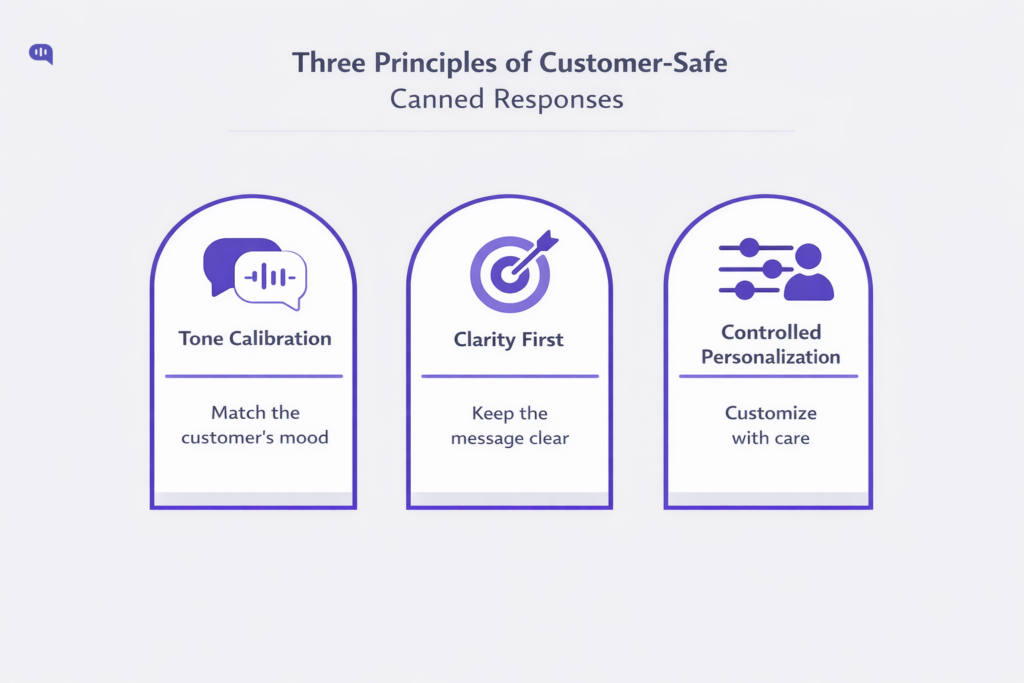
Canned responses must protect tone, clarity, and context simultaneously.
1. Tone Calibration
Tone is not decoration; it is perception management. A customer-safe canned response matches the emotional temperature of the situation.
That means controlled empathy during complaints, neutral professionalism during policy explanations, and clarity during troubleshooting. Avoid exaggerated warmth, defensive phrasing, or overly corporate language. The goal is steady, human, and situationally appropriate.
2. Clarity Over Completeness
Most canned responses fail because they try to say too much. Customer-safe templates prioritize resolution-first messaging: answer the question directly, then provide only the necessary next steps.
Use short sentences, structured bullets where needed, and unambiguous language. Remove filler phrases, internal jargon, and passive constructions. Clarity reduces friction, repeat contacts, and escalation risk.
3. Controlled Personalization
Personalization should be structured, not improvised.
Effective canned responses include defined personalization fields and conditional logic blocks, ensuring relevance without allowing unsafe or inconsistent language. This is especially critical in AI-assisted environments, where templates act as guardrails against tone drift and policy violations.
Customer-safe canned responses are built, not improvised. Next, we’ll break down the exact structure that turns these principles into a repeatable, high-quality template.
The Anatomy of a High-Quality Canned Response
Every line in a canned response should move the customer closer to clarity, confidence, or resolution.
Below is a breakdown of the structural elements that set high-quality templates apart from those customers recognize (and resent).
| Features of a High-Quality Canned Response | Operational Benefit | How It Helps the Customer |
| Specific Acknowledgment of the Issue | Reduces misrouting and misinterpretation | Confirms the agent understood the exact problem |
| Resolution-First Structure | Improves handling time and reduces back-and-forth | Gets the answer immediately without forcing customers to scan |
| Clear, Step-by-Step Instructions (When Needed) | Minimizes repeat contacts and escalations | Makes subsequent actions easy to follow without confusion |
| Defined Personalization Fields | Maintains consistency while allowing relevance | Feels contextual rather than generic |
| Expectation Setting (Timeframes, Next Steps) | Prevents uncertainty-driven follow-ups | Removes ambiguity about what happens next |
| Neutral, Professional Tone | Protects brand consistency and compliance | Feels respectful and steady — not robotic or overly scripted |
| Concise Formatting (Short Sentences / Bullets) | Improves readability across channels | Reduces cognitive effort, especially on mobile |
| Built-in Escalation or Alternative Path | Reduces dead-end responses | Gives the customer a transparent fallback if the solution doesn’t work |
Next, we’ll look at how tone and language choices determine whether a template feels human or automated.
Tone and Language Best Practices for Modern Support Teams
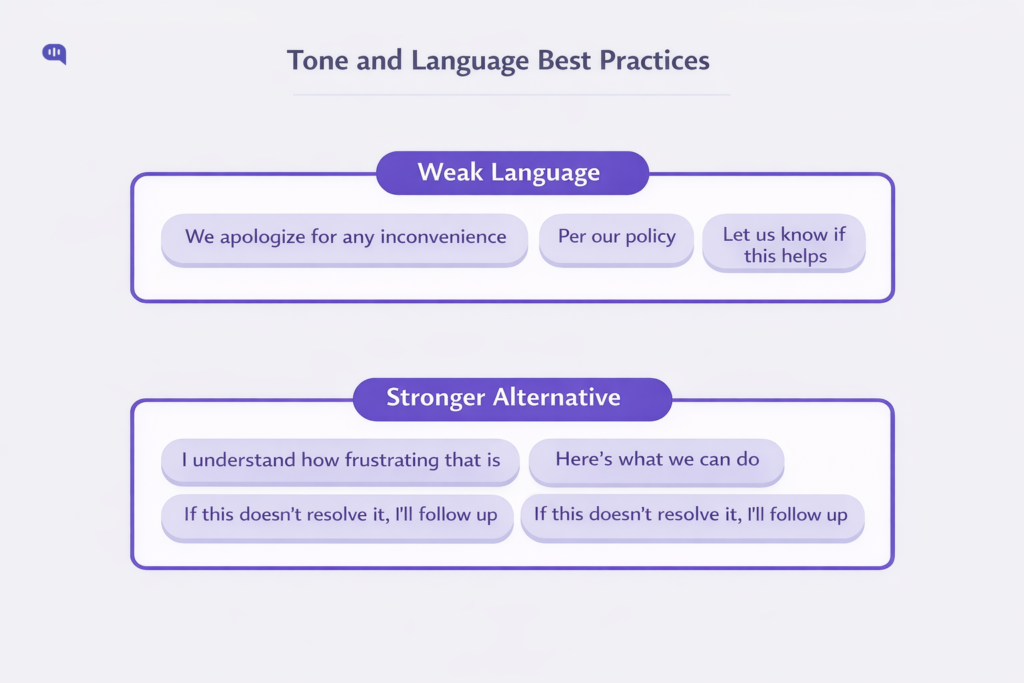
Tone is embedded in word choice, sentence structure, and sequencing. In high-volume support environments, even small tone misalignments can erode trust. Modern teams must intentionally design language, especially when responses are templated or AI-assisted.
1. Write Like a Human, Not a Policy Document
Customers do not think in internal terminology. Avoid legalistic phrasing, passive voice, and corporate filler such as “per our policy” or “we regret to inform you.” Replace abstract language with direct, plain-English statements. Short sentences, active verbs, and conversational rhythm improve readability and reduce perceived friction.
2. Match Emotional Temperature
Tone must reflect context. A shipping delay requires reassurance. A security issue requires seriousness. A feature request requires appreciation without overpromising. Overly cheerful responses during high-friction moments feel dismissive, while overly formal responses feel cold. Calibrating tone means acknowledging the impact appropriately without exaggeration or defensiveness.
3. Eliminate Weak or Deflective Language
Phrases like “Let us know if this helps,” “We apologize for any inconvenience,” or “Unfortunately, that’s not possible” subtly shift responsibility or sound scripted. Replace them with action-oriented alternatives: clarify what is possible, what happens next, or what you will do. Confidence and clarity build trust more effectively than soft, noncommittal closings.
Tone is often the difference between a fast reply and a trusted one. Next, we’ll examine real examples of inadequate vs. good canned responses, and why the differences matter.
Evil vs. Good: Real Canned Response Examples (With Commentary)
The difference between an inadequate canned response and a strong one lies in relevance, ownership, and clarity.
Below are side-by-side comparisons that illustrate how small changes in structure and tone dramatically change customer perception.
Scenario 1: Order Delay
Evil Version (Robotic + Deflective)
We apologize for the inconvenience. Due to high order volumes, shipping may be delayed. Please allow additional time for delivery. Let us know if you have any other questions.
Why It Fails:
- Generic apology
- No ownership
- No specific timeframe
- Weak closing
Good Version (Specific + Reassuring)
Thanks for checking in, Sarah. I can see your order #4821 was shipped yesterday and is currently in transit. It’s expected to arrive by Thursday. If it doesn’t move by then, I’ll personally follow up with the carrier for you.
Why It Works:
- References the specific order
- Provides a concrete expectation
- Signals ownership
- Removes uncertainty
Scenario 2: Billing Confusion
Evil Version (Policy Shielding)
Per our billing policy, charges are non-refundable once processed. Please refer to our terms and conditions for more information.
Why It Fails:
- Defensive tone
- No explanation
- No empathy
- Pushes the customer away
Good Version (Clear + Transparent)
I understand how unexpected charges can be frustrating. The fee you’re seeing is for the annual renewal processed on February 1st. While completed renewals aren’t refundable, I can help you switch to a monthly plan going forward if that works better for you.
Why It Works:
- Acknowledges impact
- Explains the charge clearly
- State the policy without sounding combative
- Offers a constructive alternative
Scenario 3: Feature Not Available
Evil Version (Flat Rejection)
That feature is not supported at this time.
Why It Fails:
- Abrupt
- No context
- No forward path
- Feels dismissive
Good Version (Appreciative + Forward-Looking)
That’s a great suggestion—I can see how it would be helpful. While we don’t currently support that feature, I’ve logged your request with our product team. In the meantime, here’s a workaround that may help.
Why It Works:
- Validates the request
- Provides transparency
- Offers a workaround
- Keeps the relationship intact
Scenario 4: Escalation Required
Evil Version (Cold Transfer)
Your issue has been escalated to the relevant department. They will contact you.
Why It Fails:
- No timeline
- No explanation
- No reassurance
- Feels like abandonment
Good Version (Structured Escalation)
I’m looping in our technical team since this requires deeper investigation. They typically respond within 24 hours. I’ve included all the details you shared, so you won’t need to repeat anything.
Why It Works:
- Explains why escalation is happening
- Sets expectations
- Reassured about context transfer
- Maintains continuity
The Pattern
Bad canned responses:
- Hide behind policy
- Overuse vague apologies
- Shift effort back to the customer
- Close conversations prematurely
Good canned responses:
- Lead with relevance
- Provide clear next steps
- Signal ownership
- Maintain confidence
The difference is not automation; it is intentional design.
Next, we’ll explore how to safely combine canned responses with AI without sacrificing tone, compliance, or control.
How to Use Canned Responses Safely With AI?
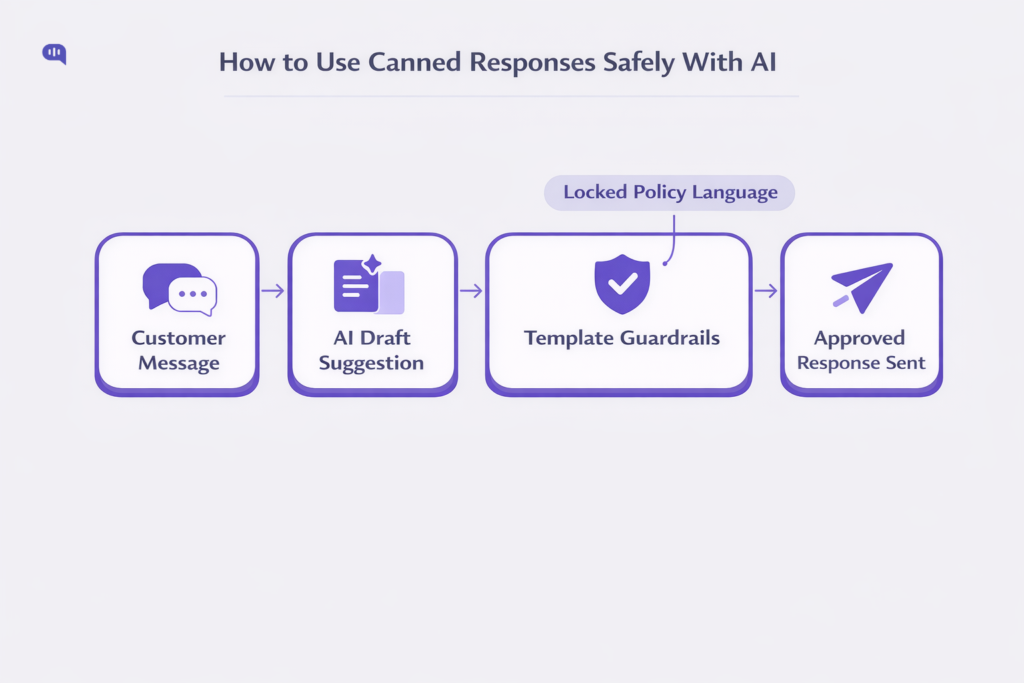
AI has changed how support teams deploy canned responses, but it hasn’t removed the need for structure. In fact, as AI drafts, rewrites, and suggests replies in real time, templates become even more critical. They act as guardrails that prevent tone drift, policy violations, and hallucinated answers.
The goal is not to replace canned responses with AI. It is to make AI operate within a controlled response framework.
Use Templates as Guardrails, Not Just Shortcuts
In AI-assisted environments, canned responses should define the safe boundaries of communication. Instead of allowing AI to generate free-form policy language, use structured templates for refunds, compliance notices, security instructions, and SLA commitments. AI can personalize around the template — but the core language should remain locked and approved.
This protects brand tone and prevents unauthorized promises.
Require Human-in-the-Loop for High-Risk Replies
Not all tickets are equal. Billing disputes, security concerns, legal complaints, and churn-risk conversations require agent review before they are sent. AI can draft, summarize context, and suggest improvements, but final approval should sit with a human when financial, regulatory, or reputational risk is involved.
This reduces liability while maintaining efficiency.
Set Confidence and Escalation Thresholds
AI suggestions should be tied to confidence scoring and clear escalation logic. If intent classification is uncertain or sentiment indicates frustration, the system should either:
- Suggest a structured canned response for agent editing, or
- Route directly to a human.
Automation without thresholds increases repeat contacts and volatility in CSAT.
Prevent Hallucinations With Retrieval and Controlled Inputs
AI should generate replies only from verified knowledge sources, not from generalized language models without context. Integrating AI with approved help center content or knowledge bases ensures responses stay accurate. Canned responses serve as a fallback when knowledge retrieval is incomplete or ambiguous.
Track and Audit AI-Modified Templates
When AI adapts tone or wording, teams should log variations and audit performance. Monitor:
- CSAT by AI-assisted reply
- Escalation rates
- Reopen rates
- Compliance deviations
Templates that drift over time must be re-governed.
AI does not eliminate the need for disciplined messaging — it increases it.
Next, we’ll explore when static canned responses should give way to fully adaptive AI-generated replies.
When to Replace Canned Responses With AI-Generated Replies?
AI can accelerate support dramatically, but without structure, it can also introduce risk. The safest approach is not choosing between templates and AI, but defining when and how they work together.
1. Use AI to Suggest, Not Finalize, High-Impact Messages
For billing adjustments, refunds, SLA commitments, or security instructions, AI should draft within an approved canned template rather than generate unrestricted responses. The template anchors policy language, while AI adjusts tone and context. This prevents accidental overpromising or policy drift while preserving personalization.
2. Deploy AI for Context Summarization Before Template Insertion
AI is highly effective at summarizing long ticket histories and extracting intent signals. Instead of having agents scan multiple messages, AI can generate a brief context and recommend the most relevant canned response.
This improves speed without sacrificing accuracy, because the final message still operates within structured language.
3. Lock Compliance-Critical Sections Inside Templates
Certain sections (such as regulatory disclosures, data-handling instructions, and contractual clauses) should not be editable by AI. These portions should remain fixed inside the canned response. AI can modify surrounding explanation text, but compliance-sensitive language must remain untouched to reduce legal and operational risk.
4. Trigger Human Review for Low-Confidence AI Suggestions
If sentiment detection flags frustration, or if intent classification falls below a defined confidence threshold, AI should escalate the interaction or require agent approval before sending. This avoids automated misfires in emotionally sensitive situations and protects CSAT during high-friction conversations.
5. Continuously Audit AI-Modified Responses
Track performance of AI-assisted canned responses through CSAT, reopen rate, and escalation metrics. If AI-driven variations increase repeat contacts or policy inconsistencies, tighten guardrails. Governance is not a one-time setup: it is an ongoing discipline that balances automation speed with message integrity.
AI works best when guided by structured boundaries. Safe automation is about reinforcing templates and canned responses with intelligent control.
Conclusion
Canned responses are not the enemy of good customer service. When templates are written with intention, structured for clarity, and properly governed, they become one of the strongest levers for scaling support without degrading the experience.
The difference between robotic and reliable is not automation; it is design. Tone calibration, resolution-first structure, and controlled personalization determine whether a reply feels dismissive or dependable.
In AI-assisted environments, this discipline becomes even more critical. Templates provide the guardrails that keep automation accurate, compliant, and brand-aligned. Teams that treat canned responses as strategic assets will resolve faster, escalate less, and build more trust.
The future of support is not fewer templates. It is the smarter ones.

Devashish Mamgain is the CEO & Co-Founder of Kommunicate, with 15+ years of experience in building exceptional AI and chat-based products. He believes the future is human and bot working together and complementing each other.