Updated on June 23, 2026
TL;DR
Poor patient communication doesn’t announce itself. But, it shows up in different ways:
- In rising no-show rates
- Rising attrition rates
- Poor online reputation
This checklist gives healthcare operations leaders 25 concrete diagnostic signals to audit their own patient communication system, organized across five failure categories: responsiveness, consistency, follow-up, staff, and reputation. Each item links to a deeper context. If you check more than five boxes, your system has a structural problem.
A hospital administrator recently remarked something at a demo I was sitting on: “We thought we had a staffing problem. We hired and trained customer service representatives, but the number of tickets kept rising. Then we finally looked at the data and realized, patients were calling about the same five things, every single day, because our system never resolved the problems.”
That’s what broken patient communication actually looks like. It’s a slow collapse that consists of:
- Repeated contacts
- Frustrated patients
- Overworked staff
- Overworked support teams
The stakes are significant. Poor communication now contributes to 24% of patient safety incidents and is the sole identified cause in 10% of them, according to a systematic review published in the “Annals of Internal Medicine.” A CRICO Strategies analysis of 23,000 malpractice lawsuits found more than 7,000 tied directly to communication failures — with $1.7 billion in costs and nearly 2,000 preventable deaths attached to those breakdowns.
Beyond safety, the retention math is becoming impossible to ignore. As of 2024, 66% of healthcare consumers say they are likely to switch providers if communication standards don’t meet their expectations (up from 51% in 2023). Poor communication is now the leading reason patients switch providers (32%), far ahead of concerns like privacy (7%).
Before working through the checklist, it helps to understand the stakes especially around responsiveness. Our breakdown of how slow response times damage patient engagement explains why this category matters most.
If your patient communication system is broken, the warning signs are already present. Our checklist helps you find them. We are covering:
- How to use this checklist?
- The full patient communications checklist
- Category 1: Responsiveness failures (Points 1–5)
- Category 2: Appointment and access failures (Points 6–10)
- Category 3: Follow-Up and continuity failures (Points 11–15)
- Category 4: Staff and operational failures (Points 16–20)
- Category 5: Reputation and retention failures (Points 21–25)
- How to use this score?
- What should you do after using the checklist?
How to use this checklist?
Each of the 25 items is a yes/no diagnostic signal. Check the box if the symptom applies.
At the end, count your checked items:
- 0–4: Your communication system has isolated weak spots; targeted fixes may suffice.
- 5–10: You have a pattern of breakdown. Manual patches are unlikely to hold.
- 11–19: Your communication infrastructure has structural failures. You need a systematic review.
- 20–25: Your patient communication is in crisis. Every week of delay compounds the cost.
For each symptom, we’ve noted which part of the patient journey it affects and linked to deeper resources where available.
The full patient communications checklist
Is your patient communication broken?
Check every symptom that applies to your practice. Your score updates in real time.
Category 1: Responsiveness failures (Points 1–5)
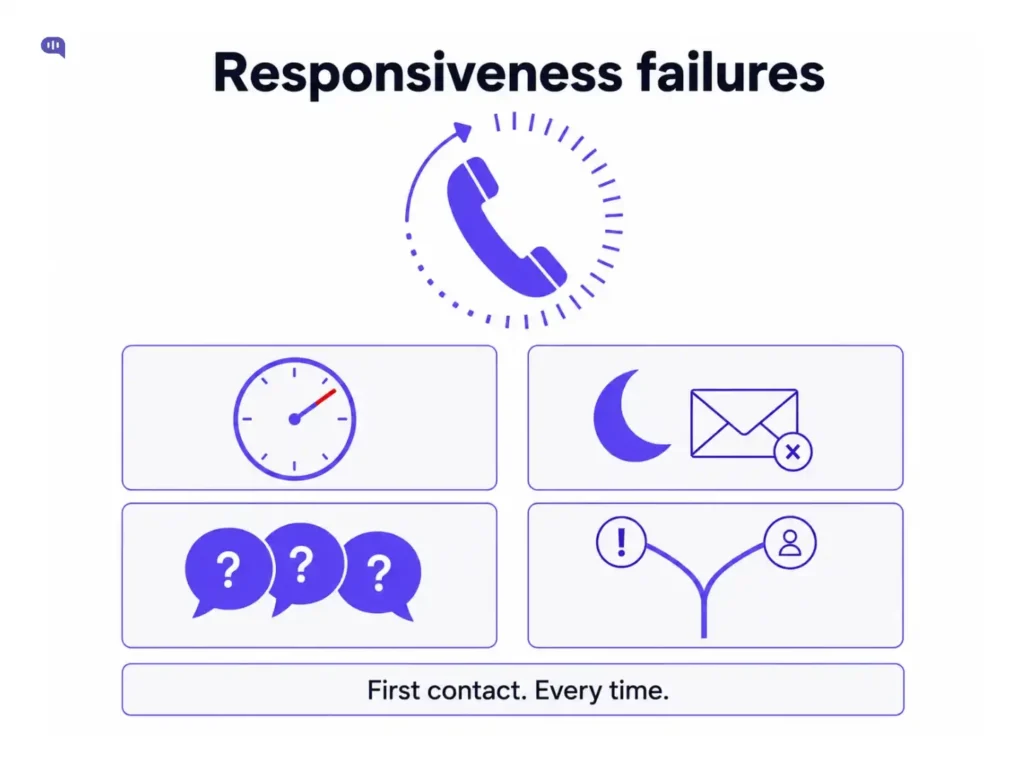
These are the symptoms patients experience first and the ones most likely to appear in online reviews for your healthcare business.
1. Patients are waiting more than 2 minutes on hold
Long hold times are the most visible symptom of a communication system under strain. Patients spend an average of 8 minutes on the phone when scheduling medical appointments, with 63% of calls transferred at least once during the process.
When hold times extend beyond what patients consider reasonable, many simply hang up and don’t call back. Some find another provider. Some miss the care they needed.
Where it shows up: Call volume reports, patient satisfaction surveys, Google reviews mentioning “impossible to reach.”
Why it persists: The structural issue is usually query volume driven by unresolved repeat contacts, not headcount.
2. After-hours inquiries go unanswered until the next business day
Healthcare doesn’t stop at 5 PM. Patients with urgent questions make contact outside business hours. If your system has no after-hours coverage, those patients either don’t get answers, call emergency lines for non-emergency questions, or disengage entirely.
Where it shows up: Monday morning inquiry spikes, patient complaints about “never being able to reach anyone.”
Why it persists: After-hours staffing is expensive. Most practices deprioritize it until the cost of lost patients becomes unavoidable.
3. Patients are contacting you on multiple channels for the same issue
A patient sends an email on Monday, calls on Tuesday, and sends a portal message on Wednesday, all with the same billing question. This is a signal that your first-contact resolution rate is failing.
When patients don’t get a clear resolution, they escalate across channels. Each escalation generates a new ticket, fragments the patient’s record, and burns staff time.
Where it shows up: High ticket volume relative to patient headcount, duplicate entries, and staff complaints about “answering the same thing again.”
Why it persists: The root cause is that the first contact never resolved the issue, so the patient keeps trying new channels to get an answer. Adding more channels without fixing resolution simply multiplies the entry points for the same unresolved problem.
4. Your team can’t distinguish urgent inquiries from routine ones
If a patient asking about a possible drug interaction is waiting in the same queue as a patient asking about parking validation, your triage system is broken. Without intelligent routing, high-priority clinical inquiries get delayed, and low-complexity ones consume disproportionate staff time.
Where it shows up: Escalation incidents and patient complaints about response speed to clinical questions, specifically.
Why it persists: Most queues are first in, first out by default, with no way to read the intent or urgency behind an inquiry. Without automated triage, a drug interaction question and a parking question are treated identically, so clinical urgency depends on who happens to pick up.
5. Your first-contact resolution rate is below 70%
First-contact resolution (the percentage of patient inquiries fully resolved in a single interaction) is one of the most important metrics in healthcare communication. Industry benchmarks for high-performing healthcare contact centers put FCR above 70–75%. If your team is regularly sending patients away with “we’ll follow up” or “let me check on that,” you are generating a second wave of contacts before the first one is closed.
Where it shows up: Ticket reopening rates, patient callback volumes, staff time spent on follow-up outreach.
Why it persists: Staff often lack the information or the authority to close an issue in a single interaction, so “let me check and get back to you” becomes the default. Every deferral generates a second contact before the first one is even closed.
Category 2: Appointment and access failures (Points 6–10)
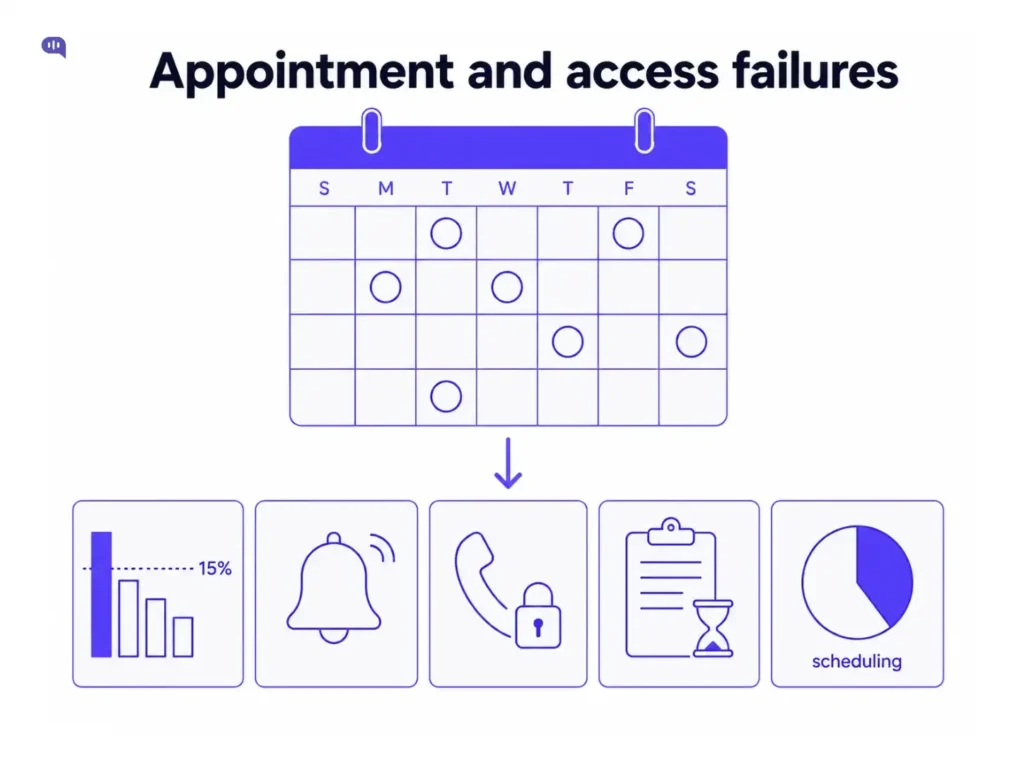
These symptoms sit at the intersection of patient communication and revenue, and they’re often more expensive than teams realize.
6. Your no-show rate is above 15%
The national average no-show rate across all medical specialties sits at approximately 23%, with some specialties reaching 30–39%. But the average is not acceptable. Each missed appointment costs an individual practice roughly $200 in direct revenue, and U.S. healthcare loses over $150 billion annually to no-shows.
Beyond the immediate financial hit, patients who miss even a single appointment have a 70% attrition rate. If your no-show rate exceeds 15%, your patient communication system is failing at one of its most fundamental jobs: preparing patients for appointments and making it easy to reschedule when life intervenes.
Where it shows up: Scheduling system reports, revenue cycle data, and empty slots visible in daily schedules.
7. Appointment reminders are going out too late, too infrequently, or via only one channel
Sending a single email reminder 24 hours before an appointment is not a reminder strategy. It is a communications minimum. Effective reminder systems use multiple channels (SMS, email, voice), multiple touchpoints (72 hours, 48 hours, day-of), and allow patients to confirm or reschedule without calling in.
If your reminder system is one-dimensional, your no-show rate will reflect that.
Where it shows up: No-show data correlated by appointment type, reminder delivery reports, and patient complaints about “not knowing.”
8. Patients can’t reschedule or cancel without calling
Self-service scheduling access is now a baseline expectation. When patients can only reschedule by calling during business hours, two things happen: some patients simply no-show instead of calling, and others can’t get through the phone queue and give up.
Both outcomes are preventable. Patients who miss just one appointment are 70% more likely not to return within 18 months. Making rescheduling harder than it needs to be accelerates that loss.
Where it shows up: High no-show volume without prior cancellation; after-hours voicemails with reschedule requests that are never acted on.
9. New patient onboarding is manual, paper-based, or inconsistent
The first communication experience a new patient has with your organization sets the expectation for every interaction that follows. If new patient intake requires faxing forms, calling to confirm insurance, or arriving early to fill out paperwork, you are starting the relationship with friction. That friction drives early attrition.
Where it shows up: High first-appointment no-show rates, specifically, front desk time consumed by intake administration, and patient feedback about “confusing onboarding.”
10. Scheduling contact represents more than 40% of your total patient contact volume
Scheduling, rescheduling, and appointment confirmations should not dominate your patient communication channels.
When they do, it signals that your booking system is generating friction rather than reducing it, and that staff time is being consumed by tasks that could be largely automated. If the majority of what your team handles every day is appointment logistics, they have less capacity for the clinical and complex queries that actually require human judgment.
Where it shows up: Contact categorization data, staff time studies, and queue composition analysis.
Category 3: Follow-up and continuity failures
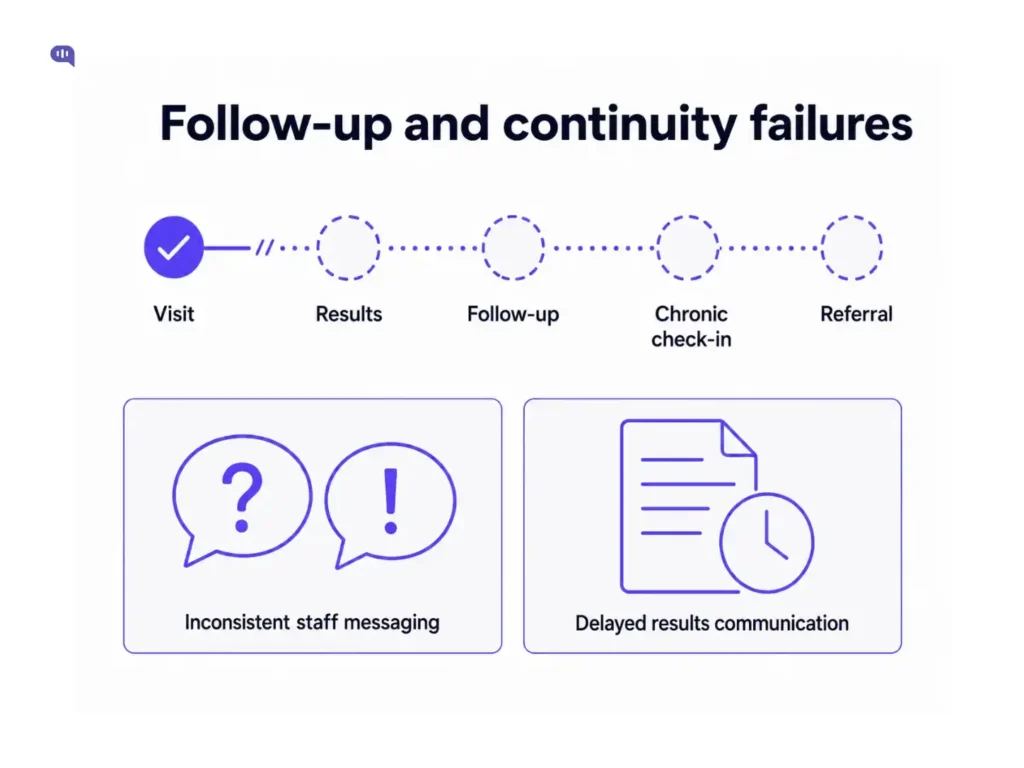
These symptoms are the quietest and the most damaging; they determine whether patients stay or leave.
11. Patients report receiving inconsistent information
Inconsistency is one of the most trust-eroding experiences in patient communication. When one staff member says a referral takes two weeks and another says four, when billing gives a different copay estimate than the front desk, and when post-visit care instructions vary by who picks up the phone, patients notice.
They stop believing what your team tells them. They start seeking secondary sources. They leave reviews.
Where it shows up: Patient complaints citing “I was told something different,” escalation requests to speak with a supervisor, and negative reviews mentioning conflicting information.
12. Post-visit follow-up is ad hoc or non-existent
Follow-up communication after an appointment is not a nice-to-have. It is a clinical continuity function. When follow-up is manual and dependent on individual staff members’ initiative, it is, by definition, inconsistent. Some patients get called. Others don’t. The ones who don’t are the ones most likely to deteriorate, miss medication instructions, or not return for follow-up care.
Where it shows up: Chronic care patient outcomes data, readmission rates, and patient complaints about “never hearing back.”
13. Test results or clinical updates are communicated with significant delays
Patients waiting for test results are not passive. They are anxious, frequently calling to follow up, and forming opinions about your organization based on how long they wait and how they’re communicated with. When results communication is delayed, that anxiety turns into distrust. In some cases, it turns into a safety incident.
Where it shows up: Patient calls asking about results, portal message volume about pending results, complaints about wait times for information.
14. Patients with chronic conditions aren’t receiving proactive outreach
Reactive patient communication is insufficient for chronic care populations.
Patients managing diabetes, hypertension, heart disease, or other ongoing conditions need regular touchpoints:
- Medication reminders
- Appointment nudges
- Check-in messages
When that outreach doesn’t happen, patients drift. They miss medications and skip follow-up visits. They show up later, sicker, and more expensive to treat.
Where it shows up: Chronic care patient retention rates, HbA1c or other clinical outcomes metrics, readmission data for high-risk panels.
15. Care coordination between departments or providers is communicated inconsistently to patients
When a patient is referred from primary care to a specialist, both providers assume the other has communicated the handoff. The patient, meanwhile, is waiting to hear what happens next.
This coordination gap is one of the most common structural failures in patient communication in healthcare. It generates confusion, missed appointments, and patients who assume nothing is happening and disengage.
Where it shows up: Referral no-show rates specifically, patient complaints about “not knowing what to do next,” and downstream specialist feedback about incomplete patient preparation.
Category 4: Staff and operational failures
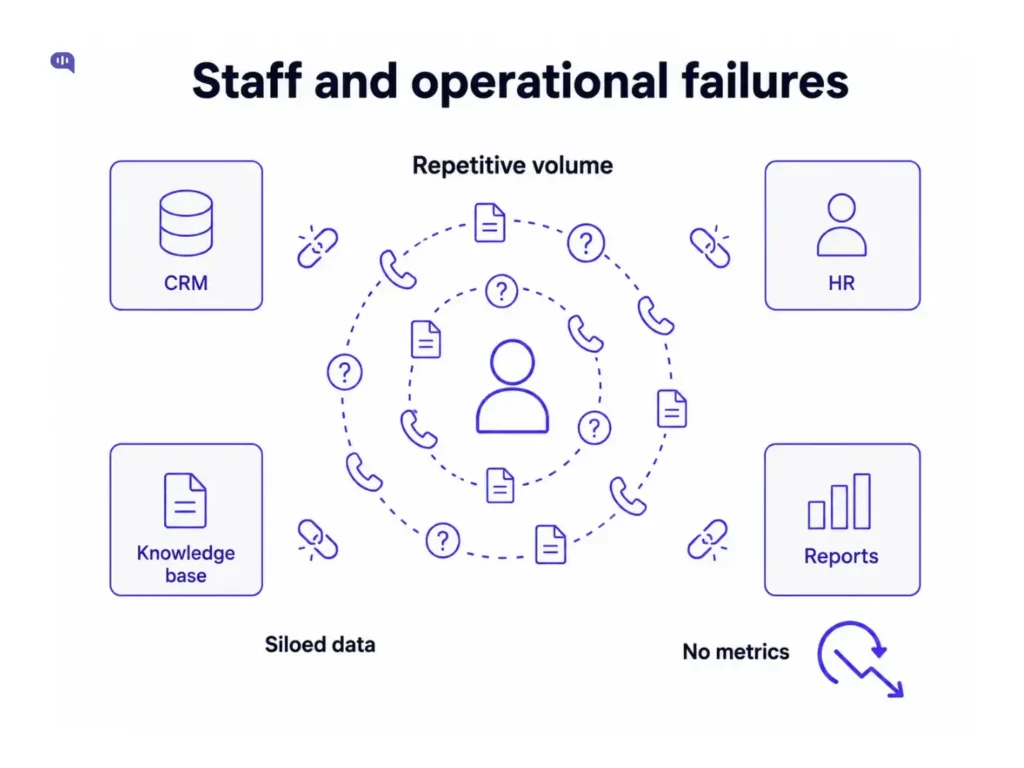
When patient communication breaks down at the system level, your staff bears the cost first.
16. Front desk and support staff are spending more than 50% of their time on repetitive, low-complexity inquiries
If your patient-facing staff is predominantly answering questions about office hours, parking, insurance verification, basic prescription refills, and appointment confirmations, your staffing model is inverted. You are deploying expensive human capacity on tasks that a well-designed automated system could handle, while complex and clinical queries are waiting in the queue.
Where it shows up: Staff time audits, query categorization data, staff complaints about “answering the same questions all day.”
17. You’ve experienced significant turnover in patient-facing roles in the past 12 months
Administrative support turnover in healthcare now sits between 30–40% annually for support roles. That turnover is expensive: replacing a single staff member costs an estimated one-half to two times their annual salary when recruitment, onboarding, and productivity loss are included.
But beyond cost, high turnover in patient-facing roles directly undermines the quality of communication. Institutional knowledge walks out the door. Patients who call back get a different person who doesn’t know their history. Consistency collapses.
If your patient-facing team looks materially different today than it did twelve months ago, ask what the role is actually like. Repetitive, high-volume, low-agency work drives attrition. A communication system that generates that kind of work at scale will keep generating turnover.
Where it shows up: HR records, exit interview data, patient complaints about “always talking to someone new.”
18. Staff regularly report feeling overwhelmed by communication volume
Work overload is significantly associated with both burnout and intent to leave across healthcare roles. Burnout manifests in patient communication as:
- Rushed interactions
- Lower empathy
- Increased errors
- Reduced attentiveness
When your staff tells you the volume is unmanageable, believe them. They are describing a system problem, not a capacity problem. Hiring more staff for the same system yields the same result, albeit with a slight delay.
Where it shows up: Staff surveys, 1-on-1 conversations, increasing sick day usage, and exit interview themes.
19. Patient communication data is siloed across multiple systems
If your phone system doesn’t connect to your EHR, your portal messages live separately from your email log, and your billing team has no visibility into what the clinical team communicated last week: you have a fragmentation problem.
Fragmented systems mean fragmented patient records. Staff answering the phone can’t see what the patient was told via the portal. Patients repeat themselves on every call. 71% of healthcare providers report minimal or no integration between the different systems they use for patient engagement. That figure shows up in every duplicate inquiry and frustrated patient experience.
Where it shows up: Staff complaints about switching between systems, duplicate entries, patient frustration about “having to explain everything every time.”
20. You have no visibility into which communication channels are performing
If you can’t answer the following questions, you’re struggling to measure the performance of your communication channels:
- “What percentage of patient inquiries are resolved on first contact?”
- “Which channel generates the most unresolved tickets?”
- “What are the top five questions patients ask every week?”
Without data, every fix is a guess. You optimize by instinct rather than evidence, and the same problems recur because their root causes are never identified.
Where it shows up: Absence of communication metrics in operational reviews and an inability to answer basic volume and resolution questions without significant manual analysis.
Category 5: Reputation and retention failures
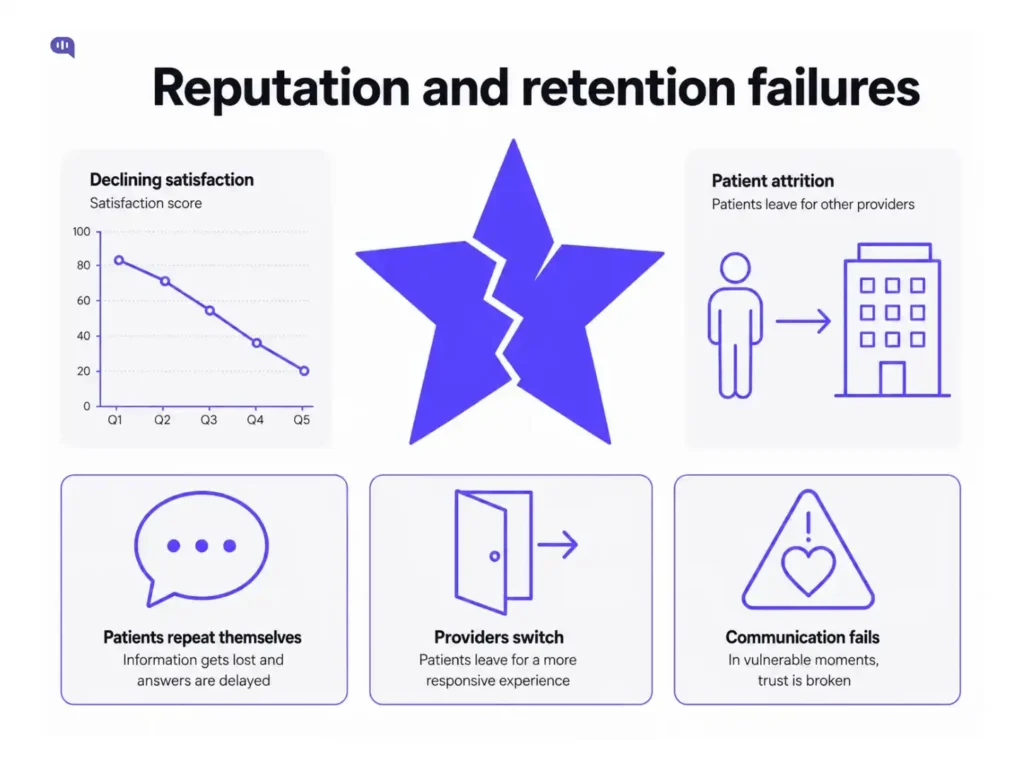
These are the symptoms that have already reached patients and the public.
21. Your online reviews frequently mention communication as a pain point
Online reviews are your patients’ unsolicited communication audit. When the same themes recur, they may be telling you something your internal data is obscuring. Physician-patient communication is one of the four primary factors influencing whether a healthcare provider receives positive or negative ratings. A pattern in your reviews is a pattern in your operations.
Where it shows up: Google reviews, Healthgrades, Yelp, patient satisfaction surveys, NPS themes.
22. Your patient satisfaction scores have declined
A single-period dip in satisfaction scores can reflect a one-off event. Two consecutive periods of decline signal a trend, and trends in patient satisfaction are almost always rooted in operational and communication consistency rather than individual interactions.
84% of global healthcare consumers identify the quality of communication as crucial to their overall provider experience. When satisfaction dips, look at your communication metrics first.
Where it shows up: HCAHPS scores, post-visit survey trends, and NPS over time.
23. Patients are expressing frustration about having to repeat their information multiple times
“I’ve already explained this twice” is one of the clearest signals of a fragmented communication system. It means your channels don’t share data, your staff doesn’t have visibility into prior contacts, and your patient record doesn’t follow the patient across touchpoints. Beyond the practical frustration, it signals to patients that your organization doesn’t see them as a person.
Where it shows up: Qualitative feedback, patient complaints, and exit survey themes for churned patients.
24. You have noticed an increase in patients switching to competitors or not returning after a single visit
Patients who miss one appointment are 70% more likely not to return within 18 months. For patients managing chronic conditions, the attrition rate doubles after a single missed appointment. If your return rate is declining, your communication system is failing at one of its most critical retention functions.
Where it shows up: Patient return rate by cohort, new vs. returning patient ratios over time, churned patient surveys.
25. You’ve received negative feedback specifically about how patients were communicated with during a difficult moment
This is the most consequential item on the checklist. When a patient or family member reports feeling confused, abandoned, or disrespected during a serious health event, the cost is not only a bad review. It is a relationship that ended badly. At its most serious, it is the kind of incident that drives malpractice exposure.
Communication failures in malpractice lawsuits have resulted in $1.7 billion in costs and nearly 2,000 preventable deaths in the cases studied.
Where it shows up: Formal complaints, patient grievance filings, legal inquiries, specific review language about being “left in the dark” or “treated like a number.”
How to use this score?
| Score | What It Means | What to Do Next |
|---|---|---|
| 0–4 checked | Isolated weak spots | Investigate individual items; targeted process fixes are feasible |
| 5–10 checked | A pattern of breakdown | Manual fixes are temporarily masking structural problems |
| 11–19 checked | Structural failure | Your communication infrastructure needs a full systems review, not patches |
| 20–25 checked | Communication crisis | Immediate intervention required — your staff, patients, and revenue are all absorbing the cost simultaneously |
The most important thing to understand about this score is that if you’re checking more than five boxes, the problem is not any individual item. It’s the system those items reveal. Each symptom reinforces the others. You cannot fix this one symptom at a time.
What should you do after using the checklist?
This checklist is a diagnostic, not a prescription. Knowing where your patient communication is broken is the first step. Understanding why it’s broken and why the usual fixes don’t hold is the harder, more important work.
The communication system most healthcare organizations use today was not designed for the volume, complexity, or expectations that patients now bring to it. This checklist helps you see that clearly. What you do with that clarity is where the work begins.
If you want to solve these problems with an AI-powered patient engagement tool that reduces ticket volume, book a demo.

Devashish Mamgain is the CEO & Co-Founder of Kommunicate, with 15+ years of experience in building exceptional AI and chat-based products. He believes the future is human and bot working together and complementing each other.