Updated on July 3, 2026
TL;DR
Healthcare customer support teams are stuck in a loop: volume spikes, a fix gets deployed, volume spikes again. The most common responses all treat symptoms rather than root causes. This guide explains why each fix fails to reach the structural problems driving demand, and sets out four markers of a solution that actually does.
| Common Fix | The Logic | Why It Fails |
|---|---|---|
| Hire more agents | More capacity = shorter queues | Doesn’t reduce contact volume; burnout drives turnover; ~29% of contacts still return |
| Launch a FAQ/patient portal | Patient self-serve = fewer calls | Portal adoption averages 30–40%; heaviest support users are least likely to self-serve |
| Send more emails | Proactive outreach = fewer inbound calls | Healthcare email CTR is under 2%; high-need patients don’t engage; HIPAA limits personalization |
| Systemic fix | Redesign how demand is generated and resolved | Omnichannel + EHR integration + AI automation + seamless escalation |
The reason manual fixes feel insufficient is that the underlying driver — slow response times — erodes patient confidence faster than any process change can compensate for. See how response time affects patient engagement for the full picture.
It’s a Tuesday morning quarterly review. Ticket volume is up 34% year-over-year. Six new support agents were hired eight months ago. Response times improved for about two months, then crept back. Last quarter, an FAQ page went live. Patients are still calling at the same rate.
This is not a failure of effort. Healthcare support teams work hard.
But the fixes they use:
- Hiring more people
- Giving patients somewhere to self-serve
- Communicating more proactively
None of these address the structural problem in healthcare customer support. Fixing it starts with getting the customer support team structure right before layering in technology. The largest problem in the function is driven by siloed systems, rising patient volumes outpacing reasonable growth in headcount, and a channel mix that hasn’t kept pace with patients’ current expectations for how they want to communicate. Research consistently shows that 42% of patients identify difficulty reaching their provider as the single largest barrier to good healthcare communication.
The fixes most teams deploy don’t touch that infrastructure. This guide identifies the structural root causes in healthcare support and sets out what a solution looks like when it is actually designed to address them. It covers:
- Before the fixes: What’s the root cause of the increase in healthcare ticket volumes?
- Fix #1 – “We Just Need More People”
- Fix #2 – “They can find it themselves.”
- Fix #3 – “We’ll just communicate more”
- Why do these fixes fail?
- What does a systemic fix look like?
- Conclusion
- FAQ
Before the fixes: What’s the root cause of the increase in healthcare ticket volumes?
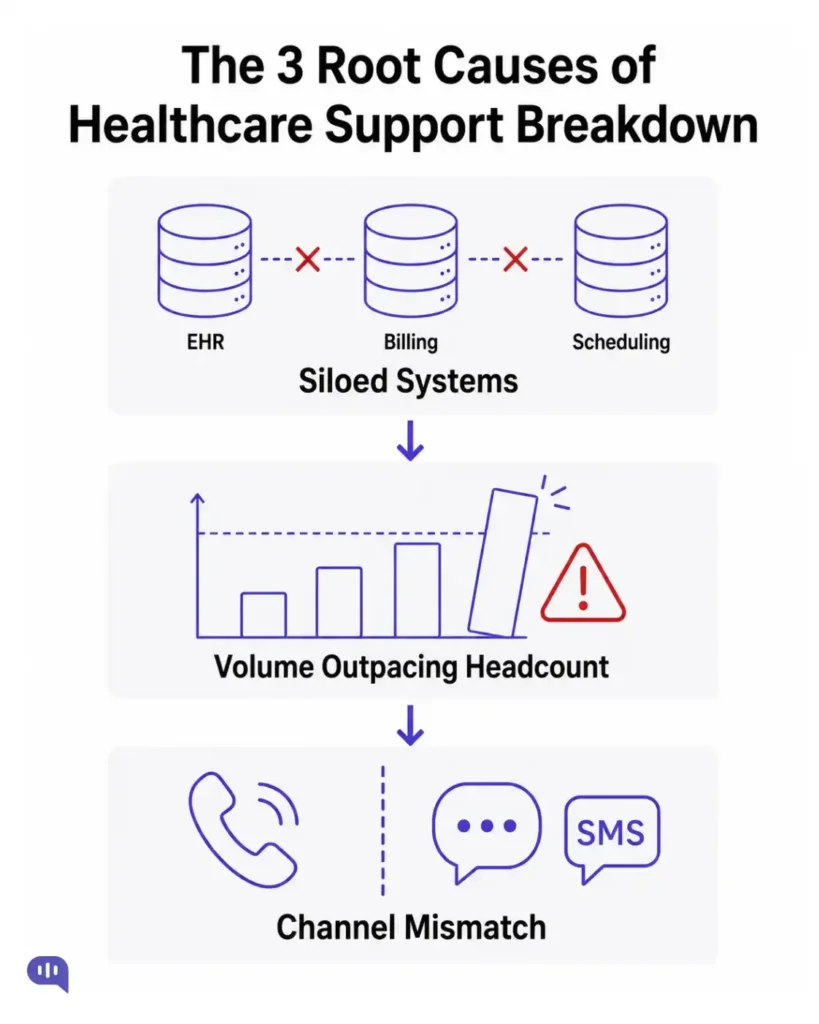
Before examining why common fixes fail, it’s worth naming what they’re failing to fix. Healthcare support breakdowns trace back to three structural problems that surface-level interventions can’t reach.
1. Siloed systems with no shared patient context
Patient information in most healthcare organizations lives across multiple disconnected systems: electronic health records, billing platforms, scheduling tools, insurance portals, and pharmacy databases. These systems were built independently, often by different vendors, and rarely share data in real time.
As a result, when a patient contacts support, the agent handling the call typically has access to only one slice of their record.
This fragmentation is not a minor inconvenience. Fragmented systems cost the global healthcare economy an estimated $3.1 trillion annually in inefficiencies alone. For support operations specifically, it drives longer handle times, higher repeat contact rates, and agent frustration that compounds into burnout.
2. Volume that grows faster than headcount can scale
More than 3.2 billion healthcare-related calls are placed in the United States each year, with over 90% still handled entirely by humans (CAQH, 2025).
This volume keeps increasing because of three primary reasons:
- An aging population
- Rising rates of chronic disease
- More touchpoints per patient across a longer care journey
No headcount strategy can outpace a demand curve built into demographics. Healthcare organizations can staff up faster than they currently are, yet they will still be behind.
3. Patient expectations have shifted; the channel mix hasn’t
Patients today are also consumers. They book restaurant tables through apps, track packages in real time, and resolve banking issues via chat at 11 PM. When they interact with their healthcare provider, they bring the same expectations.
Healthcare contact centers still rely heavily on the phone as the primary channel. IVR systems are used by 84% of healthcare organizations.
This creates a channel mismatch:
- Patients want digital, fast, and asynchronous
- Providers offer synchronous, voice-first, and slow.
That gap creates friction at the very first point of contact, before any attempt at resolution is even made.
These three problems are the actual drivers of the breakdown in healthcare support. But the most common fixes do not address these issues.
Fix #1 – “We Just Need More People”
The first fix for ticket volume in healthcare support is often to hire more people. It is intuitive that more staff solve more tickets. However, in a growing market, the fix only works in the short term.
Two problems lie beneath the surface:
1. The cost and speed problem
Healthcare call center staffing is not a ready-on-demand resource. Labor costs in healthcare have risen nearly 37% compared to pre-pandemic levels. Finding, onboarding and training qualified candidates can take between 10 to 12 weeks.
By the time a new cohort of agents reaches full capacity, the volume they were hired to address has typically grown again.
2. The burnout loop
The job’s inherent stress further complicates the hiring delay. Healthcare customer service reps need to handle:
- Distressed patients
- Complex billing disputes
- Emotionally demanding conversations
The 2025 NSI National Health Care Retention Report found an average hospital turnover rate of 16.4%. Support and administrative roles follow similar patterns.
The practical consequence is that new hires partially replace departing agents rather than fully adding to capacity. The net headcount gain is smaller than the gross hiring number suggests, and training costs accumulate on a rolling basis.
Perhaps the most revealing data point in the hiring fix argument is the first-contact resolution rate. The healthcare industry’s average FCR is 71% (Tollanis). Even top-quartile healthcare support teams, operating at an 80% FCR, still have 20% of contacts returning.
Those repeat contacts are not generated by insufficient staffing. System failures generate them. Hiring more agents gives those repeat contacts someone to land on, but doesn’t prevent them from being generated.
As Keona Health puts it directly: “Many medical call center leaders mistakenly believe that hiring more staff will solve their problems; it is equivalent to putting a band-aid on a broken leg. In reality, their staffers are usually demoralized and sluggish because their workflows are too complex and difficult.”
The problem is reducing the number of contacts that require human resolution in the first place. Headcount is a capacity solution, not a contact-avoidance solution.
Healthcare support teams that break the cycle do so not by staffing harder at the same volume, but by reducing the volume of contacts that reach human agents at all.
Fix #2 – “They can find it themselves.”
Many healthcare operators have invested in infrastructure for FAQ pages and knowledge bases. But while self-service portals work, operationalizing them in healthcare is difficult.
Patient portal adoption rates tell an uncomfortable story. Even among large, well-resourced integrated health systems, portal adoption sits at 30–40% (HIMSS). As of 2024, roughly 35% of U.S. healthcare users had never accessed their patient portal. Smartphone app access to portals, intended to lower barriers, produced negligible increases in new-user rates.
There are three reasons for this:
1. The patients who call the most won’t self-serve
In a nationally representative study (JMR, 2020), the top three barriers were:
- Preference for in-person or phone communication (64%)
- No perceived need for the portal (49%)
- Discomfort or limited experience with computers (26%)
These are not the digital-native patients who are already managing their health through apps and portals. These are the patients who generate the most support contacts.
We’ve covered this design gap in detail separately: the patients who most need reliable healthcare communication are often the ones most systematically excluded by the digital tools built to serve them.
A better FAQ page does not affect adoption numbers in this population. It improves the experience for patients who were already going to self-serve.
2. Content goes stale, and patients notice
Healthcare is not a static content domain. Insurance formularies change. Billing codes update. Procedure protocols are revised. Appointment processes shift. A FAQ page that was accurate in January may be misleading by April.
Most organizations build the self-service resource once and update it infrequently because maintaining it requires coordinated effort across clinical, billing, and administrative teams, which rarely have the bandwidth for ongoing content governance.
The result: patients find outdated answers, follow incorrect guidance, and call with more frustration than they started with.
3. It doesn’t resolve emotional complexity
Not all support contacts are informational. Patients need a conversation with a person who has their complete record in front of them and the authority actually to help.
Self-service is a legitimate tool for a narrow category of contacts: simple, informational, low-stakes, and sought by patients who are already comfortable with digital interfaces. In healthcare support, those contacts represent a minority of inbound volume. The majority come from people and situations that a FAQ page was never designed to handle.
Self-service works when the need is simple, the patient is digitally confident, and the content is up to date. Healthcare support’s highest-volume, most demanding contacts don’t meet any of those conditions. The fix deflects a small fraction of easy contacts while leaving the hard ones completely unaddressed.
Fix #3 – “We’ll just communicate more”
The third fix in the standard playbook is proactive outreach: if you can answer patients’ questions before they ask, the queue never builds. Send better emails, more targeted messages, more timely reminders. Get ahead of the call.
It’s a coherent strategy, and for narrow use cases it has genuine value. As a general solution for healthcare support volume, it consistently underdelivers due to an engagement ceiling.
The average open rate for healthcare email campaigns sits between 36–41% (Paubox, 2024; Mailchimp, 2023). These are not bad numbers for an email program. But the click-through rate averages 1.87–1.98%.
Proactive communication that reaches fewer than 2% of its intended recipients at the engagement level required to prevent a support contact does not meaningfully reduce inbound volume.
The wrong patients disengage first
The patients who generate the highest volume of support contacts are also the most likely to be overwhelmed by communication. These patients often disengage from email entirely. They call instead, because calling is how they have always navigated healthcare, and because a real person can handle the complexity that a broadcast email cannot.
Mass outreach is well-suited to patients who are already actively managing their health. It does not reach the patients who are most likely to contact support.
The personalization problem
Genuinely effective proactive outreach is not a blast campaign. It is a triggered message that arrives at the exact moment a patient needs it.
That kind of outreach requires a system that knows what’s happening with each patient in real time. Without it, teams send generic messages on a broadcast schedule that doesn’t align with an individual patient’s schedule. Patients correctly identify these messages as not relevant to their situation and call anyway.
HIPAA also constrains personalization. Without the right compliance infrastructure, embedding clinical context in outreach creates regulatory risk. Teams default to safe, generic messages, which are the least likely to prevent a support contact.
Outreach reduces inbound volume only when it’s timely, personalized, and matched to the patient’s actual moment of need. Mass email, even a well-crafted mass email, fails all three conditions for the patients who generate the most contacts. It is a communication strategy, not a support strategy.
Why do these fixes fail?
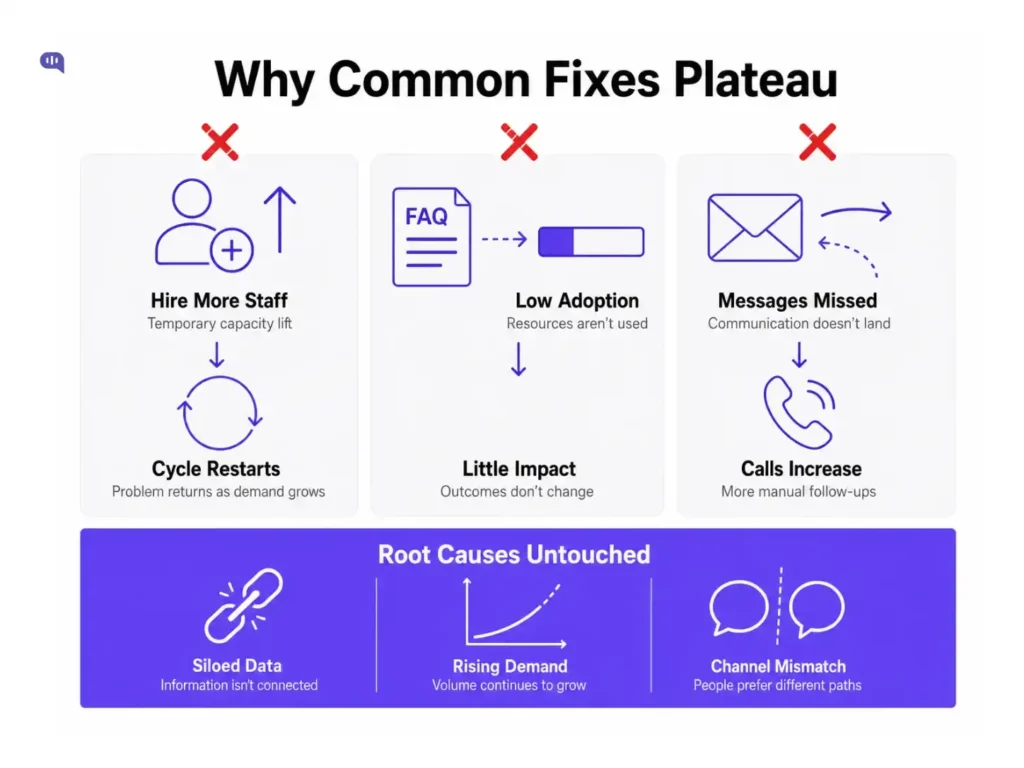
Stepping back from each fix individually, the pattern is clear. Every fix in the standard playbook targets what the support team produces rather than how the system generates demand.
- Hiring more agents handles more contacts → doesn’t reduce contacts
- FAQ pages deflect some queries → doesn’t reach the patients generating most queries
- Better emails inform some patients → doesn’t reach the patients who most need information
The root causes remain completely untouched. Each fix works temporarily, plateaus quickly, and eventually fails as the underlying demand re-establishes itself.
Consider what the scale of that unaddressed demand actually looks like.
- Research shows that 40–60% of all inbound healthcare support contacts are appointment- and scheduling-related (PMC, 2024). These are routine, repeatable, low-complexity interactions.
- At $50–$60 per manually handled ticket (Surveypal), a healthcare customer support team processing several thousand of these contacts per month is spending significant budget on interactions that a well-designed system could resolve without human involvement.
Hiring more agents, building an FAQ page, and sending more emails leave that cost structure completely intact. The question isn’t how to handle more contacts faster. It’s about reducing the number of contacts that need human resolution at all.
This is not a criticism of the teams that deploy these fixes. It is a criticism of the diagnostic framework that leads to them. When the presenting symptom is “too many tickets,” the instinct is to find ways to handle more tickets or reduce the easy ones. The harder work is redesigning the system that generates them.
What does a systemic fix look like?
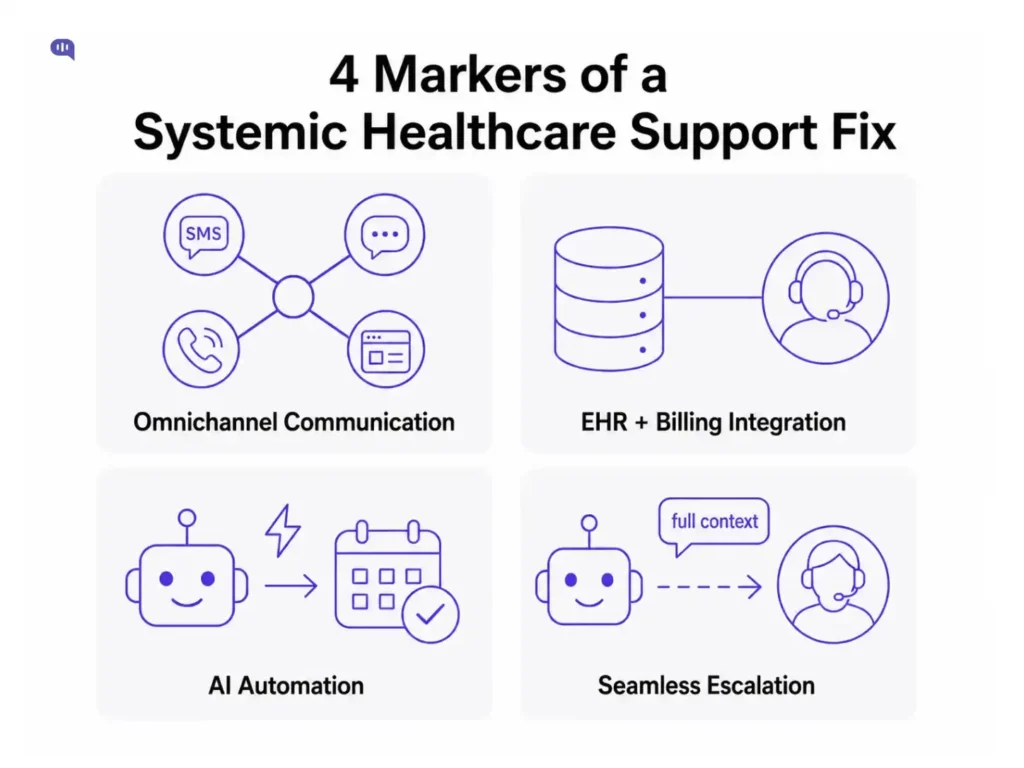
A systemic fix for healthcare support means building a system that makes your team effective at the contacts that genuinely require them, while preventing the routine contacts from reaching them at all. Four things need to be true for that to work.
1. Omnichannel patient communication
The channel mismatch between what patients expect and what healthcare organizations offer is a solvable problem.
A phone-only or portal-only approach fails because it forces patients into a channel they may not use or prefer. An omnichannel system routes contact across SMS, live chat, voice, and patient portal. A patient who starts a conversation via chat and then calls can continue without having to repeat themselves. An agent who picks up an escalated call sees the full interaction history.
This matters because different patient populations use different channels. Older patients may prefer voice. Younger patients may prefer text. Patients managing a billing dispute may need a chat that lets them reference a document. Our comparison of patient experience platforms covers what omnichannel actually means in a healthcare context, beyond the marketing language, to the specific capabilities that drive contact resolution.
2. EHR and billing integration
The single most important operational change a healthcare support team can make is ensuring that the agent who picks up a contact has the patient’s relevant history in front of them before the conversation starts: recent appointments, open claims, active prescriptions, prior contacts, and outstanding issues.
When agents have this context, handle time drops. First-contact resolution rates rise. Patients don’t have to repeat themselves. And agents can spend the conversation actually helping rather than navigating between systems.
The integration doesn’t require a proprietary layer. Platforms like Kommunicate connect to EHR systems, including Epic, via webhooks and APIs. This is the minimum condition for an agent to give a useful answer without putting the patient on hold.
3. AI automation for the contacts that don’t require human judgment
If 40–60% of your inbound contact volume is appointment- and scheduling-related, and each of those tickets costs $50–$60 to resolve manually, the automation opportunity is not marginal. It is the majority of your support operation.
Appointment scheduling, prescription refill requests, basic insurance coverage questions, post-discharge follow-up, and appointment reminders are all candidates for AI-powered automation. These contacts are high-volume, low-complexity, and highly repeatable. They are exactly the contact type that a well-configured AI can resolve accurately, instantly, and at any hour.
AI tools in healthcare administrative settings have been shown to improve staff productivity by 13–21% (SmarterTech, 2025). For support teams, the practical effect is that human agents are freed from handling contacts that don’t require them.
Kommunicate’s HIPAA-compliant AI platform, starting at $34/month, handles this automation layer while maintaining the compliance standards healthcare support requires. For a detailed walkthrough of what appointment automation looks like in practice, see our guide to building an OpenAI-powered appointment bot.
4. Seamless escalation to humans
Automation is only as good as the handoff. A patient who has explained their situation to an AI assistant and then gets transferred to a human agent who knows nothing about it has not had a better experience than if they had just called. They have had a more frustrating one.
The design test for any AI-assisted support solution is this: when a contact escalates to a human agent, does that agent already know what the patient has said, what was tried, and what still needs to be resolved?
If the answer is yes, automation reduces volume and maintains quality. If the answer is no, automation adds a step without adding value. The escalation design is not a secondary feature.
Conclusion
The three fixes in the standard healthcare support playbook are not bad ideas. They are the right interventions for a different kind of problem. Applied to a structural problem, they produce temporary improvements that plateau predictably, leaving teams in a loop they can’t break by trying harder at the same things.
The teams that actually break out of the loop are not the ones with bigger budgets or more aggressive hiring plans. They are the ones who change the diagnostic question. Not “how do we handle more contacts faster?” but “how do we redesign the system that generates them?”
The technology to do that exists and is deployed at scale today. HIPAA-compliant AI. Omnichannel communication platforms. EHR-integrated support tools that give agents full patient context before a call begins. To build accountability into the system, pair these tools with a customer service QA scorecard that evaluates agent and AI interactions against consistent standards. The question is not whether the tools are available. The question is whether your organization is ready to invest in the root cause or will keep patching symptoms until the next quarterly review brings the same conversation.
Ready to move beyond the playbook? Book a demo to see how Kommunicate’s healthcare support platform is built for the root cause →
Frequently Asked Questions
Hiring more agents increases capacity but doesn’t reduce demand. Healthcare’s average first-contact resolution rate is 71%, meaning roughly one in three contacts requires at least one follow-up interaction. Hiring handles those repeat contacts but doesn’t fix the underlying system failures that generate them. The problem is structural, not a staffing shortage.
Patient portal adoption in healthcare averages 30–40%, even among large integrated health systems. The patients who generate the most support contacts are the least likely to self-serve. The top three reasons patients don’t use portals are a preference for direct communication, a lack of perceived need, and discomfort with computers. A better FAQ page doesn’t move any of those numbers. The fix doesn’t reach the problem.
Effective customer service in healthcare requires three things working together: a unified view of the patient across systems (EHR, billing, scheduling) so agents have context before they speak; communication across the channels patients actually use, not just phone or portal; and automation of high-volume, routine contacts so human agents can focus on the complex cases that genuinely require human judgment.
Start with the contact types driving the most volume. Research shows 40–60% of all healthcare support contacts are appointment and scheduling-related. At $50–$60 per manually handled ticket, building a system that resolves routine contacts without human intervention produces a measurable ROI quickly. Combine that with omnichannel access and EHR integration, and you address contact volume, resolution quality, and agent capacity simultaneously.
Look for four things: omnichannel support across SMS, chat, voice, and portal with full context maintained across channels; EHR and billing system integration via API or webhooks; AI automation for routine, high-volume contact types; and seamless escalation to human agents with full conversation context transferred. HIPAA compliance is a baseline requirement, not a differentiator.
A basic chatbot follows a decision tree: it answers predefined questions and fails gracefully when a question falls outside its script. AI automation in a well-designed healthcare support platform uses large language models to understand patient intent, connect to live data (appointment availability, claim status, prescription refill eligibility), complete the requested action, and escalate with full context when human judgment is needed. The difference is whether the system resolves the contact or merely routes it.

Devashish Mamgain is the CEO & Co-Founder of Kommunicate, with 15+ years of experience in building exceptional AI and chat-based products. He believes the future is human and bot working together and complementing each other.